 by
Tom Gurney
Tom Gurney BSc (Hons) is an art history expert with over 20 years experience
Email:
tomgurney1@gmail.com
/ Phone:
+44 7429 011000
Henri Matisse, Sleeping Nude on a Red Background: Laurette on a Flowered Divan: Introduction
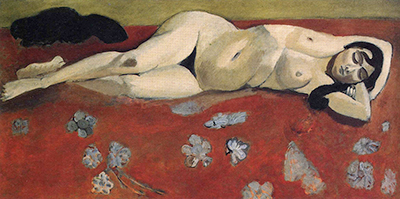
Henri Matisse's Sleeping Nude shows a reclining woman stretched across a long, low field of red. Her feet reach toward the left edge; her face and bent arms gather at the right. Flowers scattered over the fabric beneath her fill much of the lower half. The sitter is Laurette , a model who worked intensively with Matisse in Paris in 1916–17 . A Berlin museum's account identifies this separate oil painting as Sleeping Nude on a Red Background , dated 1916/17 and recorded in a private collection . The shorter English title of this page refers to that red-ground canvas, rather than to every work called Sleeping Nude . [1] [2]
At a Glance
- Artist Henri Matisse
- Work Sleeping Nude on a Red Background
- Date 1916–17
- Explore Painting
This work across Henri Matisse’s career
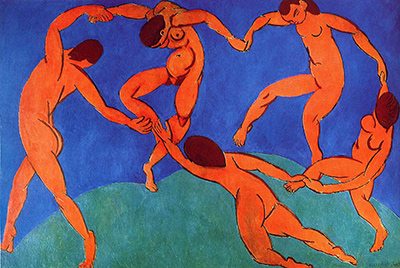
Dance (1910)
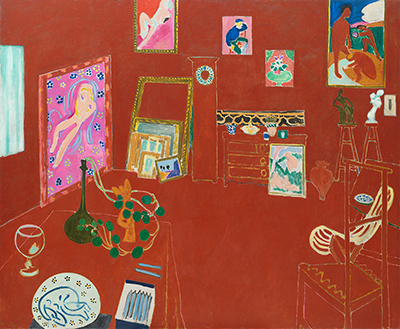
1910The Red Studio
1911The Piano Lesson
1916Henri Matisse, Sleeping Nude on a Red Background: Laurette on a Flowered Divan (current article)
1916–17The Snail
1953Contents
- What is happening in the picture?
- Who was Laurette, and when did Matisse paint her?
- How does the red-ground nude relate to the other Laurette pictures?
- Where is Sleeping Nude now?
What is happening in the picture?
The pose is readable at once, but the space around it is deliberately spare. Laurette lies on her side on a divan covered by a red floral cloth . A thin, muted strip runs across the top; below it, the bed or couch and the patterned fabric take over. Matisse does not show enough of the room to make its dimensions clear. The body nearly touches the picture's upper and side boundaries, while a large span of textile opens below it. The canvas feels both broad and tightly fitted to its subject. [1]
The pale flesh and red cloth carry the main contrast. Laurette's legs extend in a long diagonal from left to centre, then the raised curve of a hip brings the eye toward her torso and face. Her dark hair marks the head at the right. Another nearly black mass rests near her feet at the left. It might look like clothing in a small reproduction, but the Centre Pompidou's curatorial account identifies it as a shawl . The same account notes a third dark accent at the pubic area. These separated marks punctuate the pale body and tie the two ends of the unusually wide composition together. [1]
The flowers below are not treated like a neat, repeatable wallpaper pattern. Some appear as clustered grey-blue blooms; others are partial or loosely brushed. They help the red field remain active without turning it into a fully described room. The face, by comparison, occupies only a small part of the canvas. Matisse gives just enough line and tonal change to locate closed eyes and a resting expression. The title suggests sleep; the picture's visual interest lies as much in the relation between body, fabric and frame as in any story about the sitter.
Who was Laurette, and when did Matisse paint her?
Laurette was a professional model introduced to Matisse in late November 1916 , according to the Centre Pompidou's collection essay. She appeared in roughly forty canvases between the winter of 1916 and December 1917. The Musée des Beaux-Arts de Lyon likewise describes this as a period of sustained, repeated work with her. That makes Sleeping Nude part of a concentrated sequence of figure paintings, not an isolated experiment or a portrait whose meaning depends on a known private relationship. [1] [3]
Matisse painted this version in his Quai Saint-Michel studio in Paris. The address is more than background trivia: the Pompidou analysis places the divan and red floral cloth there and uses them to connect three related horizontal canvases. The nearby Studio, Quai Saint-Michel belongs to the same period and gives another view of Laurette reclining on a couch, with more of the room and window visible. The works should be read as separate compositions, each choosing how much of its setting to reveal. [1] [4]
Watch: Matisse’s art and working methods
Choose a museum film or a close reading to continue exploring Matisse’s work.
Matisse: “For Me It’s Always New”
The Museum of Fine Arts, Boston considers Matisse’s creative practice.
Watch on YouTubeHow does the red-ground nude relate to the other Laurette pictures?
The Centre Pompidou's account describes a group of three unusually horizontal canvases . This nude on the flowered red divan is the first. In an intermediate variation Laurette lies on the same cloth but is wrapped in a black lace shawl. In the Pompidou's Lorette à la tasse de café , dated 1917 , she is lightly clothed and the space is brighter and less enclosed. The museum's painting is a companion, not another title for this nude ; its catalogue dimensions and inventory number belong only to that later canvas. [1]
This comparison makes the red fabric especially revealing. Here it acts like a close-fitting stage around the body, with flowers spread below and dark accents at either end. In the Pompidou painting, the model seems to occupy a more open, luminous field. The change is not simply that clothing has been added. Matisse has altered how the figure meets the edge, how much room the eye can imagine and how colour carries the space. He was testing different answers to the same problem of placing a reclining figure across a wide canvas. [1]
A drawing in Berlin offers another useful comparison, provided it is kept distinct. The Museum Berggruen owns Nu couché (Lorette) , a 1917 charcoal and graphite drawing , not this oil painting. Its object essay observes that the drawing and the red-ground canvas share a left-to-right reclining direction and long hair falling over an arm. In the drawing, however, the body twists and stretches in a far less stable pose. The museum does not establish it as a preparatory study for the oil; it shows Matisse reconsidering a related reclining form in another medium. [2]
The series also makes the frame an active choice. In the red-ground canvas, Laurette's body runs almost the full width, while the patterned cloth claims a broad area below it. The related coffee-cup painting opens the space and changes her clothing. The Pompidou's comparison lets us see that Matisse was revising the relation between figure and surroundings, not simply recording the same reclining pose on three occasions. Even without a present public location or published size for the private red-ground canvas, those documented comparisons give a way to read its unusually close, horizontal composition. [1]
Where is Sleeping Nude now?
The Berlin museum's comparative text lists Sleeping Nude on a Red Background as in a private collection . It does not identify a present public gallery or give this oil painting's exact dimensions. The Centre Pompidou's related Lorette à la tasse de café and Berlin's Nu couché drawing have their own museum records, materials and measurements; none of those numbers should be attached to the private canvas. For a wider route through Matisse's work of the period, see the paintings directory and his Laurette in a Green Robe , another distinct Laurette picture. [1] [2]
Explore 113 Matisse artworks
This directory covers the 113 individual works explored in these articles, rather than a complete catalogue of Matisse’s output. Cut-paper designs and prints appear under Drawing in the medium filter; each row names its form. Dates retain the qualifications explained in the linked articles.
Discussion
Look again at the images and ideas explored in Henri Matisse, Sleeping Nude on a Red Background: Laurette on a Flowered Divan. These editorial prompts invite your observations.
Reader Insights
What is happening in the picture?
Which comparison discussed in the article helps you see the work differently?
How do the materials and historical setting affect your reading?
Join the Conversation
Share a detail, comparison or question about Henri Matisse, Sleeping Nude on a Red Background: Laurette on a Flowered Divan below.
References
- Isabelle Monod-Fontaine , Centre Pompidou collection analysis for Lorette à la tasse de café , excerpted from the museum's 2007 modern collection catalogue. View source .
- Staatliche Museen zu Berlin , Museum Berggruen, Nu couché (Lorette) , object record and Gabriel Montua's comparison with the private red-ground oil. View source .
- Musée des Beaux-Arts de Lyon , Henri Matisse: Le laboratoire intérieur , exhibition account. View source .
- The Phillips Collection , Studio, Quai Saint-Michel , collection record. View source .
 Henri Matisse.jpg)