


 by
Tom Gurney
Tom Gurney BSc (Hons) is an art history expert with over 20 years experience
Email:
tomgurney1@gmail.com
/ Phone:
+44 7429 011000
Henri Matisse, Interior with Aubergines (Intérieur aux aubergines), 1911: Introduction
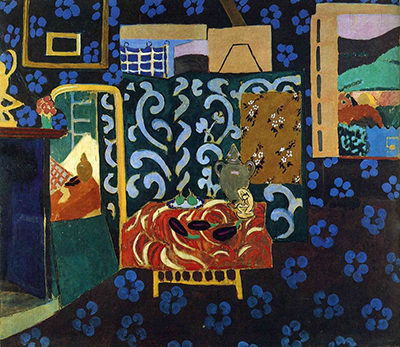
Three aubergines occupy a small table near the centre of Henri Matisse's Interior with Aubergines. Around that modest still life, the room seems to expand into a maze of screens, flowers, frames, reflections and windows. Blue-violet floral marks travel over dark areas that might first read as floor or wall. A curling screen rises behind the table, while a pale opening at the right offers a different kind of space. The fruit gives the eye a place to start; it does not contain the painting's full subject.[1][2]
The painting pictured on this page is the 1911 Intérieur aux aubergines at the Musée de Grenoble, usually rendered in English as Interior with Aubergines. It measures 212 × 246 cm, a wall-scale composition rather than a small tabletop study. The Centre Pompidou identifies its medium as glue-based tempera on canvas. This matters because Matisse also made a different 1911 work titled Still Life with Aubergines, now at MoMA, in oil on canvas. The site's established URL uses “still life,” but the Grenoble image and its visible title should be attached to the Grenoble object facts.[1][2][3]
At a Glance
- Artist Henri Matisse
- Work Interior with Aubergines (Intérieur aux aubergines)
- Date 1911
- Explore Painting
This work across Henri Matisse’s career
Dance (1910)
1910The Red Studio
1911The Piano Lesson
1916The Snail
1953Contents
- Where should you begin looking?
- Why is this an interior rather than just a still life?
- What is unusual about its material?
- How does it belong to Matisse's 1911 interiors?
- How did it reach Grenoble?
- Is it the painting at MoMA called Still Life with Aubergines?
Where should you begin looking?
Start with the little table. Its red-orange cloth is covered with looping pale marks that make the surface feel restless. Dark aubergines lie across it, and a small vessel rises behind. The table's legs and lower edge are visible, but the cloth's swirls are more insistent than a measured description of the furniture. They draw a lively shape inside a larger field already full of pattern. An ordinary bowl of vegetables could have stayed a separate island in the room; Matisse makes its colours and curves converse with everything around it.[2]
Behind the table, broad green and pale blue arabesques spread across a folding screen. Their curling lines are far larger than the aubergines. The screen seems to push forward, yet it also masks whatever depth might lie behind it. To the left is a tall reflective or framed area; to the right, a high window or opening brings in green and pink passages. Above and behind the screen are smaller framed rectangles. These are not simply background props arranged to make a realistic stage. Each rectangle offers a different possible picture within the picture.[2]
The dark ground is dotted with blue-violet flower-like marks. They run through both lower and upper parts of the composition, complicating any quick division between floor and wall. Some may register as a motif on a textile or surface, while others act almost like free marks crossing the whole canvas. Matisse has made it possible to read the room and, at the same time, to lose one's bearings inside its decorative pattern. The more carefully one follows the motifs, the less they behave like a tidy map of the architecture.
Art historian Rémi Labrusse, writing for the Centre Pompidou, points to the painting's impossible reflections, empty frames and overlapping views. In his reading, the mirror at left does not deliver a reliable duplicate of the room, and the apparent stretcher and upper windows pull other images into the scene. That is a helpful way to look without pretending that each small mark can be named with certainty from a reduced reproduction. The painting continually offers boundaries—table edge, screen edge, frame, window—then lets pattern and colour cross them.[2]
Why is this an interior rather than just a still life?
The aubergines and table are essential, but they occupy only a fraction of the surface. Grenoble's owner title, Intérieur aux aubergines, identifies a room organized around them. If we called the whole canvas merely a still life, we would miss the mirror, screen, windows and decorative ground that take up most of the viewer's attention. The established page address can remain as it is; the owner title makes the pictured work clear.[1]
This is also a large painting about how an interior can be constructed on a flat canvas. The red table stands in front of the scrolling screen, so there is some overlap and depth. Yet the repeating flowers and sharply bounded colour areas pull those planes toward the surface. Window views, reflection and framed shapes promise other spaces, but none provides a simple, stable escape from the room. Decorative does not mean that Matisse forgot structure. Here decoration supplies the structure: it guides the eye from one enclosure to the next and makes boundaries uncertain.[2]
The exceptional size strengthens this effect. At more than two metres high and almost two and a half metres wide, the screen's arabesques and the roaming floral pattern can surround a standing viewer. The aubergines, by contrast, remain a comparatively small focal group. Their place at the centre gives a point of entry, while the larger field repeatedly pulls attention away from them. In that difference of scale lies much of the painting's energy.[1]
Watch: Matisse’s art and working methods
Choose a museum film or a close reading to continue exploring Matisse’s work.
MoMA Conservators discover Matisse's process for "The Red Studio" | CONSERVATION STORIES
Conservators examine the making of The Red Studio.
Watch on YouTubeWhat is unusual about its material?
The Centre Pompidou describes the work as painted in a glue-based tempera, also called a form of distemper, on canvas. This is different from MoMA's oil-on-canvas Still Life with Aubergines. Labrusse emphasizes the Grenoble painting's matte, materially present surface and its fragility. A photograph can show colour and design, but it cannot fully convey how a large, delicate paint layer meets light. The material helps explain why the Grenoble canvas has travelled rarely, including its exceptional loan to the Centre Pompidou's 2020 Matisse exhibition.[2][3]
It would be misleading to call this painting a fresco: it is not pigment applied to wet plaster. It would also be misleading to borrow the “oil on canvas” line from MoMA's separate aubergine picture. Medium is part of object identity, not a decorative footnote. The two pictures were made in the same year and include the same vegetable, but they differ in composition, dimensions, material and collection.[1][2][3]
How does it belong to Matisse's 1911 interiors?
Interior with Aubergines is one of four large 1911 “Symphonic Interiors,” the name later used by art historian Alfred H. Barr Jr. The Centre Pompidou names the others as The Red Studio, The Pink Studio and The Painter's Family. The group is not four views of one room. It gathers Matisse's different attempts to make colour and pattern organize a whole interior at ambitious scale.[4]
The Fitzwilliam Museum identifies another object Matisse brought into the Grenoble composition: the plaster model of his 1903 L'Écorché, after Puget. Its record says the same model appears in the separate 1911 aubergine still life. This reuse connects Matisse's sculpting to his painted interiors, although the sculpture's exact position should not be guessed from this small reproduction.[5]
The closest contrast on this site is The Red Studio. MoMA dates that separate painting to fall 1911 in Issy-les-Moulineaux and identifies it as oil on canvas. There, a large red field joins the room's walls and floor while objects and Matisse's own artworks interrupt it. In Grenoble's canvas, no single colour rules the entire space. The aubergines, red table, green scrollwork, dark ground and blue-violet flowers hold their separate identities while repeatedly overlapping. Both paintings challenge ordinary room perspective, but they do so through different visual arrangements and different materials.[2][4][6]
The other two paintings are The Pink Studio and The Painter's Family. Their connection is the documented 1911 series, not a claim that their figures, rooms or provenance are interchangeable. The paintings directory lets a reader follow those distinct works without making “1911 interior” into a single generic Matisse picture.[4]
How did it reach Grenoble?
The painting first belonged to Michael and Sarah Stein, American collectors close to Matisse's early career. The Centre Pompidou's essay says they acquired it in autumn 1911, and that Matisse probably regained it around 1917. It also describes his changes to a floral border at different stages. Those changes caution against treating every border visible in an old reproduction as a permanent, original state of the work.[2]
In 1922, Matisse and his family gave the canvas to the Musée de Grenoble. Grenoble's account links the gift to the forward-looking curator Pierre Andry-Farcy and says Matisse wanted such an important work to remain in France and be shown publicly. The museum even records a telegram in which Matisse advised on a frame darker than the wall, so it would appear set into that wall. That instruction fits a painting concerned with how a picture meets a real room: the boundary between artwork and surrounding architecture mattered beyond the painted surface.[1]
Grenoble remains the owner. Consult the museum's current object record for gallery placement before visiting; a fragile painting may be moved or temporarily unavailable. Its scale, glue-based paint and dense network of pictures within pictures are all part of what a small screen image can only begin to show.[1][2]
Is it the painting at MoMA called Still Life with Aubergines?
No. MoMA's Still Life with Aubergines is a summer 1911 oil on canvas from Collioure, measuring 116.2 × 89.2 cm, object 782.1995. The pictured work on this page is Grenoble's much larger Interior with Aubergines, painted in glue-based tempera on canvas and given to Grenoble in 1922. The similar English titles and shared vegetable make them easy to confuse. Museum, medium, size and pictured composition settle the distinction.[1][2][3]
Explore 113 Matisse artworks
This directory covers the 113 individual works explored in these articles, rather than a complete catalogue of Matisse’s output. Cut-paper designs and prints appear under Drawing in the medium filter; each row names its form. Dates retain the qualifications explained in the linked articles.
Discussion
Look again at the images and ideas explored in Henri Matisse, Interior with Aubergines (Intérieur aux aubergines), 1911. These editorial prompts invite your observations.
Reader Insights
Where should you begin looking?
Which comparison discussed in the article helps you see the work differently?
How do the materials and historical setting affect your reading?
Join the Conversation
Share a detail, comparison or question about Henri Matisse, Interior with Aubergines (Intérieur aux aubergines), 1911 below.
References
- Musée de Grenoble , Intérieur aux aubergines , owner record and 2019 exhibition label. View source .
- Rémi Labrusse , Centre Pompidou, “Focus on… Intérieur aux aubergines ”, 2020 essay. View source .
- The Museum of Modern Art , distinct Still Life with Aubergines , 782.1995. View source .
- Centre Pompidou , description of Dominique Fourcade's Rêver à trois aubergines , identifying the four 1911 interiors. View source .
- Fitzwilliam Museum , L'Écorché, d'après Puget , M.1-2001, record of the plaster model's appearance in the two aubergine paintings. View source .
- The Museum of Modern Art , The Red Studio , 8.1949. View source .






 Henri Matisse.jpg)
