 by
Tom Gurney
Tom Gurney BSc (Hons) is an art history expert with over 20 years experience
Email:
tomgurney1@gmail.com
/ Phone:
+44 7429 011000
Henri Matisse, View of Notre Dame (1914): The Cathedral in Blue: Introduction
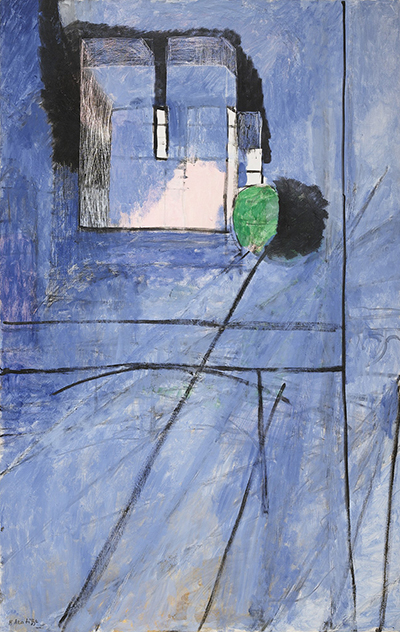
At first, Henri Matisse's View of Notre Dame can seem almost like a field of blue crossed by a few dark lines. Then the cathedral comes into focus near the top: two pale towers, a lighter facade below them and a vivid green form beside them. The rest of the scene is less willing to settle into recognizable streets and riverbanks. A black vertical at the right, a horizontal across the middle and long diagonals over the lower half could help build a view into depth, yet they also hold the eye on the painted surface. This tension gives the work its force. It is a view of a known Paris monument that keeps the act of painting visible. [1]
The Museum of Modern Art in New York owns the canvas, dates it to spring 1914 and records it as oil on canvas , 147.3 × 94.3 centimetres , object 116.1975 . These facts identify the blue painting reproduced here. Matisse had painted Notre-Dame from the Quai Saint-Michel before, and another large 1914 canvas now belongs to the Kunstmuseum Solothurn. The repeated subject does not make these versions interchangeable: each gives a different answer to what the window, cathedral and surrounding city need to look like in paint. [1] [2] [3]
At a Glance
- Artist Henri Matisse
- Work View of Notre Dame (1914)
- Date 1914
- Explore Painting
This work across Henri Matisse’s career
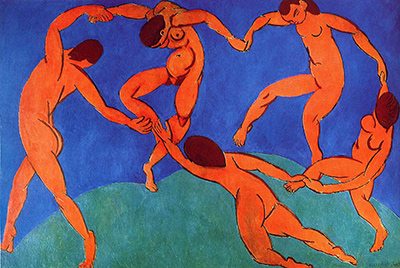
Dance (1910)
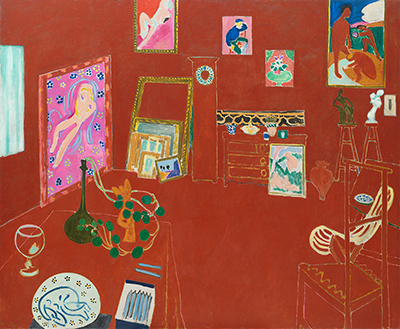
1910The Red Studio
1911The Piano Lesson
1916The Snail
1953Contents
- What can be seen in the blue view?
- Where was Matisse looking from?
- Why does blue cover so much of the canvas?
- Is this the same painting as the other 1914 Notre-Dame?
- How should a viewer approach it?
What can be seen in the blue view?
Begin with the cathedral, because it is the strongest clue to the title. High in the composition, a dark, roughly squared frame surrounds pale blue and pink architectural shapes. The two towers rise with some of their divisions indicated, but the building is not described stone by stone. Its light lower portion seems to emerge from the blue around it. The pale area does not fully detach from the rest of the canvas, so the cathedral can appear to come forward and recede again as the viewer looks.
Immediately to the right is a compact green oval, edged by dark paint. It reads as a tree or foliage in the city view. The green is striking because most of the canvas is blue-grey; it provides a bright point of difference near the cathedral without making the rest of the scene naturalistically green. A short dark diagonal runs down from that area toward the lower half. Rather than filling a tree trunk with branches and leaves, Matisse lets a colored shape and a few lines do the work of placing vegetation beside architecture.
The lower half looks open, but it is not blank. Thin changes in blue, pale strokes and the grain of worked paint interrupt it. Dark diagonals cut across the area, while two nearly horizontal lines divide the picture. They may suggest elements of the window, the river view or the constructed perspective of the scene, depending on how the eye groups them. The Metropolitan Museum of Art identifies a few dark curves as possible reflections of Matisse's balcony railing in the windowpane. That curatorial reading is more precise than a viewer can prove from a small reproduction alone, so it should remain a qualified interpretation rather than a label attached to every black mark. [2]
A firm vertical near the right edge gives the whole image a frame within the frame. It helps us understand that the painter looked outward from a room; it also acts as an independent black line on blue. This double role is characteristic of the work. We can look through the pictured window toward Notre-Dame, or follow the lines as a spare geometry across the canvas. Neither way of seeing cancels the other. The cathedral's towers keep the picture tied to an observed place even while the surrounding blue makes that place unusually elusive.
Where was Matisse looking from?
Matisse knew this prospect from his working life. The Met records that he rented a studio on the Quai Saint-Michel from the 1890s to 1907 and returned to the riverside location in late 1913 . His windows overlooked the Seine; Notre-Dame appeared to the right. The view was familiar enough for him to revisit it across years. That history matters because the 1914 canvas was not the product of seeing the landmark for the first time. It was a renewed engagement with a place he already knew how to describe more fully. [2]
Earlier paintings preserved more of the city around the cathedral. The small Notre-Dame of circa 1900 , now at Tate, shows boats, bridge, river and towers in a compressed but recognizable view. Buffalo AKG's Notre-Dame, une fin d'après-midi of 1902 includes a shutter and wall close to the viewer, with bridge and cathedral beyond. Those canvases use near architecture and the river to lead the eye into the distance. The MoMA picture keeps a sign of the near window, but much of the earlier topographic detail has fallen away. It does not ask us to locate every boat or read the precise outline of each bank. [2] [4]
This change is especially striking because the motif itself had not vanished. The cathedral was still across the Seine. Matisse altered the kind of picture he made from it. A dark line that once might have stabilized a recession into space becomes part of a pattern across a broad blue field. An architectural edge can hold both a position in the view and a place in the composition. The image offers just enough of the known landmark for the viewer to notice how much descriptive scenery Matisse chose to release.
The Met cautions against treating these pictures as a systematic series of fixed viewpoints, like Monet's repeated paintings of the Rouen Cathedral facade. Notre-Dame was part of Matisse's daily surroundings. He returned to it with changing problems of color, representation and how a painting might be brought to a conclusion. The 1914 canvas should therefore be read as one complete proposition from a familiar view, not merely as a step on a ladder from realism to abstraction. [2]
Watch: Matisse’s art and working methods
Choose a museum film or a close reading to continue exploring Matisse’s work.
Matisse: “For Me It’s Always New”
The Museum of Fine Arts, Boston considers Matisse’s creative practice.
Watch on YouTubeWhy does blue cover so much of the canvas?
MoMA's current gallery text describes a process of revision. Matisse reworked features of this picture before covering almost the entire surface with blue, leaving elements of an earlier composition visible beneath it. The blue is thus more than a quick atmospheric wash. It is a layer through which previous decisions can still be sensed. Near the cathedral and across the broad lower area, different marks and densities make the surface appear worked rather than uniformly filled. [1]
An earlier MoMA catalogue reads those underlying changes as signs that the picture once followed the motif more closely. It observes that a right-hand window jamb, which in earlier Notre-Dame views helped establish depth, becomes a stronger part of the surface geometry here. The catalogue also notes an enlarged cathedral and the loss of more specific details of the river scene. This is a curatorial reconstruction from the visible painting, not a complete step-by-step record of every brushstroke. It helps explain why the final blue can feel both reduced and dense with earlier looking. [4]
The contrast between blue and black is central. The blue field holds much of the picture together, while dark lines create sharp direction. A vertical emphasizes height; a horizontal checks it; a diagonal moves the eye from near the green form toward the lower edge. Yet these lines do not lock the whole canvas into a conventional street or river perspective. They give the painter a way to keep the scene organized after many of its familiar details have been covered. The small green and pink areas become more noticeable because the surrounding blue is so extensive.
Calling this painting “unfinished” simply because it is spare would miss the evidence of active reworking. Calling it purely abstract would miss the recognizable cathedral and the relationship to Matisse's actual window. The Met identifies the question of what counts as a finished canvas as one of the issues raised by the two large 1914 Notre-Dame paintings. Here the visible earlier marks are part of the experience. They let the viewer sense the passage from a described place toward a more open arrangement of color and line, without requiring us to declare that the artist accidentally stopped midway. [2] [1]
Is this the same painting as the other 1914 Notre-Dame?
No. The Kunstmuseum Solothurn owns a distinct oil painting called Notre-Dame de Paris , dated 1914 , measuring 147 × 98 centimetres and held by the Dübi-Müller Foundation. It is close in scale to MoMA's canvas but has its own collection identity and visual treatment. The Met presented the two together as related large works from 1914 and noted that both retain subtle marks of a window edge. A shared format and view make comparison worthwhile; they do not turn Solothurn's canvas into a preliminary state of MoMA's physical painting. [3] [2]
The comparison asks what a familiar subject can sustain. In the Solothurn picture, the city and cathedral remain more readily legible as a view. In MoMA's version, blue and dark surface lines do much more of the visual work. The difference cannot be explained by saying that one belongs to an early career and the other to a later one: both are dated 1914 . Matisse could pursue distinct pictorial answers at the same time. That is the point of pairing them, even if their exact day-by-day making sequence is not secure from the available evidence. [2] [3]
MoMA's owner label records a revealing early response from Matisse's friend Marcel Sembat , who saw this work alongside another version. He favored the blue canvas's inventiveness but expected people to find its abstraction hard to grasp at first. His reaction shows that the difficulty a modern viewer may feel was present near the work's own time. It also shows that difficulty was not the only response: a contemporary could see a personal, accomplished picture in the same departure from ordinary description. [1]
How should a viewer approach it?
Find the two pale towers first. Then move outward, noticing how little of the surrounding city is needed to keep the cathedral recognizable. Follow the black line at the right and ask when it feels like a nearby window edge and when it feels like an upright on the flat canvas. Return to the green form and trace the diagonal that drops away from it. Those movements reveal how Matisse built an active composition from relatively few strong parts.
Next inspect the blue itself. It changes in warmth, thickness and direction; older marks show through in places. The painting's surface is not a neutral background for a black diagram. It is the record of Matisse deciding what to keep visible from the familiar Quai Saint-Michel scene. A viewer may never be able to identify each underlying line, and need not do so to feel the difference between a blank blue sheet and this revised, painted field. [1]
Finally compare the two earlier Notre-Dame routes and the Solothurn work without asking them to form a simple march toward a single final style. The circa-1900 Tate view, Buffalo's 1902 canvas and MoMA's blue 1914 painting each organize the same landmark through different needs: urban movement, framed depth and the balance of place with surface geometry. The MoMA canvas keeps Notre-Dame in sight while making us aware of how a painting can alter the act of seeing it. Continue to the paintings guide for the broader changes in Matisse's work.
Explore 113 Matisse artworks
This directory covers the 113 individual works explored in these articles, rather than a complete catalogue of Matisse’s output. Cut-paper designs and prints appear under Drawing in the medium filter; each row names its form. Dates retain the qualifications explained in the linked articles.
Discussion
Look again at the images and ideas explored in Henri Matisse, View of Notre Dame (1914): The Cathedral in Blue. These editorial prompts invite your observations.
Reader Insights
What can be seen in the blue view?
Which comparison discussed in the article helps you see the work differently?
How do the materials and historical setting affect your reading?
Join the Conversation
Share a detail, comparison or question about Henri Matisse, View of Notre Dame (1914): The Cathedral in Blue below.
References
- Museum of Modern Art , View of Notre Dame , current owner metadata, 2022 gallery text and provenance. View source .
- Metropolitan Museum of Art , “For Me It Is Always New”: Matisse's View of Notre-Dame, 2012 exhibition text on the studio view, two 1914 works and window details. View source .
- Kunstmuseum Solothurn , Notre-Dame de Paris , owner record for the separate 1914 painting. View source .
- Museum of Modern Art , Matisse in the Collection of The Museum of Modern Art , 1978 catalogue discussion of the early Notre-Dame pictures, blue surface and visible revisions. View source .
 Henri Matisse.jpg)