


 by
Tom Gurney
Tom Gurney BSc (Hons) is an art history expert with over 20 years experience
Email:
tomgurney1@gmail.com
/ Phone:
+44 7429 011000
Henri Matisse, Woman in a Purple Coat (1937): A Portrait Across Patterns: Introduction
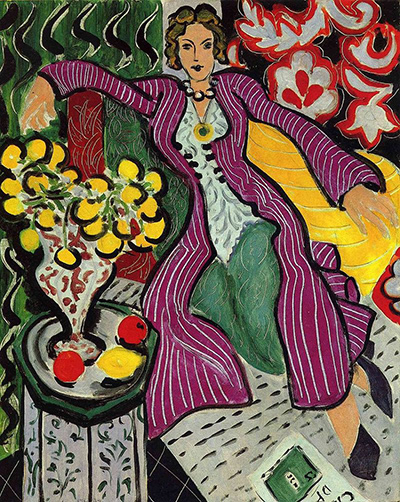
A woman sits with her arms extended across a yellow chair. Her long purple coat runs from one edge of the composition towards the other, its white stripes bending around her shoulders, sleeves and knees. To her left are a vessel of yellow flowers and a dish of fruit; behind her, green and red-black patterned areas compete for attention. Henri Matisse's Woman in a Purple Coat is a portrait, but the sitter does not occupy an empty background. The room presses into the figure's space, and the figure gives its many patterns a centre. The Museum of Fine Arts, Houston records the painting as a 1937 oil on canvas , measuring 81 × 65.4 cm , with the signature and date at the lower left. [1]
The title points to the coat, and it is a good place to begin. Its striped outline stretches out with the woman's arms and then returns around her body. Yet looking only at the garment misses the painting's real activity: the repeated curves of flowers, fruit and wall decoration are just as insistent. Matisse makes a relatively small canvas feel crowded and expansive at once. This page looks closely at how those pieces fit together, what the museum record actually establishes about the object, and how the work differs from another purple-robed portrait of the same year.
At a Glance
- Artist Henri Matisse
- Work Woman in a Purple Coat (1937)
- Date 1937
- Explore Painting
This work across Henri Matisse’s career
Dance (1910)
1910The Red Studio
1911The Piano Lesson
1916The Snail
1953Contents
- What do we see in the painting?
- Why does the coat matter so much?
- How do the room's patterns change the portrait?
- Is this the same picture as Purple Robe and Anemones?
- What is known about the painting's history?
- Annotated details
What do we see in the painting?
The woman's face sits near the top centre. Her eyes and dark mouth are drawn with relatively few marks compared with the varied surfaces around her. A pale blouse, a circular pendant and a green area below it form a light channel down the middle of the body. That central passage is held inside the coat's dark border. It gives the eye a route through the sitter before the abundant pattern on either side pulls it away.
The arms make a wide, almost horizontal shape. One hand drops near the flowers on the left; the other rests over the yellow chair at the right. The purple sleeves connect those areas without making them symmetrical. The flower arrangement rises higher and crowds the figure's left arm, whereas the chair opens into a broad yellow curve beneath the other hand. The sitter appears settled, but her silhouette is also a device for spanning the painting's whole width. Rather than placing her in front of a decorative setting, Matisse lets clothing and furniture divide that setting into active zones.
At lower left, a vessel of yellow blooms stands behind a dish with several rounded pieces of fruit. Their black contours are emphatic. The flower heads repeat in clusters, each with a dark curved edge; the round fruit below repeats the rhythm at another scale. A small red and yellow group near the lower edge intensifies the still life. These objects are not only signs of a domestic room. They make yellow, green, black and red recur where the portrait might otherwise become dominated by purple.
The right-hand chair offers the largest unbroken yellow area. It curves behind the sitter's arm and narrows toward the edge. The strong colour helps us locate a seat, even while the exact construction of the furniture remains hard to read. The chair's broad arc and the sleeve's striped arc cross one another. That crossing is one reason the coat looks substantial despite the simplified body beneath it. We can see a person reclining; we can also follow a set of shapes that bend, interrupt and resume across the picture.
Why does the coat matter so much?
The coat is purple, but it is not one flat block. Narrow pale lines track each change in its direction. Across the shoulders they slope outwards; around the sleeves they turn with the arms; down the front they gather into long, falling runs. The stripe pattern gives an immediate sense of draped fabric without relying on careful modelling of folds. It also keeps the eye moving over a very large portion of the canvas. The garment becomes both the sitter's clothing and a network of lines that holds the composition together.
Matisse uses dark contours to separate the coat from nearby green, yellow and white areas. Those lines are especially useful where patterns threaten to merge. Follow the upper edge from one shoulder across the other: it makes the woman legible against two very different backgrounds. Then follow the coat down and see how its outline divides the green central area from the patterned lower cloth. The boundary is sometimes more important than a shaded volume. We understand where one thing ends because Matisse chooses a dark edge or a decisive colour shift.
That does not mean everything is equally flat. The sitter's face remains a point of human attention; the limbs describe a relaxed pose; the yellow chair curves around her. But perspective and modelling do not control the whole scene. A patterned wall can feel as near as a sleeve, and a cluster of fruit can claim as much visual weight as the face. The tension between a recognisable person and a surface packed with independent shapes is the painting's distinctive effect.
The word “coat” also distinguishes this Houston work from other purple-garment paintings of the period. The title identifies what dominates the visible figure; it does not establish where a real garment came from, that it was a particular regional costume, or that every painted stripe corresponds to a surviving piece of fabric. The available Houston collection entry documents the painting, not a costume inventory. A careful close reading can say much about the painted lines without attaching an unsupported history to the clothing. [1]
Annotated Details from Woman in a Purple Coat (1937)
The numbered points identify visible features discussed in this article. Return from each detail to the whole composition. Woman in a Purple Coat (1937) — Henri Matisse
.jpg)
Details from WOMAN IN A PURPLE COAT (1937)
Compare the cropped details with the complete images above. Notice how their colours, shapes and positions contribute to the larger compositions.
The coat connects the pose
Pale stripes run through the purple shoulders, sleeves and front. Their changes of direction connect the seated pose while a dark border keeps the coat distinct.
 Detail 01 the-coat-connects-the-pose.jpg)
Still life beside the sitter
Yellow flowers and rounded fruit answer the colour of the chair. Dark curved edges hold these separate objects within the crowded left side.
 Detail 02 still-life-beside-the-sitter.jpg)
Two patterned grounds
Narrow waves on green meet broad red-and-white forms behind the face. The small head remains a focus between those different rhythms.
 Detail 03 two-patterned-grounds.jpg)
Watch: Matisse’s art and working methods
Choose a museum film or a close reading to continue exploring Matisse’s work.
Matisse: “For Me It’s Always New”
The Museum of Fine Arts, Boston considers Matisse’s creative practice.
Watch on YouTubeHow do the room's patterns change the portrait?
The background is divided more by colour and mark than by clearly described architecture. Behind the sitter's left side, black wavy strokes move over green. Behind the right side, larger red-and-white shapes fill a dark field. These areas could be read as decorated surfaces within a room, but the picture does not require us to identify every wall or hanging. Their main visible work is to set the figure between different rhythms: narrow vertical wavering marks on one side, broad rolling shapes on the other.
The floral vessel complicates that division. It rises in front of the green area and contains its own dense network of curved edges. The painted flowers do not simply repeat the red-and-white wall pattern, yet both are built from loops and rounded forms. Across the canvas, the eye moves from small yellow heads to the woman's circular pendant and onward to larger red-and-white motifs. Scale changes while the curving movement continues. In this way the setting is not an inert frame. It supplies alternatives to the figure's outline and keeps returning us to it.
The lower area adds another pace. Dark short marks scatter over light fabric near the woman's legs. Under the fruit dish, a smaller green-and-white pattern runs vertically. A dark grid appears at the bottom. No single pattern covers everything, and the changes make the room feel assembled from several materials. At the same time, the strong black lines across figure, flowers and fruit tie those materials into one painted surface. Close up, the marks differ; from a distance, their intervals help the whole scene cohere.
The Museum of Fine Arts, Houston's Beck Collection introduction describes this 1937 picture as showing the persistence of Matisse's interest in vivid colour long after the brief Fauve period. That is a useful long view, but the canvas itself is more specific than a general style label. Purple stripes, black contours, yellow fruit and chair, and split green/red grounds are choices made for this particular portrait. Calling it simply “Fauvist” would obscure its 1937 date and its distinctive handling of figure and interior. [2]
Is this the same picture as Purple Robe and Anemones?
No. Matisse painted Purple Robe and Anemones in 1937 as well, and the two images are closely related in their seated figure, purple striped clothing and dense arrangement of nearby objects. The Baltimore painting puts a jug of anemones prominently beside the sitter. The Museum of Fine Arts, Boston's Matisse in the Studio account identifies the jug as a studio object and draws attention to wavy lines shared by its body, the woman's dress and the wall. It also describes the painted table that helps organise that work's foreground. [3]
The Houston canvas, by contrast, spreads the sitter's arms farther across the width. Its flowers and fruit form a heavier cluster at the left, while a large yellow chair dominates the right. The Houston coat is almost an architectural band running between those zones. In Baltimore the jug and anemones assert themselves as the closest rivals to the figure. In Houston, the balance is distributed among fruit, flowers, chair and two opposed background fields. Looking between the paintings reveals Matisse testing related ingredients rather than repeating an identical image.
MoMA's retrospective account places Matisse's work of the 1930s and early 1940s in a period of themes and variations. That framework fits the pairing, provided it does not flatten the paintings into copies. Each has its own size, owner and arrangement, and each deserves to be read on its own terms. [4] The Minneapolis Institute of Art identifies Lydia Delectorskaya as the model in the Baltimore painting. The Houston online object record does not name its sitter, so the Baltimore identification should not simply be transferred to the Houston canvas without an additional source. [5] [1]
What is known about the painting's history?
The Houston record gives a clear sequence after Matisse completed the work. It lists exhibitions of recent works in Paris and London in 1937 . It then traces the painting through Madame Meric Callery in Paris, Frederic R. Mann in Philadelphia and M. Knoedler and Co. in New York before John and Audrey Jones Beck acquired it in 1965 . Audrey Jones Beck gave it to the Museum of Fine Arts, Houston in 1974 . The accession number is 74.141 . These details matter because they identify the particular canvas among several late-1930s portraits with similar dress and decorative surroundings. [1]
The museum measures the canvas at 81 × 65.4 cm . It is upright and intimate enough that the wide-armed pose has to work within a narrow rectangle. Matisse solves that difficulty by turning the sleeves, chair and background patterns into a connected design. We do not need to invent a story about the sitter's thoughts or a hidden meaning for each fruit. The picture offers more concrete questions: where does the purple stripe lead, where does a black border stop, and when does a patterned wall begin to feel as forceful as the person in front of it?
Look first at the face and pendant, then take the coat's line out to each hand. Return by way of the flowers, fruit and yellow chair. Finally compare the green field with the red-and-white one. That route makes visible a portrait built from relationships among shapes rather than from a single isolated figure. The paintings directory places it among Matisse's other canvases, while the Baltimore comparison shows how differently he could arrange a purple garment and a flower-filled room within the same year.
Explore 113 Matisse artworks
This directory covers the 113 individual works explored in these articles, rather than a complete catalogue of Matisse’s output. Cut-paper designs and prints appear under Drawing in the medium filter; each row names its form. Dates retain the qualifications explained in the linked articles.
Discussion
Look again at the images and ideas explored in Henri Matisse, Woman in a Purple Coat (1937): A Portrait Across Patterns. These editorial prompts invite your observations.
Reader Insights
What do we see in the painting?
Which comparison discussed in the article helps you see the work differently?
How do the materials and historical setting affect your reading?
Join the Conversation
Share a detail, comparison or question about Henri Matisse, Woman in a Purple Coat (1937): A Portrait Across Patterns below.
References
- Museum of Fine Arts , Houston, Woman in a Purple Coat , object record for title, date, medium, measurements, signature, accession, exhibitions and provenance. View source .
- Museum of Fine Arts , Houston, Beck Collection introduction, collection context and interpretation of the painting's colour. View source .
- Museum of Fine Arts , Boston, Matisse in the Studio , discussion of the distinct Baltimore Purple Robe and Anemones , its jug, painted table and repeated curves. View source .
- Museum of Modern Art , Henri Matisse: A Retrospective , curatorial account of themes and variations in the 1930–43 period. View source .
- Minneapolis Institute of Art , Matisse: Masterworks from The Baltimore Museum of Art , exhibition preview, sitter identification and visual account of the separate Baltimore painting. View source .






 Henri Matisse.jpg)
