 by
Tom Gurney
Tom Gurney BSc (Hons) is an art history expert with over 20 years experience
Email:
tomgurney1@gmail.com
/ Phone:
+44 7429 011000
Henri Matisse, Woman with a Veil (1927): Face, Fabric and Painted Revision: Introduction
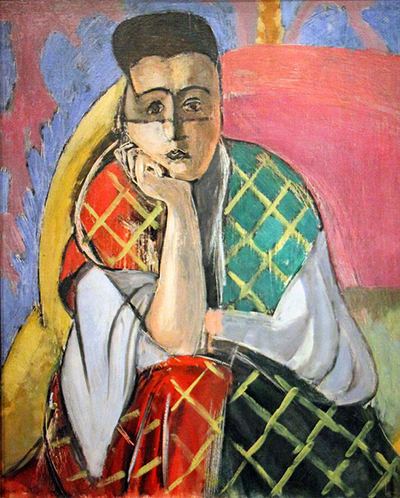
A woman sits close to the picture plane, resting her chin on one hand. A dark veil crosses her face, but it does not hide her. Her eyes still meet the viewer, while a grid of yellow lines moves across bright red, green and black fabric. Behind her, large pink and blue areas resist becoming a clearly described room. Henri Matisse painted Woman with a Veil in Nice, winter–spring 1927 , according to the Museum of Modern Art. The oil on canvas , 61.6 × 50.2 cm , belongs to MoMA's William S. Paley Collection , object SPC22.1990 . [1]
The painting rewards time spent at its centre. Matisse had to show a recognisable face and a thin screen in front of it without letting either disappear. The veil makes looking itself the subject: how much of a person can be seen through fabric, and how much does a painted line change that view? Around this close encounter, the patterned garment and broad background colours press against the face. The result feels intimate in scale but visually forceful. It is a portrait made from a difficult balance between likeness, concealment, surface and pattern.
At a Glance
- Artist Henri Matisse
- Work Woman with a Veil (1927)
- Date 1927
- Explore Painting
This work across Henri Matisse’s career
Dance (1910)
1910The Red Studio
1911The Piano Lesson
1916The Snail
1953Contents
- Who is the woman in the painting?
- How does the veil change the face?
- What do the patterned clothes do?
- Why does the portrait matter in Matisse's later work?
Who is the woman in the painting?
The Musée de l'Orangerie identifies the model as Henriette Darricarrère . Its 2023 exhibition booklet says that Matisse began the work in 1926 , completed it in 1927 and that it was her last painting as his model . MoMA's current object record gives the narrower public date winter–spring 1927 . The accounts can be read together: one describes when the work was completed and where, while the Orangerie's account adds an earlier start and a relationship to the model's time in Matisse's studio. [1] [2]
Henriette had appeared in other Nice-period pictures. The Metropolitan Museum of Art identifies her as the model for its Odalisque with Gray Culottes and says she posed for Matisse between 1920 and 1927 . That record helps place Woman with a Veil at the end of a sustained working relationship, but it does not make the two paintings interchangeable. The Met work stages a reclining figure in an elaborate setting; this one draws us towards a seated woman's face, hand and clothing. A reader can compare how Matisse used his model in different compositions without assuming that either image explains Henriette's private life. [3]
The Orangerie booklet interprets Woman with a Veil as sounding a double farewell : to Henriette as a model and to a way of painting. That is a curatorial reading, not a statement Matisse wrote on the canvas. It is suggestive because of the work's documented date and the changes visible in its surface. Yet the portrait can be understood without assigning a single emotion to the woman or a definite personal message to the artist. What the picture provides directly is a face seen through a veil and a painted field held in productive tension around it. [2]
How does the veil change the face?
The short dark veil runs from the hat across the upper face. It makes the eyes harder to locate at first, then more insistent once found. Dark lines divide the features and seem to shift as the viewer moves between the woman's face and the fabric over it. One side reads more openly as cheek and eye; the other becomes harder to separate from shadow and painted contour. The mouth and the hand beneath the chin hold the face in place while its upper half remains optically unsettled.
This is a different effect from simply painting an opaque mask. The veil lets part of the face remain available, and that partial visibility is its difficulty. In a recorded interview for the Orangerie's exhibition, the curator describes Matisse wrestling with transparency : the veil both covers and reveals. She points to repeated erasure and scraping in the painting, and to an unusual division of the face. Those are observations and a curatorial interpretation of the worked surface; the public materials do not provide a pigment map or a step-by-step reconstruction of each revision. The safe conclusion is that Matisse visibly laboured over this relation between face and screen. [4]
The supporting hand is also more than a familiar portrait gesture. It brings pale skin and bright sleeve into the centre, lifting the face from the patterned clothes. Its upright arm forms a strong line beneath the chin. This physical support stabilises a head whose features the veil makes less secure. The pose can suggest thoughtfulness or fatigue, but those are viewer responses, not evidence of what Henriette felt while sitting. Matisse needed the gesture to organise the picture as much as to identify a person.
Her dark head covering supplies an upper boundary. Against the mottled blue area behind it, its nearly black shape has the force of a cut-out silhouette. The face below is comparatively modelled, with light and dark planes that give it volume. This meeting of a strong flat cap, transparent net and bodily face makes the upper half unusually complex. An eye looking for a simple portrait likeness has to work through layers of paint and represented material before reaching it.
Watch: Matisse’s art and working methods
Choose a museum film or a close reading to continue exploring Matisse’s work.
Matisse: “For Me It’s Always New”
The Museum of Fine Arts, Boston considers Matisse’s creative practice.
Watch on YouTubeWhat do the patterned clothes do?
The garment is built from broad red, green and black areas crossed by yellow diagonal lines . Its coloured sections are easy to recognise as clothing, but the repeated lattice also behaves like a pattern spread across the painting. It links the figure's left and right sides while refusing to follow every fold or seam. A sleeve of pale grey-blue separates the hand from the darker pattern below, so the viewer can still read a bent arm and seated body.
The repetition is not evenly mechanical. Lines turn at the shoulder, cross differently at the knee and vanish where the hand or pale sleeve interrupts them. These changes keep the fabric responsive to the pose. At the same time, the lattice gives the eye a route around the canvas, from red at one shoulder through green at the other and down into the lower black field. The face becomes a still point amid those repeated diagonals. Matisse's interest in textile pattern is visible here as a pictorial problem: how can decoration energise a figure without dissolving it?
Behind Henriette, pink and blue do not settle into a detailed wall, chair or curtain. A yellow curve at one side and a pale area at the other hint at objects or spatial boundaries, but they need not be named precisely to matter. They push colour towards the sitter and make the patterned clothing feel even denser. The Orangerie curator describes an ambiguous relation to depth created by the crossing motifs and broad colour fields . This is useful language for the picture's effect: it offers a body with volume while allowing its surroundings and fabric to approach the flatness of a painted surface. [4]
The canvas is small enough to feel like a close conversation, yet it resists being read as a quick character sketch. The central hand and face invite proximity. The strong colour divisions and pattern demand that we step back to see the whole arrangement. Moving between those distances is part of the experience. A viewer who looks only for Henriette's expression misses the work done by its fabrics; one who looks only at the pattern misses the persistence of the individual face.
Why does the portrait matter in Matisse's later work?
The Orangerie's 2023 exhibition placed the 1927 portrait near the transition into Matisse's 1930s reassessment of his methods. Its curator saw in this small canvas a sign of difficulty and revision before the later large decorative projects. The exhibition booklet's “farewell” reading belongs to that argument. It does not mean the painting alone caused the later change, or that Matisse immediately abandoned portraiture. It shows him testing how far pattern and broad colour could carry a figure while still making a face present. [2] [4]
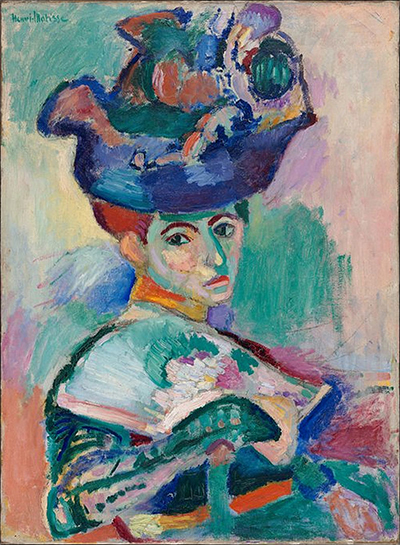
An earlier Woman with a Hat offers a useful contrast in the site collection. Both are portraits in which colour changes the viewer's expectations of likeness, but they were painted more than two decades apart and depict different women. The 1905 work is a Fauve portrait of Amélie Matisse; this 1927 work is a Nice portrait of Henriette seen through a veil and dense fabric. A later Purple Robe and Anemones again makes patterned clothing and surroundings central to a figure, though its sitter and setting belong to another moment. These comparisons help trace a recurring problem without collapsing distinct paintings into one formula.
The picture had an early public life. MoMA's exhibition history includes it in the museum's 1931 Henri Matisse retrospective , and the contemporary catalogue listed Woman with a Veil as collection of the artist . MoMA's provenance then records a sale through Pierre Matisse Gallery to William S. Paley on 9 October 1936 . The work entered the Paley Collection at MoMA in 1990 . The Orangerie presented it in its 2023 exhibition, giving the painting a recent French context alongside the museum's account of Matisse's move towards the 1930s. [1] [2] [5]
For a final look, follow the yellow lattice across the clothing until it reaches the pale arm. Let that arm lead up to the hand, then try to separate veil from face. The eye keeps crossing from one material to another: represented textile, thin net and actual painted canvas. Matisse did not resolve the portrait by making those layers easy. He made their overlap the work's central event. The paintings directory places this compact Nice portrait among his changing approaches to figure, colour and decoration.
Explore 113 Matisse artworks
This directory covers the 113 individual works explored in these articles, rather than a complete catalogue of Matisse’s output. Cut-paper designs and prints appear under Drawing in the medium filter; each row names its form. Dates retain the qualifications explained in the linked articles.
Discussion
Look again at the images and ideas explored in Henri Matisse, Woman with a Veil (1927): Face, Fabric and Painted Revision. These editorial prompts invite your observations.
Reader Insights
Who is the woman in the painting?
Which comparison discussed in the article helps you see the work differently?
How do the materials and historical setting affect your reading?
Join the Conversation
Share a detail, comparison or question about Henri Matisse, Woman with a Veil (1927): Face, Fabric and Painted Revision below.
References
- Museum of Modern Art , Woman with a Veil , current object record, date, medium, size, Paley Collection, exhibition history and provenance. View source .
- Musée de l'Orangerie , Matisse: Cahiers d'art, The Pivotal 1930s exhibition booklet (2023), model identification and curatorial interpretation. View source .
- Metropolitan Museum of Art , recent acquisitions bulletin on Odalisque with Gray Culottes , Henriette Darricarrère as the model and 1920–27 working period. View source .
- Musée de l'Orangerie , curator interview transcript for the 2023 exhibition, discussion of transparency, scraping, pattern and depth. View source .
- Museum of Modern Art , Henri Matisse retrospective catalogue (1931), contemporary listing of Woman with a Veil as then in the artist's collection. View source .
 Henri Matisse.jpg)