


 by
Tom Gurney
Tom Gurney BSc (Hons) is an art history expert with over 20 years experience
Email:
tomgurney1@gmail.com
/ Phone:
+44 7429 011000
Henri Matisse, Nude on a Yellow Sofa (Yellow Odalisque) , 1926: Introduction
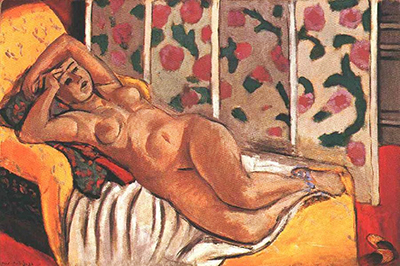
A reclining nude stretches across a brilliant yellow sofa while red and green floral forms repeat across a screen behind her. The figure is modeled with warm, rounded strokes, yet the room continually pulls attention toward flat pattern. This is Henri Matisse's Nude on a Yellow Sofa , dated 1926 by its owner, the National Gallery of Canada . The page title calls it Yellow Odalisque , a name associated with the picture, but the museum's current headline title identifies the work most securely. It is an oil on canvas , 55.1 × 80.8 centimetres , accession 6971 , purchased by the gallery in 1958 . [1]
That identification matters because Matisse also made a different picture titled Yellow Odalisque in 1937 , now in Philadelphia. The image and Canada's 1926 object record belong together: a horizontal nude on yellow upholstery before a patterned screen. The later Philadelphia painting has a clothed sitter and different objects. Reading the Canadian canvas on its own terms lets its particular balance of body, fabric and repeated flowers come into view. [2] [1]
At a Glance
- Artist Henri Matisse
- Work Nude on a Yellow Sofa (Yellow Odalisque)
- Date 1926
- Explore Painting
This work across Henri Matisse’s career
Dance (1910)
1910The Red Studio
1911The Piano Lesson
1916The Snail
1953Contents
- What is visible in the Canadian painting?
- Why do figure and pattern feel different?
- What does “odalisque” mean here?
- Which other works should be kept separate?
What is visible in the Canadian painting?
The woman lies diagonally from the upper left toward the lower right. One arm bends above her head; the other follows her torso. Her body occupies much of the width, but it is not isolated against a plain ground. The sofa's yellow and orange surfaces rise around her, while white fabric gathers below. Behind, vertical divisions of a folding screen hold a busy design of red flowers and green leaves. A darker strip at the right and warm color along the bottom give the setting further edges without supplying a fully measured room.
The figure's head rests near the left side, among yellow upholstery and dark outlines. Curved arm, neck and shoulder lead the eye toward the center of the canvas. The torso is built with changes of warm tone rather than a hard, continuous contour everywhere. At the right, the legs extend and overlap the sofa's bright edge. A small reproduction can show this overall structure but cannot settle every boundary between skin, white drapery and painted support. The legibility of the pose comes from their relations across the whole.
Yellow does more than name the furniture. It surrounds parts of the woman's body, catches the eye before the more muted flesh tones and returns at several points along the reclining line. Orange and red passages near the sofa and floor intensify its warmth. The dark curve under the torso gives the light fabric and skin something firm to press against. Even before a viewer identifies the screen's flowers, the painting offers a strong exchange among warm ground, pale body and darker contour.
The screen makes the upper half comparatively restless. Its light vertical supports divide the repeated floral design into panels, but the leaves and flowers nearly fill those divisions. We can read the screen as an object behind the model and also as a pattern brought forward toward the surface of the painting. The figure is three-dimensional enough to occupy the sofa; the floral backdrop resists receding politely into the distance. This contrast is one of the picture's main visual problems, not a background flourish to be ignored.
Why do figure and pattern feel different?
The National Gallery of Canada describes the patterned fabrics and screen as making a lively space around the model. It sees a balance between flat decorative elements and the three-dimensional figure . That is a useful way to describe what the eye does. The screen's repeated flowers can be scanned almost as a surface design, while the body's shoulders, waist and legs turn and overlap. Matisse asks these different kinds of space to coexist without making one defeat the other. [1]
The white cloth is an intermediary. Its folds suggest weight and volume, but its pale band also becomes a shape across the sofa. It does not simply identify a bed covering or costume. It separates the woman's warm body from the yellow below and sends the gaze along the reclining diagonal. If the white were absent, the figure might merge too easily into the furniture; if it dominated, the bright sofa would lose much of its force. The folds help the viewer move between modeled flesh and flat color.
The floral screen works differently from an open window. It encloses the setting and keeps the eye within the picture. Yet the screen's repeated shapes do not form an entirely uniform wallpaper. Their scale and spacing change slightly from panel to panel, and the light dividers stop the eye from drifting without pause. This rhythm makes the room feel staged for looking. The painting's subject is a reclining person, but its visual energy also comes from how cushions, fabric and screen are assembled around her.
The owner's interpretation connects Matisse's treatment of the body to a renewed interest in sculpture . That is a curatorial reading, not proof that he copied a particular bronze when making this canvas. It directs attention to how the figure occupies volume against the decorative setting. The torso and legs have weight, while the red-green screen remains comparatively planar. A viewer can sense the body turning through space even as the surrounding patterns keep pulling vision back to the painted surface. [1]
Watch: Matisse’s art and working methods
Choose a museum film or a close reading to continue exploring Matisse’s work.
Matisse: “For Me It’s Always New”
The Museum of Fine Arts, Boston considers Matisse’s creative practice.
Watch on YouTubeWhat does “odalisque” mean here?
The page's inherited title places the painting within Matisse's long engagement with the odalisque , a reclining or posed woman in a staged interior. The Met links his Nice pictures of this kind to a much older tradition of French Orientalist painting, including works by Ingres and Delacroix. That context helps explain the genre and its inherited ways of presenting women for a viewer. It does not establish that the Canadian sitter lived in a harem, belonged to a particular culture, or can be given a name from this picture alone. [3]
Canada's current title, Nude on a Yellow Sofa , is more specific about what is actually shown. It directs attention to the reclining body and vivid piece of furniture rather than suggesting an identity for the sitter. The term Yellow Odalisque remains useful for finding the historic page and placing the work beside related Nice pictures, provided it is not mistaken for documentary evidence about the model. The painting is a constructed studio image, with fabric and screen chosen for their pictorial effects; the institutional sources consulted here do not identify the exact room or sitter.
Matisse worked on a series of such paintings during winters in Nice between 1918 and 1928 , according to the National Gallery of Canada. The 1926 canvas belongs within that series without standing for every work in it. Its horizontal format and densely patterned screen give it a particular character. The museum describes this period as a move toward a more traditional treatment of the figure after some earlier experiments. That broad historical observation should not erase what is modern here: pattern and color still compete with the illusion of a fully continuous room. [1]
Which other works should be kept separate?
The Philadelphia Museum of Art's Yellow Odalisque is from 1937 . Its sitter, Hélène Galtzine , wears a striped robe over modern clothing, and the museum identifies a small painted table and a jug of anemones nearby. None of these details appears in the Canadian nude's owner record or image. The two paintings share Matisse and a title that invites confusion, but they differ in date, sitter presentation, format and setting. Philadelphia's named model is not evidence for the Canadian figure's identity. [2]
There is also a separate Reclining Odalisque from 1926 at the Metropolitan Museum of Art. Its owner gives an oil-on-canvas medium, 38.4 × 54.9 cm dimensions and inventory 67.187.82 . The shared year and subject show Matisse returning to the reclining figure, but they do not turn the Met painting into another photograph of Canada's 55.1 × 80.8 cm Nude on a Yellow Sofa . Museum numbers and dimensions are practical safeguards when titles are similar. [4] [1]
Return to the Canadian image by tracing the line from the bent arm over the head, along the torso and toward the legs. Then let the white cloth carry the eye back across the yellow support. Finally, look up to the flowered screen and notice how little it allows the room to dissolve into distant space. The picture holds a bodily figure and a decorated surface in sustained tension. Its owner title gives the best starting point: a nude, a yellow sofa and an arrangement of pattern that makes both more than a simple studio pose. The paintings guide places this 1926 work among Matisse's wider changes of subject and method.
Explore 113 Matisse artworks
This directory covers the 113 individual works explored in these articles, rather than a complete catalogue of Matisse’s output. Cut-paper designs and prints appear under Drawing in the medium filter; each row names its form. Dates retain the qualifications explained in the linked articles.
Discussion
Look again at the images and ideas explored in Henri Matisse, Nude on a Yellow Sofa (Yellow Odalisque) , 1926. These editorial prompts invite your observations.
Reader Insights
What is visible in the Canadian painting?
Which comparison discussed in the article helps you see the work differently?
How do the materials and historical setting affect your reading?
Join the Conversation
Share a detail, comparison or question about Henri Matisse, Nude on a Yellow Sofa (Yellow Odalisque) , 1926 below.
References
- National Gallery of Canada , Nude on a Yellow Sofa , owner title, date, medium, dimensions, accession, purchase and curatorial account of the Nice series. View source .
- Philadelphia Museum of Art , Yellow Odalisque , distinct 1937 painting and sitter/context record. View source .
- Metropolitan Museum of Art , Odalisque with Gray Trousers , institutional context for the separate Nice odalisque genre. View source .
- Metropolitan Museum of Art , Reclining Odalisque , distinct 1926 painting and owner dimensions. View source .






 Henri Matisse.jpg)
