 Buy Art Prints Now
from Amazon
* As an Amazon Associate I earn from qualifying purchases.
 by Tom Gurney
Tom Gurney BSc (Hons) is an art history expert with over 20 years experience
Published on June 19, 2020 / Updated on October 16, 2026
Email: tomgurney1@gmail.com / Phone: +44 7429 011000
Psyche Abandoned: Introduction
Psyche Abandoned is one of the quieter and more fragile works in the Jacques-Louis David cluster. It does not have the museum certainty of The Oath of the Horatii, The Death of Socrates or Love and Psyche. It is usually dated around 1795, but the strongest available scholarly notice gives a broader span, between 1787 and 1795. That difference is important. This is a painting that should be presented with care: a private-collection work, known through source records and reproductions, not a public museum object with a fully stable display history. [1] [2] [4]
The subject is Psyche, the mortal woman from the ancient story of Cupid and Psyche. The Utpictura18 record identifies the work as a painting on canvas by Jacques-Louis David, gives its dimensions as 80 by 63 cm, and locates it in a private collection. The same record connects the subject to Apuleius's Metamorphoses, especially Book 6, where Psyche is already beyond the secret night visits of Cupid and must face abandonment, wandering, pleading and trial. [1] [2] [4]
This makes Psyche Abandoned distinct from David's Cleveland painting, known locally through Love and Psyche. The Cleveland work shows Cupid and Psyche together in a bedroom in 1817, with Cupid awake and Psyche asleep. Psyche Abandoned is more solitary. It takes the myth after intimacy has broken. Cupid is absent. Psyche is left alone, exposed, emotionally open and difficult to protect with the usual language of ideal beauty. [1] [2] [4]
At a Glance
- ArtistJacques-Louis David [1]
- TitlePsyche Abandoned [1] [2]
- French Source TitlePsyche abandonnee [1]
- DateBetween 1787 and 1795; often c. 1795 in supporting routes [1] [2] [3]
- MediumPainting on canvas [1]
- CollectionPrivate collection [1]
- Dimensions80 by 63 cm [1]
- SubjectPsyche after Cupid's departure [1] [4]
- Interpretive CautionDo not turn the date hypothesis into certainty [1]
- Distinct FromLove and Psyche / Cleveland Cupid and Psyche, 1817 [1]
- Image CautionUtpictura image reuse red/hold; Commons likely verification path [1] [2]
Contents
- Introduction
- Object Identity and Caution
- The Story of Psyche
- Looking at the Painting
- David in the 1790s
- Image and Source Cautions
- Why It Matters
Object Identity and Caution
The safest public identity is straightforward but limited. Psyche Abandoned is an oil painting on canvas by Jacques-Louis David, connected with a private collection, with a recorded size of 80 by 63 cm. Utpictura18 dates it between 1787 and 1795 and notes a scholarly hypothesis associated with Guillaume Faroult: David may have begun the canvas around 1787 as a possible companion to La Vestale and then returned to it in 1795, in a different style, around the same time that he painted the portrait of Emilie Seriziat and her son. [1] [2] [3]
That hypothesis should not be turned into certainty. It is useful because it explains why the picture can feel suspended between two moments in David's career. Around 1787, David was already a celebrated painter of antique seriousness. By 1795, he had passed through the most violent years of the French Revolution and through political danger of his own. A work about a deserted Psyche can be read against that changed emotional world, but the interpretation has to remain careful. The painting is not a diary entry, and the private-collection record does not authorize a neat autobiographical claim. [1] [2] [3]
The date range also matters because 1795 was a productive and psychologically charged year for David. The Seriziat portraits belong to this moment after imprisonment and political reversal. Psyche Abandoned can be placed near that climate of recovery, vulnerability and reorientation, while still remaining a mythological painting. For related portrait context, compare Portrait of Emilie Seriziat and Her Son and Portrait of Pierre Seriziat. [1] [2] [3]
The Story of Psyche
The ancient story survives most fully in Apuleius. Psyche is admired for her beauty, suffers Venus's jealousy, and is joined to Cupid under conditions of secrecy. She may receive his visits, but she must not look upon him. When she breaks that condition, Cupid leaves. The moment after his departure is one of shock and exposure. Psyche has moved from hidden desire to knowledge, and knowledge brings loss. [1] [4]
David's painting is best understood in that emotional zone. Psyche is not shown in triumph, marriage or divine reunion. She is not surrounded by the full machinery of the myth: no palace, no sisters, no Venus, no Cupid, no final immortal resolution. The picture concentrates on abandonment itself. That narrowing gives the work its power. A whole myth has been reduced to one figure and one state of mind. [1] [4]
The title also keeps the viewer from treating the nude merely as a studio figure. Psyche's body is mythological, but her isolation is psychological. She is not simply a classical nude placed in a landscape. She is a person in the aftermath of love and loss. The lack of narrative accessories increases the pressure on posture, face, light and setting. [1] [4]
Looking at the Painting
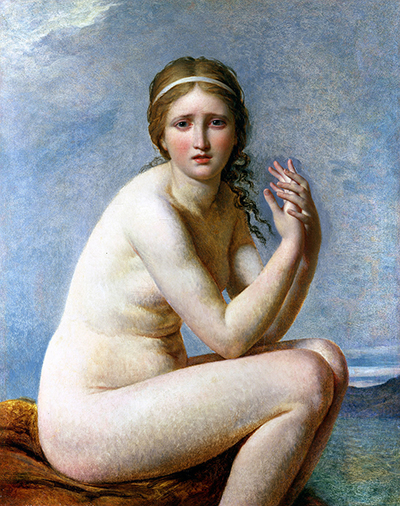
The image known through reproductions shows Psyche seated outdoors, nude, with a pale headband and loose hair. Her body faces the viewer while her emotional state turns the scene inward. The background opens toward land, water or distant hills beneath a restless sky. The setting is not densely described. It works more as an atmosphere of exposure than as a specific topographical place. [1] [2]
This spareness separates Psyche Abandoned from the richer interior worlds of David's late mythological paintings. The Farewell of Telemachus and Eucharis uses colour, embrace and fabric to stage a scene of parting. The Anger of Achilles concentrates several figures around a moment of explosive family and military conflict. Mars Being Disarmed by Venus fills the canvas with late mythological ceremony. Psyche Abandoned is almost the opposite. It depends on a single figure and a stripped emotional field. [1] [2]
The figure's nudity should be handled carefully. In Neoclassical painting, nudity can signal ideal form, antique subject and academic discipline. Here it also reads as vulnerability. Psyche has no armour, no rich clothing and no protective interior. Her body is exposed to the viewer and to the weather of the picture. That exposure fits the mythic moment after Cupid's departure, when the hidden chamber has vanished and Psyche is thrown back into the world. [1] [2]
Her expression is central. The painting's emotional charge comes from the way Psyche appears aware, wounded and uncertain. David had long been interested in expressive states: stoic resolve in Socrates, public grief in Brutus, political martyrdom in Marat, and familial strain in Andromache Mourning Hector. Psyche Abandoned belongs to that same concern with feeling, but in a more solitary key. It is a history painting reduced to one exposed body and one private crisis. [1] [2]
David in the 1790s
The 1790s were not a simple stylistic corridor between the heroic David of the 1780s and the imperial David of Napoleon. They were years of public role, political risk, imprisonment, reassessment and portraiture. Psyche Abandoned matters because it offers a mythological subject close to that moment of instability. [1]
If David did return to the canvas in 1795, as the Utpictura18 notice reports through Faroult's hypothesis, the painting belongs near a period when he was rebuilding his artistic and personal footing. That does not make Psyche a stand-in portrait of David. It does mean that abandonment, isolation and exposure would have had a different resonance after the Terror than they might have had in a purely decorative pre-Revolutionary setting. [1]
The possible relation to La Vestale is also useful. A vestal subject and a Psyche subject would place two antique women in states of inner crisis. One is bound to sacred duty; the other is left by love after forbidden knowledge. Even if the companion idea remains uncertain, it helps frame the painting as more than an isolated nude. It belongs to David's wider interest in single figures who carry moral or emotional pressure. [1]
Image and Source Cautions
This page uses Utpictura18 for object evidence, not for image reuse. Utpictura records reproduction restrictions, so Commons or another open derivative record is the safer image reference. Obelisk is useful as a secondary cross-check, but it is not stronger than the source-locked Utpictura record. [1] [2] [3]
Why Psyche Abandoned Matters
Psyche Abandoned is not a flagship David painting, but it fills an important space in the cluster. It shows how David could turn mythology away from large public action and toward private vulnerability. The work is closer in scale and mood to a psychological study than to the great civic canvases. Its strength lies in restraint. [1] [2]
It also helps readers separate two Psyche subjects in David's career. Love and Psyche in Cleveland is a large late painting of Cupid and Psyche together. Psyche Abandoned is a smaller, private-collection work centred on Psyche alone. Keeping those works distinct prevents a common error: treating all David Psyche imagery as one generic mythological theme. [1] [2]
The painting also offers a useful bridge between David's pre-Revolutionary antique language and his later mythological works. It shares the classical subject matter of The Loves of Paris and Helen, but without that painting's courtly luxury. It anticipates the emotional privacy of the Brussels works, but without their late decorative finish. It is spare, wounded and unresolved. [1] [2]
For David's broader career, see the Jacques-Louis David biography and the David paintings hub. For related mythological works, compare Love and Psyche, The Farewell of Telemachus and Eucharis, The Anger of Achilles, Mars Being Disarmed by Venus and The Loves of Paris and Helen. For another single-figure or concentrated emotional subject, see Andromache Mourning Hector. [1] [2]
Frequently Asked Questions
Discussion
Psyche Abandoned is a source-cautious page about vulnerability, myth and a private-collection object known through records and reproductions.
Use the prompts below to think about Psyche's solitude, the uncertain date range and the difference between this work and David's later Cupid and Psyche.
Reader Insights
How does the absence of Cupid change the emotional force of the Psyche story?
How should the broader 1787 to 1795 date range shape interpretation?
What does the outdoor setting add to the sense of abandonment and vulnerability?
Join the Conversation
Share your reading of Psyche Abandoned below.
References
- Utpictura18, Psyche abandonnee - David, accessed 27 July 2026.
- Wikimedia Commons, File: David Psyche 1795.jpg, accessed 27 July 2026.
- Obelisk Art History, Psyche Abandoned, accessed 27 July 2026.
- Harvard Geoffrey Chaucer Website, Cupid and Psyche, accessed 27 July 2026.