Buy Art Prints Now
from Amazon
* As an Amazon Associate I earn from qualifying purchases.
 by Tom Gurney
Tom Gurney BSc (Hons) is an art history expert with over 20 years experience
Published on June 19, 2020 / Updated on October 16, 2026
Email: tomgurney1@gmail.com / Phone: +44 7429 011000
Saint Jerome Hears the Trumpet of the Last Judgement: Introduction
Saint Jerome Hears the Trumpet of the Last Judgement is an early religious painting by Jacques-Louis David, made while the artist was in Rome and still proving himself to the French academy. The active English title is long and descriptive, but the Quebec heritage record uses the simpler title Saint Jerome and gives the variant Saint Jerome Hearing the Trumpets of the Last Judgement. It identifies the work as an oil on canvas, 174 x 124 cm, produced in 1779 by David and later signed with a Rome 1780 inscription. [1] [2]
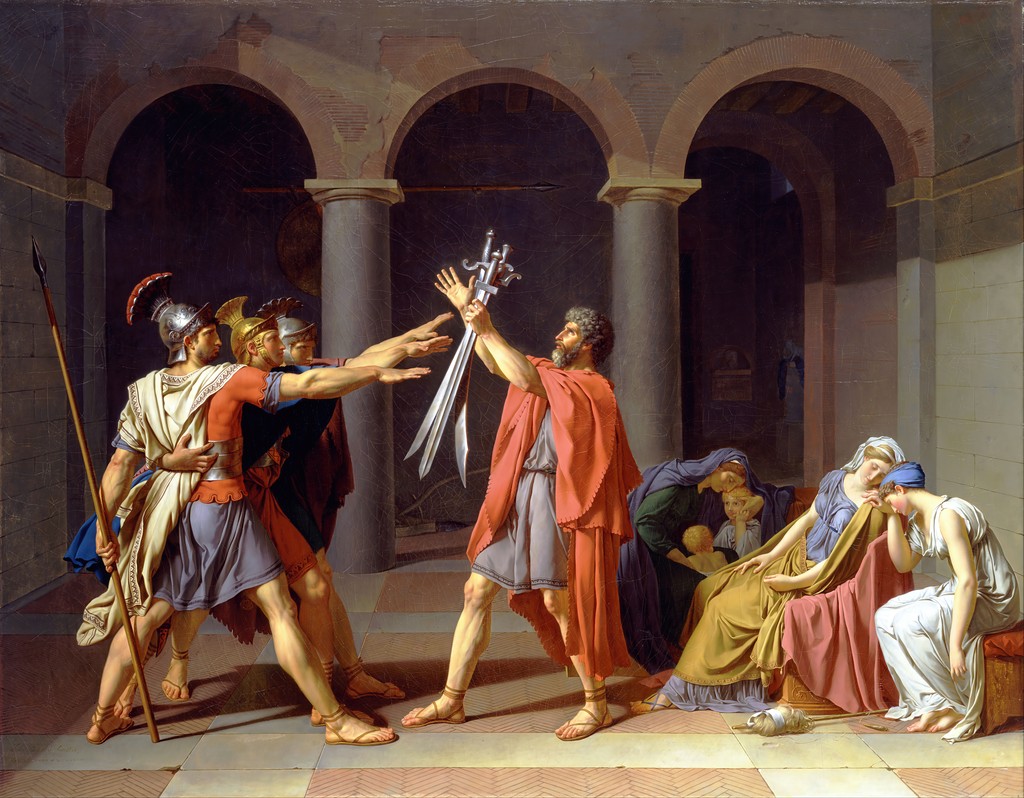
The painting sits apart from David's better-known public images of antiquity, Revolution and Napoleon. It does not have the civic architecture of The Oath of the Horatii or the staged philosophical calm of The Death of Socrates. Instead, it shows an elderly saint reacting to a supernatural call, surrounded by the signs of penitence, study and mortality. For a painter often associated with Roman virtue and political drama, this is a useful reminder that David's early formation also passed through religious subjects, anatomy and darker Roman models. [1] [2]
At a Glance
- ArtistJacques-Louis David [1] [2]
- Active TitleSaint Jerome Hears the Trumpet of the Last Judgement [1] [2]
- Quebec Record TitlePeinture (Saint Jerome) [1]
- Variant TitleSaint Jerome entendant les trompettes du Jugement dernier [1]
- Commons Title VariantSaint Jerome Hears the Trumpet of the Last Judgment / Saint-Jerome [2]
- Active URL/jacques-louis-david/saint-jerome-hears-the-trumpet-of-the-last-judgement/ [1]
- Date1779 production; 1781 exhibition; David inscription with Roma 1780 [1] [2]
- MediumOil on canvas [1] [2]
- Dimensions174 x 124 cm [1] [2]
- Place of ProductionRome [1]
- Heritage StatusClassified heritage object, Minister of Culture and Communications, 2019-04-11; effective 2018-04-26 [1]
- Custody NoteCommons notes Musee de la civilisation, Quebec, deposit from Fabrique Notre-Dame de Quebec, accession 1984.1 [2]
- Visual MotifsQuebec describes an elderly bearded Jerome, pen, book, inkstand, cross, skull, red and white textiles, dark rocky setting [1]
- Training ContextAcademy work demonstrating anatomy for the Royal Academy in Paris while David was in Rome [1]
- InfluenceCaravaggism, chiaroscuro, possible Jusepe de Ribera influence and emerging Neoclassicism [1]
- ProvenanceJohann Anton de Peters, Jean-Guillaume Moitte, Cardinal Joseph Fesch, Mailand collection, Cramail/Pinault family and Notre-Dame de Quebec [1]
- Modern DebateNational Gallery of Canada display from 1995 to 2013 and 2010s acquisition/export debate [3] [4]
- Image CautionCurrent page image retained; Commons public-domain helper is not the sole object authority [1] [2]
Contents
- Introduction
- Object Facts and Quebec Record
- David in Rome
- Saint Jerome and the Last Judgement
- Caravaggesque Darkness and Ribera
- Provenance and Canadian Heritage
- Image and Source Cautions
- Why the Painting Matters
Object Facts and Quebec Record
The strongest public record for the painting is the Repertoire du patrimoine culturel du Quebec, maintained by Quebec's Ministry of Culture and Communications. It classifies the work as movable heritage, an artwork and ethno-historical object, and records its formal heritage status from 2019. The same record gives the date of production as 1779, the exhibition date as 1781, the medium as oil on canvas, and the place of production as Rome. [1] [2]
The dimensions are large enough to make this more than a small devotional study. At 174 cm high, the figure of Jerome has physical presence. The Quebec record describes him as an elderly, bearded man with a pen in his hand, a book and inkstand nearby, his head and gaze turned upward behind him, and his arms raised and spread apart. A plain wooden cross, skull and book are placed near his feet, while the setting is dark and rocky. [1] [2]
Those details matter because the picture was not simply a religious illustration. The Quebec heritage record calls it an academy, meaning a work that demonstrated the artist's skill in handling the human body and that David was expected to send to the Royal Academy of Painting and Sculpture in Paris as evidence of his progress. The religious subject gave him a dramatic pretext for anatomy, expression, light and gesture. [1] [2]
David in Rome
David painted Saint Jerome during a decisive period in Rome. The Quebec record says he was there to perfect his training as a painter. This places the work before his great 1780s public successes and before the hard Neoclassical language that would make him famous across Europe. The page therefore belongs beside David's early and student-period works, not beside the later images of imperial power. [1]
The painting's Rome inscription is especially helpful. It ties the object to the city where David was studying ancient art, Italian painting and the discipline expected of a young French artist supported by the academic system. The work does not yet look like the cold, lucid David of the mid-1780s. It is more dramatic, more shadowed and more physically agitated. [1]
That is why the painting connects naturally to David's early development in the Jacques-Louis David biography and the wider Jacques-Louis David paintings group. It helps readers see that David did not arrive at Neoclassicism in a single leap. He moved through older religious models, Italian study, anatomical exercise and experiments in light before settling into the civic severity of his mature works. [1]
Saint Jerome and the Last Judgement
Saint Jerome was one of the great scholar-saints of Christian tradition, closely associated with scripture, translation, penitence and withdrawal from worldly life. In art he is often shown with books, writing tools, a skull, a cross and the rough setting of retreat. David uses that familiar vocabulary, but he gives it a heightened moment: Jerome is not quietly writing; he has been interrupted by the imagined trumpet of the Last Judgement. [1]
The painting's emotional force depends on this interruption. Jerome's body is twisted upward, his arms opened as if startled by a sound from beyond the visible world. The pen and book still identify him as a scholar, but the pose makes scholarship suddenly inadequate before divine judgement. The skull at his feet compresses the theme: human study, repentance and mortality all meet in the same image. [1]
The red and white drapery also supports the subject. The Quebec record notes the red and white textiles covering only part of the saint's body. In the older iconographic tradition, red can recall Jerome's status as a church father and, in later imagery, his association with cardinal-like dress. David does not turn the costume into ceremonial splendour. The drapery is rough, physical and partly displaced, so the saint's body remains the main field of expression. [1]
Caravaggesque Darkness and Ribera
The Quebec heritage record is careful about artistic influence. It says the work is strongly marked by Caravaggism during David's Roman stay, especially through chiaroscuro and the realistic treatment of the hands and face. It also notes that the influence may have come through paintings and prints by Jusepe de Ribera, whose images of Saint Jerome offered close comparisons in posture, clothing, rocky setting, skull and writing implements. [1]
This gives the painting a useful place in David's development. The work is not yet the purified antique world of The Death of Socrates. It belongs to a darker, more bodily language, where holiness is expressed through age, strain, flesh and sudden light. The torso, arms, beard and hands are treated as instruments of intensity. Jerome is not idealized into calm; he is made vivid through shock. [1]
At the same time, the Quebec record sees the beginning of a more idealizing movement inspired by antiquity. That tension is one of the painting's best qualities. It looks backward to Caravaggio and Ribera, but it also points forward to David's emerging Neoclassical authority. The work is transitional without being confused. [1]
Provenance and Canadian Heritage
The painting's later history is unusually important. The Quebec record says the first known owner was Johann Anton de Peters, who may have acquired it around 1782. It later passed through several owners, including Cardinal Joseph Fesch, Napoleon Bonaparte's uncle and one of the major collectors of the early nineteenth century. After further transfers, part of the Mailand collection crossed the Atlantic at the end of the nineteenth century and came into the orbit of Quebec. [1] [3] [4]
The work eventually became connected with Notre-Dame de Quebec. After the cathedral-basilica fire of December 1922, the building and its decoration were reconstructed, and David's Saint Jerome was donated between 1922 and 1938 so that the church could again be ornamented with major European paintings. The record later notes loans and display history, including the National Gallery of Canada and the Montreal Museum of Fine Arts. [1] [3] [4]
Its Canadian story became especially visible in the 2010s, when questions about possible sale, acquisition and export brought the painting into public debate. The Quebec heritage classification in 2019 now frames the work as a protected cultural object. That status does not change the painting's eighteenth-century meaning, but it changes its modern public life. Saint Jerome has become both an early David painting and a Quebec heritage object. [1] [3] [4]
Image and Source Cautions
The page keeps the current page image while the source note marks image evidence as amber. Commons supplies a public-domain file and useful custody metadata, but the Quebec heritage record remains the authority for object facts, provenance and heritage status. Any later image-refresh or annotated-image work should verify the retained file against the Quebec and Commons records, confirm resolution and credit language, and keep the Judgement/Judgment title variants visible without changing the active route. [1] [2] [3] [4]
Why the Painting Matters
Saint Jerome Hears the Trumpet of the Last Judgement matters because it shows a young David before the formulas of his fame had hardened. The painting is religious, anatomical, shadowed and emotionally abrupt. It has little in common with the polished public authority of The Coronation of Napoleon, yet it helps explain how David learned to make a body carry moral pressure. [1] [2]
The work also broadens the David cluster beyond politics. His career cannot be understood only through Revolution, Empire and antique exempla. This canvas shows a painter studying Rome, looking at earlier masters, testing the expressive power of the body and using religious iconography as a vehicle for artistic discipline. [1] [2]
For readers moving through the early David pages, Saint Jerome is best seen beside The Death of Seneca and the other academy-period works. It is not a major public manifesto, but it is a valuable early painting with unusually rich later provenance. Its importance lies in the meeting of youthful training, religious drama and a modern Canadian heritage story. [1] [2]
Frequently Asked Questions
Discussion
Saint Jerome Hears the Trumpet of the Last Judgement shows David working through religious drama, anatomy and Roman shadow before his mature public style.
Use the prompts below to think about title variants, early training and the painting's Canadian heritage afterlife.
Reader Insights
How does the figure of Jerome turn religious subject matter into an academy exercise in anatomy and expression?
Where do Caravaggism and possible Ribera models remain visible before David's more severe Neoclassicism?
How does the Quebec classification change the modern public life of an early David painting?
Join the Conversation
Share your reading of Saint Jerome Hears the Trumpet of the Last Judgement below.
References
- Repertoire du patrimoine culturel du Quebec, Peinture Saint Jerome, accessed 27 July 2026.
- Wikimedia Commons file, Saint-Jerome par David, accessed 27 July 2026.
- Canadian Art, What to Know About the National Gallery's Latest Chagall-David Move, accessed 27 July 2026.
- ARTSFILE, Gallery reveals painting to be purchased by Chagall sale is David's Saint Jerome, accessed 27 July 2026.