


 Buy Art Prints Now
from Amazon
* As an Amazon Associate, and partner with Google Adsense and Ezoic, I earn from qualifying purchases.
 by Tom Gurney
Tom Gurney BSc (Hons) is an art history expert with over 20 years experience
Page Created on June 19, 2020 / Page Updated on November 1, 2026
Email: tomgurney1@gmail.com / Phone: +44 7429 011000
Gabriel: the announcing angel on the Ghent Altarpiece
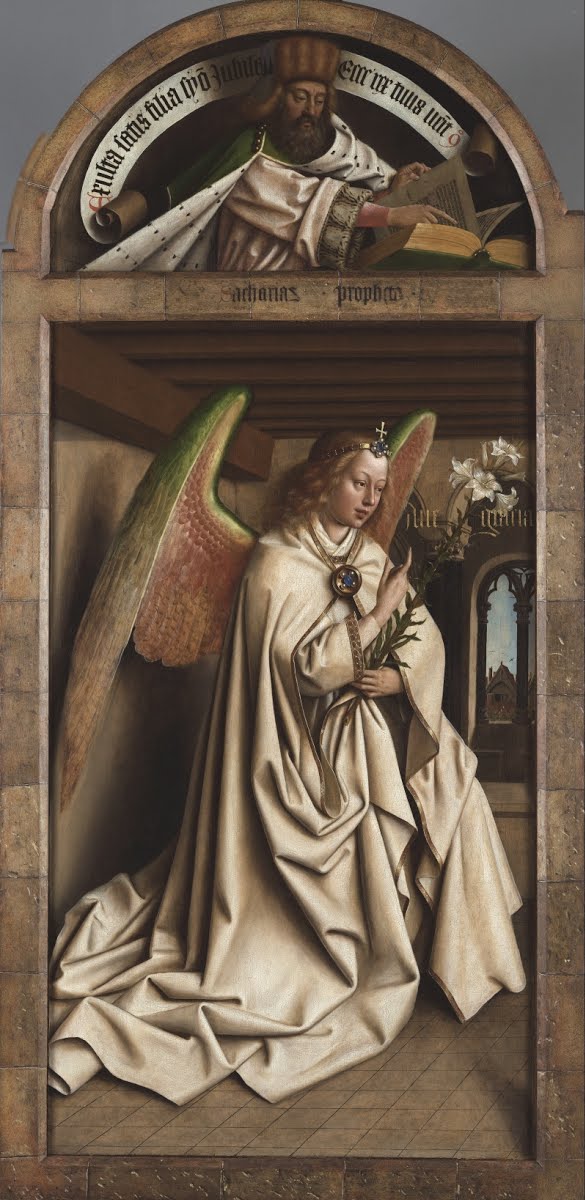
Gabriel kneels at the left of the Ghent Altarpiece’s closed Annunciation, lifting one hand as he addresses Mary across the room. His other hand holds a flowering lily. Saint Bavo’s Cathedral identifies the flower with Mary’s virginity and the angel’s message with the coming birth of the Son of God. The figure is the announcing messenger; he is not one of the musicians gathered around the enthroned figures in the opened painting.[1]
The title Angel Annunciate isolates Gabriel’s part in a larger exchange. The Virgin Annunciate occupies the opposite broad section, beyond two narrow passages of architecture. The washing alcove belongs to that intervening room. Here the focus is the speaker: the hands that deliver his greeting, the flower identifying his mission, and the face, feathers and folds whose appearance has been clarified through conservation.
At a Glance
Details from Gabriel: the announcing angel on the Ghent Altarpiece
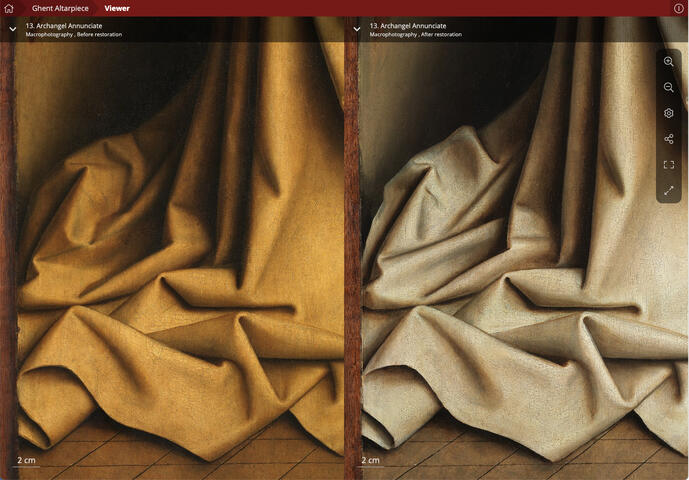
Compare the robe: before and after treatment
Left: before restoration. Right: after restoration. Published by conservator Kathleen Froyen (2025). View publication. © Visit Gent; source viewer KIK-IRPA / Closer to Van Eyck. Unmodified publisher comparison.
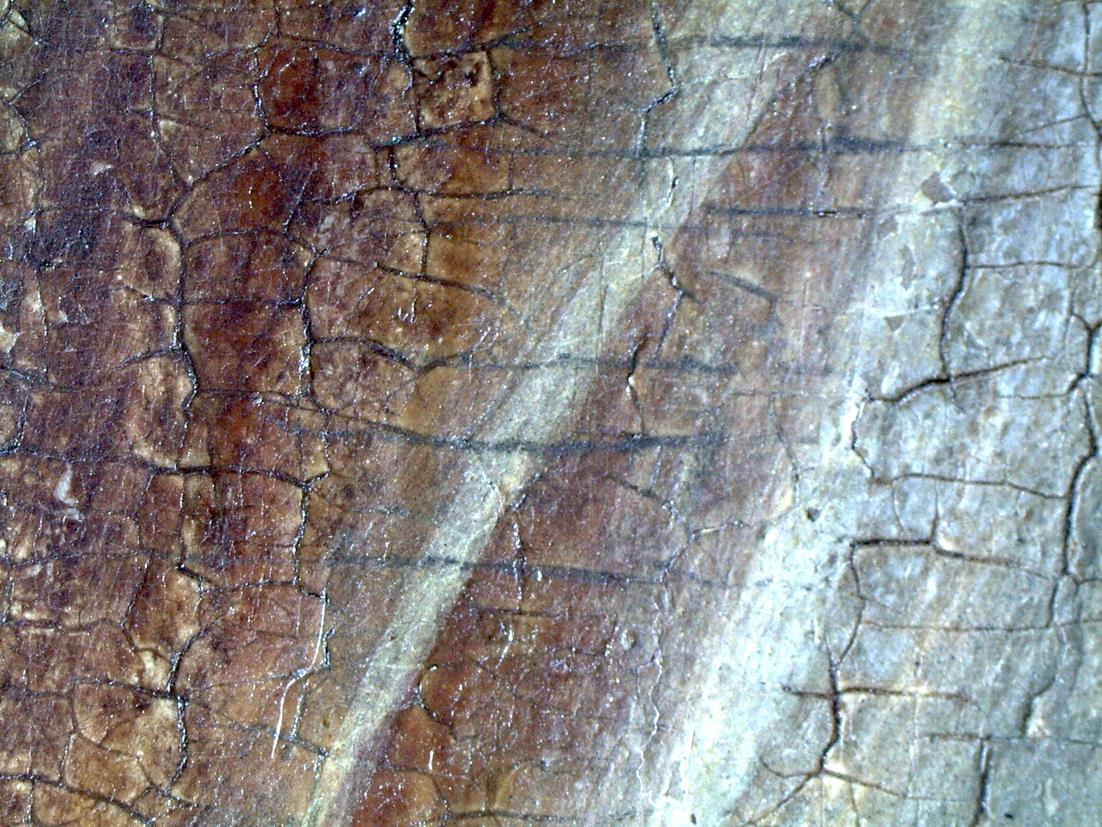
Examine the wing: added lines under magnification
Wing microphotograph: added yellow, white and pencil lines. KIK-IRPA treatment report, p. 53. View publication. © KIK-IRPA. Complete publisher image; treatment documentation, not a final-state photograph.
A figure that turns towards a listener
In the restored colour view, Gabriel’s body inclines towards the right. His head follows the same direction, with the mouth slightly parted and the eyes turned towards the person outside his own compartment. The gesture does not depend on a dramatic stride. A bent knee, tilted head and raised hand are enough to give the figure a direction. The room continues beyond him, but his attention has already crossed its divisions.
The lifted hand is held before the upper body, its long fingers separated. Below it, the other hand steadies the lily stem against the gathering cloth. The two actions remain distinct: one addresses, the other carries. The blossoms rise towards the level of the face and greeting, while the leaves mark a darker vertical line against the pale garment. Gabriel’s hands, flower and words draw attention to a relatively small area above the enormous sweep of his mantle.
The head is surrounded by loose, curling hair. A jewelled circlet crosses the forehead, with a tiny cross rising above its central ornament. Another conspicuous jewel fastens the clothing at the chest. Small points of brilliance interrupt the otherwise restrained tones of face and fabric. The wings behind introduce a more extensive field of colour, with their tall, tapering forms lifting the eye towards the ceiling.
The announcement in Luke
Luke 1:26–38 identifies Gabriel as the angel sent to Mary in Nazareth. He greets her, reassures her and announces that she will conceive and name her son Jesus. The passage then describes his future kingship and Mary’s question, followed by the explanation concerning the Holy Spirit. The painted greeting selects a moment within this longer conversation. It does not attempt to display every sentence that the Gospel gives the messenger.[2]
This distinction matters for the lily and wings. Luke identifies the angel and his mission but does not inventory a flower, feather colours or this particular costume. Those belong to the pictorial presentation of the encounter. The narrative provides the announcement; the painting gives its speaker a bodily presence and recognisable attributes. There is no need to treat every visible detail as though it were prescribed by the Gospel.[2]
Clothing, jewels and written speech
W. H. James Weale’s 1912 description identifies a white alb beneath a voluminous mantle secured by a circular clasp, or morse. He also records the lily, raised right hand and jewelled circlet. His account distinguishes the clothing’s different parts rather than reducing everything to a single white robe. The terms connect Gabriel’s appearance with ceremonial dress, without establishing that a surviving garment can be named as the painter’s actual model.[3]
Weale observes that the greeting is written in the air instead of on a scroll. His transcription gives the familiar Latin opening, Ave, gracia plena, Dns tecum, with abbreviated words. The lettering is therefore represented speech, situated near the messenger’s mouth. It is different from the names written on architectural frames. The words do something within the episode: they make the act of address visible.[3]
Lukas–Art in Flanders’s object record dates this Gabriel image to 1432 and describes his message concerning Mary’s motherhood and the Holy Spirit. Its published colour view includes the prophet above the angel as well as the room below. This complete shutter helps establish scale: Gabriel fills much of the lower compartment, while Zechariah belongs to a distinct upper space. Their proximity is part of the altarpiece’s arrangement, rather than a meeting staged inside Mary’s room.[4]
Wings and the shadow behind them
The French guide to the MSK’s 2020 exhibition singles out the shadow cast by Gabriel’s wing on the wall. It describes light arriving from the right and continuing across the exterior. The shadow makes the wing appear to occupy space in front of the masonry rather than being a coloured pattern attached to it. This is an especially useful detail because it links a supernatural attribute with an ordinary optical effect: a body obstructing light.[5]
Watch: Jan van Eyck in context
Choose a Smarthistory close reading of the Arnolfini Portrait or the closed and opened Ghent Altarpiece.
Van Eyck, Ghent Altarpiece (1 of 2)
Explore the Annunciation, donors and painted sculpture on the closed altarpiece.
Watch on YouTubeThe feathers themselves are organised in overlapping ranks. The outer contour is long and relatively continuous, but the interior is divided into smaller rounded and tapering shapes. Green borders, pinkish passages and warmer lower feathers produce a change of colour along the wing. These differences can be followed in the published image without assigning the feathers to a particular species. The painting’s angelic wings need not be a literal specimen of one bird.
The tallest wing approaches the ceiling, while the mantle spreads across the floor. Together they stretch the figure through much of the available height. Between those extremes, the face and hands remain comparatively delicate. This disparity helps explain Gabriel’s presence: he is both an intimate speaker and an expansive, winged figure whose clothing and feathers exceed the dimensions of an ordinary seated person.
Why the robe looked different
Conservator Kathleen Froyen uses Gabriel’s robe as a specific example of sixteenth-century repainting. Her 2025 account explains that later painters generally followed the composition but simplified and softened folds according to their own preferences. The uncovered earlier handling has sharper contrasts and more strongly defined turns. The paired photograph reproduced here shows this distinction in the cloth pooled near the floor: colour has changed, but so has the structure through which the fabric suggests weight and volume.[6]
Following one fold across the published pair is more informative than describing the result simply as a brighter painting. On the right, pale ridges meet darker hollows more abruptly, and the cloth divides into more angular planes. The larger fabric shape remains recognisable in both views, yet its internal organisation changes. The comparison makes visible how an intervention can preserve a subject and much of its outline while altering the way its forms are understood.
The face, sleeve and feathers under examination
The Dutch treatment report distinguishes several interventions on Gabriel’s flesh. Opaque retouches affected places including the forehead, nose bridge and fingers; a more translucent greyish layer obscured parts of the cheeks, neck and temple. The condition of the face was therefore not explained by discoloured varnish alone. Paint added over different areas had also changed its modelling.[7]
The same report records a yellow-green layer over the upper wing, additional blue-grey lines in its middle and dark repainting below. It describes subtler greens and finer feather details becoming visible during removal. It also identifies a small sleeve whose later purple-blue appearance concealed pale pink. These findings concern separate passages, each with its own history. They should not be compressed into a claim that every feather or every part of the garment underwent identical treatment.[7]
The 2020 scientific volume adds another qualification: intervention was avoided on Gabriel’s left sleeve where evidence remained insufficient. A revealed earlier layer in one area does not justify removing a questionable layer elsewhere. The volume also identifies abundant soda-ash glass powder in a later overpaint sampled from the wings. That is evidence about a particular added layer, not a claim that all the angel’s original colour was made with the same mixture.[8]
What the scientific images could—and could not—show
Marie Postec and her co-authors explain in their French and Dutch study why the pale Annunciation draperies posed a difficult problem. Earlier and later paint could both contain lead white, limiting the ability of an elemental map to distinguish them. They describe repeated comparison between physical observation, stratigraphic samples and highly magnified digital images. A suspected difference in handling was a reason to investigate, not sufficient proof for removal.[9]
The study credits imaging technology developed through Antwerp and Delft, but also insists on the conservator’s trained examination. This is a useful corrective to the idea that one scan simply reveals the authentic picture. Different methods answer different questions: an elemental distribution can identify materials across a surface, while a sample helps establish their sequence and a microscope permits examination of paint at a particular crack or loss.[9]
The University of Antwerp’s project account explains why ordinary radiographs and infrared images had failed to expose the full scale of exterior repainting. Later paint often respected both the composition and the earlier crack pattern. The team combined large-area chemical imaging with analysis of paint cross-sections to investigate the hidden surface. Its published examples include the donor panels; those examples should not be relabelled as maps of Gabriel’s face or sleeve.[10]
A changed design and a divided shutter
The 2020 conservation volume also records a revision to the position of a window column in Gabriel’s compartment. A line was scored into still-wet paint, allowing the composition to be adjusted after painting had begun. The surrounding room was worked out through successive decisions. It was not necessarily transferred to the panel in every final detail from a single unaltered design.[8]
The angel’s shutter was originally painted on both sides, with the singing angels on its other face. Unlike the still-double-sided Adam and Eve units, it was divided through its thickness in Berlin in 1894. This material history helps explain why photographs of the isolated Gabriel scene cannot fully convey the original object: the room was once one face of a moving, double-sided wing.[8]
The messenger within the brothers’ work
Leen Huet’s Dutch account treats Gabriel’s golden greeting as the beginning of the humanity-saving event represented by the Annunciation. She distinguishes the domestic Ghent setting from Van Eyck’s separate, church-interior Annunciation associated with Dijon. The comparison is useful for identifying this figure correctly. A familiar angel, lily and greeting can appear in different paintings without making those paintings fragments of the same commission.[11]
The cathedral attributes the beginning and completion of the altarpiece to Hubert and Jan respectively, while acknowledging that their precise contributions remain unresolved. The 1432 date belongs to the completed undertaking. Neither Gabriel’s conventional attributes nor the discovery of an earlier fold identifies the individual painter of every passage. The restored figure can be examined closely without forcing its face, feathers and clothing into an unsupported division between the brothers.[12]
A final look can begin with the open mouth and lifted hand, move to the flower and chest clasp, and then follow the wings and mantle outwards. The small details locate the speaking figure; the larger shapes establish his weight and reach. Returning to the greeting brings those observations together. Gabriel’s painted presence gives a voice a body at the moment it is directed towards Mary.
Related reading


Discussion
What do you notice in Gabriel: the announcing angel on the Ghent Altarpiece? Share a close observation or a source that adds useful context.
Join the Conversation
Keep observations specific and evidence clear.
References
- Saint Bavo’s Cathedral, English panel guide, Gabriel’s greeting and lily. View Source
- United States Conference of Catholic Bishops, Luke 1:26–38. View Source
- W. H. James Weale, The Van Eycks and Their Art, 1912, pp. 50–51. View Source
- Lukas–Art in Flanders, The Ghent Altarpiece: Archangel Gabriel, object record and published colour image. View Source
- MSK Ghent, Van Eyck: Une Révolution optique, French visitor guide, 2020, p. 33. View Source
- Kathleen Froyen, The conservation in three details, Visit Gent, 19 September 2025, Gabriel’s robe and published comparison. View Source
- KIK-IRPA, Behandelingsverslag Lam Gods, Fase 1: 2012–2016, pp. 51–55, face, wings, drapery and sleeve. View Source
- Bart Fransen and Cyriel Stroo, editors, The Ghent Altarpiece: Research and Conservation of the Exterior, KIK-IRPA, 2020, pp. 48, 92, 138 and 218–219. View Source
- Marie Postec and co-authors, Découvertes spectaculaires sur l’Agneau mystique des frères Van Eyck: le rôle essentiel du restaurateur, 2016, bilingual French/Dutch study, pp. 161–165. View Source
- University of Antwerp, Phase I: The Ghent Altarpiece: finding Van Eyck, MA-XRF and cross-section research. View Source
- Leen Huet, Van Eyck: De optische revolutie, Openbaar Kunstbezit Vlaanderen, 2020, p. 25. View Source
- Saint Bavo’s Cathedral, The Ghent Altarpiece, frame attribution, 1432 installation and division of hands. View Source


 Jan van Eyck.jpg)
 Jan van Eyck.jpg)


