


 Buy Art Prints Now
from Amazon
* As an Amazon Associate, and partner with Google Adsense and Ezoic, I earn from qualifying purchases.
 by Tom Gurney
Tom Gurney BSc (Hons) is an art history expert with over 20 years experience
Page Created on June 19, 2020 / Page Updated on November 1, 2026
Email: tomgurney1@gmail.com / Phone: +44 7429 011000
The Man with the Pinks: a portrait transformed after Jan van Eyck
An old man looks out beneath an enormous fur hat, holding small flowers beside a silver-coloured cross and bell. The Man with the Pinks has the presence of a memorable individual, but the painting in Berlin is by an unknown artist copying Jan van Eyck, rather than a surviving portrait painted by Jan himself. The Gemäldegalerie's current record dates it to about 1520: its visible surfaces belong to a later generation.[1]
The distinction opens up the picture's most interesting questions. How much of the likeness comes from the lost model? Why were its hands and flowers arranged this way? Could the collar identify its wearer? Scholars have offered different answers, sometimes proposing quite different men. The painting brings us unusually close to a face while leaving its biography unresolved.
At a Glance
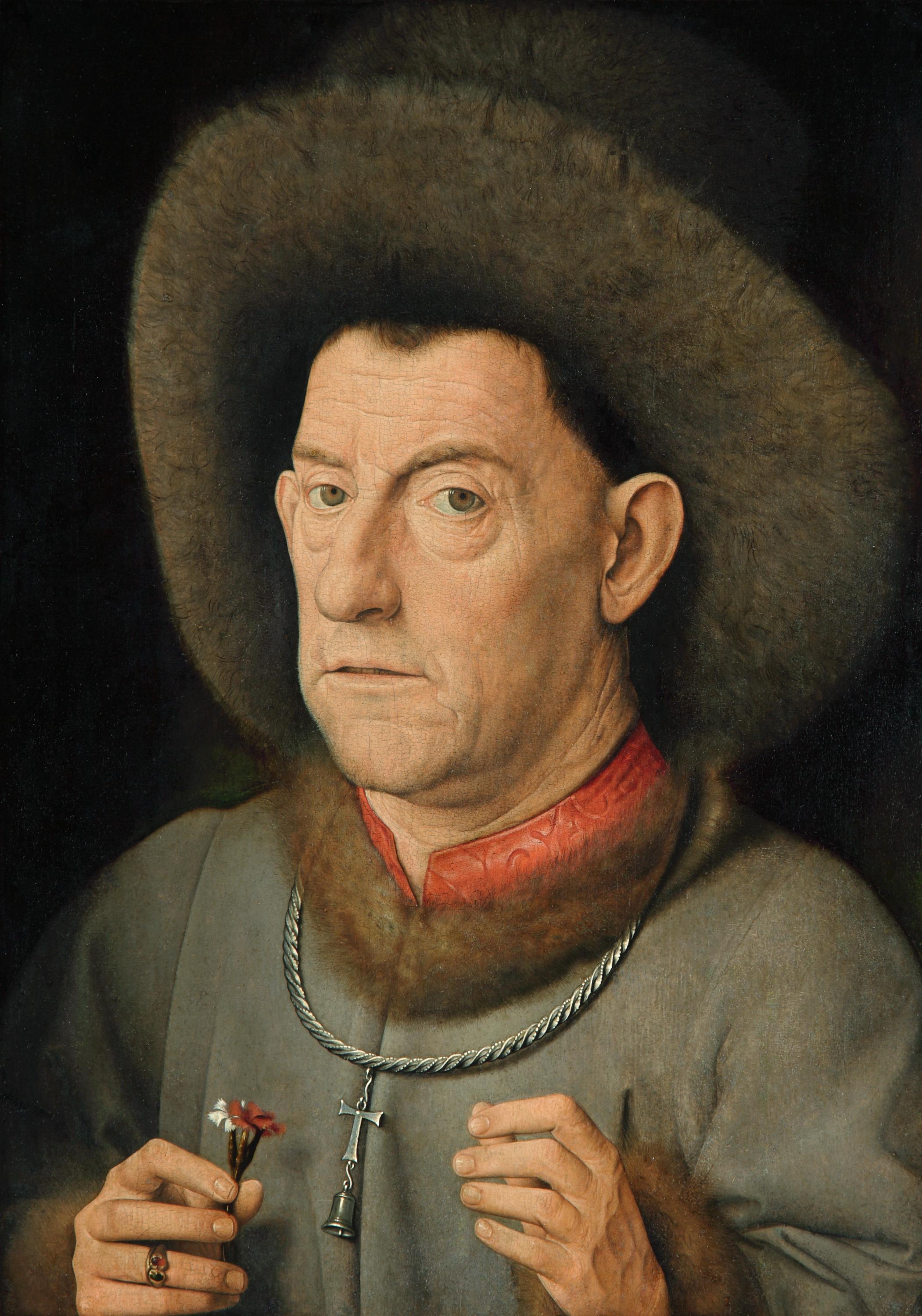
Looking closely: face, fur, flowers and hands
The hat occupies almost the full width above the head. Its broad oval rim surrounds the cropped dark hair like a second outline, making the narrow, brightly illuminated face seem more exposed. Small changes in brown describe the hat's soft surface; below it, the fur at the neck forms a continuous curved band. The two areas of fur enclose the flesh without distracting from the eyes.
Those eyes are not identical. One appears rounder and more open, while the other sits within a deeper fold. The mouth is slightly parted, with its corners descending into pronounced lines. Fine horizontal wrinkles cross the forehead, and the creases beneath the eyes are carried down towards the cheeks. These are visible decisions in the surviving painting, rather than clues from which we can diagnose the man's temperament or health.
A bright red patterned collar interrupts the otherwise restricted clothing colours. Across the grey garment, the twisted chain catches little streaks of white light. Follow it down to the horizontal bar of the tau-shaped cross and the small bell suspended below. These objects are placed between the two hands, making the lower half of the portrait as carefully organised as the head.
At our left, the flower stems pass between finger and thumb, with a ring visible farther down the hand. At our right, the other hand is raised, its fingers separated and bent. The flowers are tiny beside the oversized hat, yet their red and white accents compete with the red at the throat. A viewer's attention can move from eyes to bouquet to collar and back again without needing an elaborate setting.
The museum records oak, a picture measurement of 44.4 × 32.1 centimetres, and inventory 525A. Its German title, Der Mann mit den Nelken, supplies the flowers translated as “pinks” in English. This is not a reference to a pink background or garment.[1]
A likeness becomes an old lover
Berlin's 2023 exhibition, Zoom auf van Eyck, called the work a variation after a lost painting. Its interpretation is specific: a later painter put a small bouquet into an elderly man's portrait, turning it into a genre image of the comic old lover. The familiar association between flowers and love supplies the joke. This account concerns the adaptation's meaning; it does not recover an actual courtship involving Jan's sitter.[2]
The implication is that likeness and character type can coexist. A face inherited from an older portrait may remain strikingly particular, even when an accessory encourages viewers to treat its owner as a figure in a humorous situation. “Copy” therefore describes a relationship to a model without promising that every feature was repeated unchanged. The museum's word “variation” leaves room for invention.[2]
We should also distinguish flowers introduced when this version was made from flowers painted over a completed, older portrait at some later date. Berlin's explanation assigns the transformation to the copyist; it does not, by itself, establish a subsequent restoration campaign. Nor can an imaginary removal of the bouquet reveal Jan's original hand positions. The absent panel prevents that direct comparison.
The Saint Anthony collar and an unresolved identity
The pendant has prompted more than a general description of expensive jewellery. In his French-language study of the Hainaut Order of Saint Anthony, Alain Marchandisse examined the tau and bell alongside the order's rules and other representations. The contrast between plain silver for esquires and silver gilt for knights made the painted metal potentially significant. But he also warned that a later painter could misunderstand or disregard distinctions in an older ceremonial system.[5]
Marchandisse tested the identification with John of Bavaria, Jan's former employer at The Hague, rather than accepting it from the collar alone. Among the difficulties was the lack of resemblance to John's image in the Recueil d'Arras. He raised possibilities involving a marriage portrait and a companion panel, while leaving the problem open. His discussion shows why recognising an order is only the beginning of identifying its member.[5]
That distinction changes how we look at the jewellery. The cross and bell can be described precisely even when the person remains unnamed. A badge may connect someone with an institution shared by numerous members; it is not the equivalent of a written name. Its appearance in a later adaptation also means that its colour and form must be weighed alongside the copy's other changes.
Ludovic Nys, writing in Francia in 2008, proposed Adolf of Cleves, count Adolf II and the first duke of that name. He considered the man's apparent age, links between Cleves and the Burgundian world, Saint Anthony affiliations and comparative images. He also explored whether the lost portrait might originally have belonged to the order's display at Barbefosse. These are connected historical arguments, rather than a newly discovered inscription naming the sitter.[6]
Watch: Jan van Eyck in context
Choose a Smarthistory close reading of the Arnolfini Portrait or the closed and opened Ghent Altarpiece.
Jan van Eyck, The Arnolfini Portrait
Look closely at the room, mirror and gestures in the London double portrait.
Watch on YouTubeNys discussed an Arnhem account of 1437 recording wine offered to a “Johan van Eck” arriving from Flanders. It suggested a possible route for considering Jan's movements near Cleves, but did not document this portrait's commission. Even within the theory, the encounter between painter and proposed sitter remains reconstructed. The surviving Berlin panel cannot supply the missing commission record.[6]
A further proposal came from Albert Châtelet in 2010: Jean II de Ligne, associated with Jacqueline of Bavaria. He compared the face with a tomb effigy and a figure in a Louvre drawing, connecting the flowers with a proposed marriage context around 1440. Châtelet also challenged Nys's Cleves identification, questioning the collar comparison and facial resemblance. His own attribution to Albert van Ouwater formed part of a broader reconstruction of that painter's career, rather than the current Berlin catalogue position.[7]
The disagreement is useful because it exposes what each solution requires. John of Bavaria, Adolf of Cleves and Jean de Ligne lead towards different dates, patrons and original functions. A resemblance judged convincing by one scholar may appear insufficient to another. None of these names has replaced the anonymous title in Berlin's current record.[1]
Why the attribution changed
An older catalogue captures the instability particularly well. W. H. James Weale and Maurice Brockwell's 1912 book records the panel's sale from Philip Engels's collection at Cologne on 16 May 1867, when it was described as a duke of Burgundy by Hubert van Eyck. Barthold Suermondt bought it, and it subsequently entered Berlin. Their entry also preserves Claude Phillips's objection that its modelling differed from Jan's other portraits, before concluding that it was probably by Hubert.[4]
Thus some early discussion moved between the two brothers instead of recognising a later copy. The same book describes a covered parapet beneath the hands and traces of a related face in an Adoration of the Magi. Those observations belong to the work's research history; they do not establish that its present hand arrangement exactly repeats an original Van Eyck composition. Historical catalogues must be read as dated arguments, especially when their maker attribution has changed.[4]
Gemäldegalerie curator Stephan Kemperdick revisited the painting in a 2016 paper published by the Netherlands-based curators' network CODART. He noted the confidence with which Waagen recognised Jan's hand in 1855, followed by doubts around 1900 and Friedländer's defence of the picture as an early work. Minute detail could be praised as realistic or criticised as laborious, depending on the viewer's expectations.[3]
Material study provided another kind of comparison. Kemperdick discusses Alan Burroughs's 1938 X-ray analysis, in which substantial lead white shaped the Berlin face very differently from Jan's securely associated portraiture, including Canon van der Paele. He also reports dendrochronological evidence for a painting made around 1500 or later. Together these arguments distinguish the maker of the physical panel from the older composition thought to lie behind it.[3]
Châtelet's alternative deserves a qualification of its own. He reported a latest identified tree ring of 1459, discussed an earliest possible execution in 1468, and raised the possibility that replacement edge strips might complicate the examination. The strip explanation was a conditional suggestion, not a demonstrated correction of the analysis. His resulting earlier chronology differs from Berlin's current approximate 1520 date.[7]
There is no need to force these published dates into a single supposedly exact year. A tree ring dates growth in the wood examined; the proposed painting date additionally depends on which wood was studied and its preparation and use. Here the responsible description follows the owning museum for the surviving object's attribution and approximate date, while acknowledging the history of competing explanations.
How a French engraving carried the image abroad
The portrait's fame also owes something to an artist separated from Van Eyck by more than four centuries. Ferdinand Gaillard reproduced it as an engraving published in the Gazette des beaux-arts in 1869. In a study available through Paris's Sorbonne research centre, Stephen Bann explains that Gaillard's unusually pale treatment of the face provoked resistance: Émile Galichon defended the plate against Charles Blanc, who wanted to reject it. Reproduction involved aesthetic choices of its own.[8]
Bann's illustration retains the printed identification with Suermondt's gallery. The image was therefore circulating in this form before the painting's Berlin acquisition. The engraving helped create a portable version of the encounter with the man: readers could study the hat, stare and raised hands through black lines and paper instead of coloured paint. Its own disputed reception adds another chapter to the changing valuation of the portrait.[8]
US collections preserve different impressions. The National Gallery of Art, Washington, records its engraving as Gaillard after Jan van Eyck, accession 1946.9.59, a gift of Addie Burr Clark, and identifies it as the fifth of six states in Beraldi's catalogue. That “after” field describes the print's model tradition; it is not a new authentication of the Berlin oil painting.[9]
The Cleveland Museum of Art dates its Man with a Pink to 1869 and catalogues its impression as state VI/VI, accession 1939.587, a gift of Robert Hays Gries. Buffalo AKG also holds an impression, given by Willis O. Chapin in 1891. Its record distinguishes the roughly fifteen-centimetre image from the substantially larger sheet. These are separate collected objects, not evidence for additional painted originals.[10][11]
A reproduction can preserve both an appearance and an old attribution. That is why the names printed beneath an engraving need to be read alongside its date and purpose. Gaillard's work belongs to the portrait's nineteenth-century reception, while the anonymous oak panel belongs to a much earlier act of adaptation.
Reading this work within Van Eyck's portraits
Comparison with the portrait of Jan de Leeuw is especially revealing at the level of the hands: an object held up for notice can guide the whole encounter with a sitter. In The Man with the Pinks, however, the very elements that organise that encounter are among those whose relationship to the lost model remains debated. The picture's force does not dissolve when Jan's authorship of the surviving paint is rejected. Instead, its unnamed maker becomes visible as someone capable of redirecting an inherited likeness.
Look again at the small bouquet between the fingers and the great arc of fur above the forehead. One accessory supplies a possible story of desire; the other gives the head its extraordinary visual weight. Between them, an anonymous face has sustained arguments about courtly identity, institutional membership, artistic authorship and humour. Keeping those arguments distinct allows the surviving work to retain its complexity without turning any proposed sitter into a fact.
Related reading


Discussion
What do you notice in The Man with the Pinks: a portrait transformed after Jan van Eyck? Share a close observation or a source that adds useful context.
Join the Conversation
Keep observations specific and evidence clear.
References
- Staatliche Museen zu Berlin, Gemäldegalerie, Der Mann mit den Nelken, inventory 525A, current object record: maker, date, dimensions, acquisition and titles. View Source
- Staatliche Museen zu Berlin, Zoom auf van Eyck, 2023 exhibition checklist, PDF p. 4: copy as variation and old-lover interpretation. View Source
- Stephan Kemperdick, “Connoisseurship: Authority of Experts and Authority of Science,” CODART NEGENTIEN, 2016, pp. 2–3: attribution history, Burroughs and dendrochronology. View Source
- W. H. James Weale and Maurice W. Brockwell, The Van Eycks and Their Art, 1912, pp. 80–82: provenance, historical descriptions and attribution debate. View Source
- Alain Marchandisse, “L'ordre de Saint-Antoine en Hainaut et l'Homme à l'œillet de la Gemäldegalerie de Berlin,” 2001, particularly pp. 124–131: rules, collar and unresolved sitter questions. View Source
- Ludovic Nys, “Jean Van Eyck et Clèves,” Francia 35, 2008, particularly pp. 73–77, 82–94: copying, Barbefosse, Adolf of Cleves and the Arnhem account. View Source
- Albert Châtelet, “Early Dutch Painting: Thirty Years On,” Oud Holland 123, 2010, pp. 316–317 and notes 15–17: Jean de Ligne, alternative attribution, dating and reservations. View Source
- Stephen Bann, “Autour de la revue L'Art: René Ménard et son rapport à la gravure,” in L'amateur d'estampes, pp. 314–315: Gaillard's 1869 engraving and its reception. View Source
- National Gallery of Art, Washington, Ferdinand Gaillard, The Man with the Pink, 1946.9.59: medium, gift and state. View Source
- Cleveland Museum of Art, Claude-Ferdinand Gaillard, Man with a Pink, 1869, 1939.587: gift and state VI/VI. View Source
- Buffalo AKG Art Museum, L'Homme à l'œillet, P1891:4.90: impression, dimensions and Chapin gift. View Source
 Jan van Eyck.jpg)
 Jan van Eyck.jpg)


