 Buy Art Prints Now
from Amazon
* As an Amazon Associate, and partner with Google Adsense and Ezoic, I earn from qualifying purchases.
 by Tom Gurney
Tom Gurney BSc (Hons) is an art history expert with over 20 years experience
Page Created on June 19, 2020 / Page Updated on November 1, 2026
Email: tomgurney1@gmail.com / Phone: +44 7429 011000
Portrait of Baudouin de Lannoy
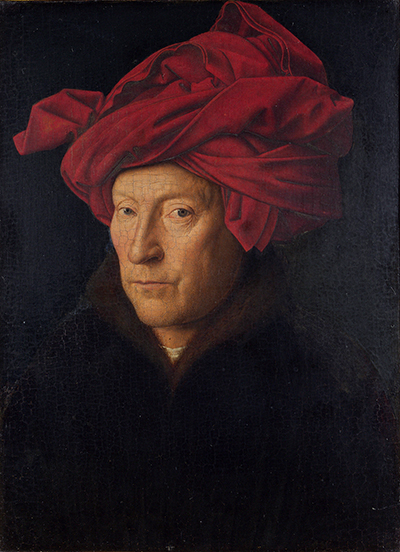
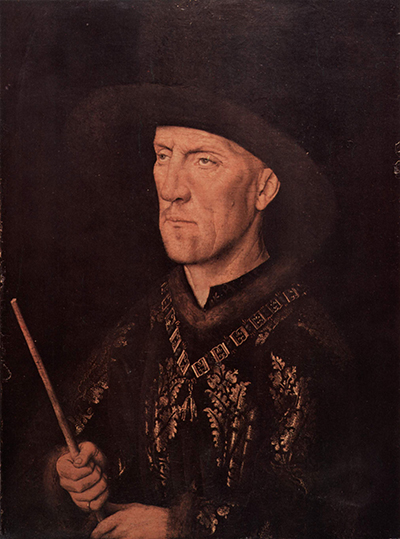
An enormous fur hat spreads above a narrow, brightly lit face. Below it, a collar of gold crosses a purple robe patterned with shining foliage, while a plain wooden staff rises from the sitter's hand. Baudouin de Lannoy presents himself through strikingly different materials: soft fur, precious cloth, worked metal and unfinished-looking wood. Jan van Eyck gives these distinctions extraordinary clarity without allowing the finery to eclipse the particular face beneath the hat.
The small oak panel belongs to the Gemäldegalerie in Berlin, inventory 525G, and measures 26.6 by 19.5 centimetres. Its current catalogue gives 1430–40, while the museum's conservation project favours about 1438–40. The portrait is generally placed towards the end of the 1430s, but no surviving date settles the year. Its original frame is lost. The name by which we know the sitter survives through a different object: a later labelled drawing.[1][2]
At a Glance

Reading the head and hands
Lannoy's gaze passes to the side rather than stopping at the viewer. His head turns, but the narrow slit of the mouth remains almost level. The broad nose and comparatively small eyes give the face a distinctive structure. Above them, the hat exaggerates the head's silhouette: its brim reaches far beyond the cheek and ear, while the crown rises into the dark upper field.
That disparity in scale is part of the portrait's visual force. The hat first registers as a large dark shape; close inspection breaks it into strands, irregular edges and changes of tone. The face behaves differently. Its pale light is interrupted by creases, small marks and shadows that turn the cheek and jaw. The painting permits both a quick recognition of an imposing figure and a slower examination of individual surfaces.
The hands introduce another contrast. One closes around the staff, while the other extends across the lower edge. A small ring adds a bright accent close to the grasping fingers. Neither hand is simply a second face: they divide the lower field into curved knuckles, a long pale diagonal and the broad sweep of a cuff. The richly patterned sleeves frame the gesture without explaining it.
Look from the fingertips towards the shoulder and the gold ornament changes with the cloth. Bright leaves spread across some areas and narrow or disappear as the robe turns. The decoration does not sit on an independent flat plane. Its interruptions help describe a body within the fabric. Meanwhile the collar follows another route, crossing the brocade with a more regular sequence of separate links. Luxury emerges through differences in handling, rather than through one uniform application of gold colour.
How a French drawing preserves his identity
The Recueil d'Arras, preserved in the Médiathèque de l'Abbaye Saint-Vaast at Arras, contains the drawing that identifies the sitter. The French manuscript catalogue dates the album to around 1560 and describes an assemblage of historical portraits copied from earlier images. Its paper leaves belong to a different age from Van Eyck's oak panel.[4]
The Lannoy likeness appears on folio 109. Its label names him as Baudouin de Lannoy, called Le Bègue, lord of Molembais. Christina Currie's study of the family's later imagery cites this drawing as the basis for identifying the Berlin portrait. The name is thus supported by a historical copy associated with a recognisable image, rather than by an inscription still attached to the painting.[6]
That distinction changes what the evidence can tell us. The copy connects a face with a name; it does not preserve a contract explaining the portrait's purpose. Nor does it establish that the original panel always bore the same words. A later image can transmit reliable information without becoming a substitute for the lost frame or a complete account of the first commission.
The survival of both objects is particularly valuable. The panel supplies colour, surface and Van Eyck's handling of the likeness; the drawing preserves a written identification. Each makes the other more informative. The painting can also help us judge what a copyist retained when translating a small, richly worked portrait into a drawing intended for an album of historical figures.
A knight of the Golden Fleece
The collar identifies a public distinction, independently of the later name label. Baudouin was among the founding knights of the Order of the Golden Fleece, instituted by Duke Philip the Good in 1430. André A. Moerman's Dutch-language study of Burgundian knightly portraits describes the collar's sequence of firesteels and flints, with a suspended ram's fleece. These are the order's particular devices, not an unspecified chain worn to display wealth.[8]
On this panel the collar crosses a patterned robe rather than plain black clothing. Its repeated hard shapes remain distinct against the much larger golden leaves. The pendent fleece is small beside the spreading costume, yet its position near the centre makes it a focal point. The order supplies a shared identity; the face supplies the individual who holds that honour.
A different kind of witness survives in the Rijksmuseum: an anonymous 1700–49 print of the armorial boards associated with the order's 1456 chapter at The Hague. The collection identifies Baudouin among its subjects. This is a later paper record of heraldic display, not another likeness of his face. It helps show how a knight's membership could be preserved through a coat of arms as well as a portrait.[12]
These two kinds of representation need different reading habits. The collar and heraldic board connect someone to an institution; the uneven colouring, nose, mouth and eyes make a person recognisable. Van Eyck holds the institutional and individual claims together. The honour is clear without requiring the sitter to become a smooth, ideal type of nobility.
Lannoy and Van Eyck in a diplomatic household
Berlin identifies Lannoy as lord of Molembais, governor of Lille from 1423, and a counsellor and chamberlain to Philip the Good.[1] His presence in the Burgundian delegation to Portugal in 1428–29 provides a documented connection with Van Eyck. The painter accompanied the mission and made the now-lost portrait of Isabella of Portugal for the duke.[11]
Barbara von Barghahn's study of the mission notes that Lannoy, Van Eyck and Andrieu de Toulongeon received equivalent travel allowances. Such evidence places the painter within an important diplomatic entourage. It does not mean that all its members held the same office, or that the surviving portrait was painted during the journey.[10]
Family connections extended that courtly world. Stephan Kemperdick records Lannoy's 1433 marriage to Adrienne de Berlaimont, whose father Jacques also served Philip the Good as a counsellor. Kemperdick uses the relationship to trace possible connections between the painter and the Berlaimont family. It establishes a social network, rather than a document commissioning this picture as a wedding portrait.[11]
The distinction between acquaintance and occasion matters here. Lannoy and Van Eyck could know each other through travel and employment long before this likeness was made. A shared expedition explains an opportunity for contact; it does not supply the exact date of the painting. The named courtier and the court painter belonged to overlapping circles, but the first recipient and intended location of this small panel remain unknown.
What the purple and gold robe reveals
The robe can be considered more precisely than the general word brocade suggests. Von Barghahn, drawing on textile historian Lisa Monnas, distinguishes Lannoy's silk velvet from the more elaborate velvet represented on Chancellor Rolin in the Louvre. Lannoy's cloth has one height of velvet pile with gold-brocaded plant forms; Rolin's has two pile heights and additional metallic effects. The larger pattern repeat on Rolin's textile also implies greater expense.[10]
Watch: Jan van Eyck in context
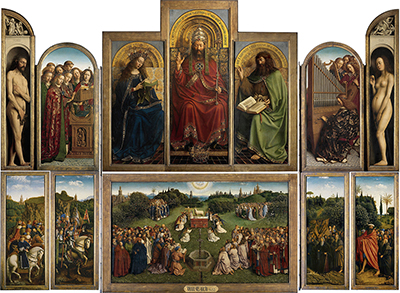
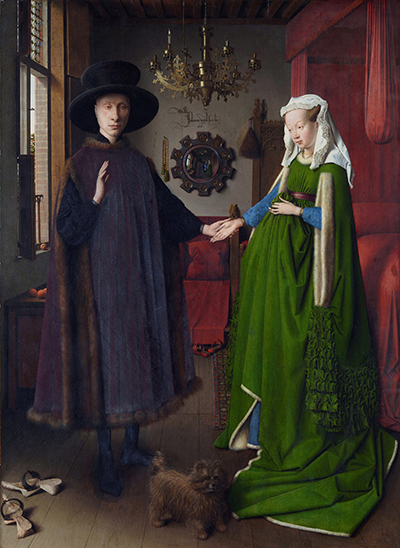
Choose a Smarthistory close reading of the Arnolfini Portrait or the closed and opened Ghent Altarpiece.
Jan van Eyck, The Arnolfini Portrait
Look closely at the room, mirror and gestures in the London double portrait.
Watch on YouTubeThis comparison does not turn Lannoy's robe into an inexpensive garment. It differentiates forms of costly cloth that a casual viewer might group together. It also makes the painter's observation of pattern, pile and metallic thread more consequential. What looks like a decorative flourish may help distinguish one textile structure from another.
An archival payment suggests a possible connection with clothing supplied by the duke. Weale's historical catalogue cites a 1428 account in Lille's Archives départementales du Nord, B 1938, folio 208, for twelve ells of violet-crimson cloth of gold given to Lannoy in 1427. The entry names the Lucchese merchant Karlos Gilles and a price of 179 livres and eight shillings. Weale proposed that the portrait might show this gift. The account documents a costly allocation of fabric; identifying it with the painted robe remains his suggestion.[5]
The distinction can be tested by looking without pretending that colour alone identifies a particular bolt of cloth. The gold design occupies large areas, but dark purple continues between the motifs and changes where the fabric folds. Bright touches describe the edges of leaves differently from the metal links resting above them. The collar and brocade both evoke gold, yet they demand different marks because one is solid jewellery and the other a woven surface.
Seen close to the painting's actual scale, the amount of information is remarkable. A leaf need not be large to appear edged with glints. A fold need not be deeply shadowed to interrupt a pattern. The robe is simultaneously an assertion of rank and a difficult pictorial problem: costly cloth has to retain its decorative repeat while yielding to the shape and movement of clothing.
The unresolved wooden staff
The staff is much less easily interpreted than the collar. Berlin's English catalogue associates it with the sitter's position as chamberlain. The German text on the same record explicitly questions that explanation: the roughly smoothed wood resembles a peeled branch rather than a formal staff of office. It offers a pilgrim's or messenger's staff as alternatives, leaving the matter open.[1]
The disagreement is useful because the image itself is unusually specific. The staff is pale, comparatively plain and held prominently. Its diagonal cuts through dark clothing and leads down into the grip. A viewer has no difficulty locating it, yet recognising its exact social meaning is another matter.
If the object refers to office, it reinforces the collar's public message. If it concerns pilgrimage or a messenger's task, it opens a different part of the sitter's identity. No surviving label on the painting chooses between those readings. Nor does Lannoy's journey to Portugal make the staff a documented souvenir of that mission. The historical journey and the visible implement can be discussed together without treating their connection as established.
There is also a compositional reason to keep looking at the wood. Its simple shaft gives the hand something definite to grasp and adds a long, clear direction among the curving leaves and linked collar. Its pictorial role remains legible even while its original significance is uncertain.
Oak, a painted reverse and workshop connections
The portrait was conceived as a physical object with more than a painted front. Berlin's conservators record remnants of stone-imitating decoration on the back and confirm that its original attached frame is gone. The surviving reverse therefore preserves evidence of a finish intended to make wood resemble another material.[2]
Technical research also connects the support with other Eyckian paintings. Lorne Campbell's National Gallery catalogue records that the Berlin Arnolfini portrait, Lannoy's portrait and the Philadelphia Saint Francis were painted on panels from the same tree. The reference is to the separate Berlin likeness traditionally associated with Arnolfini, not the London double portrait. That distinction matters when comparing workshop materials.[9]
The KIK-IRPA study of Netherlandish frames likewise discusses this group of supports in relation to a possible common supplier. Shared wood provides evidence about materials circulating through production; it does not demonstrate that the pictures were conceived as a set or painted at the same sitting. Different subjects and destinations could be served from the same stock.[14]
The panel, traces of reverse decoration and missing frame consequently answer different questions. The wood relates the portrait to a workshop's practical resources. The reverse indicates attention to the object's other face. The absent surround marks a loss in our understanding of its original presentation. None supplies the missing name of a first owner, but together they prevent the portrait from being treated as a disembodied image.
A restoration that changed what viewers could see
Berlin's June 2019–January 2020 conservation project was supported by the Museum of Fine Arts in Ghent for its Van Eyck exhibition. Examination found at least five non-original varnish layers and interventions from at least three restoration campaigns. The background contained numerous small losses and extensive overpaint, whereas the figure survived much more intact. Conservators worked under magnification with solvents and gels to reduce the later layers.[2]
The completed treatment recovered colour relationships that had been obscured. The museum's February 2020 report describes blue glints in the red-violet velvet and a range of yellow, orange and ochre tones within the golden ornament. It distinguishes the reddish fur trimming from the hat's longer hair. Removing black background overpaint also recovered fine hairs along the hat's outline.[3]
A particularly revealing discovery was an original painted scar on the brow, concealed by later retouching. Creases beside the eyes, a cheek wart and reddened patches also became easier to appreciate. The conservators retained a thin older coating, retouched small losses and applied a protective varnish. Their account describes selective treatment, rather than an entirely untouched surface emerging from beneath everything added later.[3]
The scar's recovery affects how we see the sitter without explaining how he acquired it. It cannot securely be assigned to battle, travel or any named episode. Its significance for the portrait is that Van Eyck included a mark which a later intervention hid. Conservation restored that intended particularity, while leaving its biographical cause unknown.
The same applies to the recovered hairs. Their presence changes the hat's relationship with the background: an apparently solid silhouette becomes a softer, more irregular boundary. Cleaning thus affects both small details and the larger reading of volume. The treatment's importance lies in those linked changes, rather than in a simple claim that the colours became brighter.
A likeness reused after the sitter's lifetime
The portrait's afterlife includes more than named copies. In a study published by KIK-IRPA, Christina Currie identifies its likeness behind a figure at the right of an early sixteenth-century Lamentation of Christ. An inscription on an ointment vessel, read alongside the family's genealogy, led her to propose Philippe de Lannoy, Baudouin's grandson, as the patron. The ancestral portrait helps explain the figure's deliberately old-fashioned appearance.[6]
This is a different use from the Arras album. The later composition places a recognisable likeness within a new religious setting and changes the object held by the figure. Currie's proposed patron identification remains an interpretation of the inscription and family evidence; it does not document the first commission of Van Eyck's panel.
Rubens supplies another route of transmission. Berlin notes his later interest in the likeness, but Kristin Lohse Belkin's study of the Costume Book makes the relationship more precise. She identifies the relevant figure with folio 109 of the Recueil d'Arras and proposes that Rubens probably worked through Antoon de Succa's transferred tracings. The drawing need not demonstrate that Rubens stood before the original painting.[7]
Belkin's explanation changes the emphasis from a famous artist admiring an isolated masterpiece to a working chain of visual sources. A painted courtier becomes a historical drawing, then material for another artist interested in earlier dress. The huge hat and recognisable head could remain useful even when removed from Van Eyck's colour, finish and original purpose.
From Modena to Berlin
Weale records the panel in the Coccapane collection at Modena, its unsuccessful offer to London's National Gallery, and its subsequent purchase by the dealers P. and D. Colnaghi, who sold it to Berlin in 1902. This historical account provides named stages in the painting's collecting history, without bridging the entire interval from fifteenth-century Bruges.[5]
The current Berlin object record also gives a 1902 purchase from the English art trade. A 2023 exhibition work list, however, states 1901 from Oskar Huldschinsky, Berlin. These published statements do not agree. The latter should not silently replace the current record, nor should an undocumented sequence be invented to reconcile them.[1][13]
The discrepancy concerns collection documentation, not whether the face is Lannoy's. His identification rests on the later labelled witness, while attribution and condition involve other evidence. The Belgian BALaT catalogue adds a historical photograph and a 2014 scientific-imaging file; the file reference records the existence of research documentation, not a published explanation of new findings.[15]
The portrait ultimately holds together several forms of recognition. Its collar locates a courtier within an order; its cloth describes a costly material world; its face remains individual enough to travel through later drawings and paintings. Against that accumulation of information, the modest staff still resists a single explanation. The unresolved detail does not diminish the likeness. It keeps visible the difference between what Van Eyck painted with precision and what history has preserved well enough for us to name.
Related reading
 Jan van Eyck.jpg)
 Jan van Eyck.jpg)
Discussion
What do you notice in Portrait of Baudouin de Lannoy? Share a close observation or a source that adds useful context.
Join the Conversation
Keep observations specific and evidence clear.
References
- Staatliche Museen zu Berlin, Gemäldegalerie, Baudouin de Lannoy, 525G: current record and Stephan Kemperdick's German and English text in 200 Masterpieces of European Painting (2019). View Source
- Gemäldegalerie, “Jan van Eyck's Portrait of ‘Baudouin de Lannoy’,” conservation project, June 2019–January 2020; pre-treatment account, distinct from its later completion report. View Source
- Staatliche Museen zu Berlin, “Fully Restored in Ghent: Jan van Eyck's Portrait of Baudouin de Lannoy,” 3 February 2020, treatment findings and outcome. View Source
- IRHT, Initiale, Arras, Bibliothèque municipale, 266 (CGM 1136, inv. 1839), Recueil d'Arras, manuscript catalogue. View Source
- W. H. James Weale, The Van Eycks and Their Art (1912), pp. 148–150: historical provenance, Arras drawing and cited Lille cloth account; identification of the robe as the ducal gift is a proposal. View Source
- Christina Currie, “Une Déploration du Christ du premier quart du XVIe siècle et la famille des Lannoy-Molembaix,” Bulletin de l'IRPA 30 (2003, published 2004), pp. 173–190, especially pp. 183–185 and note 20; relevant original French and Dutch passages. View Source
- Kristin Lohse Belkin, The Costume Book, Corpus Rubenianum Ludwig Burchard XXIV (1978), p. 99, on the Arras sources and proposed de Succa intermediary. View Source
- André A. Moerman, “Portretten van gulden-vliesridders uit de bourgondische eeuw: enkele bekende en minder bekende,” West-Vlaanderen 11 (1962), especially pp. 304–307. View Source
- Lorne Campbell, The Fifteenth Century Netherlandish Paintings (National Gallery, 1998), Arnolfini entry, discussion of the Berlin portrait and note 119, citing Peter Klein's dendrochronological research. View Source
- Barbara von Barghahn, Jan van Eyck and Portugal's “Illustrious Generation”, vol. I (Pindar Press, 2013), pp. 49–50, especially textile discussion and note 4 citing Lisa Monnas. View Source
- Stephan Kemperdick, “Early Texts on Some Portraits by Jan van Eyck,” in Van Eyck Studies (Peeters, 2017), pp. 311–325, especially p. 314: Lannoy, Adrienne and the Berlaimont connection. View Source
- Rijksmuseum, Wapenborden van ridders van de Orde van het Gulden Vlies, RP-P-1921-1277, anonymous, 1700–49: later printed record of the 1456 Hague chapter's armorial boards. View Source
- Staatliche Museen zu Berlin, Zoom auf van Eyck, 2023 exhibition work list, p. 1; acquisition statement differs from the current collection record. View Source
- Hélène Verougstraete, Frames and Supports in 15th- and 16th-century Southern Netherlandish Painting (KIK-IRPA, 2015), pp. 242–251, especially p. 251 on the two Berlin portraits and Philadelphia Saint Francis. View Source
- KIK-IRPA, BALaT, Baudouin de Lannoy, object 40004065: historical photograph and scientific-imaging file 2014.12510, metadata. View Source
 Jan van Eyck.jpg)