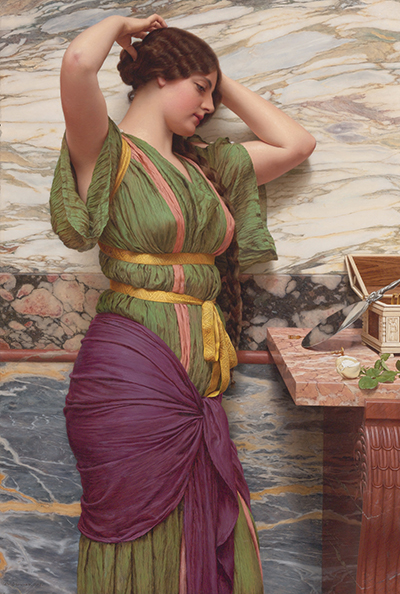
 by Tom Gurney
Tom Gurney BSc (Hons) is an art history expert with over 20 years experience
Published on June 19, 2020 / Updated on October 14, 2023
Email: tomgurney1@gmail.com / Phone: +44 7429 011000
John William Godward Prints: Introduction
John William Godward’s painted scenes reached readers and collectors through photogravures, magazine illustrations and colour plates. A collector could buy a large print on fine paper, while a magazine subscriber could come across the same scene in a bound issue, sometimes under a different name. The oil gives us the composition. A print’s margins, paper and publication details tell us how a particular version reached its audience.
At a Glance
- Works coveredPublished reproductions after paintings by Godward
- Processes discussedPhotogravure, photoengraving and colour lithography
- ExampleThe Tiff, Metropolitan Museum of Art
Contents
- The Tiff in London and New York
- From At the Fountain to The Water Carrier
- How the Berlin Photographic Company sold Godward
- Dealers, owners and the right to reproduce
- Campaspe and A Priestess
- Pears Annual and the colour presentation plate
- A Fair Reflection in an American trade catalogue
- Reading the margins of a Godward print
The Tiff in London and New York
The oil of The Tiff is only 25.5 by 30.7 centimetres. A woman seated on a tiger skin fills the foreground, while the man who has caught her attention is already on his way through the arch. Even at this scale the picture separates the two figures by placing one in full view and allowing the architecture to swallow up the other. The distance between them does much of the storytelling, as it does in Waiting for an Answer. Thomas McLean showed the oil as no. 22 in his London winter exhibition of 1888–89. It was sold at Christie’s in May 1894 as A Tiff. [1]
Christie’s records a photo-engraving by F. Hanfstaengl published by Henry Graves & Co. on 26 November 1894 and a New York photo-engraving issued by the British Art Publishers Union in 1896. The Metropolitan Museum of Art’s impression, 62.600.760, bears the catalogue date 1894 and the publisher credit Henry Graves & Co. The Met identifies it as a photogravure partially printed in colour on chine collé. Its image measures 24.3 by 29.7 centimetres, very close to the size of the canvas. The plate measures 34.4 by 37.5 centimetres. The image and plate measurements describe different parts of the object. The shared date and publisher align with the November 1894 issue in Christie’s account. The Met record supplies neither a view of the margins nor a Hanfstaengl credit for that individual impression, so the two records give different kinds of evidence. [1] [2]
In traditional photogravure, a photographic image is transferred to a prepared metal plate and etched. The plate holds ink below its surface, and under pressure the paper takes up that ink. The process handles gradual changes of tone, such as the passage from the bright foreground of The Tiff into the shadowed opening. Chine collé describes the paper structure. A thin sheet receives the image and is bonded to a heavier support. The Met’s description of partial colour concerns the printing of its particular impression. Christie’s also records appearances in the Cosmopolitan in 1896, as A Tiff, and in the April 1899 Pearson’s Magazine. Those issue references establish a further route for the composition. The auction record locates them at pp. 518 and 352 respectively. Their individual imprints and printing processes remain to be established. [1] [2] [3] [4]
From At the Fountain to The Water Carrier
Christie’s records that John Charles Tompkins, the purchaser of At the Fountain, agreed in May 1893 to allow a photogravure after the painting. The oil had appeared that year in the Royal Academy Summer Exhibition as no. 463. Its figure pauses with one hand at her necklace, a tall vessel beside her. The title the Academy audience knew places her in a setting. The title readers saw in the August 1898 Harmsworth Magazine, The Water Carrier, gives her a role. The image on p. 222 appears in a monthly gallery of paintings with a permission credit to the Berlin Photographic Company in London. Christie’s also identifies the composition as the frontispiece of the November 1894 Munsey’s Magazine, vol. 12. The Berlin permission line is visible on the Harmsworth page. [5] [6]
The Berlin company’s 1906 British trade catalogue gives At the Fountain a stock number, 2336, and describes a photogravure measuring 20¾ by 13¾ inches. It offered fifty artist’s proofs on Japan paper at four guineas each, fifty on India paper at three guineas, and India prints at one guinea. The graded offer shows how the same composition could be marketed to several kinds of customer. For a magazine illustration, the permission line acknowledges the company that supplied or licensed the image. For an individual sheet, the size, paper and any markings identifying the issue matter. [6] [7]
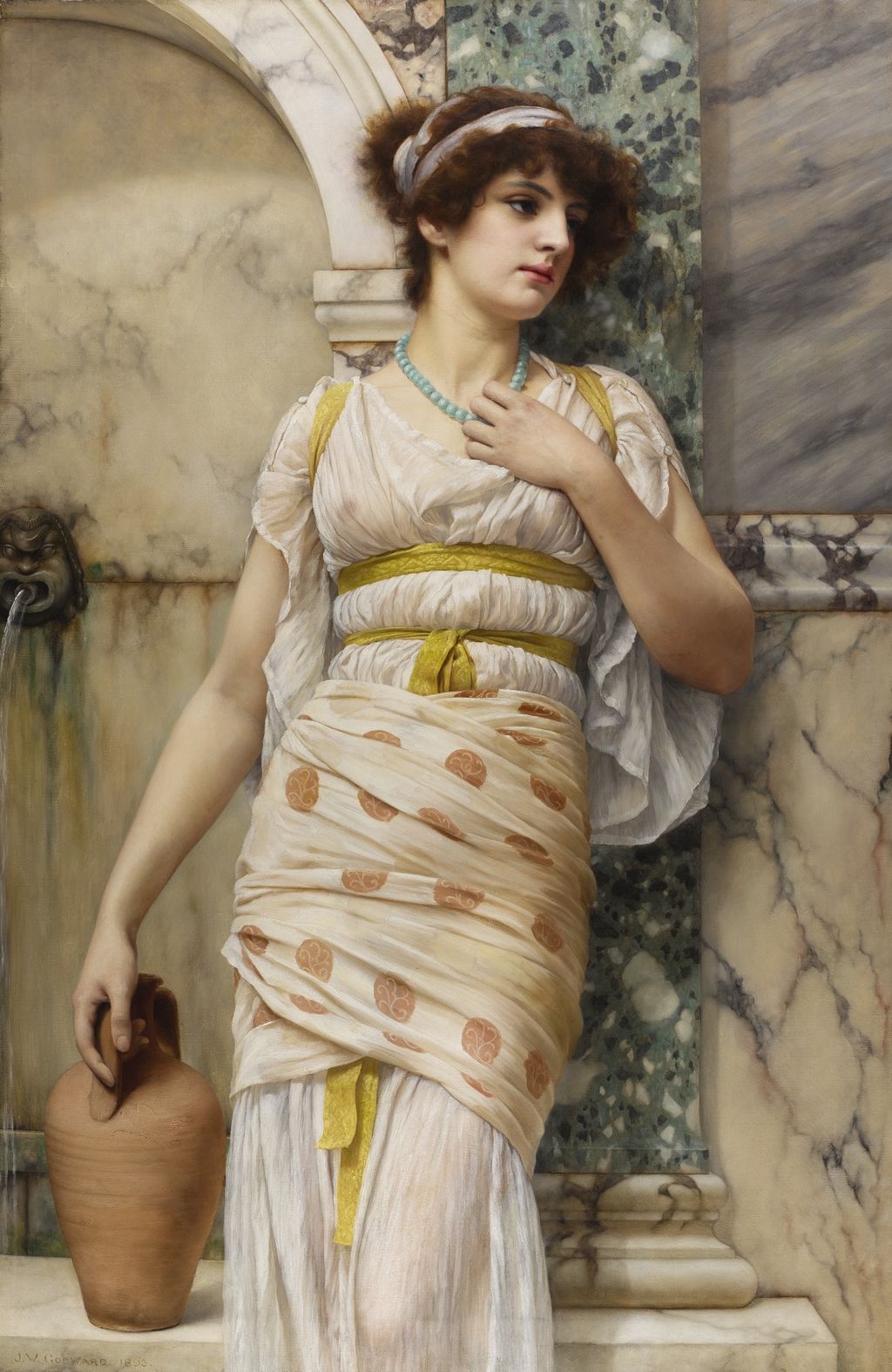
John William Godward, At the Fountain (1893). The painted composition circulated under the title The Water Carrier. Image source. Public domain.
How the Berlin Photographic Company sold Godward
The 1906 Catalogue of Select Publications gives addresses in London, Berlin, Paris and New York. On p. 74 it brings seven Godward subjects together. The entry for Yes or No? (no. 2358) says that all 150 artist’s proofs had sold and gives a separate price for India prints. It offers fifty proofs for Eighty and Eighteen (no. 2782), and one hundred each on Japan and India paper for The Bath of Venus (no. 4135). The Old, Old Story (no. 4483) has fifty proofs, while the smaller Heart on Her Lips and Soul Within Her Eyes (no. 4554) has two hundred. The entry for The Delphic Oracle (no. 2868) gives a stock number and format codes without specifying a proof run. The catalogue illustrations for Yes or No? and The Old, Old Story carry company copyright dates of 1894 and 1903 respectively. Those dates refer to the publisher’s images. [7]
The 1910 catalogue was issued in New York. Its title page gives the New York office at 305 Madison Avenue, the Berlin office at 1 Stechbahn and the London office at 133 New Bond Street. The foreword calls the catalogue a representative selection for dealers and private buyers. It offers advice on framing for homes and institutions and explains that most measurements omit the margin. The company describes transferring an image to a copper plate, then etching and printing it. It distinguishes ordinary print issues from early impressions of some subjects, marketed as artist’s proofs. It also describes a colour process that used a single impression and discusses carbon photographs, baryta prints and sepia prints. The catalogue offers hand-colouring on request for most of its products. For an individual Godward print, the description in the price list is the starting point. [8]
On p. 63 the illustrated entry for Yes or No? offers photogravures of 30 × 16 and 20¾ × 11⅜ inches. Bath of Venus is offered at 29½ × 10¼ and 21¼ × 7⅝ inches. For either picture, the larger print was $12, the smaller $6 and a photogravure folio $1.50. The foreword gives the usual folio sizes as 7 × 9 to 8 × 10 inches. Page 64 continues with The Old, Old Story in two sizes and as a folio, and with Heart on Her Lips and Soul Within Her Eyes as both a baryta print and a photogravure in folio format. These are offers for specific products. The proof terms of the 1906 catalogue should be applied only where an individual sheet can be matched to them. [7] [8]
The German provenance research for the Hessisches Landesmuseum Darmstadt provides an image of its 1893 Yes or No. The reach of the hands over the marble, the arch curving over the figures and the tiger skin below them all correspond to the catalogue illustration for no. 2358. The spelling and punctuation of the caption vary, but the composition ties the records together. For the second subject, the slender proportions and standing figure in Berlin’s illustration for Bath of Venus match Godward’s Venus at the Bath, dated 1901 in the Art Renewal Center catalogue. These comparisons identify the painted designs behind the two reproduced images. The stock numbers and paper details identify the products buyers could order. [7] [8] [9] [10]
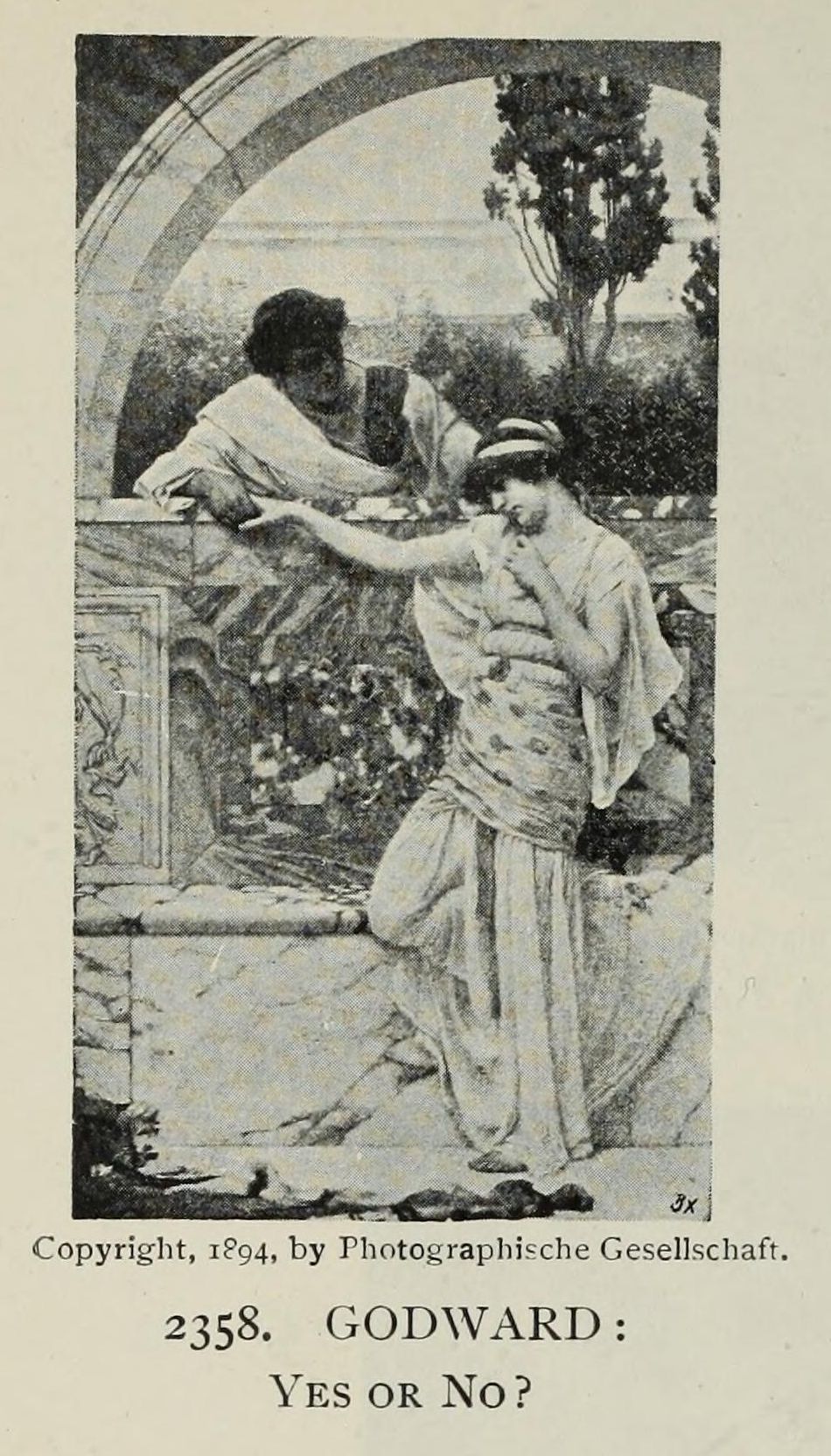
Yes or No?, Berlin Photographic Company catalogue (1906), no. 2358. The small illustration accompanies the numbered photogravure offering and carries the firm’s 1894 copyright line. Berlin Photographic Company, Catalogue of Select Publications, 1906. Image source. Public domain.
John William Godward videos
See Godward’s paintings and studio practice alongside films on two Victorian contemporaries.
John William Godward - Part 1: The Last Painter of the Victorian Age
An overview of Godward’s career and the Victorian market for pictures set in antiquity.
Watch on YouTubeDealers, owners and the right to reproduce
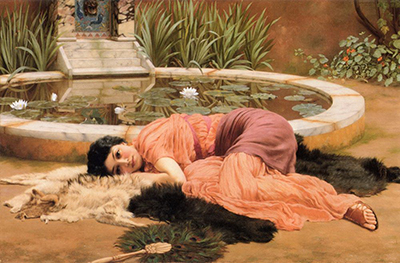
The different paintings called Dolce far niente show why the date and composition matter. In the oil Sotheby’s catalogues as signed and dated 1897, a reclining woman holds up a hand toward a small parrot. Sotheby’s traces the painting to McLean in June 1897. Vern Grosvenor Swanson records two communications from that June concerning publication. He gives a run of 150 proofs and 500 prints and reports that the buyer of the oil would receive half the profits from the publication. The transaction gave the owner a financial interest in the sale of copies even after the canvas had left the gallery. [11] [12]
The official catalogue of the 1900 Woman’s Exhibition at Earl’s Court lists Dolce far niente as no. 3154 in its section of coloured prints. The entry credits the picture to Godward, names Thomas McLean as lender and marks the sheet as available for sale. That record precedes the 1904 fishpond painting and fits the 1897 arrangement. The exhibition entry gives only the title, medium category and lender, so it leaves the precise printmaking process and class of impression open. In 1905, The Connoisseur reported that the oil from the Russell-Cotes collection sold at Christie’s for 155 guineas. Taken together, the dated oil, Swanson’s account of the correspondence and the exhibition listing show the painting and its reproduction circulating through related but separately documented transactions. [11] [12] [13] [14]
In 1908 Eugène Cremetti sent Godward £25 for the copyright of Crytilla. Swanson quotes Cremetti’s letter and reports both a large black-and-white print and a small colour illustration. The letter documents the payment for the image rights. Swanson’s separate account supplies the evidence for the two reproductions, without supplying the complete imprint or physical particulars of either. For the artist and the dealers discussed in the biography, a sale could therefore involve the canvas, the right to publish its image, or the finished printed sheets. [15]
Campaspe and A Priestess
The oil of Campaspe stood 230 centimetres high and was shown at the Royal Academy in 1896 as no. 521. Sotheby’s records the painting with McLean by 1896 and with Arthur Tooth & Sons by 1898. It also lists a reproduction in The Magazine of Art in 1896. The French Guillaumot-Richard auction catalogue records a 61 by 32 centimetre print embossed with the Arthur Tooth & Sons name and bearing an inscription crediting a Sanders-Clark owner of the original. The catalogue describes the object as a gravure, a broad term for a print. Eastbourne Auctions separately records a roughly 60 by 30 centimetre Campaspe with a Printsellers’ Association mark and a pencil signature. The embossing and the pencil mark are evidence about individual sheets. The exact process and issue date still require evidence from those sheets or the publisher’s records. [16] [17] [18]
A further clue comes from a painted object rather than an impression. Humrich Fine Art catalogues a small clothed A Priestess oil on panel (31.2 by 16.1 centimetres), dated 1895, as the source for an engraving made by W. Biscombe Gardner in 1896 for Cadbury, Jones & Co. The Academy’s 1897 exhibition catalogue lists Gardner’s A priestess, after J. W. Godward, no. 1719 in the Black and White Room. The two records tell us different things about the print’s life. The dealer associates its manufacture with a small painted panel and a named publisher. The Academy records its public showing. An impression with a legible imprint would help determine the exact publisher and how the composition relates to that panel and the other painted versions of A Priestess. [19] [20]
Pears Annual and the colour presentation plate
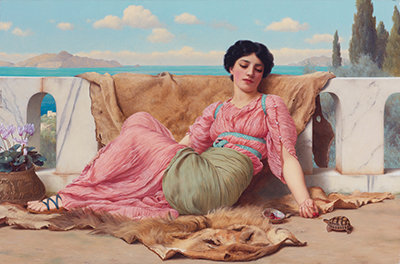
Maas Gallery’s catalogue of Godward’s dated 1903 oil sketch for Amaryllis records a chromolithograph of the finished composition in the 1906 Pears Annual. The annual’s description, quoted by the gallery, picks out a peacock-feather fan, tiger skin and poppies. A surviving copy of the plate and the publisher’s illustrated advertisement identify the scene as Il Dolce Far Niente (Sweet Idleness). The fan behind the bowed head, the striped pelt spread across the bench with the tiger’s head below the woman’s feet, and the bent knees all match the layout of the dated sketch. This use of Dolce far niente belongs to the Amaryllis composition. Sotheby’s separately reports a print sold by Pears and McLean after the signed 1906 Dolce far niente, a long terrace scene with the figure stretched out against a sea view. [21] [22] [23]
An advertisement in the New Zealand Graphic of 8 December 1906 calls the presentation plate Sweet Idleness and promises sixteen colours. In chromolithography, colours are built up using separate printing stones or plates. Pears made the number of colours part of the sales pitch, alongside the three pictures that accompanied the Christmas stories. [24] [25]
A decade later Pears offered Reverie. The source was In the Prime of the Summertime, an oil signed and dated 1914. Christie’s records the oil at the McLean Gallery with Cremetti in 1915 and identifies the 1916 reproduction as Pears Prints chromolithograph no. 13. A period advertisement shows the same broad composition as the oil, with the woman leaning back on a curved marble bench with a peacock fan raised beside her head, the sea beyond and pink flowers at the left in the painted version. The Highland News of 25 November 1916 confirms that Reverie was one of three presentation plates offered with the annual for a shilling. The newspaper likened it to the school of Lawrence Alma-Tadema, a useful glimpse of the names by which contemporary readers understood this kind of classical scene. [26] [27] [28]
The Getty’s Reverie, also known as In the Days of Sappho, is a separate oil signed and dated 1904. Its figure sits upright, with a sculpted bust near the left edge, in a more compact composition. The 1916 plate takes its long horizontal design and raised fan from the 1914 canvas. A title search for Reverie can bring both pictures up together. The year, the figure’s position and the shape of the picture resolve the ambiguity more quickly than the title. [26] [29]
A Fair Reflection in an American trade catalogue
Godward’s images continued to appear in print catalogues after his death in 1922. The 1923 Taber-Prang catalogue from Springfield, Massachusetts, shows A Fair Reflection as artotype no. 3860. The company illustrated it as a sepia product with a plate size of 13½ by 26 inches. The section places it among the larger artotypes and sends the reader to the previous page for prices. Artotype was a name for a process in the collotype family, in which the image is printed from a light-sensitive gelatin surface. [30] [31]
The little catalogue image is large enough to identify the composition. A woman in profile holds a mirror away from her face as her other arm arches over her head. A large round feature behind her fills one corner and patterned stonework lines the wall below. Those details match the 1899 A Fair Reflection illustrated in reverse by Michael Allan Kodysz. His illustration of The Mirror, also dated 1899, shows a woman facing forward, with a different arrangement of arms and stonework. Godward’s signed A Fair Reflection of 1915 has another pose and different drapery. The trade catalogue dates the offer to 1923 and its image identifies the earlier design. The first issue date of Taber-Prang’s artotype remains open. [30] [32] [33]
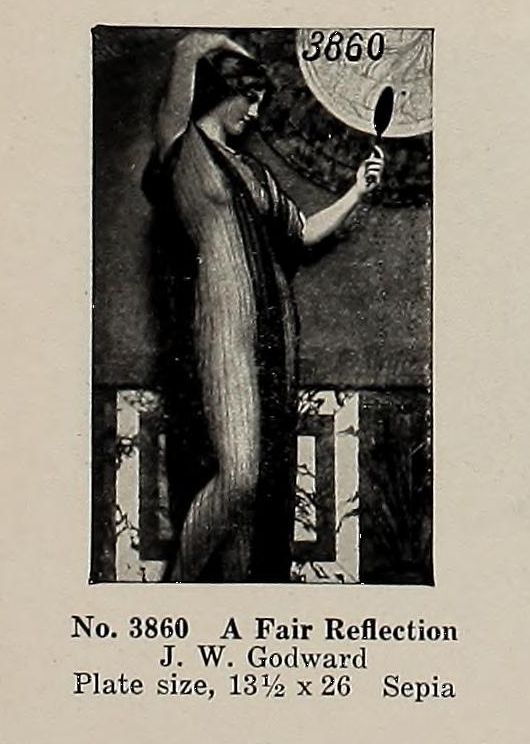
A Fair Reflection, Taber-Prang Art Company catalogue (1923), no. 3860. The Taber-Prang page puts Godward’s 1899 subject alongside other designs offered as inexpensive artotypes. Taber-Prang Art Company, Illustrated Catalog of Pictures, 1923. Image source. Public domain.
Reading the margins of a Godward print
Start with the entire image, then look at the paper beyond it. A publisher’s name, a copyright line, a plate or stock number, and a mark pressed into the paper can all lead back to a dated catalogue. Record the image, plate and sheet sizes separately where the edges can be seen. The Met’s The Tiff gives both image and plate dimensions, while the 1910 Berlin catalogue generally gives sizes without margins. If part of a sheet is covered by a mount or has been cut away, a missing mark can be inconclusive. The Getty’s conservation atlas also cautions that a plate mark alone is an unreliable way to identify photogravure. [2] [3] [8]
A signature visible within a reproduced image can come from the source painting. A mark in pencil outside the image is a separate feature to compare with a documented impression. Modern wall-art prints, magazine leaves and separately published period sheets can all carry a faithful image of the same Godward painting. The Met accession identifies a particular impression. The Berlin stock entry describes an advertised print format, while the title and publisher’s credit help locate a picture in an annual.
Further reading
Catalogue of Select Publications. Berlin Photographic Company, 1906, especially pp. 74 and 77.
Check how Godward’s pictures were titled, sized and advertised as prints. Read the original catalogue.
John William Godward artworks directory
Search documented oil paintings, drawings, watercolours and reproductive prints. The directory includes the Art Renewal Center’s catalogue and additional works in museum, exhibition and sale records.
| Name | Date | Medium |
|---|---|---|
| Absence Makes the Heart Grow Fonder | 1912 | Oil on canvas |
| Amaryllis | 1903 | Oil on canvas |
| An Amateur | 1915 | Oil on canvas |
| Ancient Pastimes | 1916 | Oil on canvas |
| The Answer | 1917 | Oil on canvas |
| An Arcadian Beauty | 1899 | Painting |
| At the Fountain | 1893 | Oil on canvas |
| At the Garden Door | 1901 | Oil on canvas |
| At the Garden Shrine, Pompeii | 1892 | Oil on canvas |
| At the Gate of the Temple | 1898 | Oil on canvas |
| At the Thermae | 1909 | Oil on canvas |
| Atalanta | 1892 | Oil on canvas |
| Athenais | 1908 | Oil on canvas |
| An Auburn Beauty | 1895 | Oil on canvas |
| Autumn | 1900 | Oil on canvas |
| Beauty in a Marble Room | 1894 | Oil on canvas |
| The Belvedere | 1913 | Oil on canvas |
| The Betrothed | 1892 | Oil on canvas |
| The Betrothed (print after Godward) | 1893 | Photoengraving, as reported |
| The Bouquet | 1899 | Oil on canvas |
| Briseis | 1896 | Painting |
| The Broken Vase | 1889 | Oil on canvas |
| By the Blue Ionian Sea | 1916 | Oil on canvas |
| By the Wayside | 1912 | Oil on canvas |
| Byrsina | 1915 | Painting |
| Campaspe | 1896 | Oil on canvas |
| Campaspe (print after Godward) | Print, process unconfirmed | |
| Chloris (A Summer Rose) | 1902 | Oil on canvas |
| Classical Beauty | Oil on canvas | |
| A Classical Beauty | Oil on canvas | |
| A Classical Beauty | Painting | |
| A Classical Beauty | Oil on canvas | |
| A Classical Beauty | 1909 | Oil on canvas |
| A Classical Beauty In Profile | Oil on canvas | |
| A Classical Lady | 1908 | Oil on canvas |
| Clymene | 1892 | Oil on canvas |
| A Congenial Task | 1915 | Oil on canvas |
| Contemplation | 1922 | Oil on canvas |
| A Cool Retreat | 1910 | Oil on canvas |
| Country House in the 18th Century | c. 1883 | Oil on canvas |
| Cytheris | 1922 | Painting |
| The Day Dream | 1920 | Oil on canvas |
| The Delphic Oracle | 1899 | Oil on canvas |
| A Dilettante | 1922 | Oil on canvas |
| Distant Thoughts | 1918 | Oil on canvas |
| Dolce Far Niente | 1897 | Oil on canvas |
| Dolce Far Niente | 1906 | Oil on canvas |
| Dolce far niente (A Pompeian Fishpond) | 1904 | Oil on canvas |
| Dolce far niente (coloured print after Godward) | Exhibited 1900 | Coloured print, exact process unconfirmed |
| Dolce far niente (grapes) | 1907 | Oil on canvas |
| Dora | 1887 | Oil on canvas |
| Drusilla | 1906 | Oil on canvas |
| An Edition de Luxe | 1920 | Oil on canvas |
| Eighty and Eighteen | 1898 | Oil on canvas |
| Endymion | 1893 | Oil on canvas |
| The Engagement Ring (horizontal composition) | 1888 | Oil on canvas |
| The Engagement Ring (upright composition) | c. 1891 | Oil on canvas |
| Erato at Her Lyre | Oil on canvas | |
| A Fair Reflection | 1915 | Oil on canvas |
| A Fair Reflection (Taber-Prang print) | By 1923 | Sepia artotype |
| Far Away Thoughts (circular sewing scene) | 1911 | Oil on canvas |
| Far Away Thoughts (left-facing profile) | 1892 | Oil on canvas |
| Far Away Thoughts (right-facing profile) | 1892 | Oil on canvas |
| Female Figure (probable Grecian Idyll study) | 1907 | Oil on board |
| Flabellifera | 1905 | Oil on canvas |
| Flabellifera (painted study) | c. 1905 | Oil study |
| Flabellifera (pencil study) | c. 1905 | Pencil on paper |
| The Flower Girl | Painting | |
| A Flower Seller | 1896 | Oil on canvas |
| The Flowers of Venus | 1890 | Oil on canvas |
| A Fond Farewell | 1918 | Watercolour |
| The Fragrant Rose | 1892 | Painting |
| The Fruit Vendor | 1917 | Oil on canvas |
| A Garland Seller | 1914 | Painting |
| Giotto Drawing from Nature | Painting | |
| Girl in Yellow Drapery | 1901 | Oil on canvas |
| Golden Hours | 1913 | Oil on canvas |
| A Grecian Girl | 1908 | Oil on canvas |
| Grecian Idyll | 1907 | Oil on canvas |
| A Grecian Lovely | 1909 | Oil on canvas |
| Grecian Reverie | 1889 | Oil on canvas |
| Grecian Reverie | 1889 | Oil on canvas |
| A Greek Beauty | 1905 | Oil on canvas |
| A Happy Awakening | 1903 | Oil on canvas |
| He Loves Me, He Loves Me Not | 1896 | Oil on canvas |
| A head and shoulders profile portrait of a young woman wearing a white tunic style blouse | c. 1889 | Painting |
| Head of a Girl (The Priestess) | 1896 | Oil on canvas |
| Heart on her Lips and Soul within her Eyes | 1904 | Painting |
| His Birthday Gift | 1889 | Oil on canvas |
| Ianthe | 1889 | Oil on canvas |
| An Idle Hour | 1890 | Oil on canvas |
| Idle Moments | 1895 | Oil on canvas |
| Idle Thoughts | 1898 | Oil on canvas |
| Idleness | 1900 | Oil on canvas |
| Il Dolce Far Niente (Pears print after Amaryllis) | 1906 | Chromolithograph |
| Il Dolce far niente (seated figure) | 1893 | Oil on canvas |
| In Expectation | c. 1892 | Oil on canvas |
| In Realms of Fancy | 1911 | Oil on canvas |
| In the Prime of the Summertime (Reverie) | 1914 | Oil on canvas |
| In the Tepidarium | 1913 | Oil on canvas |
| Innocent Amusements | 1891 | Oil on canvas |
| Ione | c. 1896-1898 | Oil on canvas |
| Ionian Dancing Girl | 1902 | Oil on canvas |
| Ismenia | 1908 | Oil on canvas |
| An Italian Beauty | 1897 | Oil on canvas |
| An Italian Girls' Head | 1902 | Oil on canvas |
| The Jewel Casket | 1900 | Oil on canvas |
| Julia | 1914 | Painting |
| Knuckle Bones | 1890 | Oil on canvas |
| La Pensierosa | 1913 | Oil on canvas |
| A Lady | 1895 | Oil on canvas |
| Landscape: Blossoming Red Almond [study] | c. 1912 | Oil on panel |
| Le Billet Doux (The Love Letter) | 1913 | Oil on canvas |
| Leaning Against a Column | 1901 | Painting |
| Leaning on the Balcony | 1892 | Oil on canvas |
| Leisure Hours | 1905 | Oil on canvas |
| Lesbia with her Sparrow | 1916 | Oil on canvas |
| The Letter | 1899 | Painting |
| Liegende | 1893 | Oil on canvas |
| A Lily Pond | 1917 | Oil on canvas |
| Looking Out to Sea | 1918 | Pencil and watercolour |
| The Love Letter (circular composition) | 1907 | Oil on canvas |
| Lucilia | 1917 | Oil on canvas |
| Lycinna | 1918 | Oil on canvas |
| Marcella | 1912 | Painting |
| Matrona Superba | Oil on canvas | |
| Megilla | 1921 | Oil on canvas |
| A Melody | 1904 | Oil on canvas |
| Memories | c. 1891 | Oil on canvas |
| Mirinna | Painting | |
| The Mirror | 1899 | Oil on canvas |
| Mischief | 1905 | Oil on canvas |
| Mischief and Repose | 1895 | Oil on canvas |
| A Mouse in the Work Basket | 1893 | Oil on canvas |
| Nerissa | 1906 | Oil on canvas |
| The New Perfume | 1914 | Oil on canvas |
| Noon Day Rest | 1910 | Oil on canvas |
| Nu Sur La Plage | 1922 | Oil on panel |
| Nude Study | Oil on canvas | |
| An Offering to Venus | 1912 | Oil on canvas |
| The Old, Old Story | Oil on canvas | |
| The Old, Old Story | 1903 | Oil on canvas |
| On the Balcony | 1911 | Oil on canvas |
| On The Terrace | 1918 | Oil on canvas |
| Ophelia | Oil on panel | |
| The Peacock Fan | 1912 | Oil on canvas |
| Phyleis | 1908 | Oil on canvas |
| The Playground | 1892 | Oil on canvas |
| Playtime | 1891 | Oil on canvas |
| A Pompeian Bath | 1890 | Oil on canvas |
| A Pompeian Lady | 1891 | Oil on canvas |
| A Pompeian Lady | 1895 | Oil on board |
| A Pompeian Lady | 1901 | Painting |
| A Pompeian Lady | 1904 | Painting |
| Portrait of Mary Frederica 'Nin' Godward | c. 1882-1883 | Oil on canvas |
| Portrait of Mary Perkinton Godward | c. 1880-1881 | Watercolor |
| The Posy | 1900 | Painting |
| A Priestess (bare-shouldered figure) | 1893 | Oil on canvas |
| A Priestess (clothed composition) | 1894 | Oil on canvas |
| A Priestess (W. Biscombe Gardner after Godward) | Exhibited 1897 | Print, process unconfirmed |
| A Priestess of Bacchus | 1890-1890 | Oil on canvas |
| Pyrallis | 1918 | Oil on canvas |
| The Quiet Pet | 1906 | Oil on canvas |
| A Red, Red Rose | 1920 | Oil on canvas |
| Reflections | 1893 | Oil on canvas |
| The Rendezvous | 1903 | Oil on canvas |
| Repose, the Flower Girl | c. 1887 | Oil on canvas |
| Reverie | 1888 | Oil on panel |
| Reverie | 1912 | Oil on canvas |
| Reverie (In the Days of Sappho) | 1904 | Oil on canvas |
| Reverie (Pears print after In the Prime of the Summertime) | 1916 | Chromolithograph |
| 'Rich Gifts Wax Poor When Lovers Prove Unkind' | 1916 | Oil on canvas |
| The Ring | 1898 | Oil on canvas |
| A Roman Matron | 1905 | Oil on canvas |
| Sabinella | 1912 | Oil on canvas |
| Sappho | 1910 | Oil on canvas |
| The Siesta | Oil on canvas | |
| A Siesta | 1895 | Oil on canvas |
| The Signal | 1899 | Oil on canvas |
| Sitting for Her Portrait | 1893 | Oil on canvas |
| Sketch for Amaryllis | 1903 | Oil on board |
| A Souvenir | 1920 | Oil on canvas |
| Stesicrate | 1914 | Oil on canvas |
| Study for 'Rêverie' | 1890 | Oil on canvas |
| Study for 'The Priestess' | 1895 | Oil on board |
| Study for An Egyptian Minstrel | 1906 | Painting |
| Study for The New Perfume | Drawing, medium unconfirmed | |
| Study for ‘The Old, Old Story’ | 1903 | Oil paint on wood |
| Study of a Girl's Head | 1899 | Painting |
| Study of Campaspe | Oil on canvas | |
| Study of Head and Drapery, Miss Ethel Warwick | 1898 | Painting |
| Summer Day | 1897 | Painting |
| Summer Flowers | 1903 | Oil on canvas |
| Sweet Dreams | 1901 | Oil on canvas |
| Sweet Dreams | 1904 | Painting |
| The Sweet Siesta of a Summer's Day | 1891 | Oil on canvas |
| The Tambourine Girl (profile at the marble wall) | 1906 | Oil on canvas |
| The Tambourine Girl (relief-backed version) | 1906 | Oil on canvas |
| Tender Thoughts | 1917 | Oil on canvas |
| Tender Thoughts (woman leaning over a parapet) | 1918 | Pencil and watercolour |
| The Tiff (oil) | By 1888 | Oil on canvas |
| The Tiff (print after Godward) | 1894 | Photogravure |
| The Tigerskin | 1889 | Oil on canvas |
| The Time of Roses | 1916 | Oil on canvas |
| Tranquillity | 1914 | Oil on canvas |
| A Tryst | 1912 | Oil on canvas |
| Tympanistria | 1909 | Oil on canvas |
| Under the Blossom that Hangs on the Bough | 1917 | Oil on canvas |
| Venus at the Bath | 1901 | Oil on canvas |
| Venus Binding Her Hair | 1897 | Oil on canvas |
| Violets, Sweet Violets | 1906 | Painting |
| Waiting for an Answer | 1889 | Oil on canvas |
| Waiting for the Procession | 1890 | Oil on canvas |
| Waiting for the Procession | 1890 | Painting |
| The Water Carrier (magazine reproduction of At the Fountain) | 1898 | Magazine reproduction |
| When the Heart is Young | 1902 | Oil on canvas |
| Who Can They Be | Painting | |
| Winding Wool | 1894 | Painting |
| 'With Violets Wreathed and Robe of Saffron Hue' | 1902 | Oil on canvas |
| The Yellow Shawl | 1893 | Painting |
| 'Yes or No?' | 1893 | Oil on canvas |
| Young Girl Picking Grapes | 1902 | Oil on canvas |
| Youth and Time | 1901 | Oil on canvas |
Discussion
Look again at the images and ideas explored in John William Godward Prints. These editorial prompts invite your observations.
Reader Insights
Which clues would help you distinguish two impressions of the same design?
Where do you see a reproduction’s title changing how someone might look at the picture?
Join the Conversation
Share a detail, comparison or question about John William Godward Prints below.
References
- Christie’s. The Tiff, lot 6438367, oil, exhibition and publication history (English). View source.
- The Metropolitan Museum of Art. The Tiff, 1894, accession 62.600.760 (English). View source.
- Getty Conservation Institute. Photogravure, Atlas of Analytical Signatures of Photographic Processes (English). View source.
- University of St Andrews, ORCHAR Collection. Glossary, entry for chine collé (English). View source.
- Christie’s. At the Fountain, lot 6338425, Royal Academy exhibit, permission and magazine publications (English). View source.
- The Harmsworth Magazine. Our Monthly Gallery of Beautiful and Interesting Paintings, vol. 1, no. 2, August 1898, p. 222, The Water Carrier (English). View source.
- Berlin Photographic Company. Catalogue of Select Publications, 1906, title page, Godward entries at p. 74 and illustrations facing p. 77 (English). View source.
- Berlin Photographic Company. Catalogue of the Berlin Photographic Company, New York, 1910, title page, foreword and pp. 63–64 (English). View source.
- Udo Felbinger, Hessen Provenienzforschung. Leider kein Leighton! John William Godwards Gemälde „Unexpected arrival“, 12 October 2023, illustration and discussion of the Darmstadt Yes or No (German). View source.
- Art Renewal Center. Venus at the Bath, artwork record 11140 (English). View source.
- Sotheby’s. Dolce Far Niente, New York, 23 April 2010, lot 64, the 1897 parrot oil (English). View source.
- Vern Grosvenor Swanson. J. W. Godward: The Eclipse of Classicism, Art Renewal Center archived web edition, p. 7, 1897 publication correspondence (English). View source.
- Woman’s Exhibition, Earl’s Court. Official Fine Art, Historical and General Catalogue, 1900, p. 152, no. 3154 (English). View source.
- The Connoisseur. Auction report on the Russell-Cotes sale, vol. XII, 1905, pp. 59–60 (English). View source.
- Vern Grosvenor Swanson. J. W. Godward: The Eclipse of Classicism, Art Renewal Center archived web edition, p. 8, Cremetti’s letter and Crytilla (English). View source.
- Sotheby’s. Campaspe, 7 December 2022, lot 35, oil and provenance (English and Chinese). View source.
- Guillaumot-Richard, via Gazette Drouot. Campaspe, 2 July 2016, lot 5, embossed print (French). View source.
- Eastbourne Auctions. Campaspe, 13 January 2026, lot 2466, print described as pencil-signed (English). View source.
- Humrich Fine Art. A Bacchante, a Priestess of Bacchus, Guarding the Gates to the Temple, small painted panel and its reported engraving history (English). View source.
- Royal Academy of Arts. Exhibition of the Royal Academy, 1897, p. 51, Black and White Room, no. 1719, Gardner’s A priestess after Godward (English). View source.
- Maas Gallery. British Pictures, 2019, p. 21, Sketch for Amaryllis and the 1906 reproduction (English). View source.
- A. & F. Pears. Pears’ Annual 1906, cover, plates and advertisements, photographs of original issue material and presentation plates assembled by dajavous, including the caption Il Dolce Far Niente (Sweet Idleness) (English). View source.
- Sotheby’s. Dolce far Niente, 8 November 2013, lot 9, the signed 1906 oil and note on the Pears and McLean print (English). View source.
- A. & F. Pears. Pears’ Annual, Christmas 1906, advertisement in the New Zealand Graphic, 8 December 1906, preserved by the National Library of New Zealand (English). View source.
- Museum of New Zealand Te Papa Tongarewa. Colour lithography, collections terminology (English). View source.
- Christie’s. In the Prime of the Summertime (Reverie), 10 December 2020, lot 33, oil and 1916 chromolithograph record (English). View source.
- The Highland News. Literary Notes: Pears’ Annual, 25 November 1916, digitised by the National Library of Scotland (English). View source.
- A. & F. Pears. Pears’ Annual 1916, cover, plates and advertisements, photographs of original publication material assembled by dajavous, including the advertisement illustrated with Reverie (English). View source.
- J. Paul Getty Museum. Reverie, 1904 oil, accession 79.PA.150, alternate title In the Days of Sappho (English). View source.
- Taber-Prang Art Company. Illustrated Catalog of Pictures, 1923, title page and pp. 87–88, A Fair Reflection, no. 3860 (English). View source.
- John L. Ridgway, United States Geological Survey. The Preparation of Illustrations for Reports of the United States Geological Survey, 1920, photogelatin processes (English). View source.
- Michael Allan Kodysz. The Classical-Genre Paintings of John William Godward: From Archaeology to Archetypes, University of Manchester master’s dissertation, 2007, restored digital edition, figs. 14 and 33 (English). View source.
- Art Renewal Center. A Fair Reflection, 1915, artwork record 41630 (English). View source.