by Tom Gurney
Tom Gurney BSc (Hons) is an art history expert with over 20 years experience
Published on June 19, 2020 / Updated on November 20, 2026
Email: tomgurney1@gmail.com / Phone: +44 7429 011000
Introduction
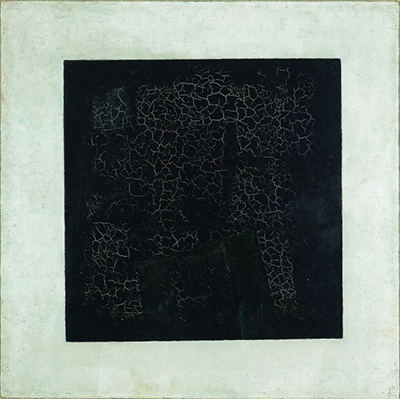
A woman with a bouquet and a yellow basket stands in the foreground of Kazimir Malevich's Flower Seller. Trees, buildings and other people fill the street or park behind her. The scene seems far removed from the empty geometry of Black Square, yet its broad blue jacket and orange-red skirt hold the composition with unusually forceful colour. This painting is also a dating problem: reproductions have called it an early work from 1903, but its owner now catalogues the canvas as 1930. [1] [2]
The State Russian Museum's illustrated record names the work Flower Seller in English and Цветочница in Russian. It identifies a 1930 oil-on-canvas painting, 80 × 100 cm, inventory ЖБ-1502, received from Malevich in 1930. The saved image on this page matches the museum's illustrated object: the central hat, blue jacket, red-orange skirt, bouquet, yellow basket and strolling figures behind. The inherited site name “Flowergirl” remains useful as an alternative English label, while the museum title and object number anchor the page to the physical painting. [1]
At a Glance
- ArtistKazimir Malevich
- Museum titleFlower Seller (Russian: Цветочница)
- Also calledFlowergirl
- Date1930, State Russian Museum; older 1903 dating discussed below
- MediumOil on canvas
- Dimensions80 × 100 cm
- CollectionState Russian Museum, Saint Petersburg, ЖБ-1502
- Visual focusA still central seller against a busy, loosely painted public setting
Contents
- Looking closely at the scene
- Why is 1903 sometimes given?
- Brushwork, colour and stillness
- Collection and limits of the record
- Patterns of stillness and movement
Looking closely at the scene
The flower seller faces us with her head near the upper middle of the canvas. Her dark brimmed hat frames a fully visible face. In one hand she holds a small group of flowers; with the other arm she carries a round basket whose yellow front and dark rim stand out from the blue jacket. The skirt supplies a large orange-red shape below. These areas make her easy to locate even though the setting behind her contains many competing marks and people. [1]
A tree rises at the left and branches over the background. Light-coloured buildings appear beyond the foliage. Several smaller figures stand or walk behind the seller, including a pale dressed figure at right. Rather than giving each person the same degree of detail, Malevich lets the background break into lively strokes and patches of light, blue and green. The seller, by contrast, remains relatively stable and front-facing. Her pose feels almost posed for a portrait inside a busy genre scene. [1] [3]
The composition has both a broad landscape format and a figure that occupies much of its height. The woman's blue jacket and warm skirt create two large colour zones that resist dissolving into the setting. The bouquet and basket mark her role in the scene, but the artist gives no named sitter or specific city. The painting provides the visual idea of a public place; it does not establish a documented street, market or biography of the woman. [1]
Why is 1903 sometimes given?
The current Russian Museum object record dates the canvas to 1930. Irina Vakar, writing from her research experience in a Tretyakov Gallery publication, says Malevich himself dated Flower Seller 1903. She recalls discussions with Russian Museum scholar Elena Basner about the difficulty of placing the work among genuine early twentieth-century paintings. Their comparison of its red, blue and green colour relationships helped support the later dating. Vakar presents this as part of a wider reassessment of Malevich's self-dated early and late works. [1] [2]
The museum's Russian-language interpretation likewise treats the canvas as a work made around the turn of the 1920s and 1930s. It says Malevich was revisiting Impressionism in a retrospective or experimental way rather than simply painting in an early Impressionist phase. The pictured costumes do not fit a single period: in the museum's reading, background women evoke late nineteenth-century dress, while the seller's clothes recall the 1920s. The owner sees this mixture as a deliberate feature of the painting's construction. That explanation is an attributed museum reading, not a claim that the scene records an actual encounter between people from different eras. [1] [3]
This distinction matters because a wrong date reverses the artwork's place in Malevich's career. If the canvas belonged to 1903, it might be treated as a youthful stage on the road toward Suprematism. Catalogued in 1930, it becomes a later engagement with a style he had known earlier, after the radical abstractions for which he is most famous. The picture does not become less observational when its date changes, but its relationship to the rest of the work changes substantially. [1] [2] [3]
Brushwork, colour and stillness
The museum's commentary calls attention to a paradox: the setting has vibrating, Impressionist-looking brushwork, but the seller herself appears static. Her arms and basket are arranged so firmly that the figure almost spreads across the canvas. The blue jacket and red-orange skirt carry the bold colour of Malevich's later experiments, while the surrounding trees and crowd seem more fleeting. This is why a simple label such as “Impressionist painting” can describe part of the surface without exhausting the work's construction. [3]
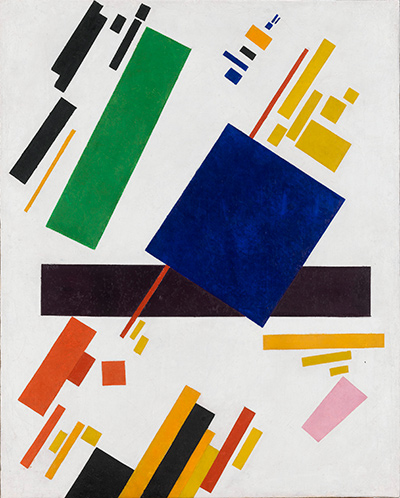
The painting also differs from Malevich's late rural scenes such as Girls in the Fields and At Harvesting (Marfa and Vanka). Those works set geometrized figures against striped land. Here a person with a recognizable face and occupation stands in a busy public setting. Yet strong red and blue masses still determine how the image holds together. The owner's interpretation explicitly connects the seller's open colour to certain pictures from the second peasant cycle. [1] [3]
What looks spontaneous in the distant foliage need not mean the whole image was painted quickly outdoors. The checked museum sources do not say that. Nor can a digital reproduction establish exact brush depth, pigment mixture or the sequence in which the central figure and background were painted. The visual contrast between active surroundings and firm central pose is clear; the precise working method would require technical evidence. [1] [3]


Collection and limits of the record
The Russian Museum says it received the canvas from Malevich in 1930. That short acquisition line is unusually close to the museum's accepted date, but it is not a complete provenance, exhibition history or contract record. The museum labels the work a genre painting and supplies keywords for a female portrait, city view, clothing, plants and flowers. Those categories are cataloguing aids, not proof of an exact street or of the seller's identity. [1]
The image already held by this site is useful for appreciating the relationship among the seller, the basket and the crowded background. Its 400-pixel width is limited for studying tiny figures or paint texture. Colour reproduction varies by screen, so precise comparisons to the physical canvas require a visit or calibrated conservation images. [1]
Patterns of stillness and movement
The Russian Museum draws attention to the stillness of the seller while the brushwork around her seems to move. Follow the edges of her clothing first and the pose is relatively easy to hold in view. Then follow the shorter marks around the flowers or the figures behind her. They pull the eye in several directions. The result is an image that can feel restless at one distance while preserving an unusually stable principal subject at another. The division is visible even without interpreting the different styles of costume as evidence for a particular year. [1] [3]
The museum’s account of the costumes makes this distinction sharper. It reads the seller’s clothes in relation to a more recent period than those of the women behind her. A viewer might normally expect clothing to establish when a street scene takes place. Here it can strengthen the impression that the scene brings several visual models together. That is part of what makes the painting useful in considering Malevich’s late return to earlier styles. The publication history gives a reason to examine the differences rather than assign the scene an early date from the handling alone. [1] [2] [3]
Frequently Asked Questions
Was it painted in 1903 or 1930?
Are Flowergirl and Flower Seller two paintings?
On this page they name the same Russian Museum canvas, ЖБ-1502. Flower Seller is the museum's English title; “Flowergirl” is the inherited site title and an alternative translation of Цветочница. [1]
Is this an Impressionist work?
The museum discusses Malevich's retrospective experiments with Impressionist brushwork around 1930. It also stresses the seller's static pose, emphatic colour and mixed period costumes. Those features make the painting more complicated than a simple return to an earlier style. [3]
Who is the woman?
Discussion
How does the woman remain visually steady against the busy trees and crowd?
Which colour shapes first guide your eye to the seller and her basket?
Reader Insights
Compare the blue jacket with the orange-red skirt: how much of the scene do they organize?
Look at the background figures. How do their smaller scale and looser marks change the sense of space?
What changes in your reading when you know the museum dates the canvas to 1930 rather than 1903?
Join the Conversation
Share a close observation or a source-backed detail about Russian Museum ЖБ-1502.
References
- State Russian Museum, Flower Seller, ЖБ-1502: illustrated owner record for title, date, medium, dimensions, inventory and 1930 receipt from the artist. View source.
- Irina Vakar, “On the History of Studying Kazimir Malevich: Personal Experience,” Tretyakov Gallery's Lavrus: first-person account of the 1903 versus 1930 dating reassessment, the discussion with Elena Basner and the picture's colour relationships. View source.
- State Russian Museum, Цветочница, Russian-language object record and interpretation: owner's discussion of retrospective Impressionism, mixed period costumes, strong colour and the still central pose. View source.