by Tom Gurney
Tom Gurney BSc (Hons) is an art history expert with over 20 years experience
Published on June 19, 2020 / Updated on November 20, 2026
Email: tomgurney1@gmail.com / Phone: +44 7429 011000
Introduction
Bright orange and yellow trunks rise over a steep, dark foreground. Their branches cross a pale blue and warm sky, while the lower half of the image is built from broad grey, green and violet strokes. Christie’s illustrated catalogue entry for Kazimir Malevich’s Trees dates the painting circa 1904, calls it oil on thick card, and measures it 30.8 × 19 cm. [1]
Two small marks connect this landscape to the object described in the sale catalogue. Christie’s records Malevich’s initials at the lower right and a further signature and inscription in Cyrillic on the back. The catalogue lists a chain of former owners and earlier illustrated appearances. Its account ends with the family associated with that sale. [1]
At a Glance
- ArtistKazimir Malevich
- TitleTrees
- Catalogue dateCirca 1904
- MaterialOil on thick card
- Dimensions30.8 × 19 cm
- Source objectChristie’s archived illustrated lot 1478621
- Current ownerNot established by the historical sale record
- Documented former collectionsMieczyslaw Malevich; George Costakis; Galerie Gmurzynska; then a private family holding recorded in the sale catalogue
Contents
- Looking at the trees
- Why does the support matter?
- An early landscape in Malevich's career
- Two small landscapes on card
- What is known of its ownership?
- How the work travelled through exhibitions
Looking at the trees
The narrow vertical format makes the trunks feel tall, although the painting itself is only about thirty-one centimetres high. A dark diagonal bank cuts from upper left toward the lower right, occupying much of the lower image. Three prominent trunks rise from it, with many thinner stems behind. The branches at the top weave across one another, breaking the sky into small spaces. [1]
Orange and yellow are concentrated in the upper trunks and branches. Dark green clings to their bases and appears in patches behind them. The sloping foreground is cooler, with grey, violet and deep green strokes running diagonally. This contrast between warm upright trunks and a cool oblique bank provides much of the image's structure. It also pulls attention to a small bright opening beyond the trees near the centre-right. [1]
The painter does not describe each leaf or bark texture separately. Short and broad marks build the setting through colour and direction. The lower ground reads as a hillside or bank, while the opening behind the trunks remains ambiguous. The object title establishes the main subject, but the checked catalogue does not name a location or identify a particular species. [1]
Why does the support matter?
The archived Christie’s entry explicitly says oil on thick card. The card is a rigid support for a painting small enough to examine at close range. On a reproduction the blue passages and the dark bank can fill an entire screen, so the surface seems spacious. The thirty-centimetre original brings the short marks of sky and longer strokes of earth into a much more compact field. At that scale a slight change in the direction of a stroke can alter the relation of a trunk to the hillside or open a gap that lets the eye through to the sky. Those changes are visible in the illustrated catalogue. It supplies no technical examination of the surface beneath the paint. [1]
The dimensions are also more exact than the legacy rounding. Christie’s gives 30.8 × 19 cm. “About 31 × 19 cm” is a reasonable shorthand in discussion, but the fact table keeps the stated measurement. The catalogued initials at lower right and reverse inscription help distinguish the work from other Malevich landscapes with trees. The auction house transcribes the reverse inscription alongside the signature. A photograph of the reverse would help establish where the marks sit and how they relate to one another. [1]
An early landscape in Malevich's career
At circa 1904, Trees belongs to the artist's early figurative and landscape work. The Museo Nacional Thyssen-Bornemisza's artist chronology notes his move toward formal study in Moscow from 1904, a useful broad point of context rather than proof of where this particular landscape was painted. The work shows the artist attending to a recognizable outdoor motif while experimenting with vigorous colour and visible paint handling. [1] [2]
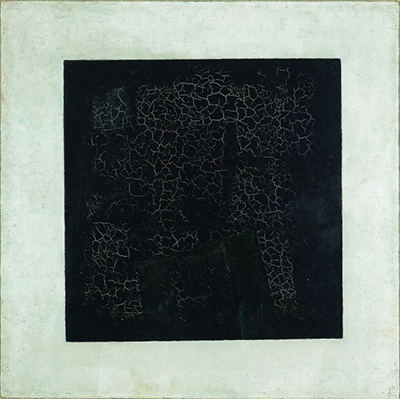
This painting is separated by about a decade from the nonobjective paintings associated with Black Square. MoMA's historical account places Malevich's public introduction of Suprematism at the 1915 0.10 exhibition. The distance between those dates is instructive, but it should not turn the woodland picture into a supposedly preplanned first step toward abstraction. The trees and sloping land remain its immediate subject. [1] [3]
Another early small-scale comparison is Three Female Figures, dated circa 1905–1906 by the Stedelijk. Both works use compact surfaces and broken colour, yet one is a woodland and the other a group of people. Their different collections and object records should remain distinct. [1] [4]
Two small landscapes on card
The Russian Museum’s Landscape with a Yellow House gives a way to compare Malevich’s handling of another small landscape without guessing about the construction of Trees. The museum dates its own work circa 1906 and lists oil and wax tempera on cardboard. Its dimensions, 19.2 by 29.5 centimetres, are similar to those of Trees with the proportions turned the other way. The broader, horizontal field gives the house space to sit within its surroundings. In Trees, the narrow upright format brings the trunks close to the viewer and sends them towards the upper edge. [1] [5]
The Russian Museum describes the marks in its own work as dots of colour that resolve into a scene as a viewer looks. In Trees, broader strokes of cool colour cut across the bank while warm marks carry the eye upwards. Recognition happens partly through the shape of each trunk and partly through the contrast between the two dominant directions. Both works make colour structurally important, but the owner’s account of the dotted handling and the mixed oil and tempera belongs specifically to Landscape with a Yellow House. [1] [5]


What is known of its ownership?
Christie’s names Malevich's brother Mieczyslaw Malevich in Moscow, followed by collector George Costakis in Athens and Galerie Gmurzynska in Cologne. The catalogue says the father of the then owners acquired it from the gallery. Those are documented steps in a published provenance chain, not proof that every transfer or intervening date is known. Nor does a historical catalogue identify the painting's present owner. [1]
The same record links Trees to several publications, including Angelica Zander Rudenstine's 1981 Russian Avant-Garde: The George Costakis Collection, and lists exhibitions in New York and Munich. It says the Guggenheim showed it in a Costakis collection exhibition during 1981–1982. Such exhibition history helps identify the exact painted object across sources, but does not imply that the Guggenheim owns it. [1]
Christie’s also notes that the work was intended for a forthcoming catalogue raisonné being prepared by Andréi Boris Nakov. The archived entry is evidence of that stated intention at the time, not confirmation of how the work was eventually entered in any later completed publication. [1]
How the work travelled through exhibitions
The auction entry identifies Trees as number one in the Guggenheim’s New York exhibition and in the published Munich exhibition record for 1984. It notes the Munich exhibition’s later travel to Hanover in 1985. The separate catalogue references give readers a way to follow this small painting even when a short title such as Trees could identify many works. The New York and Munich entries have different catalogue page numbers and belong to different exhibitions. The Munich tour entry documents the exhibition itinerary. An object-level Hanover checklist would clarify the exact works shown at the second venue. [1]
The 1981 Costakis collection book gives it yet another number, 476. Christie’s also cites illustrated entries in books by Jean-Claude Marcadé and by Rainer Crone and David Moos. These different numbers are references to publications. They can help link an illustration or catalogue description back to the painting when used with its size and support. The sale record remains the source that ties these appearances to the front and reverse marks and the chain of former collections. [1]
Frequently Asked Questions
When was Trees painted?
Christie’s dates the work circa 1904. The “circa” signals an approximate date. [1]
Is it oil on canvas?
No. The object-specific Christie’s catalogue gives oil on thick card. [1]
How large is it?
The recorded dimensions are 30.8 × 19 cm, a narrow vertical format. [1]
Where is the painting now?
The historical Christie’s entry supplies provenance through the private family holding associated with that sale. It does not establish a current owner or on-view location. [1]
Discussion
How does the diagonal bank change your sense of the upright trunks?
Which strokes make the foreground feel different from the bright upper branches?
Reader Insights
Follow the three prominent trunks from their dark bases to the upper branches.
Locate the bright opening beyond the trees near the centre-right.
Compare the painting’s small physical dimensions with its enlarged screen reproduction.
Join the Conversation
Share a close observation or source-backed detail about the Christie’s documented Trees.
References
- Christie’s, illustrated archived lot 1478621, Kazimir Malevich, Trees: object-specific date, oil-on-thick-card medium, dimensions, inscriptions, provenance, literature and exhibition history. View source.
- Museo Nacional Thyssen-Bornemisza, Kazimir Malevich artist chronology: context for his early Moscow studies and later artistic development, not an object record for Trees. View source.
- The Museum of Modern Art, The Russian Avant-Garde Book, 1910–1934 exhibition brochure: dates Malevich's public introduction of Suprematism to December 1915. View source.
- Stedelijk Museum Amsterdam, Three Female Figures, 4.2001(092): separate early figurative comparison. View source.
- State Russian Museum, Landscape with a Yellow House (Winter Landscape), Ж-9411: separately identified early landscape and owner’s account of its handling. View source.