 by Tom Gurney
Tom Gurney BSc (Hons) is an art history expert with over 20 years experience
Published on June 19, 2020 / Updated on August 2, 2026
Email: tomgurney1@gmail.com / Phone: +44 7429 011000
The Baptism of Christ
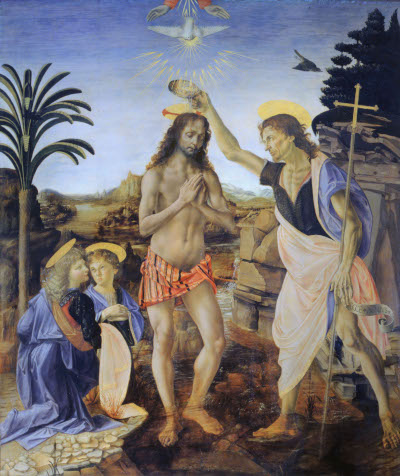
The Baptism of Christ in the Uffizi is a collaborative painting by Andrea del Verrocchio and Leonardo da Vinci, with evidence that at least one additional workshop painter may also have participated. Its importance does not rest only on the famous angel associated with the young Leonardo. The panel preserves different moments of design, tempera painting, interruption and later oil revision, making it an unusually rich record of how a leading Florentine workshop could operate.
At the centre, Christ stands in the River Jordan with his hands joined while John the Baptist pours water over his head. Two angels kneel at the left. Above, the dove of the Holy Spirit descends beneath the hands of God the Father. Rocks and vegetation frame the figures, while a river landscape opens into golden distance.
The Uffizi credits Verrocchio and Leonardo and dates the work to about 1470–75. Its collection record identifies Leonardo’s turning angel at the far left and notes that current research extends his intervention to the river landscape, golden light and figure of Christ. Yet technical scholarship complicates any simple division. Earlier tempera layers and modelling remain beneath passages later worked in oil, and differences across the panel point to more than two stages or two hands.[1] [3]
The result is best understood as a workshop object with a history. Verrocchio’s design and early campaign establish the composition. Other painters appear to have executed assigned zones. Leonardo then revised and completed parts of the panel in a different medium and emerging style. Looking closely means following those relationships without reducing the painting either to one master’s design or one pupil’s breakthrough.
At a Glance
- ArtistsAndrea del Verrocchio and Leonardo da Vinci, with probable workshop participation [1]
- TitleThe Baptism of Christ [1]
- DateAbout 1470–75 [1]
- MediumTempera and oil on panel [1]
- Dimensions177 × 151 cm [1]
- CollectionUffizi Galleries, Florence [1]
- Gallery locationRoom A35, Leonardo da Vinci [1]
- Inventory1890 n. 8358 [1]
- InscriptionECCE AGNUS DEI [QUI TOLLIT PECCATA MUNDI] [1]
- ProvenanceSan Salvi; Santa Verdiana from 1730; Florentine Galleries 1810; Uffizi since 1919 [1]
Contents
- Introduction
- At a Glance
- The Baptism Subject
- The Scroll and Its Words
- San Salvi and the Commission
- Verrocchio’s Workshop
- A Painting Made in Campaigns
- The Left Angel
- Christ, Landscape and Golden Light
- Evidence for More Than Two Hands
- Annotated Details
Annotated Details from The Baptism of Christ
Use the annotated image to move from the whole workshop composition into the passages most often discussed: Christ and John, the angel traditionally associated with Leonardo, the river landscape and the upper divine sign.
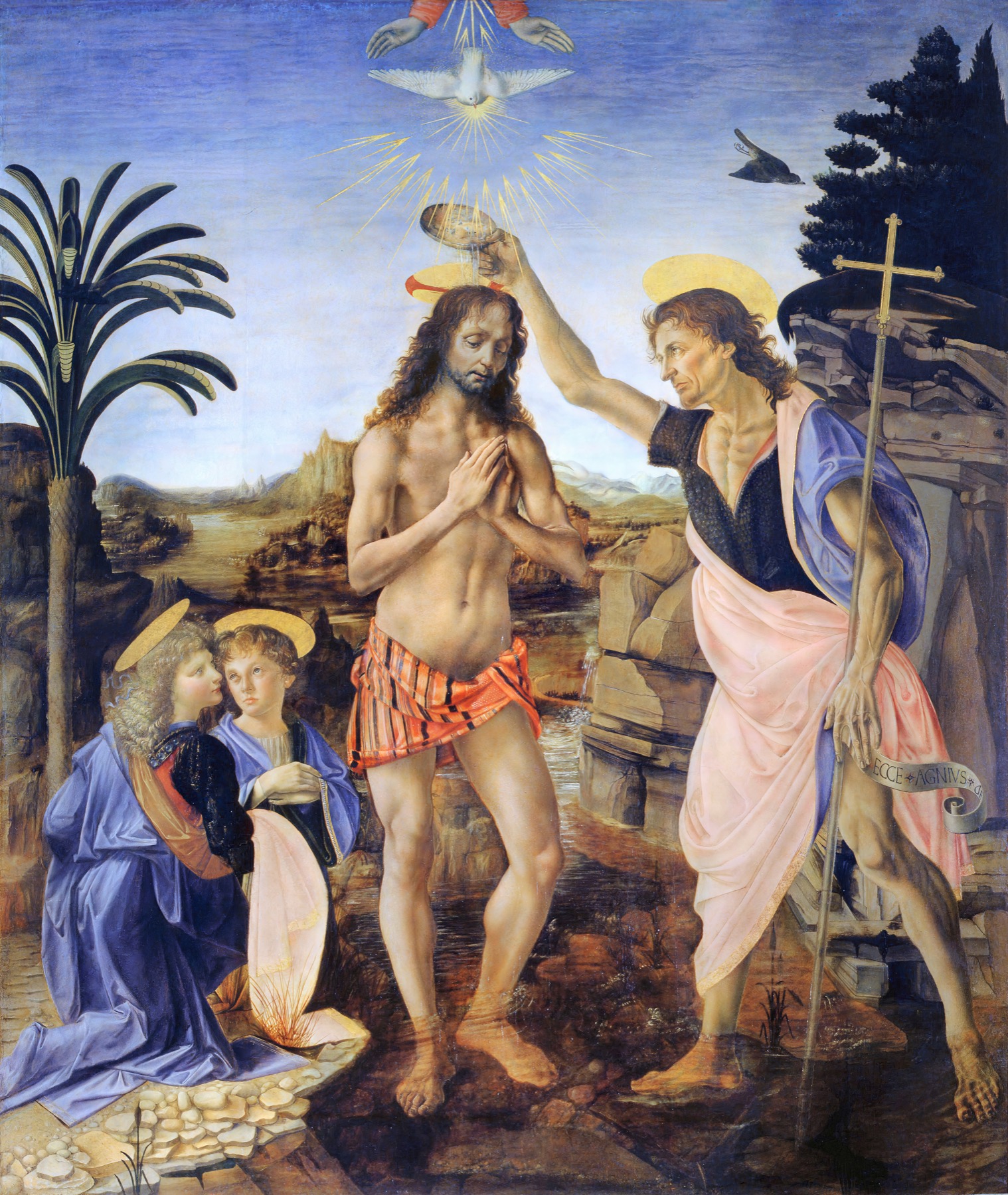
Details from THE BAPTISM OF CHRIST
Close looking highlights the details that structure this Leonardo page while keeping object and image-source caveats separate.
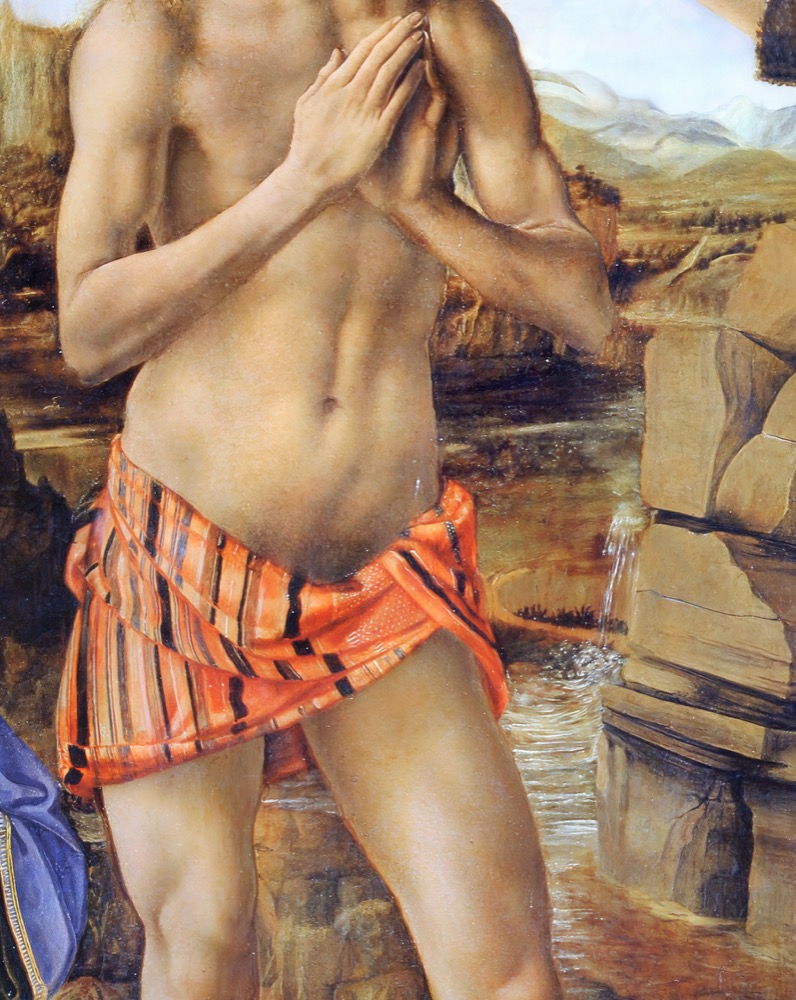
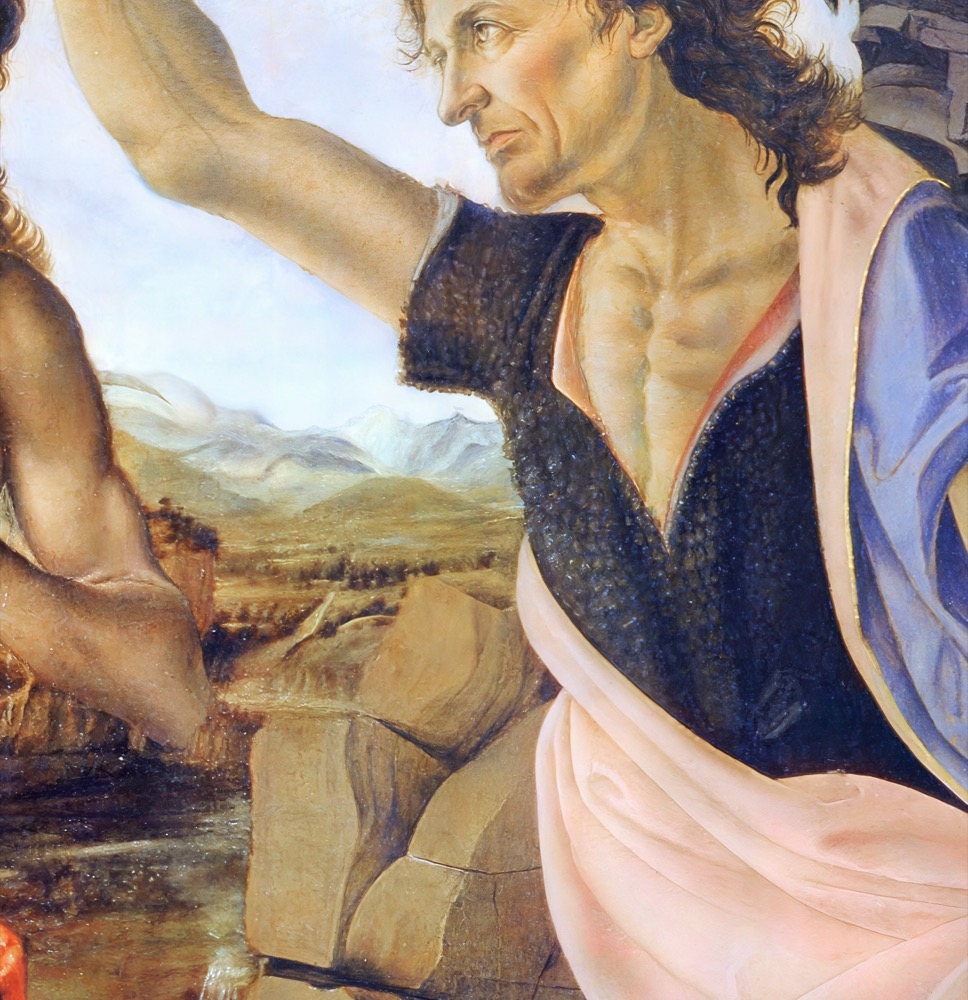
Christ and John
The central exchange keeps the baptism readable before the more delicate workshop distinctions are considered.
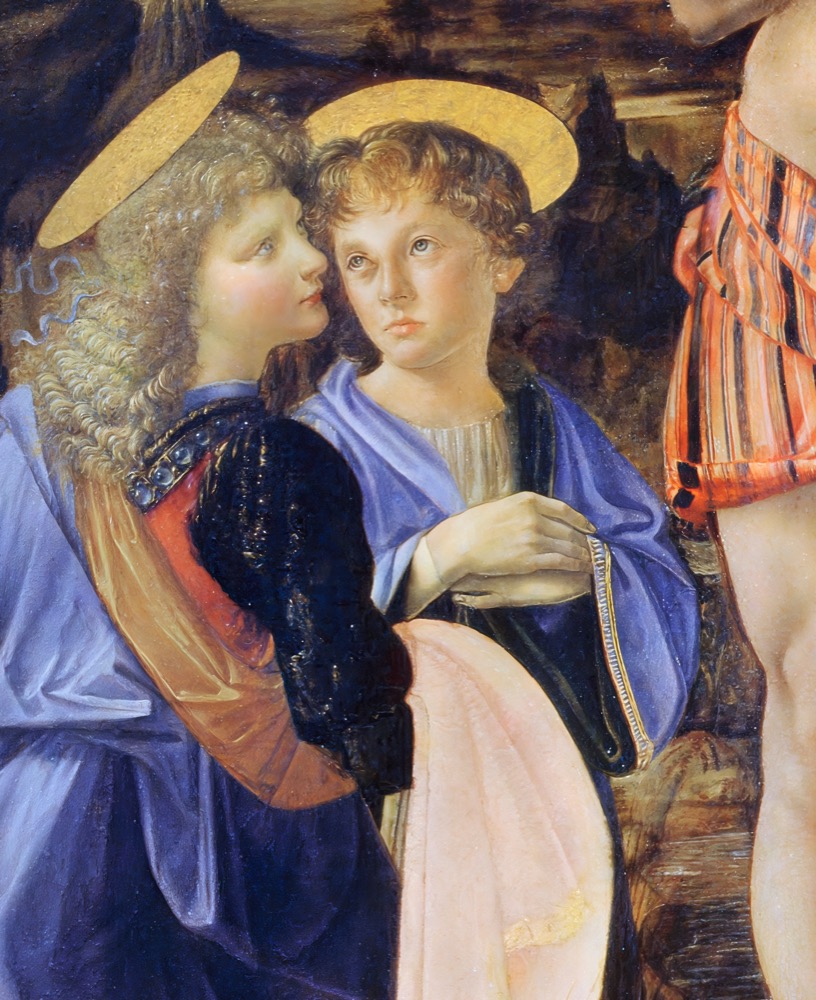
Leonardo's angel
The kneeling angel is the detail most closely associated with the young Leonardo inside Verrocchio's workshop setting.
River landscape
The landscape and water soften the scene and help connect the sacred event to a continuous natural world.
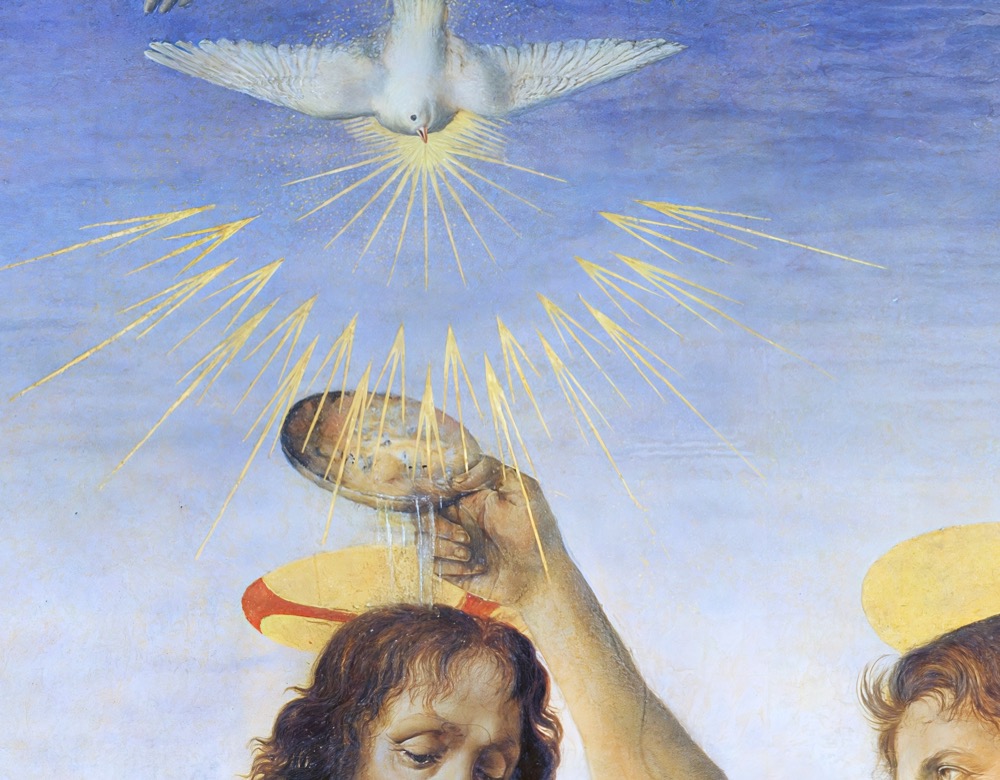
Dove and upper light
The upper passage frames the baptism with the descending dove and divine light above the figures.
The Baptism Subject
The baptism of Jesus is narrated in the Gospels of Matthew, Mark and Luke. Christ comes to John at the Jordan; after the baptism, the heavens open, the Spirit descends like a dove and a divine voice identifies Jesus as the beloved Son. Matthew also records John’s initial reluctance and Christ’s insistence that the act should proceed.[2] [6]
The event marks a beginning. It precedes Christ’s public ministry and reveals his identity through the combined presence of Son, Spirit and Father. In the painting, this theological structure becomes a vertical axis: God’s hands at the top, the dove below, water descending from John’s vessel and Christ standing in the river.
John appears at the right of Christ. His lean body, simple clothing and slender cross identify the ascetic prophet and forerunner. He bends towards Jesus while balancing the bowl from which water falls. The rite shown is baptism by infusion—water poured over the head—rather than full bodily immersion. The Uffizi notes that infusion had largely replaced immersion in Florentine practice from the fourteenth century, giving the ancient event a form familiar to contemporary viewers.[2]
Christ stands almost frontal, eyes lowered and hands joined in prayer. His feet enter the shallow water, while the pale body is set against darker rocks and vegetation. The pose emphasises humility and stillness. John acts; Christ receives.
Above them, the dove and the hands of God make the revelation visible. The canonical accounts describe the descending Spirit and the voice from heaven, not a pair of divine hands, but artists needed a pictorial sign for the Father. The three aligned presences allow the Baptism to be read as a manifestation of the Trinity.[2]
The two angels at the left are not named in the canonical or apocryphal baptism narratives. The Uffizi traces their presence in images of the event to Christian Eastern tradition and offers possible connections with the angels who serve Christ after the temptations or with assistants in baptismal ritual. They hold or attend to Christ’s clothing, which the museum interprets in relation to new life.[2]
Their inclusion also solves a compositional problem. Without them, Christ and John would create a narrow central pair. The kneeling angels widen the human group, draw attention towards the sacrament and provide a place for quieter observation beside the main action.
The Scroll and Its Words
John holds a scroll alongside his slender cross. The Uffizi records the inscription as:
ECCE AGNUS DEI [QUI TOLLIT PECCATA MUNDI]
The phrase means “Behold the Lamb of God [who takes away the sin of the world]” and comes from John 1:29.[1] [7] In the Gospel of John, it is a proclamation of recognition rather than part of the synoptic baptism narrative itself. The painting combines the words with the baptism episode to make John’s role as forerunner immediately explicit.
The text works at several levels. It identifies Christ, directs the viewer towards him and anticipates sacrifice through the image of the lamb. The scroll also echoes John’s cross-staff, so word and object both point beyond the river scene towards the Passion.
Only part of the phrase is visibly available across the curling surface, but the complete formula was familiar in Christian imagery. Brackets in the Uffizi transcription indicate the reconstructed continuation rather than letters necessarily legible in full on the panel.[1]
The inscription reminds us that Renaissance sacred painting often gathered several moments of scriptural meaning into one image. The baptism, the recognition of the Messiah and the future sacrifice do not unfold as separate episodes here. They are compressed through figure, gesture and text.
San Salvi and the Commission
The panel comes from the church of San Salvi, a Vallombrosan monastery outside Florence. The Uffizi’s public record begins its provenance there without naming a surviving contract or exact commissioning date.[1]
Jill Dunkerton’s National Gallery technical study brings archival and material evidence into the discussion. It proposes that the altarpiece may have been commissioned as early as 1468, when Don Simone, one of Verrocchio’s brothers, became abbot of San Salvi. According to this reconstruction, much of the composition was executed in traditional tempera and then set aside, perhaps because other commissions took priority. Leonardo later completed and retouched significant passages in oil.[3]
This wider sequence differs from the tempting picture of master and pupil painting side by side in one brief campaign. A large altarpiece could remain in a workshop, pass through pauses and receive additions by artists at different stages of training. The finished surface may therefore join decisions separated by years.
The San Salvi origin also matters to the subject. A monastic church required a public sacred image, not an exercise made solely to display technique. The Baptism offered a clear narrative, a manifestation of the Trinity and a theme connected to repentance, initiation and new life.
The painting later moved within Florentine religious and state collections. In 1730 it was transferred to another Vallombrosan monastery, Santa Verdiana. It entered the Florentine Galleries in 1810 and has been in the Uffizi since 1919.[1]
That provenance is unusually concise and secure compared with the uncertain early histories of some Leonardo paintings. It anchors the panel in a known institutional setting even while the exact pace and division of its making remain subjects of study.
Verrocchio’s Workshop
Andrea del Verrocchio ran one of the most important workshops in late fifteenth-century Florence. He worked across sculpture, painting and design, and artists associated with his shop included Leonardo and other younger masters. The National Gallery of Art describes Verrocchio’s painting practice as especially collaborative: the master could supply designs, younger painters could execute assigned passages and final work could return to senior supervision.[5]
A workshop was not simply a classroom. It was a production structure capable of accepting commissions, preparing supports and pigments, developing designs, distributing labour and completing objects across several media. Participation could include apprentices, experienced assistants, independent masters and specialists.
Collaboration therefore does not imply that every person contributed equally or that authorship can always be divided into clean blocks. The workshop head carried responsibility for the commission and overall invention, but an assistant might design as well as paint an assigned zone. Another artist might later revise the same area.
The Uffizi explains the general practice in relation to this panel: a studio head could devise the work while leaving secondary parts to pupils and collaborators.[1] Differences in the Baptism support that model. Some passages have a sculptural firmness associated with Verrocchio, others show more conventional or less developed execution, and later oil work creates softer transitions and atmospheric unity.
The National Gallery study argues that Verrocchio’s shop included artists of differing experience rather than a simple master-and-beginner pair. It also cautions that technical evidence cannot automatically confirm Verrocchio’s own hand in every passage of the first tempera campaign.[3] “Workshop” is sometimes the most accurate attribution when a zone belongs to the shared production system but not securely to one named painter.
This distinction protects both artists from caricature. Verrocchio was not merely an old-fashioned obstacle waiting to be surpassed, and Leonardo was not an isolated genius who appeared without training. The panel shows invention and knowledge moving through a collaborative structure.
A Painting Made in Campaigns
The visible image combines two main media. Tempera uses pigments mixed with a water-soluble binder, traditionally egg, and commonly produces relatively quick-drying, controlled strokes. Oil paint dries differently and can support translucent layers, softer transitions, blending and revisions over an existing surface.
The Uffizi lists the panel as tempera and oil.[1] Dunkerton’s technical account distinguishes an early tempera phase from later oil additions through close examination, X-radiography, infrared evidence and the behaviour of the paint surface. Leonardo’s oil can appear thicker, brush-marked or blotted, with characteristic drying patterns in certain passages.[3]
An underpainting is an early painted layer used to establish forms, light or colour before final surface work. Green earth or verdaccio could help model flesh beneath later tones. On this panel, such layers complicate authorship because a figure later associated with Leonardo may preserve an earlier workshop foundation.
This is especially important for Christ and the left angel. Technical study indicates that the figures did not begin as empty spaces waiting for Leonardo. Earlier drawing, drapery or modelling remained underneath. His intervention could preserve, adjust and cover parts of an established design.[3]
The chronology is therefore layered:
- Verrocchio and his workshop devised and began the altarpiece.
- Different zones were executed in tempera, apparently with variation in hand and quality.
- The project was interrupted or set aside.
- Leonardo later revised and completed selected areas in oil.
- Age, fading, abrasion and restoration affected how those differences now appear.
This sequence is a scholarly reconstruction, not a signed log left by the workshop. It is strongest where material boundaries and archival evidence coincide, and weaker where style alone must carry the argument.
The combined surface also affects visual unity. Later oil passages do not sit like detachable labels on top of an otherwise untouched work. They modify light, texture and transitions. Leonardo’s contribution can be extensive without erasing Verrocchio’s structure.
The Left Angel
The angel at the far left is the most celebrated passage. It kneels with its back partly towards the viewer, turns its head towards Christ and supports his garment. The twist reveals the shoulders and youthful face at once, while the blue robe spreads in crisp, fan-like folds.
The Uffizi credits this angel to Leonardo and contrasts its articulated pose and natural drapery with other parts of the panel.[1] The figure is a convincing marker of his participation, but technical evidence makes “Leonardo’s angel” a useful shorthand rather than a complete account of its manufacture.
Dunkerton’s study argues that the garment held by the angel belongs to the first tempera campaign. Flaking also reveals green-earth or verdaccio underpaint in the hair, which the author considers more likely to derive from Verrocchio’s earlier painting. In this interpretation, the head was already substantially developed before the work was set aside.[3]
Leonardo’s later interventions remain significant. Dunkerton attributes the soft final hair and blue ribbons to him, along with oil passages in the mouth and nearer eye and the angel’s final draperies. The robes’ triangular folds are related to Leonardo’s emerging drapery style, even if an earlier drawing or modelling lay below.[3]
The figure therefore demonstrates revision through collaboration. Verrocchio or the workshop established a body and head; Leonardo changed how that body was perceived. Softer hair, subtle facial accents, oil drapery and the turning movement create a new visual presence without necessarily replacing every underlying decision.
The angel’s gaze is as important as technique. It directs attention towards Christ while inviting the viewer to join a state of concentrated witnessing. The face does not merely display skill; it contributes to the painting’s devotional structure.
Placed beside the other angel, it also creates a comparison within the work. Differences in pose, modelling and finish have long encouraged attribution. Yet those differences should be examined with condition in mind. Fading and past abrasion have altered some tempera passages, making original contrasts harder to judge.[3]
Christ, Landscape and Golden Light
The Uffizi says current studies are moving towards a broader view of Leonardo’s intervention, including Christ, the river landscape and its golden light.[1] The wording is important: these are the direction of research, not a claim that every visible stroke in those areas belongs wholly to Leonardo.
Christ’s final flesh and facial accents show oil reworking, but the figure retains proportions and an underlying construction associated with Verrocchio. Dunkerton notes that the striped loincloth began in the tempera phase and that later oil strokes overlap it. Green-earth modelling may survive beneath the surface paint.[3]
This layered history helps explain why Christ feels both structurally firm and atmospherically integrated. The body belongs to the original composition, while later paint adjusts its relationship to surrounding air, water and light. Authorship operates vertically through layers as well as horizontally across zones.
The landscape works in a similar way. The central river and golden distance have been connected with Leonardo, but technical analysis suggests that earlier landscape painting may lie beneath his revision. Edge areas not covered by the reworking belong to the first campaign, and their quality varies.[3]
The river creates more than setting. It flows from the sacramental foreground towards the distance, linking local action with a larger natural world. Pale light settles through the valley, and softer transitions reduce the abruptness between figures and background.
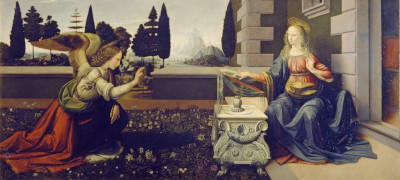
These atmospheric effects connect the Baptism with Leonardo’s Annunciation, where a distant water landscape and blended colour establish recession. The relationship is not proof that the same exact hand painted every background detail in both pictures. It shows a shared early concern with how air, water and light can make distance felt.[4]
Rocks and plants frame the composition. The Uffizi’s online exhibition identifies a palm at the left and reads it as a symbol of glory.[2] Elsewhere, vegetation contributes natural variety and creates thresholds between the sacred group and the open landscape.
Evidence for More Than Two Hands
The Uffizi credits Verrocchio and Leonardo but also states that another, older painter probably worked on the panel. It points to less developed passages in the hands of God and the dove as evidence.[1]
Dunkerton likewise finds variations in design and execution that fit a workshop distribution of zones. The sky, dove, divine hands and unreworked landscape edges belong to the early campaign, yet not every part reaches the same level. The technical study discusses the possibility of another assistant but does not turn that proposal into a settled named attribution.[3]
This possible third hand matters because it breaks the familiar two-person contest. If the panel includes Verrocchio, Leonardo and one or more assistants across successive campaigns, differences cannot be explained solely as “master versus pupil.”
Attribution should therefore operate at several levels:
- The Uffizi catalogues the object under Verrocchio and Leonardo.
- The overall design and early campaign belong to Verrocchio’s workshop.
- The left angel is associated with Leonardo, with technical evidence for an earlier foundation beneath his finishing.
- Christ and the central landscape contain broader Leonardo revision according to current study.
- Other areas may belong to Verrocchio or additional workshop painters.
- The exact division remains partly unresolved.
That layered account fits the evidence better than a diagram assigning every centimetre to one painter.
How Technical Evidence Changes the Attribution
Attribution begins with looking, but different tools reveal different parts of a painting’s history. Ordinary surface examination can distinguish variations in brush handling, texture, cracking and the way one paint layer overlaps another. Under magnification, a later oil stroke may be seen crossing an earlier tempera boundary.
X-radiography records how X-rays pass through the panel and paint. Materials containing heavier elements, especially lead-based pigments, can appear more strongly, allowing researchers to compare dense modelling beneath the visible surface. In the Baptism, X-radiographic evidence contributes to the argument that Christ possessed substantial earlier construction before Leonardo’s oil intervention.[3]
Infrared examination can reveal carbon-rich drawing or dark undermodelling beneath some paint layers. It does not make every hidden mark equally visible, because pigments, binders, layer thickness and later condition all affect the result. The absence of a clear infrared line is not automatically evidence that no drawing existed.
Paint samples can show a vertical sequence in miniature: ground, underpaint, colour and later coating. Yet a sample represents only the tiny point from which it was taken. Researchers must combine it with broader imaging and surface observation rather than extending one microscopic result across the whole panel.
Condition complicates every method. Red lakes can fade, abrasion can flatten modelling, upper layers can flake and old restoration can alter what the eye sees. A passage that now appears weak or abrupt may not preserve its original colour or volume. Style-based comparison must account for those losses.[3]
Technical evidence is therefore powerful but interpretive. It can show that one campaign lies beneath another, that different media behave differently or that a visible form was revised. Moving from those findings to the name of a particular painter requires comparison with documented or securely attributed works. The strongest conclusions bring material, documentary and stylistic evidence together.
This method explains why recent scholarship can both broaden and qualify Leonardo’s role. Oil reworking links him with Christ, the angel and central landscape, while underlying tempera demonstrates that those passages also belong to the earlier workshop history. Discovery produces a more layered attribution, not merely a larger territory labelled “Leonardo.”
Looking at the Whole Composition
Attribution can easily draw attention away from the painting’s coherence. The figures form a broad triangular group. Christ is the central vertical, John leans inward from the right and the angels build a lower mass at the left. The dove and divine hands continue the central axis upward.
The landscape opens behind that geometry without dissolving it. Rocks on either side act like natural wings, containing the action before the river leads away. Light separates Christ’s body from the darker bank.
Hands create a second structure. God’s hands appear above; John’s hands hold cross, scroll and bowl; Christ’s hands meet in prayer; the angels’ hands secure the garment. Each gesture carries a different form of agency—blessing, proclamation, administration, acceptance and service.
The composition also balances active and receptive bodies. John bends and pours. Christ remains upright and still. The left angel turns, while the right angel faces more directly. These variations give the sacrament a human rhythm rather than presenting four equivalent figures.
The areas often called less advanced still have a role in this whole. The simplified divine hands and dove are small, distant signs. Their difference in execution may indicate another painter, but it also marks a shift from earthly bodies to a vision in the sky. Material cause and pictorial effect can coexist.
Looking at the entire panel prevents Leonardo’s passages from becoming fragments cut away from Verrocchio’s design. The later oil work gains meaning because it modifies an already intelligible sacred image.
Vasari’s Anecdote
In the mid-sixteenth century, Giorgio Vasari told a memorable story: Leonardo painted an angel with such skill that Verrocchio was upset and gave up painting. The Uffizi recounts the anecdote as part of the work’s reception.[1]
The story has survived because it offers a perfect drama of succession. A brilliant pupil surpasses the master in a single passage; the old order recognises defeat; a new artistic age begins. It turns stylistic difference into biography.
As history, however, the tale is unreliable. Dunkerton argues that archival and technical evidence contradicts the idea of a young Leonardo simply working beside Verrocchio and causing him to abandon the medium. The painting appears to have developed over a longer interval, with substantial tempera work already in place and later completion by Leonardo.[3]
The angel itself also resists the anecdote’s clean separation. If earlier underpainting and parts of the head belong to Verrocchio’s campaign while Leonardo supplied later hair, facial accents and drapery, the celebrated figure embodies continuity as much as competition.
Vasari’s account remains valuable as evidence of sixteenth-century reputation. In his Life of Verrocchio, he says Leonardo’s angel was “much superior to the other parts” of the picture.[8] The anecdote shaped how later audiences looked at the panel, even if it does not provide a dependable workshop record.
The best response is neither to repeat the anecdote as fact nor to omit it entirely. It should be identified, explained and tested against the object.
From Annunciation to Adoration
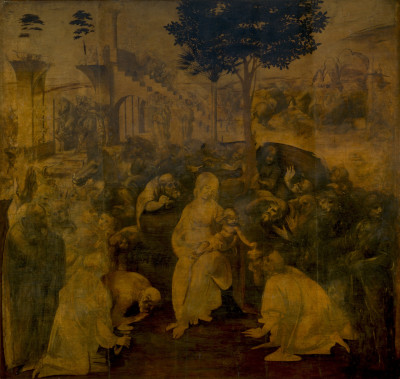
The Uffizi displays the Baptism of Christ, Annunciation and Adoration of the Magi together in its Leonardo room. The arrangement encourages comparison across the young artist’s Florentine development.[4]
The Baptism is collaborative and layered. The Annunciation is catalogued as a youthful Leonardo painting still connected with Verrocchio’s studio. The Adoration is a major independent commission left unfinished when Leonardo departed for Milan. These works present three different relationships between artist, workshop and completion.
In the Annunciation, observed shadow, bird-like wings and a water landscape help make a sacred event physically present. In the Baptism, oil revisions soften selected passages and connect bodies with golden distance. The similarities support a history of developing interests without erasing the collaborative basis of the San Salvi panel.
The Adoration expands the problem of collective response into a large crowd and exposes multiple stages of Leonardo’s own process. It demonstrates that visible difference within a painting need not always result from multiple artists; stages, revisions and incompletion can also create variety.
Together, the three panels teach a useful caution. Style changes with date, task, medium, condition and collaboration. Attribution must draw on technical and documentary evidence, not on a simple scale from stiff to beautiful.
Importance in Leonardo’s Early Career
The Baptism records Leonardo learning and intervening within one of Florence’s leading workshops. His contribution is meaningful not because it proves instant independence, but because it shows how inherited structures could be transformed through new handling.
Oil paint was central to that change. It allowed later passages to achieve different transitions, accents and atmospheric relations from the underlying tempera. Yet the National Gallery study also emphasises what Leonardo learned from Verrocchio, including underdrawing and monochrome modelling practices.[3]
The panel therefore opposes the myth of effortless invention. Leonardo’s emerging method developed through materials, workshop organisation, prior designs and the opportunity to revise an existing object.
For Verrocchio, the painting demonstrates a practice broad enough to accommodate several contributors and technical phases. His authorship resides not only in individual brushstrokes but in design, organisation and the visual framework later artists developed.
For viewers, the work offers two complementary experiences. From a distance, it is a coherent representation of the Baptism. Up close, it becomes a map of collaboration, interruption and change. Neither experience cancels the other.
Artist Up Close: The Art of Revision
Leonardo’s role in the Baptism can be understood through revision rather than replacement. He did not need to invent the entire composition to change its effect. Reworking Christ, the left angel and central landscape could alter where the eye rests, how light travels and how bodies belong to the surrounding air.
A small accent may matter: a softened lock of hair, a glistening eye, a change at the mouth or an oil fold laid over earlier modelling. Such interventions demonstrate that authorship can be cumulative. One artist’s surface decision may depend on another artist’s underlying form.
Revision also demands restraint. Technical evidence indicates areas where Leonardo respected Verrocchio’s proportions and construction rather than redesigning them entirely.[3] The later painter responded to an inherited image, preserving enough of it for the commission to remain coherent.
The panel is more than a search for the most impressive passage. It shows Leonardo making consequential choices inside limits, and a workshop capable of absorbing those choices into a shared work.
Frequently Asked Questions
Discussion
Use this space to discuss The Baptism of Christ by Verrocchio and Leonardo, its source evidence and how it fits into Leonardo da Vinci's wider cluster.
Keep comments focused on close looking, attribution language, object evidence and page-specific caveats.
Reader Insights
Which detail on this page most changes how you read the work?
How does this page connect to Leonardo's paintings, drawings, inventions or workshop context?
Where should the wording stay cautious because the source evidence is qualified?
Join the Conversation
Share your reading of The Baptism of Christ by Verrocchio and Leonardo below.
References
- Gallerie degli Uffizi, “The Baptism of Christ,” collection record by Daniela Parenti, accessed 28 July 2026.
- Gallerie degli Uffizi, “The Saint Who Baptized Christ,” online exhibition, accessed 28 July 2026.
- Jill Dunkerton, “Leonardo in Verrocchio’s Workshop: Re-examining the Technical Evidence,” National Gallery Technical Bulletin 32 (2011), accessed 28 July 2026.
- Gallerie degli Uffizi, “The New Room of Leonardo da Vinci”, accessed 28 July 2026.
- National Gallery of Art, “Verrocchio’s First Comprehensive Exhibition Explores His Innovation in Renaissance Art and Culture”, accessed 28 July 2026.
- United States Conference of Catholic Bishops, “Matthew, Chapter 3”, accessed 28 July 2026.
- United States Conference of Catholic Bishops, “John, Chapter 1”, accessed 28 July 2026.
- Giorgio Vasari, Lives of the Most Excellent Painters, Sculptors, and Architects, Life of Andrea Verrocchio, Wikisource page 255, accessed 2 August 2026.