 by Tom Gurney
Tom Gurney BSc (Hons) is an art history expert with over 20 years experience
Published on June 19, 2020 / Updated on July 28, 2026
Email: tomgurney1@gmail.com / Phone: +44 7429 011000
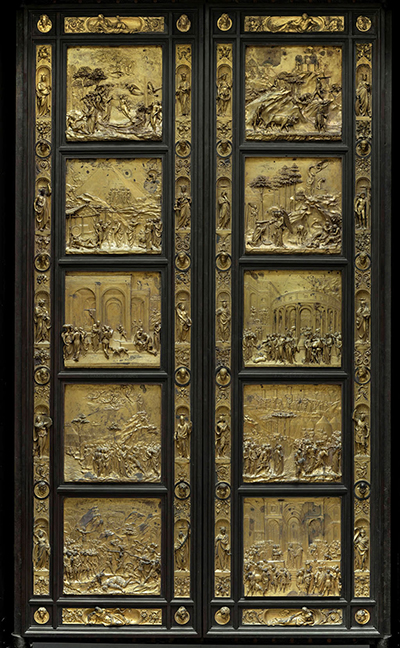
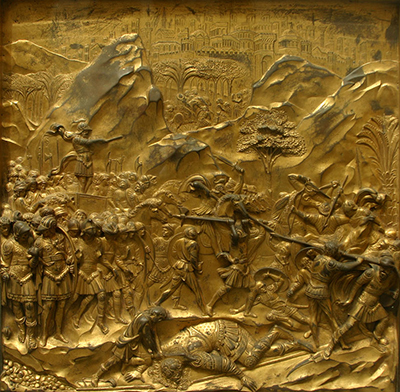
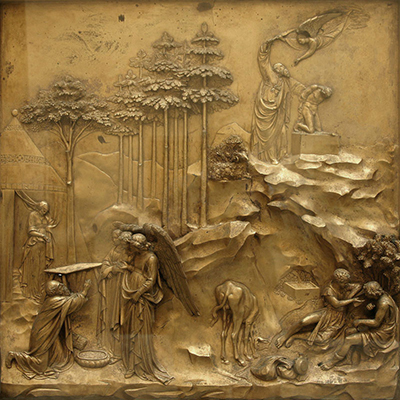
Lorenzo Ghiberti's Abraham and Isaac panel joins two episodes from Abraham's story: his encounter with three heavenly visitors and the interrupted sacrifice of Isaac. The first action unfolds near a tent and arriving figures; the second rises to a rocky summit where an angel arrests Abraham's hand. Terrain turns physical ascent into narrative and spiritual progression.
Contents
- The panel on the Gates
- Abraham and the visitors
- The journey upward
- The sacrifice interrupted
- A later answer to the competition relief
The panel on the Gates
The relief occupies the right side of the second register from the top of the Gates of Paradise, opposite the Noah cycle. The Opera del Duomo catalogues it under the broader title Stories of Abraham. That title prevents a common confusion: this is not Ghiberti's earlier competition relief of 1401, although both works address the sacrifice of Isaac.[1][4]
The Gates panel belongs to the great bronze doors made between 1425 and 1452. The original is viewed today as part of the doors in the Museo dell'Opera del Duomo, while replicas stand outside on the Baptistery.[2]
Abraham and the visitors
Genesis 18 describes three visitors received by Abraham near the oaks of Mamre and the promise that Sarah will bear a son. In the relief, the tent and approaching heavenly figure establish the lower zone. Abraham bows before the visitors, making hospitality and recognition the beginning of the panel's movement.[3]
The promised birth gives the later sacrifice its emotional force. Ghiberti does not need to illustrate every intermediate event. By setting promise and threatened loss within one field, he makes the two episodes interpret one another.
The journey upward
Servants and a donkey occupy another part of the landscape, marking the journey toward the place of sacrifice. These secondary figures slow the transition between the lower encounter and the summit. They also help the viewer understand that the climb is an episode, not merely a compositional slope.
Rocky ground connects the actions while separating their levels. The eye is encouraged to climb, passing from arrival and hospitality through travel to the exposed drama above. Ghiberti uses the landscape as both setting and narrative syntax.
The sacrifice interrupted
At the summit, Isaac is placed at the altar while Abraham prepares to act. A descending angel stops Abraham at the wrist, converting the raised gesture from impending violence into interruption. The ram supplies the substitute prescribed in Genesis 22.
The scene depends on crossed directions: Abraham's action moves toward Isaac, the angel descends against it, and the rocky ascent pushes the eye upward. Because the decisive moment occupies a high, exposed position, it reads clearly even within a panel containing another major encounter.
A later answer to the competition relief
Comparison with the 1401 Sacrifice of Isaac should remain bounded. The earlier work was made for the Baptistery door competition and survives as an independent quatrefoil relief in the Bargello. The Gates panel was designed decades later for a square, multi-episode format. Its task is different: not to compress one dramatic test into a single compartment, but to connect promise, journey and threatened sacrifice across a continuous terrain.
Begin a close reading at the tent, locate Abraham before the visitors, then follow the servants and donkey toward the summit. Finally, look at the contact between the angel and Abraham's wrist. That route reveals how the panel's landscape makes two distant scriptural episodes into one sustained meditation on promise, obedience and reprieve.
Discussion
Ghiberti rewards slow looking: relief, gilding, narrative structure, workshop practice and conservation evidence can all change how a work is read.
Join the Conversation
Have an observation about Abraham and Isaac, a source to add, or a comparison that sharpens the reading? Share it below.
References
- Opera del Duomo scientific catalogue, Stories of Abraham
- Opera del Duomo, Gates of Paradise
- Genesis 18:1–15; 22:1–19.
- Annamaria Giusti and Gary M. Radke, The Gates of Paradise: Lorenzo Ghiberti's Renaissance Masterpiece (2012), pp. 88–93.