 by Tom Gurney
Tom Gurney BSc (Hons) is an art history expert with over 20 years experience
Published on June 19, 2020 / Updated on July 28, 2026
Email: tomgurney1@gmail.com / Phone: +44 7429 011000
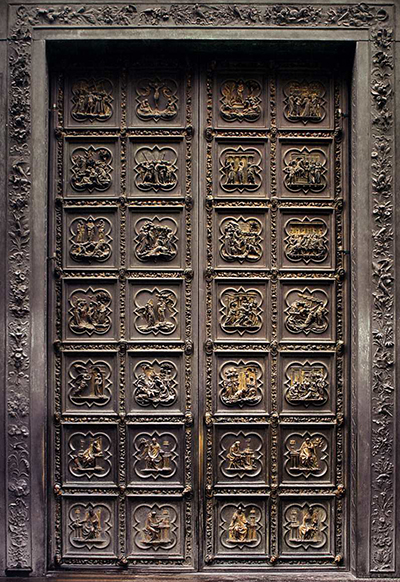
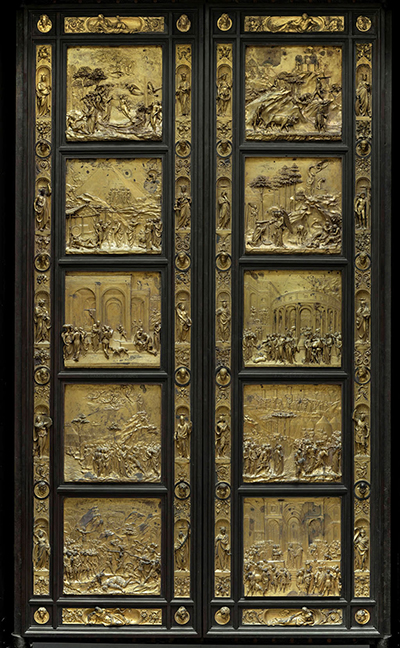
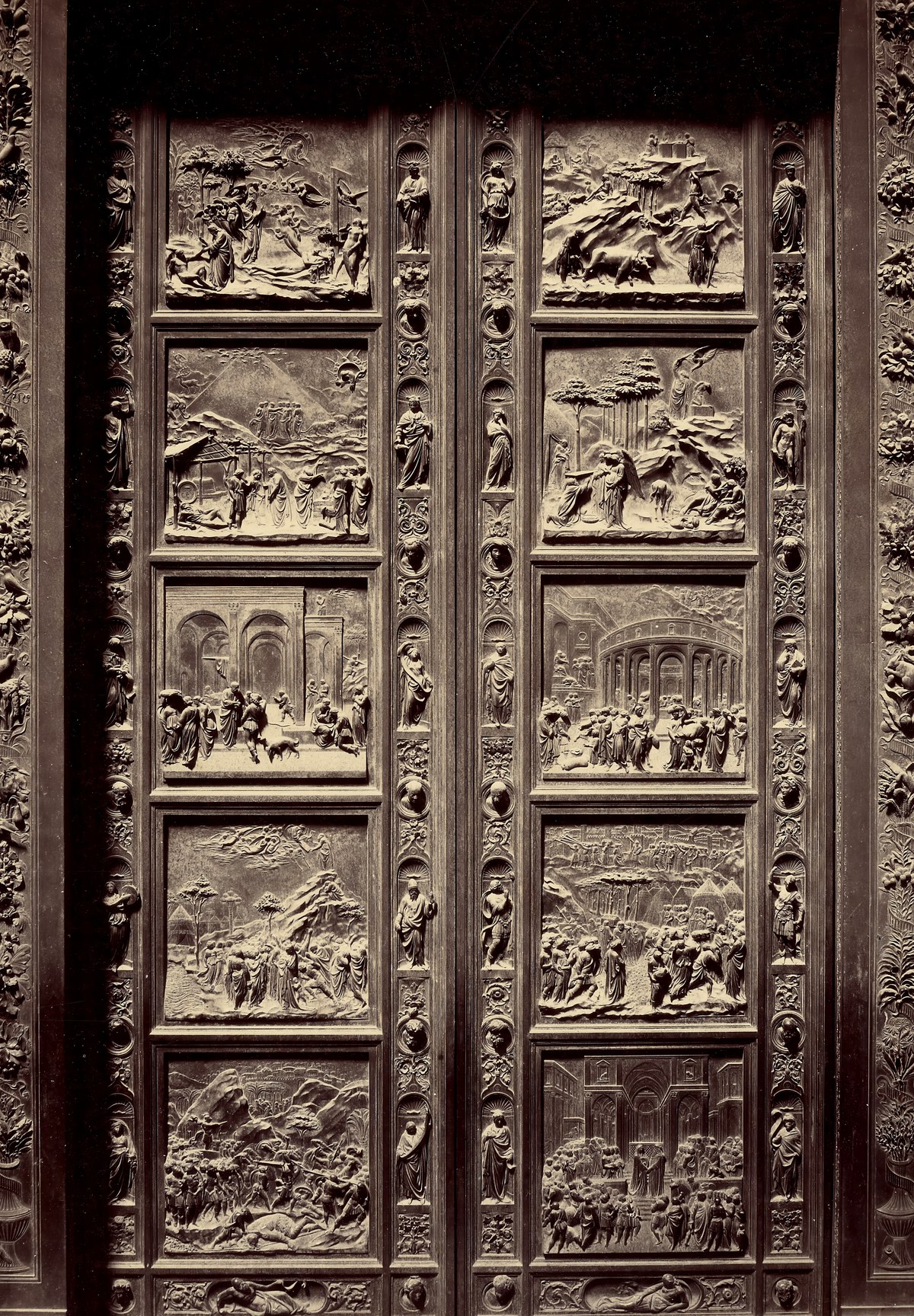
The Gates of Paradise transformed a doorway into a vast field for narrative sculpture. Made by Lorenzo Ghiberti and his workshop between 1425 and 1452, the gilded bronze doors were created for the Baptistery of San Giovanni in Florence. Ten large panels tell stories from the Old Testament through figures, landscape and architecture arranged at different depths. The original doors are now protected inside the Museo dell'Opera del Duomo; the doors seen on the Baptistery's eastern exterior are replicas. [1]
Contents
- From twenty-eight compartments to ten narrative fields
- Programme and invention
- How the workshop made the doors
- Relief, space and close looking
- Gold, corrosion and restoration
- Why are they called the Gates of Paradise?
From twenty-eight compartments to ten narrative fields
Ghiberti's earlier North Doors follow the repeated quatrefoil format established by Andrea Pisano's fourteenth-century doors. The Gates of Paradise abandon that system. Each leaf contains five large rectangular panels, giving Ghiberti far more space in which to combine several moments from a biblical story.
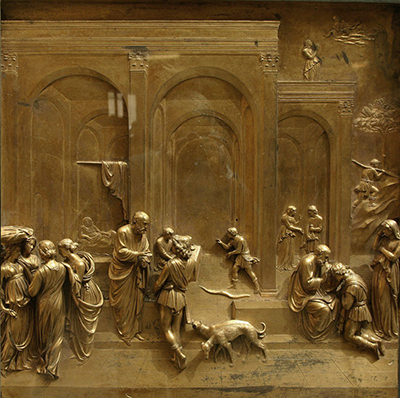
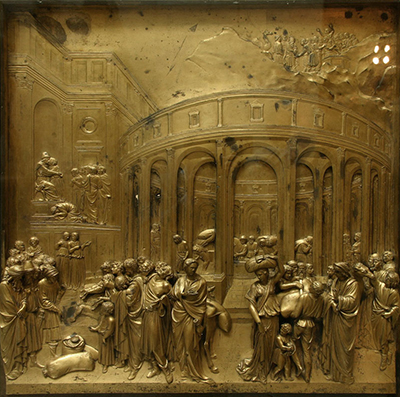
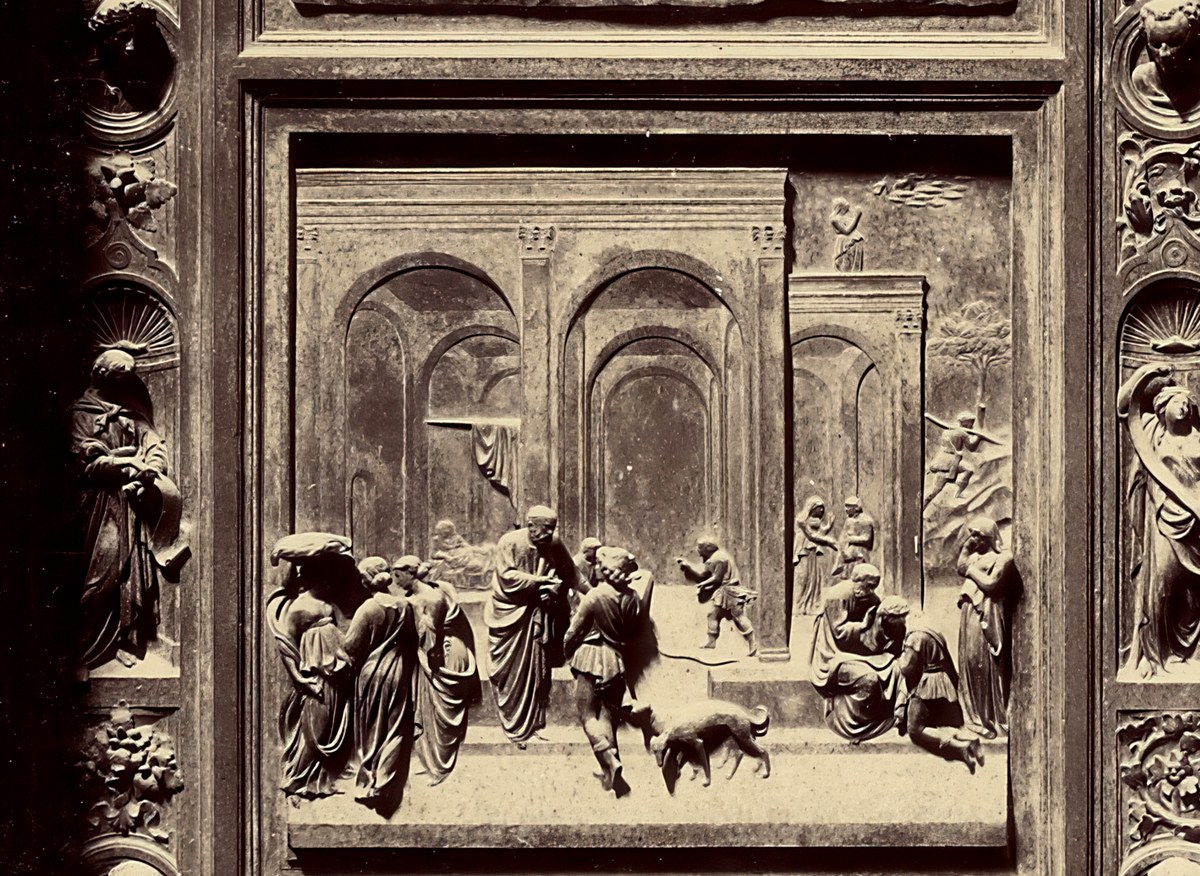
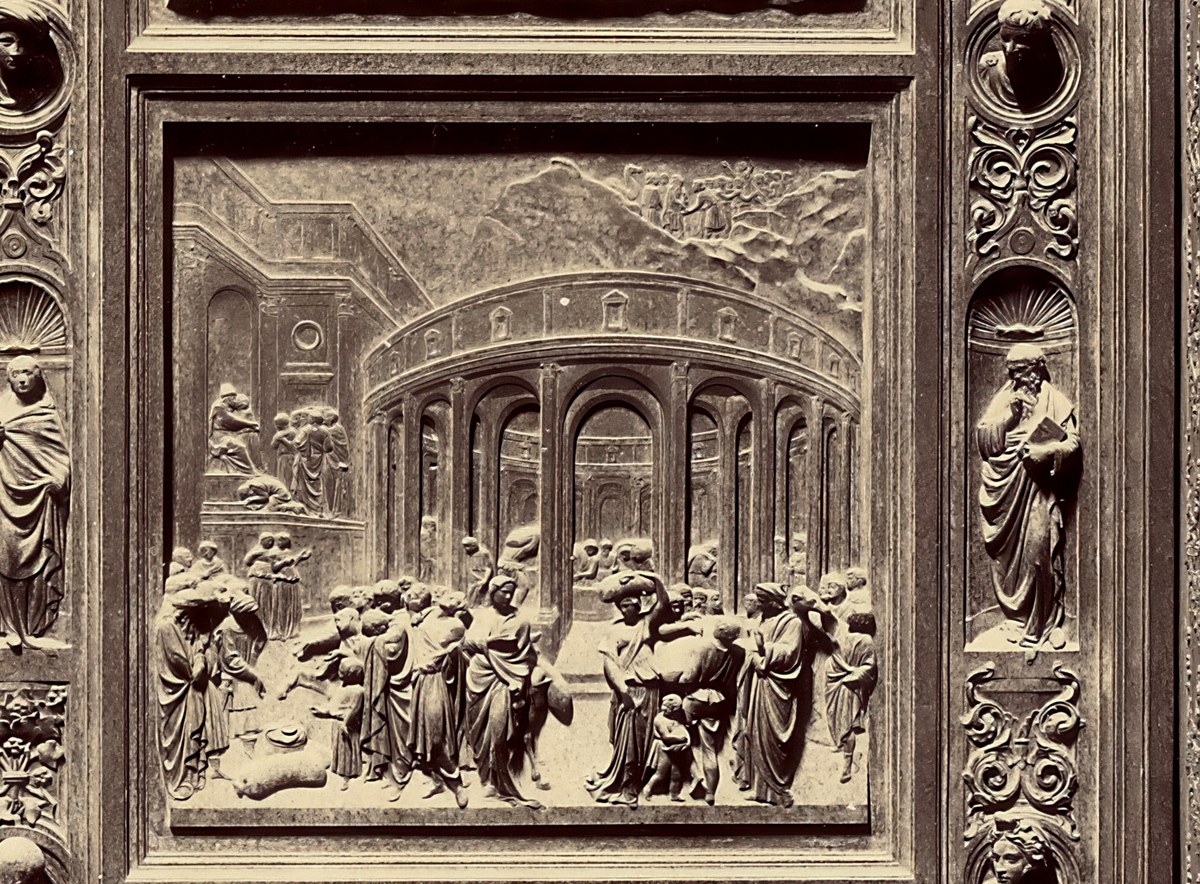
This change is fundamental to the experience of the work. A panel does not simply illustrate one frozen event. In the Joseph panel, for example, separate episodes unfold across an architectural setting; in the Isaac panel, encounters involving Isaac, Rebecca, Esau and Jacob are distributed through a unified landscape. Variations in figure size and relief depth guide attention from foreground action to more distant events.
The ten subjects move from the Creation and the story of Cain and Abel through Noah, Abraham, Isaac, Joseph, Moses, Joshua, David, and Solomon with the Queen of Sheba. Figures of prophets and other biblical characters occupy the surrounding frame, accompanied by heads, foliage and animals. Portrait heads identify Ghiberti and his son Vittorio within the ensemble.
Programme and invention
The final programme was not inevitable. In 1424, the humanist Leonardo Bruni proposed a scheme involving twenty Old Testament reliefs and prophets. The completed doors contain only ten narrative panels, and several choices differ from Bruni's proposal. The surviving documentation therefore cautions against identifying Bruni as the straightforward author of the final programme.
Ghiberti later emphasized the freedom and learning he brought to the commission. His Commentarii are valuable evidence of his intellectual ambitions, but they are also self-presentation. The doors are better understood through the combination of his account, guild documentation, the surviving object and modern scholarship. [2]
How the workshop made the doors
The dates 1425–1452 can suggest that the panels were produced steadily over twenty-seven years, but the work proceeded in distinct phases. By April 1437, all ten principal panels and twenty-four strips of framing decoration had been cast. Much of the remaining period was devoted to cleaning and chasing the casts, gilding, producing the massive backing structures and additional heads, and completing the threshold, lintel and jambs.
Ghiberti directed a changing workshop rather than executing every surface alone. Michelozzo took part during early and later phases; Benozzo Gozzoli worked on the doors during the 1440s, probably assisting with chasing; Vittorio Ghiberti participated in the family workshop. The design and artistic direction belong to Lorenzo Ghiberti, while the physical object records sustained collaboration by modellers, founders, chasers and finishers. [2]
Relief, space and close looking
The panels exploit the ability of bronze relief to shift between sculpture and drawing. Foreground figures may project strongly enough to cast emphatic shadows. Farther back, forms become progressively shallower until distant buildings and bodies are traced in a thin skin of metal. Gilding catches light across these changes, helping the surface remain active even when the relief is extremely low.
Architecture is more than background decoration. Colonnades, stairs and receding floor patterns organize crowds and separate episodes. Landscape performs a similar role, using rocks, paths and groups of trees to divide a continuous field without returning to rigid frames. Perspective contributes to this order, but Ghiberti should not be credited with simply “inventing” it. His achievement lay in adapting spatial systems, classical and medieval models, and subtle relief to the demands of complex bronze narrative.
Gold, corrosion and restoration
The original surface was produced with mercury-amalgam gilding over bronze. Over centuries, cleaning, abrasion, weather and corrosion changed its appearance. The Florence flood of 1966 forced the heavy doors open and dislodged six of the ten panels. Although the fallen panels survived without catastrophic damage, the event accelerated the effort to understand and protect the ensemble.
Scientific study found unstable corrosion products beneath the gold layer. Some of the gold no longer adhered directly to bronze but rested over corrosion strata; removing those strata indiscriminately would also remove the gilding. The Opificio delle Pietre Dure developed chemical cleaning using Rochelle salts for removable elements and later employed carefully tested laser ablation where extensive washing and disassembly were impractical. [3]
The entire original was removed from the Baptistery in 1990 and replaced by a bronze copy. After restoration, the doors were installed in the museum in a protective enclosure designed to control their environment. Their current golden appearance is therefore not a simple return to a pristine fifteenth-century state. It is the result of sustained study and selective conservation intended to preserve fragile original material.
Why are they called the Gates of Paradise?
The famous name has more than one history. The space between the Baptistery and cathedral was itself associated with “Paradise,” and the eastern entrance had liturgical significance. Vasari later reported the tradition that Michelangelo considered the doors beautiful enough for the entrance to Paradise. That anecdote belongs to the work's reception history, not to the documentation of its commission.
The name endures because it captures the doors' later fame, but it should not conceal their original function. They were made for a working Baptistery, commissioned by the Arte di Calimala and positioned within one of Florence's most important sacred and civic spaces.
Annotated Close Reading of the Gates of Paradise
This historic full-door photograph makes it possible to compare the ten narrative panels with the surrounding figures, heads, animals and plants. The numbered details move from individual stories to the door’s larger sculptural structure.
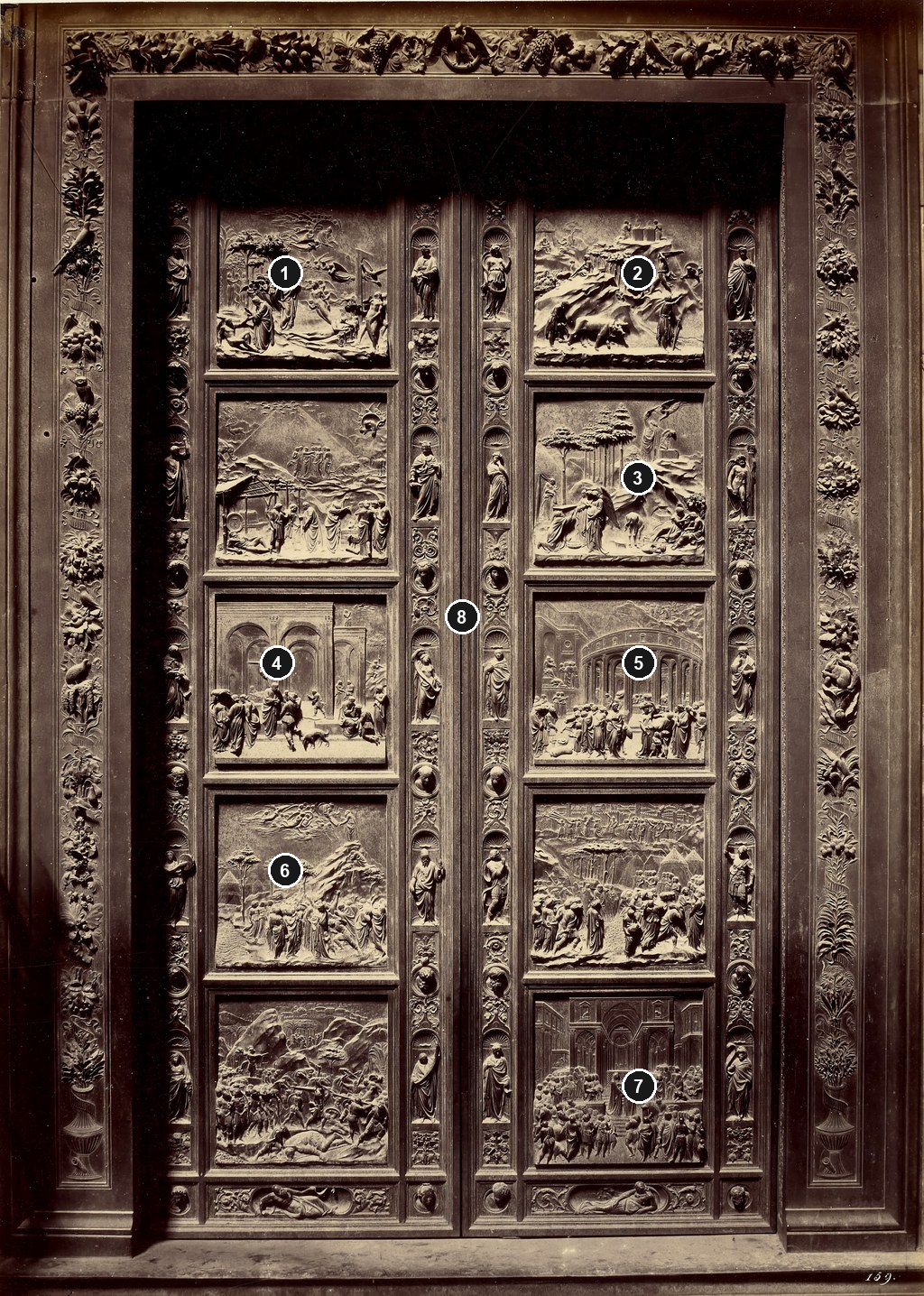
8 DETAILS to Notice
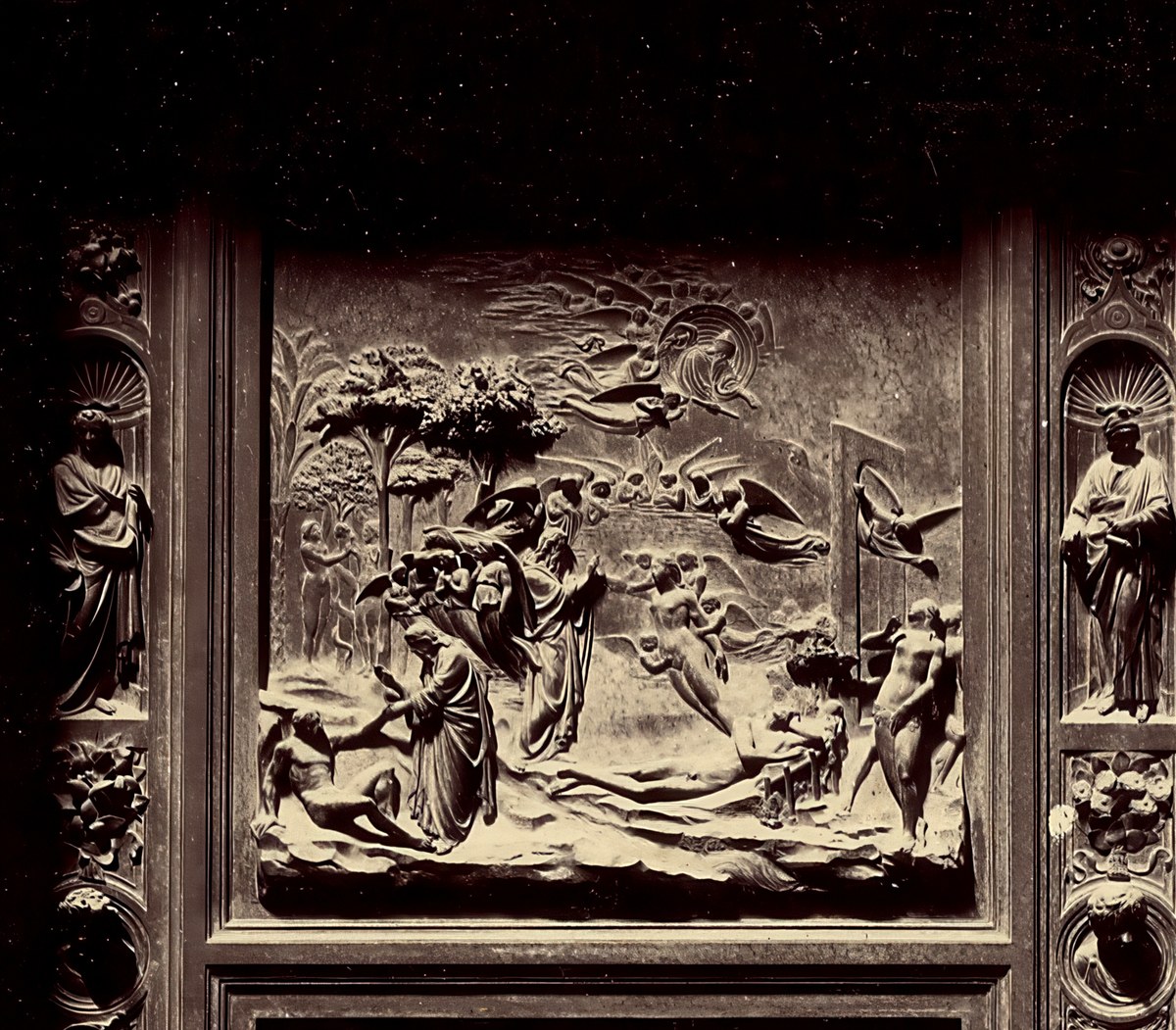
Creation, Fall and Expulsion
The upper-left panel compresses the creation of Adam and Eve, the Fall and expulsion into one continuous field. [1]
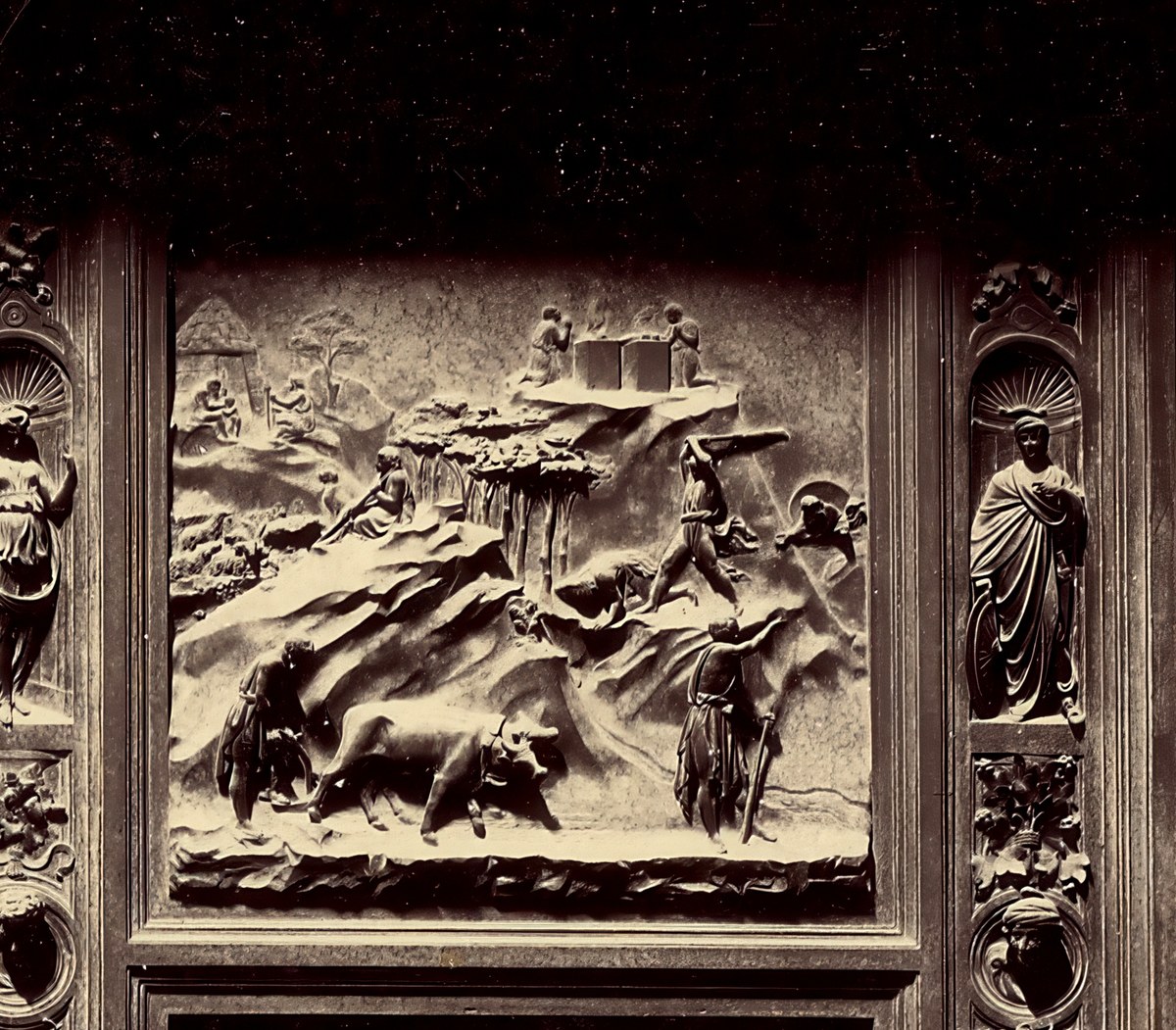
Cain and Abel
The upper-right panel uses landscape and changing relief to separate episodes from the story of Cain and Abel. [1]
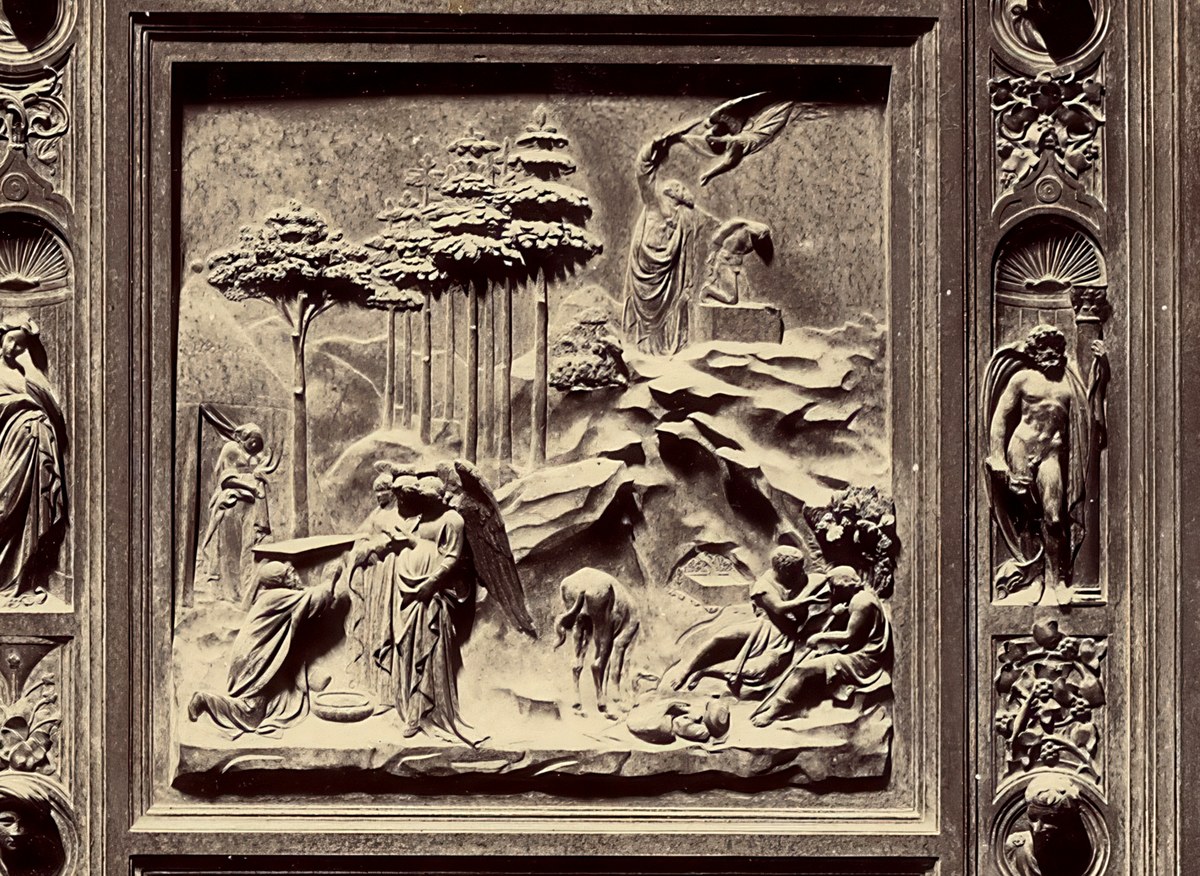
Abraham and Isaac
The Abraham panel distributes successive moments through rocky terrain rather than enclosing them in separate frames.
Isaac, Esau and Jacob
Architecture, foreground groups and distant encounters allow several moments from Isaac’s family story to coexist.
Joseph
The circular architecture in the Joseph panel organizes a dense sequence of recognition, judgment and reconciliation.
Moses and Joshua
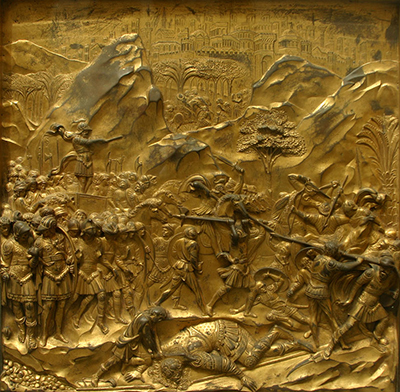
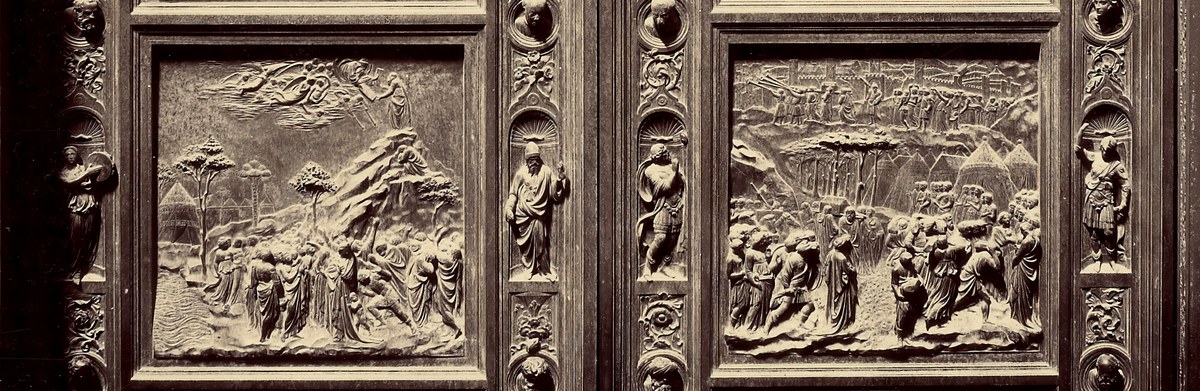
The middle-lower panels show how mountain, crowd and architecture create different kinds of large-scale public action.
David and Solomon
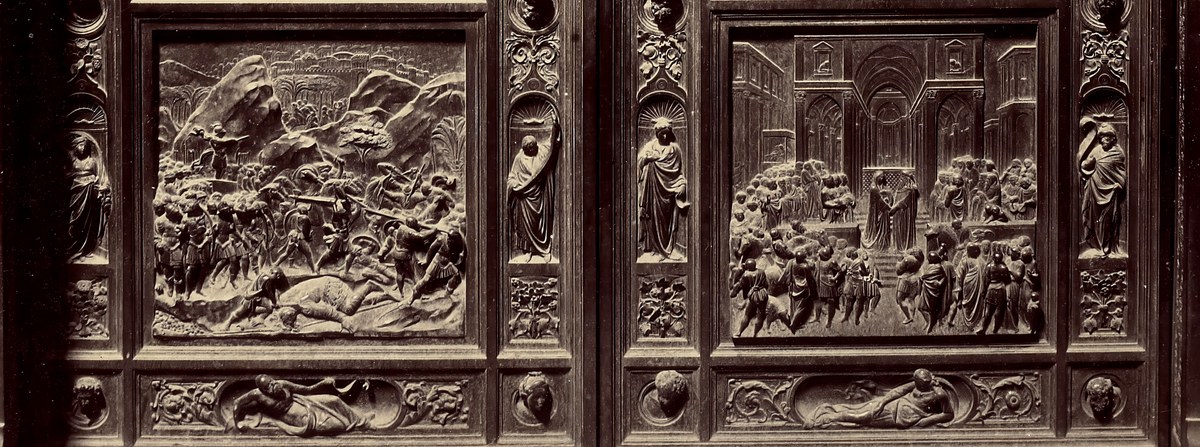
The final panels move from battle and kingship to the ordered ceremonial meeting of Solomon and the Queen of Sheba.
Figures, heads and botanical frame
Prophets, heads, animals and plants make the frame an active sculptural programme rather than a neutral border. [1]
Discussion
Ghiberti rewards slow looking: relief, gilding, narrative structure, workshop practice and conservation evidence can all change how a work is read.
Join the Conversation
Have an observation about Gates of Paradise, a source to add, or a comparison that sharpens the reading? Share it below.
References
- Opera di Santa Maria del Fiore, Gates of Paradise.
- Amy R. Bloch, *Lorenzo Ghiberti's Gates of Paradise*, introduction.
- Opificio delle Pietre Dure, conservation intervention (in Italian).