 by Tom Gurney
Tom Gurney BSc (Hons) is an art history expert with over 20 years experience
Published on June 19, 2020 / Updated on July 28, 2026
Email: tomgurney1@gmail.com / Phone: +44 7429 011000
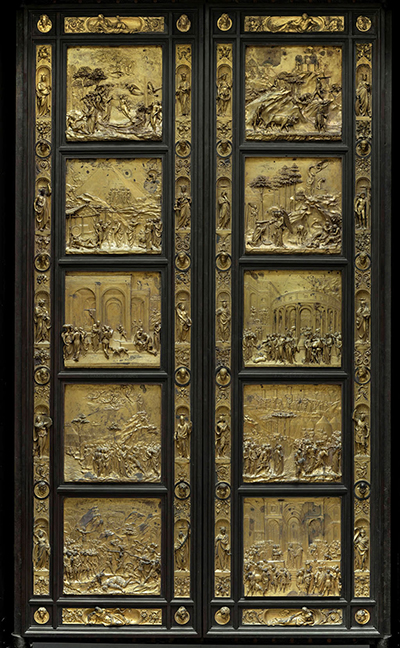
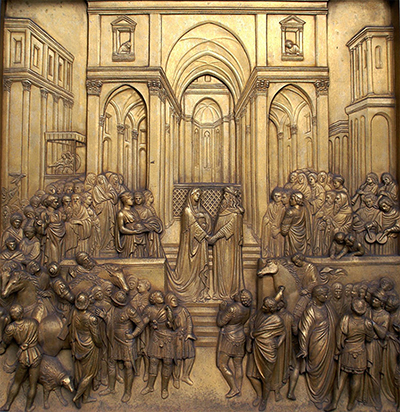
The final panel of Lorenzo Ghiberti's Gates of Paradise replaces the conflicts and separations of the preceding stories with a ceremonial meeting. Solomon and the Queen of Sheba approach one another at the centre of a symmetrical architectural setting, accompanied by their courts. The scene concludes the doors through balance, recognition and encounter rather than through another crowded sequence of violence or deception.[2]
Contents
- The concluding panel
- Solomon and the Queen
- Architecture and symmetry
- A different kind of narrative
- Typology and the Council of Florence
- From division to reunion
- Relief, crowd and hierarchy
- Reading the end of the Gates
The concluding panel
The relief occupies the lower-right position on the Gates of Paradise. Opera del Duomo's catalogue identifies it as the Meeting of Solomon and the Queen of Sheba and records its original location on the Baptistery's east doors. The original gilded bronze is now in the Museo dell'Opera del Duomo; the exterior doors are replicas.[1]
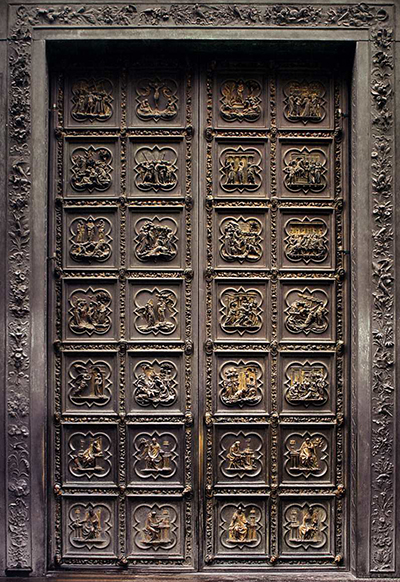
Ghiberti's final programme differs from Leonardo Bruni's earlier proposal, which called for more numerous scenes in quatrefoil frames and concluded with the Judgement of Solomon. The surviving door instead contains ten square narrative fields and ends with the Queen's visit. The precise process by which that change was decided is not fully documented.
Solomon and the Queen
The two rulers meet near the central axis. The Queen approaches from the left, accompanied by women and members of her court. Solomon stands to the right with servants, musicians and seated courtiers. Their gestures create a controlled encounter rather than a sudden dramatic climax.
The bilateral arrangement gives each side comparable visual weight. Differences in clothing, attendants and direction preserve the identity of the two groups, but the central meeting draws them into a common order. The relief's subject is therefore expressed not only by the protagonists but by the relation between their communities.
Architecture and symmetry
A large central arch dominates the setting, flanked by smaller openings and surmounted by windows and a horizontal entablature. Steps lead towards an open space where the courts gather. Pilasters, arches and repeated verticals organize the crowd into depth without losing the frontal stability appropriate to the final panel.
The architecture is more than a perspective exercise. It produces a shared ceremonial space. Earlier Gates panels often use terrain or buildings to separate successive moments; here the dominant structure brings two processions together beneath one visual centre.
A different kind of narrative
Many panels on the Gates repeat protagonists across several episodes. The Solomon relief is more concentrated. Its principal action is a meeting, and its meaning develops through arrangement, approach and recognition rather than through a long chain of events.
This concentration makes the panel feel conclusive. The viewer has descended through stories of creation, rivalry, betrayal, law, warfare and conquest. At the bottom of the doors, movement from two sides resolves into a balanced encounter.
Typology and the Council of Florence
Opera del Duomo's catalogue discusses Christian typological interpretations of Solomon and the Queen and connects the meeting with ideas of ecclesiastical unity. It also presents a proposed relationship with the Council of Florence, where eastern and western churches pursued reunion in 1439.
These readings are important parts of the panel's scholarly interpretation, but they are not equivalent to a surviving commission document that explicitly orders Ghiberti to commemorate the council. They should therefore be introduced as interpretations supported by the subject, date and later programme analysis—not as uncontested facts.
The panel can sustain several levels of reading at once. It depicts a biblical royal visit; it can function typologically within a Baptistery programme; and later viewers can associate its balanced meeting with Florentine hopes for religious and civic concord.
From division to reunion
The official catalogue proposes that the descending sequence of the Gates repeatedly explores separation: humanity from God, brother from brother and family members through betrayal. The final meeting then provides a visual image of recomposition.
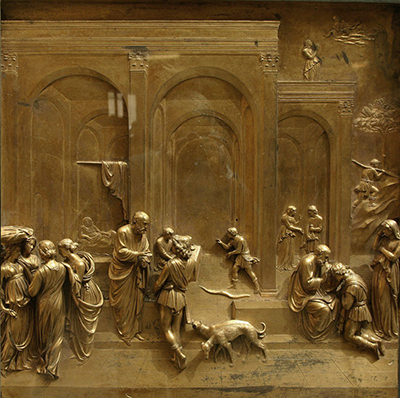
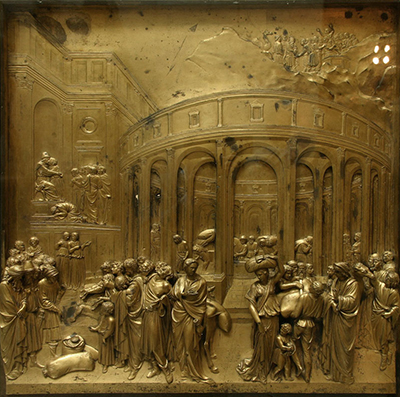
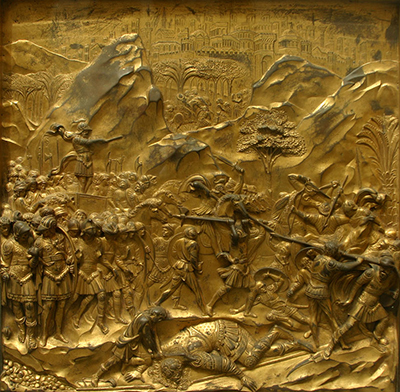
Whether or not a viewer accepts every element of this interpretive scheme, the formal contrast is visible. The Joseph panel contains separation followed by reconciliation; David contains battle followed by triumph; Solomon presents two ordered groups converging without a depicted conflict. Its symmetry makes reunion perceptible before any theological explanation is supplied.
Relief, crowd and hierarchy
The two courts contain many figures, yet the central pair remains legible. Stronger foreground projection and clearer spacing around Solomon and the Queen distinguish them from the seated and standing attendants. Figures recede beneath the arches in progressively shallower relief.
Ghiberti described using measure and low relief to make near figures appear larger and remote figures smaller. Here those devices serve ceremony rather than battle. Depth expands the scale of the gathering, while symmetry holds that expansion under control.[3]
Reading the end of the Gates
Start with the central meeting, then trace the Queen's attendants to the left and Solomon's court to the right. Follow the steps and arches into depth before returning to the protagonists. This outward-and-back movement reveals how the panel balances plurality with unity.
As the conclusion to the Gates of Paradise, the relief should be read in relation to the panels above it. Its calm does not erase their conflict. Instead, it offers a final image in which difference is organized into encounter—an ending expressed through bodies, architecture and the shared brilliance of gilded bronze.
Discussion
Ghiberti rewards slow looking: relief, gilding, narrative structure, workshop practice and conservation evidence can all change how a work is read.
Join the Conversation
Have an observation about Solomon and the Queen of Sheba, a source to add, or a comparison that sharpens the reading? Share it below.
References
- Opera del Duomo, Meeting of Solomon and the Queen of Sheba (in Italian)
- Opera del Duomo, Gates of Paradise
- Lorenzo Ghiberti, I Commentarii, ed. Julius von Schlosser (Berlin, 1912), printed pp. 48–50.