 by Tom Gurney
Tom Gurney BSc (Hons) is an art history expert with over 20 years experience
Published on June 19, 2020 / Updated on July 28, 2026
Email: tomgurney1@gmail.com / Phone: +44 7429 011000
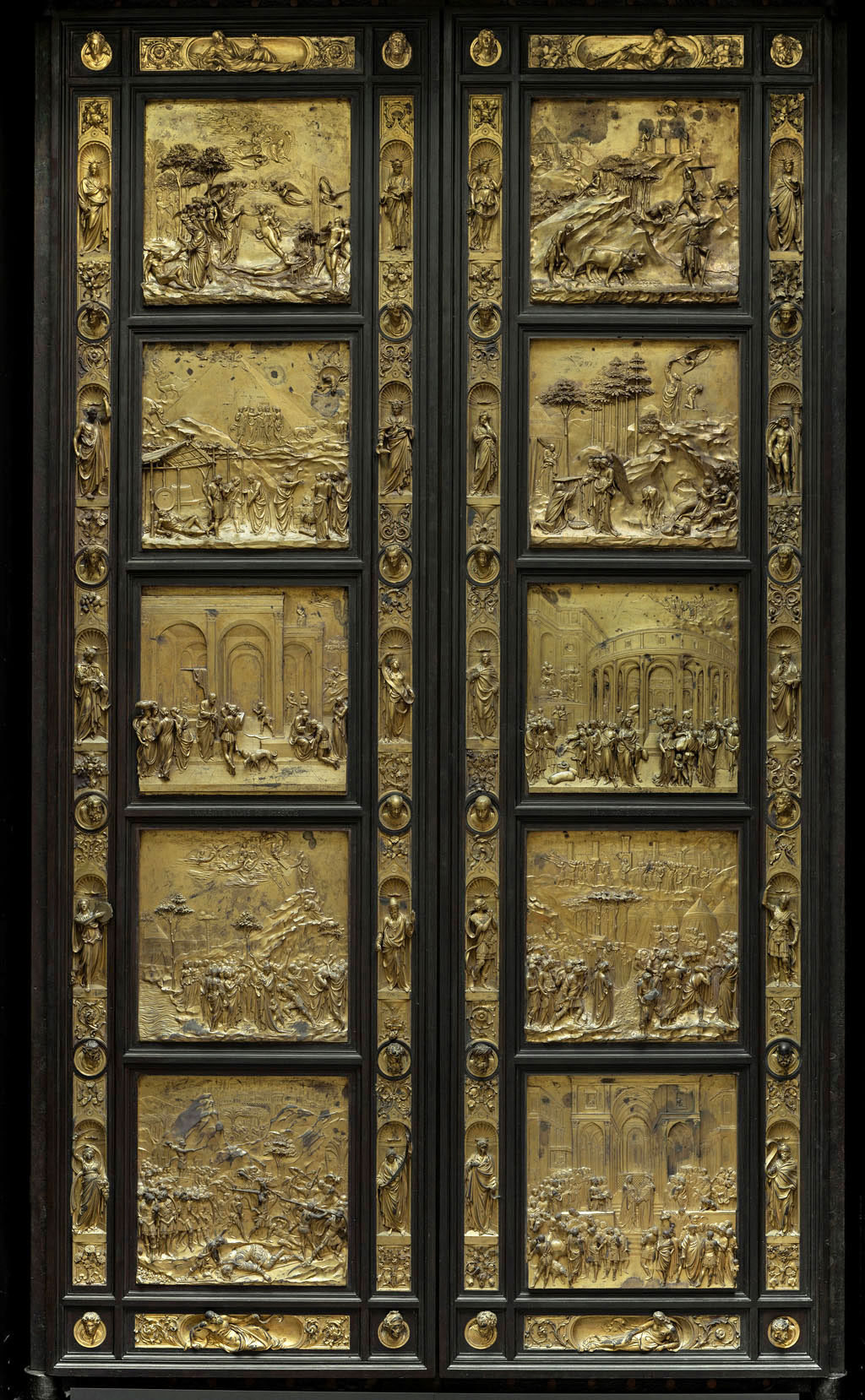
Ghiberti's bronze doors were created for fixed architectural settings, but most people have encountered them through another medium. Engravings, casts, photographs, museum replicas and commercial prints translate the doors into different scales and surfaces. These reproductions expanded the works' audience while also changing what viewers could see.
Contents
- Why reproduce a monumental door?
- Casts, Mengs and eighteenth-century looking
- Gregory and Patch, 1774
- Gozzini and Lasinio, 1821
- Kalmuk's twelve engravings
- Photography and detail
- Originals, replicas and museum display
- Modern prints and wall reproductions
- How to read a reproduction responsibly
Why reproduce a monumental door?
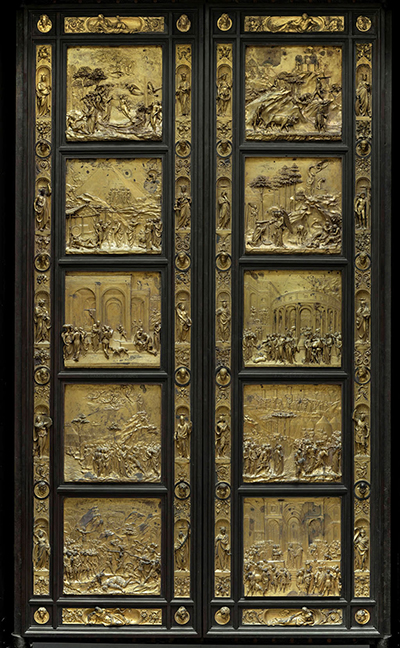
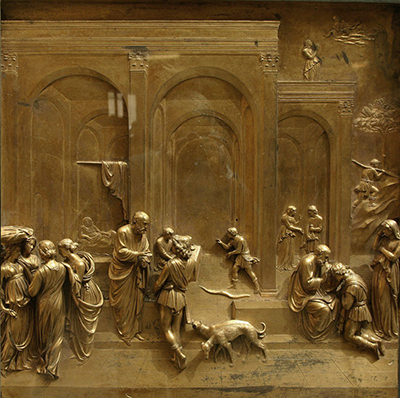
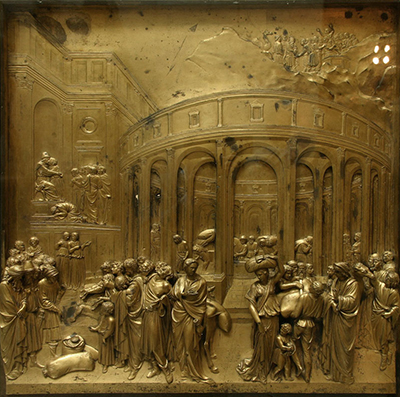
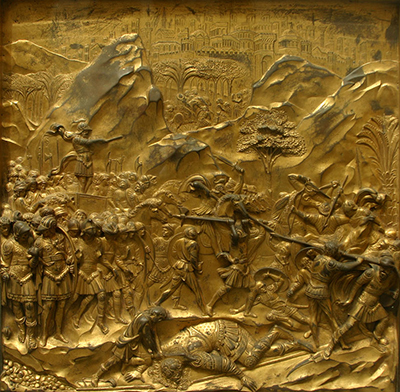
The Gates of Paradise are approximately 5.2 metres high and weigh around eight tonnes. Their ten panels form only part of an ensemble that includes heads, statuettes, plants and animals. A visitor in Florence could see the complete doorway but not necessarily inspect every shallow detail.[3]
Reproduction solves one problem by creating others. An engraving can clarify contour but cannot reproduce gilded light. A cast preserves relief but changes material and colour. A photograph can isolate a detail while losing architectural scale. Understanding those transformations is essential when using a reproduction as evidence.
Casts, Mengs and eighteenth-century looking
In 1772, Anton Raphael Mengs obtained permission to have casts made from the Gates reliefs. Opera del Duomo's catalogue places this episode within the door's reception and cleaning history. The ability to remove three-dimensional information from Florence allowed artists and collectors to study relief depth elsewhere.[2]
Casting is not mechanically neutral. Moulding records a surface at a particular moment, including wear, dirt or damage. The cast material responds differently to light from gilded bronze, and its installation may separate a panel from the surrounding frame.
Gregory and Patch, 1774
The 1774 publication The Gates of the Baptistery of St. John in Florence, associated with Gregory and Patch, was an early attempt to circulate the doors through prints. Opera del Duomo includes it in the bibliography of the individual panels.
Such volumes allowed comparison and repeated study without travel. They also placed the engraver between Ghiberti and the reader. Line, shadow and emphasis had to be reinvented in ink, making each plate an interpretation as well as a record.
Gozzini and Lasinio, 1821
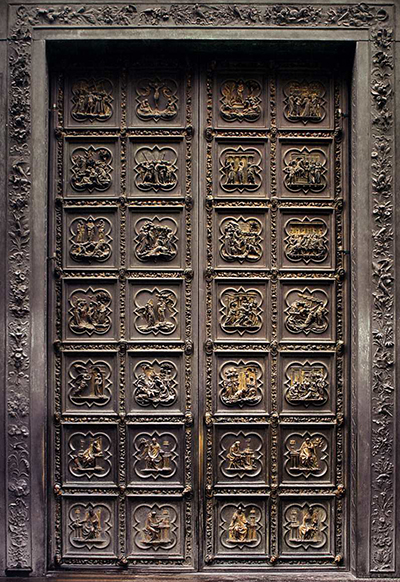
Vincenzo Gozzini and Giovanni Paolo Lasinio's Le tre porte del Battistero di San Giovanni a Firenze: incise e illustrate appeared in 1821. Its title is important: the project considered all three Baptistery door campaigns rather than isolating the Gates.
Engraved reproduction made programme and comparison portable. Readers could place panels side by side, examine narrative sequence and study works that remained exposed outdoors. At the same time, monochrome plates encouraged formal attention to contour and modelling at the expense of bronze colour, gilding and environmental light.
Kalmuk's twelve engravings
The Metropolitan Museum of Art holds Feodor Ivanovich Kalmuk's Gates of Paradise, a set of twelve engravings made after Ghiberti. The museum record supplies a direct object anchor for this history of reproduction.[1]
The set demonstrates that reproductions are collection objects in their own right. They have an artist, date, technique and institutional history. Describing them merely as images “of Ghiberti” would erase the decisions involved in translating sculpture into print.
Photography and detail
Photography changed access again. A camera could record the complete door, isolate one panel or enlarge a head, figure or botanical ornament beyond what a street viewer could see. Historic photographs also preserve earlier surface conditions and display arrangements.
Yet photographs remain selective. Direction of light can flatten or exaggerate relief. Black-and-white images suppress gilded colour; strong contrast may make corrosion resemble intentional modelling. Cropping can turn one episode from a continuous narrative into an apparently independent work.
Originals, replicas and museum display
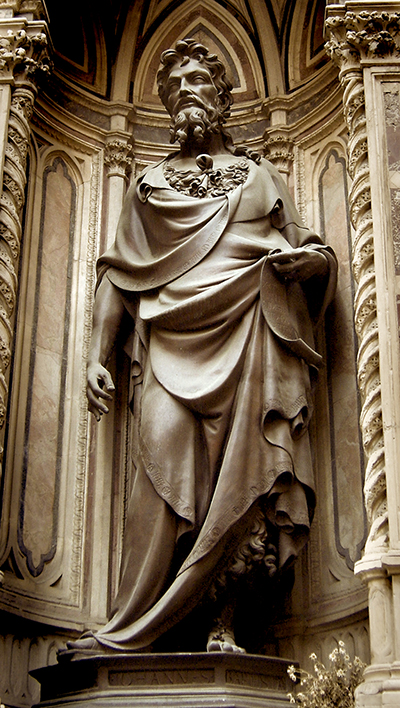
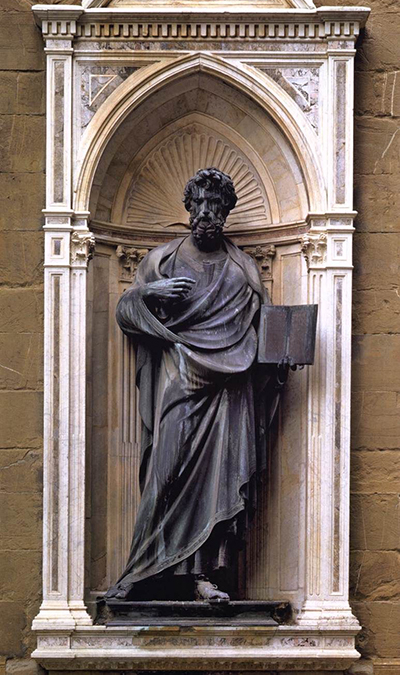
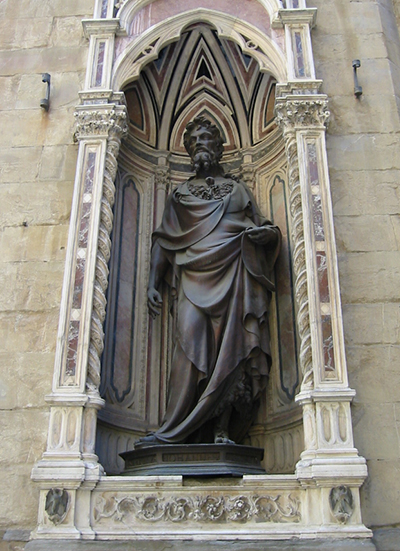
The original Gates are protected in the Museo dell'Opera del Duomo, and replicas occupy the Baptistery exterior. The original Orsanmichele sculptures are similarly housed in the museum while copies stand in the niches. Captions must say which object a photograph shows.[4]
Exterior replicas retain architectural placement and street viewing. Museum originals preserve Ghiberti's bronze and permit controlled close looking. Neither context replaces the other; each answers a different question.
Modern prints and wall reproductions
Commercial products may use photographs of the whole doors or selected panels. Their quality varies with source image, crop, colour management, paper and declared licence. A seller's title does not guarantee that an image shows the original rather than a replica, or that its colours accurately represent gilded bronze.
Before choosing a modern reproduction, check the depicted object, photographer or source institution, dimensions, crop and material. Product availability, prices and return terms are volatile and should be verified at the time of purchase rather than embedded permanently in an art-historical account.
How to read a reproduction responsibly
Ask five questions:
- Is this the original, an architectural replica, a cast, an engraving or a photograph?
- Does it show the complete door, one panel or a cropped episode?
- What scale has been lost or created?
- How has the medium changed relief, colour and light?
- Is the creator and licence identified?
Reproductions do not simply weaken contact with the original. They can reveal details, preserve past conditions and make comparison possible. Their value increases when their transformations are acknowledged rather than hidden.
Discussion
Ghiberti rewards slow looking: relief, gilding, narrative structure, workshop practice and conservation evidence can all change how a work is read.
Join the Conversation
Have an observation about Ghiberti Prints, a source to add, or a comparison that sharpens the reading? Share it below.
References
- Metropolitan Museum of Art, Kalmuk's Gates of Paradise engravings
- Opera del Duomo scientific catalogue, Gates of Paradise (in Italian)
- Opera del Duomo, Gates of Paradise
- Musei del Bargello, Orsanmichele