 by Tom Gurney
Tom Gurney BSc (Hons) is an art history expert with over 20 years experience
Published on June 19, 2020 / Updated on July 28, 2026
Email: tomgurney1@gmail.com / Phone: +44 7429 011000
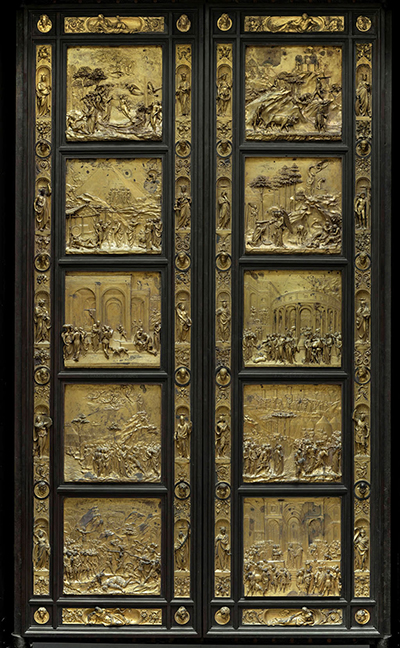
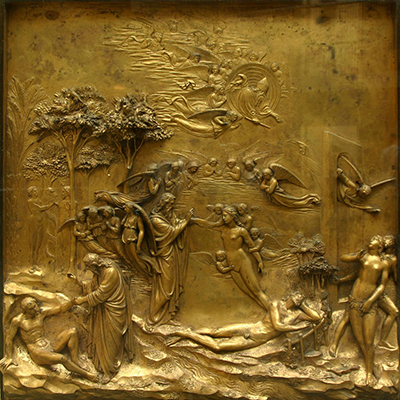
The Adam and Eve panel begins Lorenzo Ghiberti's Gates of Paradise with the creation of humanity, the Fall and the expulsion from Eden. Rather than dividing these events into separate compartments, Ghiberti places repeated figures of Adam and Eve within one continuous landscape. The panel establishes a method used throughout the doors: successive moments become parts of a single visual field, organized by relief depth, gesture and position.
Contents
- The first panel of the Gates
- Creation of Adam
- Creation of Eve
- Temptation and Fall
- Expulsion from Eden
- Relief depth and distance
- How to read the panel
The first panel of the Gates
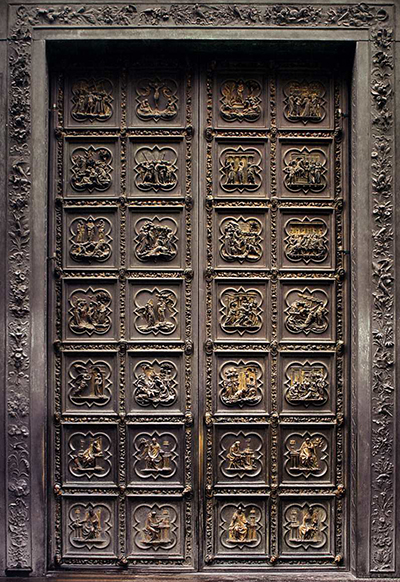
The Gates of Paradise were made between 1425 and 1452 for the Baptistery of San Giovanni in Florence. Their ten large square panels replaced the twenty-eight quatrefoil compartments used on the earlier bronze doors. The official Opera del Duomo sequence begins at the upper left with the creation of Adam and Eve and proceeds across and down through Old Testament history.[1]
The original doors are now displayed in the Museo dell'Opera del Duomo. Replicas stand on the Baptistery's eastern exterior. This museum setting protects the gilded bronze and permits close examination of surfaces that were designed to be read within a much larger doorway.
The Met's exhibition account identifies the creation of Adam, creation of Eve, temptation and expulsion as the principal episodes. Its object gallery records the panel at approximately 31.5 inches square.[2][3]
Creation of Adam
Adam's creation occupies the lower-left region. His body rises from the earth while God and a company of angels support the event from above. The pose connects human anatomy with the curving ground: Adam appears both newly formed from the landscape and already capable of movement.
The episode is not isolated by a frame within the panel. Open ground around the body separates it from the other events, while the direction of divine and angelic attention identifies the action. Ghiberti uses landscape as a narrative boundary without turning it into a wall.
Creation of Eve
The creation of Eve occupies the central area. Eve rises from the sleeping Adam as God draws her upward. The composition is more vertical than the creation of Adam, giving the new figure a clear upward movement and placing divine action near the visual centre.
Angels gather around the group in different degrees of projection. Some bodies emerge strongly from the bronze; others are shallower. The changes make the company appear to occupy a space rather than a single metallic plane. They also allow light to move unevenly across the gilded surface, strengthening the distinction between principal actors and their celestial witnesses.
Temptation and Fall
Elsewhere in the garden, Adam and Eve appear again beside the tree. The serpent, temptation and taking of the forbidden fruit are condensed into a small but recognizable exchange. Ghiberti assumes that the viewer can identify the protagonists across repeated appearances. Narrative continuity depends on recognition rather than on a separate portrait or label for every moment.
This repetition should not be mistaken for confusion or careless crowding. Each version of Adam and Eve belongs to a different action, and the surrounding landscape directs the eye between them. The panel asks the viewer to move through time by moving across the bronze.
Expulsion from Eden
The expulsion provides the strongest directional movement. Adam and Eve leave the garden under angelic command, their bodies now marked by shame and urgency. The transition from the calm, supported acts of creation to the contracted poses of exile gives the panel an emotional sequence as well as a chronological one.
Ghiberti does not treat Eden as a fully enclosed architectural stage. Trees, rocks and changes in ground create zones that remain visually connected. This continuity makes the expulsion feel like movement out of a known landscape rather than a cut to a completely separate scene.
Relief depth and distance
Ghiberti later described using very shallow relief so that nearby figures appear larger and distant figures smaller. In the Commentarii, as edited by Julius von Schlosser, his discussion of the Gates links low projection, optical measure and the appearance of recession. The Adam and Eve panel shows how that principle could operate without a grand architectural perspective.[4]
Foreground bodies project more strongly and catch emphatic highlights. Angels and secondary forms can be thinner, allowing their edges to merge more gently with the background. The result lies between sculpture and drawing: volume is real, but very small changes in depth create effects associated with pictorial space.
How to read the panel
A useful first reading follows four principal moments: Adam's creation, Eve's creation, the Fall and the expulsion. A second reading should ignore the plot temporarily and follow the movement of bodies: reclining, rising, reaching and finally departing. The contrast reveals how Ghiberti made posture carry narrative time.
The panel also introduces themes that recur across the Gates: repeated protagonists, divine and human action within the same field, landscape as an organizer, and gilded relief changing with light. Its importance is therefore not merely that it comes first. It teaches the viewer how the remaining panels can be read.
Discussion
Ghiberti rewards slow looking: relief, gilding, narrative structure, workshop practice and conservation evidence can all change how a work is read.
Join the Conversation
Have an observation about Adam and Eve, a source to add, or a comparison that sharpens the reading? Share it below.
References
- Opera del Duomo, Gates of Paradise
- Metropolitan Museum of Art, The Gates of Paradise
- Metropolitan Museum of Art, exhibition object gallery
- Lorenzo Ghiberti, I Commentarii, ed. Julius von Schlosser (Berlin, 1912), printed pp. 48–50.