


 by
Tom Gurney
Tom Gurney BSc (Hons) is an art history expert with over 20 years experience
Published on June 19, 2020 / Updated on October 22, 2026
Email:
tomgurney1@gmail.com
/ Phone:
+44 7429 011000
Dürer’s Adam and Eve, 1507: Introduction
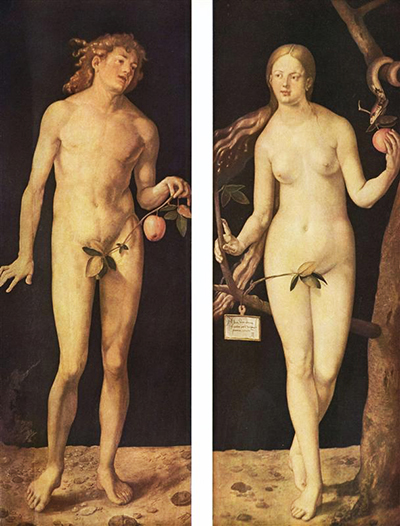
Adam leans towards Eve with his mouth slightly open. Eve looks across at him while holding a red apple beside the serpent’s head. Between these small movements stretches the space separating two tall paintings. Dürer has made the first human couple almost share our scale, yet each occupies a narrow field of darkness. Their encounter happens across the division as much as within either picture.
Painted in 1507, the pair belongs to the Museo Nacional del Prado in Madrid. Both are oils on panel, 209 centimetres high; Adam , inventory P002177, measures 81 centimetres across, and Eve , P002178, 80. [12] [13]
At a Glance
- Date 1507 [12] [13]
- Medium Oil on panel [12] [13]
- Collection Museo del Prado, Madrid; P002177 and P002178 [12] [13]
This work across Albrecht Dürer’s career
Young Hare
1502Praying Hands
1508Melencolia I
1514Four Apostles
1526Contents
- Two bodies and the space between them
- Adam’s suspended movement
- Eve, the apple and the serpent
- Italy, drawing and the painted hand
- What changed after the 1504 engraving?
- Proportion, grace and the signed date
- A pair passed between courts
- What conservation recovered
- Frequently Asked Questions
Two bodies and the space between them
The darkness gives the figures exceptional clarity. There is no distant view to draw the eye beyond them, no architecture to establish their social world, and little vegetation to suggest the abundance of a garden. Adam’s loosely held branch and the tree beside Eve provide the principal surviving framework of Eden. A shallow strip of stony earth supplies somewhere for their feet to stand. Almost everything else yields to the contours of skin.
The narrowness of each panel matters. Adam’s lowered hand approaches one side while his bent elbow and the hanging apple approach the other. In Eve’s picture, the raised fruit and tree occupy the right side, counterbalancing the long sweep of hair towards the left. Neither figure simply fills an empty rectangle. Their gestures make the edges felt, encouraging us to look from one panel to its neighbour.
Their bodies are paired without being mirror images. Adam’s shoulders slope and his head inclines towards Eve; she holds her head more upright. His feet open away from one another, while her legs overlap in a much tighter arrangement. The differences create an exchange of rhythms: his expansive, hers gathered; his torso turning, hers more directly presented. Their differences make the bodies seem responsive to one another.
The ground connects them at a second level. Small stones, patches of bare earth and cast shadows establish a low, tangible foreground beneath the deep darkness. The feet are important precisely because the upper bodies can appear so weightless. To follow the figures downwards is to see an ideal of bodily grace meet the practical business of standing. Adam’s spread toes and Eve’s overlapping ankles give different answers to that problem.
The division also changes how we experience the story. Our eyes repeatedly cross a space that the painted hands never close. Adam and Eve are near enough to look towards one another, but no embrace joins them and no single handover of fruit unites the panels. Dürer leaves a relation to be completed by looking. The pair works both as two sustained studies of bodies and as an encounter that neither panel can contain alone.
Adam’s suspended movement
Adam's curls catch light in small loops. His mouth is slightly open, while the eyes look towards the other panel. The turned face interrupts the broad, quieter surfaces of his chest and abdomen. It gives us a direction to follow before we begin tracing the arrangement of his limbs.
Below Adam's head, one shoulder rises as the other falls; the chest turns slightly; the hips shift above legs set at different angles. This is contrapposto, a standing arrangement in which the body's weight is distributed unequally. Follow the line from his raised shoulder to the knee beneath it: its changing direction gives the upright figure an irregular, flexible silhouette.
His hands pull in different directions. The lowered hand is open, its separated fingers projecting into the darkness. The other bends at the wrist above the branch. It neither grips the apple nor offers it with a demonstrative gesture. Instead, the fruit hangs below, a rounded weight at the end of a slender stem. The hand, branch and apple form a small suspended arrangement beside the broad modelling of the abdomen.
The leaves crossing his groin make that branch serve two purposes. It belongs to the story of the forbidden fruit and gives the painter a covering for the nude. Its slant cuts across the body’s upright length, introducing a sharp, fragile line against flesh. The apple’s red and yellow surface provides another concentrated accent. Around it, the warm skin moves through much gentler transitions of light and shadow.
Adam’s anatomy is particularly legible across the chest and abdomen, where the light picks out changes in volume without turning every muscle into a separate emblem of strength. Yet the hands and feet retain their own awkward specificity. The figure’s elegance depends on these changes of pace: broad passages invite a distant view, while curls, knuckles, leaves and toes reward a closer one.
Eve, the apple and the serpent
Eve’s silhouette is more continuous. The pale torso flows towards the hips, then narrows into the overlapping legs. Her hair supplies a contrasting movement, streaming leftwards in long strands while the solid tree rises along the opposite side. Against this framework, the raised forearm opens a clear pocket of darkness between arm and body.
The apple rests against long, lightly bent fingers. Above it the serpent loops around the branch before lowering its head towards the fruit. Dürer gives the animal a patterned surface and a taut, curling body, distinct from both the rougher tree and the smooth skin. The encounter is compressed into a very small area. A viewer following the bright arm upwards arrives at temptation through the shape of a hand.
Below, Eve’s other hand holds a branch. Its upright portion gives her fingers something slender to clasp; another portion passes across the hips, carrying a small group of leaves. The hanging inscription occupies the dark space nearby. These objects complicate the impression of effortless display. Several different kinds of holding and suspension surround a body whose balance itself looks delicate.
The face adds restraint. Eve does not look down at the apple or follow the serpent with her eyes. Her sideways glance carries our attention towards Adam, while the fruit remains raised at the other side. We read two directions at once: the connection between the human figures and the encounter between hand, apple and snake. This division prevents the narrative from resolving into a single obvious gesture.
Genesis 3 describes the woman taking the fruit, eating and giving it to her husband. It does not identify the fruit as an apple. Only afterwards do the couple recognise their nakedness and make coverings from fig leaves. Dürer brings fruit, exposure and leafy concealment together in a single arrangement. The pictures compress the narrative into recognisable objects and bodily relations rather than illustrating every action in sequence. [19]
That compression is especially effective because neither figure is shown biting. The fruit retains its rounded completeness, holding the composition around a consequential action without supplying a visibly decisive instant. Eve’s poised fingers, Adam’s answering attention and the serpent’s lowered head make the possibility of action more compelling than a busy account of its consequences would have been.
The chapter also gives their exposure a future. Adam will eat through labour; the ground will produce thorns and thistles; the couple will leave the garden. God makes them garments of skins before their expulsion. Read against that sequence, the paintings' bare feet and unworked ground become particularly quiet. There is no spade, labouring body or visible punishment here. Those later events belong to the story that the apples call to mind, while the images hold us before their arrival. [19]
Italy, drawing and the painted hand
The paintings' date falls at the end of Dürer's second Italian stay, 1505–07. A more intimate connection with their making survives in Cleveland's Arm of Eve : a 1507 study in brush, grey and black wash, and white gouache on blue laid paper, 34.4 by 26.7 centimetres. Cleveland identifies it as the pair's only surviving preparatory drawing and explains that its blue was introduced during papermaking. [20] [21]
The cropped upper arm, elbow, forearm and apple-bearing hand make an ascending zigzag across the sheet. Dark strokes accumulate beneath the forearm; white touches run towards the wrist and fingers. Against the blue, the brightest marks seem to lift the hand towards us. In the painting, that same small action must hold its own beside a snake and a tree. The sheet lets us concentrate on the turning limb and the contact of fingertips with fruit. [21]
What changed after the 1504 engraving?
Dürer's earlier Adam and Eve is an engraving dated 1504; the Metropolitan Museum's impression 19.73.1 measures 25.1 by 20 centimetres. The Met interprets four of its animals through the medieval temperaments. Its crowded forest and animal foreground make a striking comparison with the paintings' darkness. A central trunk divides the printed couple, yet Eve's lowered fruit and Adam's empty hand draw attention into the middle. In the paintings the fruit moves towards the outer sides, while Adam's lowered hand opens towards the opposite edge. Colour gives the painted apples a concentrated redness. Line gives the engraved leaves, bark and skin distinct densities. Both versions invite close inspection, but the narrow painted panels spread the action across two separate fields. [17]
Proportion, grace and the signed date
The Prado describes the figures as nine heads high, replacing an eight-head scheme. Dürer's own later writing makes proportion a more open question than the idea of a single perfect body might suggest. His Four Books of Human Proportion appeared posthumously in 1528, more than twenty years after these paintings. [22] [20]
In passages translated by William Martin Conway, Dürer doubts that anyone can identify the best possible proportions with complete confidence. Human judgements change; one beautiful person may differ from another in every measurement. This does not lead him to abandon study. It makes the artist's task more demanding: to learn enough about bodies to make convincing choices while recognising that a successful figure is not the last imaginable word on beauty. [23]
Knowing a canon, he insists, cannot make an unpractised hand draw well. A person may possess the measurements and still spoil the figure in outlining it. Conversely, a skilled draughtsman can improve on a prescribed design. Curves must be followed from point to point: the turns of a forehead, cheek, mouth or chin cannot all be settled with a compass. The measured body still requires a hand capable of the small, continuous decisions through which it becomes visible. [23]
His concern with the whole body is equally practical. A youthful head should not be assembled with an old chest and middle-aged hands. He recommends studying many people, gathering observations while maintaining a coherent kind of figure. These are historically situated ideals, not a neutral definition of which bodies possess value: his surrounding discussion contains prejudices about race and physical difference. Yet he also allows trained artists to work from accumulated knowledge. Repeated study can educate the eye and hand until an apparently easy stroke carries years of experience. His later account illuminates the work of constructing a body without documenting a particular model or studio sitting for these panels. [23]
The signed tablet beside Eve brings us back to the painting's own moment. It names Dürer as German, gives 1507 and adds his AD. Its phrase post virginis partum reckons the year after Christ's birth; it does not prove completion after Christmas 1507. The straight frame interrupts the curves of hair and twigs, while Adam's separate AD sits near the stones at lower right. Authorship enters the pair at different heights and in different forms. [13] [12]
Silva Maroto reads the Virgin reference through Mary as the New Eve, whose child brings redemption. She connects the affected gestures with later Mannerism, a name for the figures' studied, artificial grace. [13]
A pair passed between courts
The patron is unknown. Nuremberg's council gave the pair to Rudolf II; Swedish forces took it from Prague in 1648. Christina gave it to Philip IV in 1654. The Prado's 2024 Female Perspective II places the gift within her relationship with the Spanish king around her abdication and conversion to Catholicism, when she sought his support. Royal collecting here was also an exchange between courts, giving the German pair a new political setting. [22] [24]
Its later survival involved a different argument about what a nude painting was for. In a letter of 18 August 1795, published from the Academy of San Fernando's archive in 1921, Alejandro de la Cruz recalled accompanying Mengs in 1762 to select royal pictures considered too exposed to survive. His list expressly includes Dürer's Adam and Eve . He remembered Mengs taking the pictures home and persuading the minister Esquilache that they were useful for his pupils to study, thereby suspending the destruction order. [25]
The letter is a retrospective account, written more than thirty years after the event, rather than the original royal instruction. It also had a practical purpose: de la Cruz wanted a missing Titian traced and preserved. Its particularity matters. Dürer's nudes were recalled among works by Titian, Rubens and other painters whose artistic value could be urged against their supposed indecency. Teaching offered a reason to save the objects, even when their display remained unacceptable. [25]
The documents printed with the letter show how narrow that protection could be. A list associated with the Academy's receipts of royal nudes in 1792 and 1796 names Adam and Eve separately, under the Buen Retiro numbers 1067 and 1068. The paintings were to be kept in closed rooms, accessible to those who needed to study them. Preservation and concealment belonged to the same arrangement: entering a place devoted to art did not automatically bring an unrestricted audience. [25]
An instruction of 5 July 1793 makes the restriction unusually tangible. The Marqués de Santa Cruz conveyed the king's renewed demand that the rooms stay closed, even during the Academy's public prize distribution. Bernardo de Iriarte replied that he had already reserved the most exposed pictures and now had all the entrusted paintings placed in complete seclusion. These letters concern the group of royal nudes, rather than describing a visitor standing before Dürer's panels, but the named list places the pair within that institutional history. The distinction between seeing for study and seeing for pleasure was being enforced through doors and permission. [25]
Access could change again. In February 1809, the minister Manuel Romero ordered celebrated originals brought from obscurity into the Academy's principal rooms, where pupils could study, artists could examine and imitate, and lovers of art could enjoy them. The archival account records renewed restriction after 1813. A delivery letter dated 3 April 1827 then acknowledges the transfer of the reserved collection to the Royal Museum. The Prado dates the pair's public display to 1838. Its biblical identity had travelled with it throughout these changes, while the terms on which people could look at its naked bodies repeatedly shifted. [22] [25]
What conservation recovered
The backs preserve different histories. Eve retained a porphyry-like reverse; Adam's thinned wood had split beneath a rigid cradle. Bisacca and José de la Fuente repaired Adam, which regained a curvature matching Eve's, and fitted a spring support allowing movement. Maite Dávila's cleaning recovered flesh modelling beneath darkened coatings. Repairing wood and paint together improved the bodies' continuity: broken supports and altered contrasts both affected their apparent solidity. [26] [22]
The project also became a means of preserving the knowledge needed to care for such objects. The Getty Foundation's 2018 report identifies these panels as the first training-grant project of its Panel Paintings Initiative. Experts from the Prado and Metropolitan Museum worked with trainees who observed and contributed to the treatment. The report describes a wider problem: too few people possessed the combination of woodworking skill and aesthetic judgement needed for wooden paintings, and many leading specialists were nearing retirement. [27]
José de la Fuente explains in that report why the support deserves attention as part of the artwork itself. Treating a panel involves decisions about the painted image as well as the timber underneath it. The training programme therefore combined practical work with study of materials, historical interventions and the judgement needed to choose a treatment. Dürer's pair helped transmit that expertise while receiving care itself. The paintings returned to view in 2010. [22] [27]
Look again at Eve's hand and the serpent's head. The bright, rounded fruit separates them, close enough to make contact seem imminent. Across the division, the other apple hangs from Adam's much longer branch. These two small red forms punctuate an expanse dominated by skin and darkness. They hold our attention on the action that the poised bodies have yet to complete.
Frequently Asked Questions
Artworks directory
These 187 records include individual works, reverse sides, detail views, paired panels and reconstructed arrangements. Three additional catalogue images repeat works already listed. Related views are not counted as separate originals; qualified attributions and published dating are retained.
Discussion
Look again at the images and ideas explored in Dürer’s Adam and Eve, 1507. These editorial prompts invite your observations.
Reader Insights
Which detail or idea in Dürer’s Adam and Eve, 1507 most changed your reading, and why?
How does the discussion of “Two bodies and the space between them” affect your understanding?
What comparison would you bring to the discussion of “What conservation recovered”?
Join the Conversation
Share a detail, comparison or question about Dürer’s Adam and Eve, 1507 below.
References
- S. R. Koehler, A Chronological Catalogue of the Engravings, Dry-Points and Etchings of Albert Dürer (New York: Grolier Club, 1897), selected dated print entries, including p.37, no.34. Original English edition. View source.
- Charles Ephrussi, Albert Dürer et ses dessins (Paris: A. Quantin, 1882). French original edition; selected catalogue entries and illustrations. View source.
- Campbell Dodgson, Catalogue of Early German and Flemish Woodcuts Preserved in the Department of Prints and Drawings in the British Museum, vol. I (London: British Museum, 1903). Original English edition; selected Dürer book and print entries. View source.
- Heinrich Wölfflin, Die Kunst Albrecht Dürers, second enlarged edition (Munich: F. Bruckmann, 1908), p.178 and facing Prado pair plate, with selected catalogue entries. German original edition. View source.
- Moriz Thausing, Dürer: Geschichte seines Lebens und seiner Kunst (Leipzig: E. A. Seemann, 1876), pp. 303–309. German original edition. View source.
- Burlington Fine Arts Club, Exhibition of Early German Art (London, 1906), p. 24, no. 38. Original English exhibition catalogue. View source.
- National Gallery of Art, Annual Report 1974 (Washington, 1975), printed p. 23 (PDF p. 25). English. View source.
- Max J. Friedländer, Die Zeichnungen von Matthias Grünewald (Berlin, 1927), printed pp. 9–11, catalogue no. 26 and plate 26. German. View source.
- Moriz Thausing, Albert Dürer: His Life and Works, vol. II, translated from the German, edited by Fred. A. Eaton (London: John Murray, 1882), pp. 16–18. Historical English edition. View source.
- Friedrich Winkler, Die Zeichnungen Albrecht Dürers, four volumes (Berlin, 1936–1939), selected entries, including vol.II (1937), nos.357 and431, pp.73–74 and111–112; vol.III (1938), no.512, pp.7–8. German.. View source.
- Stijn Alsteens and Freyda Spira, Dürer and Beyond: Central European Drawings in The Metropolitan Museum of Art, 1400–1700 (New York: The Metropolitan Museum of Art, 2012), p.15, fig.2. English. View source.
- Museo Nacional del Prado , Adam , P002177, object record. View source .
- Museo Nacional del Prado , Eva , P002178, object record and essay (Spanish). View source .
- Bayerische Staatsgemäldesammlungen, Selbstbildnis im Pelzrock, inv. 537 (German). View source.
- ALBERTINA, Feldhase, inv. 3073 (German). View source.
- ALBERTINA, Das große Rasenstück, inv. 3075 (German). View source.
- Metropolitan Museum of Art , Adam and Eve , 19.73.1, object record and essay. View source .
- Bayerische Staatsgemäldesammlungen, Vier Apostel: Hll. Johannes Ev. und Petrus, 1526, inventory 545. German collection record and shared paired-panel commentary.. View source.
- Genesis 2–3 , King James Bible, 1611, original page scans; English translation. View source .
- ALBERTINA , Albrecht Dürer , 2019 press dossier, pp.16–17 (German). View source .
- Cleveland Museum of Art , Arm of Eve , 1965.470, object record. View source .
- Silva Maroto, Dávila and de la Fuente , Adam and Eve following restoration , Prado, 2010–11. View source .
- Albrecht Dürer, writings on proportion, in William Martin Conway, Literary Remains of Albrecht Dürer (Cambridge,1889), pp.243–250 and selected references to dated works used in the directory. Historical English edition.. View source.
- Museo Nacional del Prado , The Female Perspective II , 2024, Christina of Sweden section. View source .
- N. Sentenach , Cuadros famosos condenados al fuego , Boletín de la Real Academia de Bellas Artes de San Fernando , 57, 1921, pp.46–54; archival documents (Spanish). View source .
- George Bisacca , Adam and Eve: A wonderful experience , Prado oral-history segment. View source .
- Getty Foundation , Panel Paintings Initiative: Impact Report , 2018, pp.3–13, 17–18. View source .
- Germanisches Nationalmuseum, Barbara Dürer (German and English). View source.
- Web Gallery of Art, Tucher–Rieter reverse (English). View source.
- National Gallery of Art, Portrait of a Clergyman (English). View source.
- Dürer Art, Portrait of a Man (English). View source.
- Hessen Kassel Heritage, Elsbeth Tucher (German). View source.
- Web Gallery of Art, Hans Tucher (English). View source.
- Germanisches Nationalmuseum, Emperor Maximilian I (German and English). View source.
- National Gallery of Art, Lot and His Daughters, reverse (English). View source.
- Bayerische Staatsgemäldesammlungen, Glim Lamentation (German). View source.
- Museo Nacional del Prado, Portrait of a Man (Spanish). View source.
- Bayerische Staatsgemäldesammlungen, Madonna of the Carnation (German). View source.
- Städel Museum, Job on the Dungheap (German). View source.
- Wallraf-Richartz-Museum, Piper and Drummer (German). View source.
- Italian Ministry of Culture / Uffizi, Head of Saint James (Italian). View source.
- Klassik Stiftung Weimar, Dresden Altarpiece (German). View source.
- Staatliche Museen zu Berlin, Girl with a Red Beret (German and English). View source.
- Dresden State Art Museums / Roland Enke, Bernhard von Reesen (German). View source.
- Royal Collection Trust, Burkhard von Speyer (English). View source.
- Dresden State Art Museums, Seven Sorrows of the Virgin (English). View source.
- Bayerische Staatsgemäldesammlungen, Mater Dolorosa (German). View source.
- Bayerische Staatsgemäldesammlungen, Lucretia (German). View source.
- Städel Museum, Young Woman with Her Hair Down (English). View source.
- ALBERTINA, Portrait of a Young Man (German). View source.







