 by Tom Gurney
Tom Gurney BSc (Hons) is an art history expert with over 20 years experience
Published on June 19, 2020 / Updated on July 28, 2026
Email: tomgurney1@gmail.com / Phone: +44 7429 011000
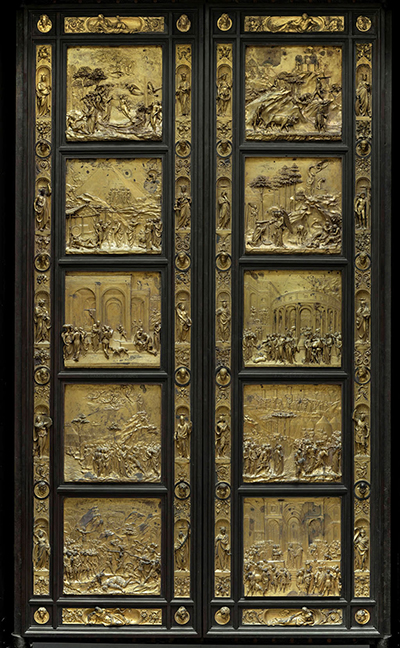
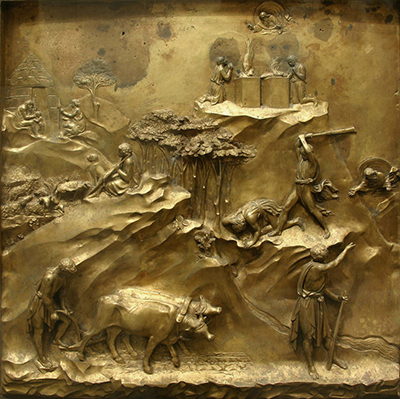
Lorenzo Ghiberti's Cain and Abel relief is broader than its familiar title suggests. The Opera del Duomo catalogues it as a cycle concerning the first family: Adam and Eve labour, Abel tends his flock, the brothers make their offerings, Cain murders Abel, and God confronts the killer. Ghiberti joins these successive events in one landscape rather than separating them into framed scenes.[1]
Contents
- Position on the Gates of Paradise
- Labour after Eden
- The two offerings
- Murder and judgement
- How to read the relief
Position on the Gates of Paradise
The panel occupies the upper-right position of the Gates of Paradise, opposite Adam and Eve. Together, the pair moves from creation and expulsion to work, worship, jealousy and the first murder. The doors were produced for the Florentine Baptistery between 1425 and 1452. The originals are now in the Museo dell'Opera del Duomo; replicas occupy the Baptistery's eastern doorway.[2]
That larger history matters, but the panel's own problem is narrative: how can five episodes involving repeated figures remain intelligible inside one square field?
Labour after Eden
Adam and Eve appear at work, establishing life outside Paradise before the conflict between their sons takes over. Abel's care of the flock identifies the pastoral world associated with his offering. These forms of labour are not incidental background. They connect the preceding panel's expulsion with the new conditions of human life and give the brothers distinguishable roles before their sacrifices.
Ghiberti does not provide a diagrammatic boundary around each task. Changes in terrain, spacing and the direction of bodies create local zones while allowing the landscape to remain continuous.
The two offerings
Genesis 4 describes Cain bringing produce from the ground and Abel offering from the firstborn of his flock. The paired acts provide the moral hinge of the cycle, but the biblical passage does not explain the relief's formal choices. Ghiberti makes comparison possible by placing related actions within the same field: the viewer can move between the brothers, their offerings and the divine response without leaving the landscape.[3]
The repeated bodies require attentive looking. Cain and Abel are not fixed portraits occupying one place; their identities are carried across time by action and context. This continuous-narrative method rewards a slow reading rather than a glance at one central climax.
Murder and judgement
The murder gives physical force to the hostility that begins with the offerings. Cain's attack on Abel is followed by divine questioning and the curse pronounced upon him. Ghiberti therefore includes both violence and its moral aftermath. Calling the work only Cain and Abel can hide this carefully constructed sequence, just as treating it only as an image of fratricide would omit labour, sacrifice and judgement.
The landscape helps control the shift. Openings and rises in the ground distinguish one encounter from the next, while repeated diagonals lead the eye through them. Stronger projection brings principal bodies forward; shallower forms and terrain allow secondary events to recede. Narrative time is translated into visual distance without becoming a simple left-to-right strip.
How to read the relief
Begin by locating the different kinds of work, then find the two offerings. From there, identify the bodily collision of the murder and the later confrontation between Cain and God. A second viewing can follow the landscape instead of the plot: note where ground lines separate actions and where they connect them.
The panel's distinctive achievement is this balance between division and continuity. It belongs to the Gates' larger Old Testament programme, but it does not merely illustrate a sequence of verses. It turns repeated protagonists, changing labour and moral consequence into a single field that must be read across both space and time.
Discussion
Ghiberti rewards slow looking: relief, gilding, narrative structure, workshop practice and conservation evidence can all change how a work is read.
Join the Conversation
Have an observation about Cain and Abel, a source to add, or a comparison that sharpens the reading? Share it below.
References
- Opera del Duomo scientific catalogue, Stories of Cain and Abel
- Opera del Duomo, Gates of Paradise
- Genesis 4:1–16.