 by Tom Gurney
Tom Gurney BSc (Hons) is an art history expert with over 20 years experience
Published on June 19, 2020 / Updated on July 28, 2026
Email: tomgurney1@gmail.com / Phone: +44 7429 011000
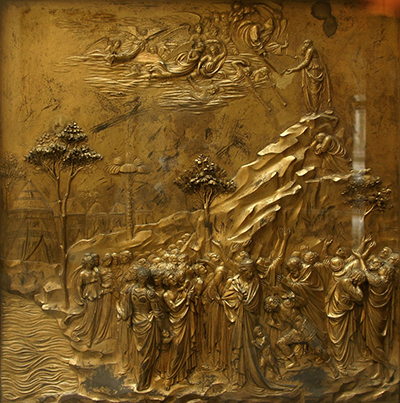
The title Moses and the Ten Commandments identifies the climax of Lorenzo Ghiberti's relief, but the panel contains a wider journey to Sinai. The Israelites move through a landscape marked by water, tents and trees; the people gather below in fear; Moses rises to the summit to receive the tablets amid divine and angelic presence. The mountain converts narrative sequence into vertical structure.
Contents
- Position and full subject
- From the sea to Sinai
- The people below
- Revelation at the summit
- How the mountain organizes time
Position and full subject
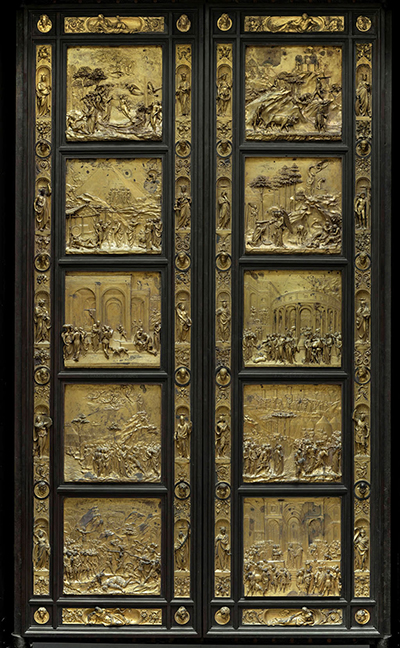
The panel occupies the left side of the fourth register from the top of the Gates of Paradise, opposite the Joshua cycle. Opera del Duomo catalogues it as Stories of Moses. It is approximately 80 by 79 centimetres and is cast, chased and gilded bronze.[1]
The relief belongs to doors produced between 1425 and 1452 for the eastern entrance of the Florentine Baptistery. The originals are preserved in the Museo dell'Opera del Duomo; the exterior doors are replicas. For this panel, however, the most important parent-door context is sequential: it follows the Joseph story and precedes Joshua within the Old Testament programme.[2]
From the sea to Sinai
The official catalogue identifies the Red Sea at the right, as well as the movement of the Israelites toward Sinai. Tents and trees locate the travelling community in a changing landscape. These details widen the subject beyond the solitary image of Moses holding tablets.
Ghiberti uses groups rather than a single marching line. Crowds can register departure, travel and waiting, while landscape features guide the eye between them. The journey is therefore understood through accumulated signs—water, encampment and directed bodies—rather than through a separate compartment for each stage.
The people below
Aaron stands among the frightened Israelites at the foot of the mountain. Their clustered bodies create a collective human register beneath the revelation above. Gestures and upward attention connect the zones, but the physical separation remains emphatic.
This lower crowd is not passive filler. It gives the summit its scale and makes divine encounter a communal event experienced unequally: Moses approaches the source, while the people witness from a distance.
Revelation at the summit
Moses receives the tablets above, accompanied by a representation of God and angels. Exodus 19–20 supplies the scriptural route, but the relief's argument is visual. Height distinguishes revelation; the mountain's slopes regulate access; stronger and shallower projections make bodies occupy different distances within a very limited bronze depth.[3]
The summit is both the end of the journey and the apex of the composition. By directing movement upward, Ghiberti avoids treating the tablets as a detached attribute. They belong to an encounter reached through the whole landscape.
How the mountain organizes time
A useful close reading begins at the water and encampment, follows the Israelites toward Sinai, pauses among Aaron and the crowd, and then climbs to Moses. A second reading can examine the relief vertically: densely gathered people below, narrowing rock between, and celestial revelation above.
The panel's distinctive achievement lies in this conversion of history into elevation. Journey, waiting and revelation remain separate moments, yet the mountain makes them parts of one intelligible structure. The familiar title names the culminating gift of the law; the bronze shows the larger human passage required to reach it.
Discussion
Ghiberti rewards slow looking: relief, gilding, narrative structure, workshop practice and conservation evidence can all change how a work is read.
Join the Conversation
Have an observation about Moses and the Ten Commandmen, a source to add, or a comparison that sharpens the reading? Share it below.
References
- Opera del Duomo scientific catalogue, Stories of Moses
- Opera del Duomo, Gates of Paradise
- Exodus 14:1–20:21.