 by Tom Gurney
Tom Gurney BSc (Hons) is an art history expert with over 20 years experience
Published on June 19, 2020 / Updated on July 28, 2026
Email: tomgurney1@gmail.com / Phone: +44 7429 011000
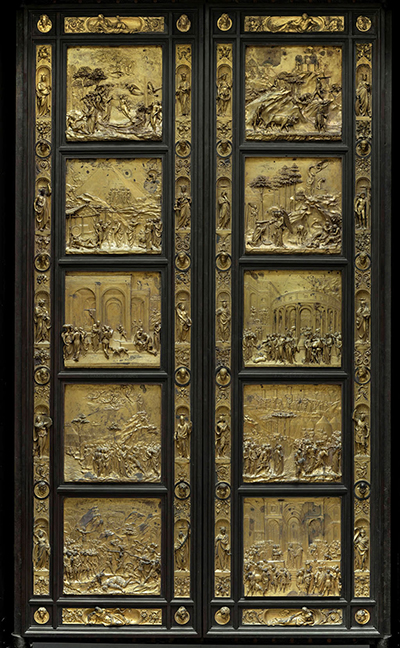
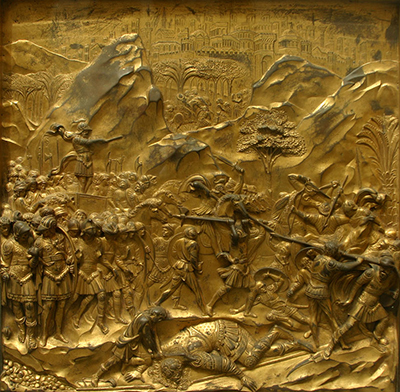
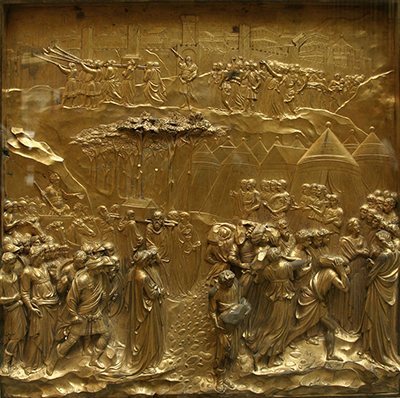
Lorenzo Ghiberti's Joshua and the Fall of Jericho panel is not simply a battle scene. It brings together the Israelites leaving camp with the Ark of the Covenant, the crossing of the Jordan, the fall of Jericho and Joshua's erection of twelve memorial stones. Procession, water, collapsing architecture and acts of remembrance share one continuous field.[3]
Contents
- Position on the Gates
- Leaving camp with the Ark
- Crossing the Jordan
- Jericho and its fall
- The twelve stones
Position on the Gates
The relief occupies the right side of the fourth register from the top of the Gates of Paradise, opposite the Moses cycle. Opera del Duomo catalogues it under the broader title Stories of Joshua. The inherited page title names its most spectacular episode, but the full cycle extends from entry into the promised land to the preservation of communal memory.[1]
The original gilded bronze is now seen with the Gates in the Museo dell'Opera del Duomo. Replicas occupy the Baptistery's eastern entrance. Within the doors' sequence, Joshua follows Moses: law and revelation give way to crossing, procession and possession.[2]
Leaving camp with the Ark
The Israelites emerge in procession carrying the Ark. This sacred object gives order and purpose to the crowd, distinguishing the movement from a generic military march. Figures and standards create direction while the surrounding terrain allows the group to remain connected to later actions.
Ghiberti must make many bodies legible without giving each one equal emphasis. Variations in projection, overlap and scale let the procession thicken and recede. The result is collective movement rather than a row of isolated actors.
Crossing the Jordan
Joshua 3–4 describes the crossing and the taking of stones as a memorial. The river is therefore both a physical boundary and a narrative threshold. Movement across it marks transition, while the later stones convert a temporary passage into remembered history.
In relief, water and changes in ground can connect spaces more fluidly than a wall or frame. The viewer follows bodies across terrain and through time, recognizing that the same people participate in several episodes.
Jericho and its fall
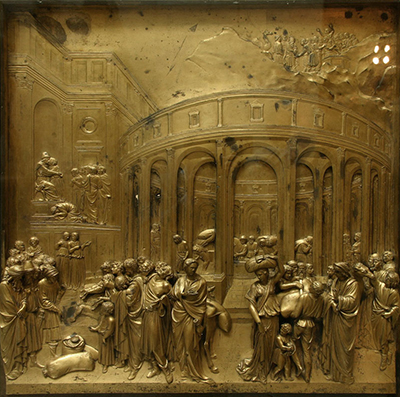
The city is identified by the inscription `GER|ICO` beside its gate. Architecture provides a fixed visual mass against which procession and collapse become readable. The fall of Jericho is not represented as an undifferentiated clash. It is the culmination of ritual movement around a named, bounded city.
The contrast between ordered procession and unstable walls gives the panel much of its energy. Lines of bodies and the Ark create continuity; the city concentrates disruption. Ghiberti thereby makes conquest visible through the opposition of moving community and failing architecture.
The twelve stones
Joshua's memorial stones complete the cycle. They are easy to overlook if attention stops at Jericho, yet they alter the panel's meaning. The narrative does not end only with victory. It also concerns how a community marks divine aid and transmits the memory of crossing to later generations.
Begin a close reading with the Ark and the departing group, locate the river crossing, then identify the inscribed city and the fall of its walls. Finally, search for the memorial action. This route reveals a carefully organized sequence: departure, threshold, conquest and remembrance.
The relief's achievement is to keep those actions distinct while binding them through circular and processional movement. Its city is a dramatic anchor, but the people, sacred object, river and stones carry the fuller story.
Discussion
Ghiberti rewards slow looking: relief, gilding, narrative structure, workshop practice and conservation evidence can all change how a work is read.
Join the Conversation
Have an observation about Joshua and the Fall of Jeric, a source to add, or a comparison that sharpens the reading? Share it below.
References
- Opera del Duomo scientific catalogue, Stories of Joshua
- Opera del Duomo, Gates of Paradise
- Joshua 3:1–6:27.