 by Tom Gurney
Tom Gurney BSc (Hons) is an art history expert with over 20 years experience
Published on June 19, 2020 / Updated on July 28, 2026
Email: tomgurney1@gmail.com / Phone: +44 7429 011000
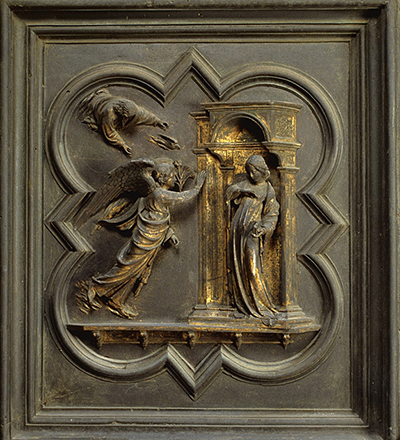
In Lorenzo Ghiberti's Annunciation, motion approaches from the left and stillness answers from the right. Gabriel advances with spread wings and sharply directed drapery, while Mary stands within a compact architectural setting. God appears above, sending rays toward her. The Gothic quatrefoil does not merely contain the event: its curves help separate and connect the heavenly messenger, the Virgin and the divine source.
Contents
- Position on the North Door
- Gabriel in motion
- Mary and the architecture
- Divine direction
- Reading the quatrefoil
Position on the North Door
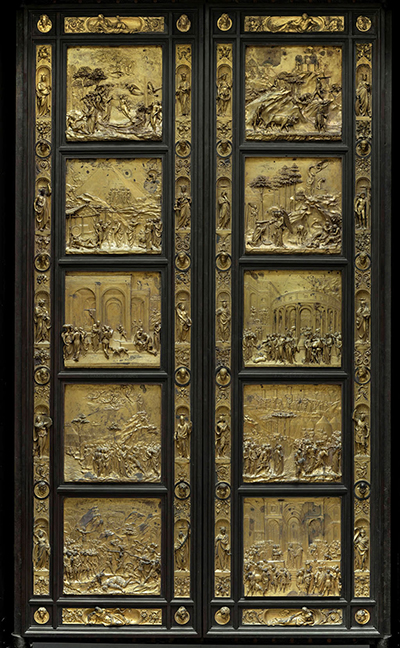
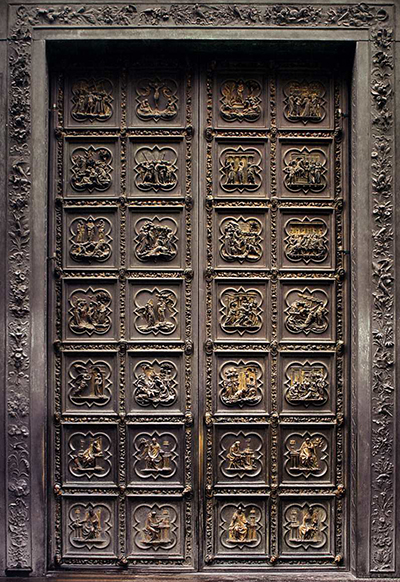
The relief is on the left leaf of the North Door, at the lowest level of its twenty narrative scenes and above the Evangelists and Doctors. It is paired horizontally with the Nativity. The programme begins here with Christ's Incarnation and proceeds upward through his life, Passion, Resurrection and Pentecost.
Ghiberti worked on the North Door from 1403 to 1424. Opera del Duomo reports a scholarly reconstruction, associated with Richard Krautheimer, that places the Annunciation in a proposed early phase around 1403–1407. This is a stylistic grouping, not a documented completion date for the individual relief.[1]
The original bronze door is now in the Museo dell'Opera del Duomo. The door seen outside on the Baptistery is a copy.[2]
Gabriel in motion
Gabriel fills the lower-left curve of the quatrefoil. His wings enlarge his silhouette, while the forward action of body and drapery makes the arrival feel sudden. The messenger does not stand frontally as an isolated emblem. He crosses into Mary's space.
This movement is reinforced by the frame. The rounded lobe gives the advancing figure room to expand, but the pointed inner edges push attention toward the centre. Ghiberti makes a medieval compartment participate in the story rather than treating it as a neutral border.
Mary and the architecture
Mary occupies the right side within an aedicule-like architectural enclosure. Its verticals and small roof or canopy stabilize her against Gabriel's diagonal energy. Her response is conveyed through posture and gesture rather than through physical movement across the panel.
The contrast is not simply angel versus human. It is also flight versus building, approach versus reception, and flowing drapery versus measured structure. The architecture identifies a protected interior without closing Mary off entirely from the encounter.
Divine direction
God appears in the upper-left lobe and directs rays toward Mary. This diagonal establishes the event's divine source and creates a second movement across the relief. Gabriel advances below; divine action travels above. Both converge on the standing figure at right.
Luke 1:26–38 establishes the subject and the exchange between Gabriel and Mary. The relief, however, makes that exchange visible through directional forces. It does not require an extensive narrative setting because the figures, rays and architecture carry the essential relationships.[3]
Reading the quatrefoil
Begin with Gabriel's wings and follow his forward movement toward the centre. Then compare that diagonal with the rays descending from above. Finally, look at the architectural lines around Mary and how they resist or receive those movements.
The panel's particular achievement lies in balancing interruption with order. The messenger seems to enter suddenly, yet the composition remains lucid. Ghiberti uses the quatrefoil's unequal spaces to give each participant a distinct zone while ensuring that every line directs attention toward the moment of consent.
Discussion
Ghiberti rewards slow looking: relief, gilding, narrative structure, workshop practice and conservation evidence can all change how a work is read.
Join the Conversation
Have an observation about Annunciation, a source to add, or a comparison that sharpens the reading? Share it below.