 by Tom Gurney
Tom Gurney BSc (Hons) is an art history expert with over 20 years experience
Published on June 19, 2020 / Updated on July 28, 2026
Email: tomgurney1@gmail.com / Phone: +44 7429 011000
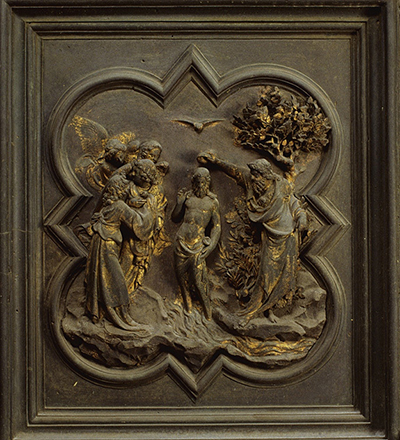
Lorenzo Ghiberti organizes Christ's baptism around a still central body. Christ stands frontally in the water, John leans toward him from the bank, angels wait opposite, and the dove descends from above. Water, witnesses and divine sign form a clear vertical and lateral structure within the Gothic quatrefoil.
Contents
- Position on the North Door
- Christ in the water
- John and the angels
- Descent from above
- How to read the panel
Position on the North Door
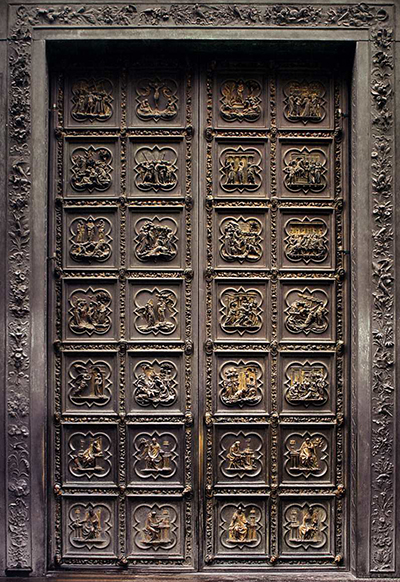
The relief is on the left leaf of the North Door, above the infancy scenes and paired with the Temptation in the Wilderness. These two episodes begin the public ministry after the door's Annunciation, Nativity, Adoration and Temple scene.
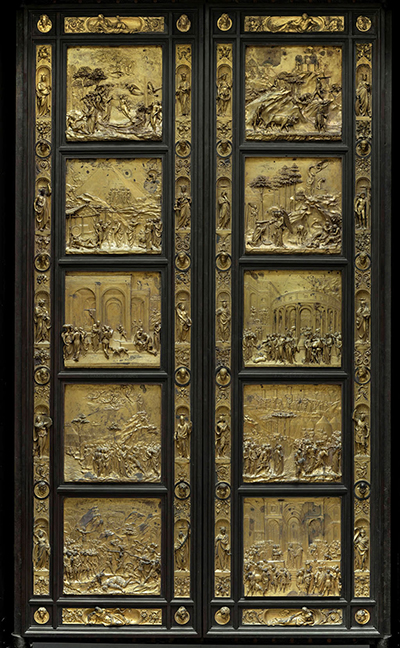
The North Door was made between 1403 and 1424. Its original bronze panels are now in the Museo dell'Opera del Duomo; a copy occupies the Baptistery's exterior. Opera del Duomo reports the Baptism within a proposed Krautheimer phase of about 1407–1413/15. This is a modern stylistic reconstruction, not a documented date for the individual panel.[1][2]
Christ in the water
Christ's upright body creates the principal axis. The water is essential to the subject, but it does not overwhelm the figure. Its lower ridges establish a distinct element and separate the central body from the firmer ground on either side.
The frontal pose produces calm. While John reaches and the angels attend, Christ remains the stable point around which the other actions are arranged.
John and the angels
John leans from the right bank to perform the baptism. The inclined body bridges land and water, and his gesture crosses toward Christ's head. Angels gather on the opposite side as witnesses and attendants. The asymmetry of their group balances John's single active figure.
Matthew 3:13–17, Mark 1:9–11 and Luke 3:21–22 identify the baptism and divine manifestation. The relief makes those relations spatial: officiant at one side, witnesses at the other, recipient between them.[3]
Descent from above
The dove appears over Christ, extending the central axis upward. A tree closes the upper-right area and anchors the landscape. The divine sign, human body and water therefore align through the panel's height.
This vertical structure distinguishes the scene from the adjacent Temptation, where opposition is primarily lateral. Here, revelation descends into an ordered ritual gathering.
How to read the panel
Begin with Christ's frontal body, then follow John's lean across the water. Compare his action with the quieter angelic group, and finally trace the line upward to the dove. The sequence reveals how small differences in pose establish separate roles.
The relief's achievement is one of balance without rigid symmetry. Banks, tree and attendant figures give the landscape variety, while Christ's stillness keeps the event legible. Water does not simply identify the baptism; it creates the central interval across which ministry, witness and divine recognition meet.
Discussion
Ghiberti rewards slow looking: relief, gilding, narrative structure, workshop practice and conservation evidence can all change how a work is read.
Join the Conversation
Have an observation about Christ is Baptised by John, a source to add, or a comparison that sharpens the reading? Share it below.
References
- Opera del Duomo scientific catalogue, North Door
- Opera del Duomo, North Door
- Matthew 3:13–17; Mark 1:9–11; Luke 3:21–22.