 by Tom Gurney
Tom Gurney BSc (Hons) is an art history expert with over 20 years experience
Published on June 19, 2020 / Updated on July 28, 2026
Email: tomgurney1@gmail.com / Phone: +44 7429 011000
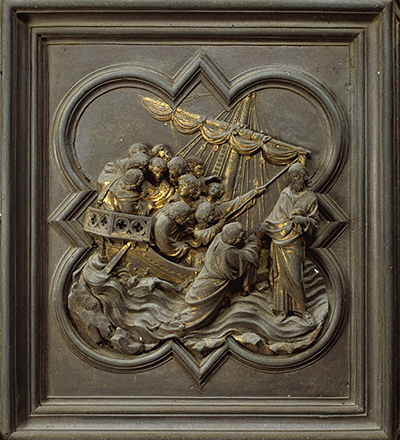
Lorenzo Ghiberti makes instability surround Christ in Christ Walks upon the Water. A crowded boat fills the left side; sail, mast and rigging climb into the upper lobes; wave ridges disturb the lower field. Christ stands on the water at the right, while Peter moves through the dangerous interval between boat and saviour.
Contents
- Position and source
- The boat as compressed community
- Christ and Peter
- Making water visible in bronze
- A nautical close reading
Position and source
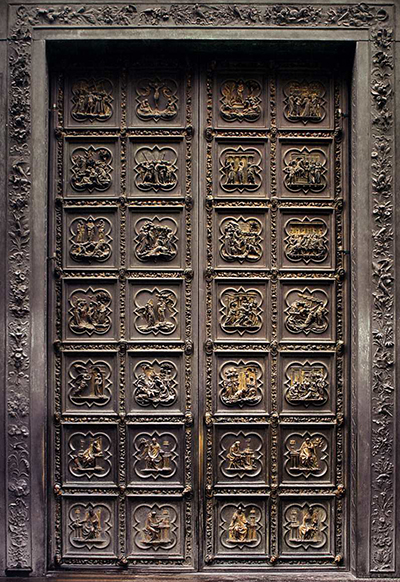
The panel is on the right leaf of the North Door, paired in the programme with the Expulsion of the Money-Changers. Opera del Duomo's individual catalogue record fixes its position and subject within the twenty-scene Christ cycle.[1][2]
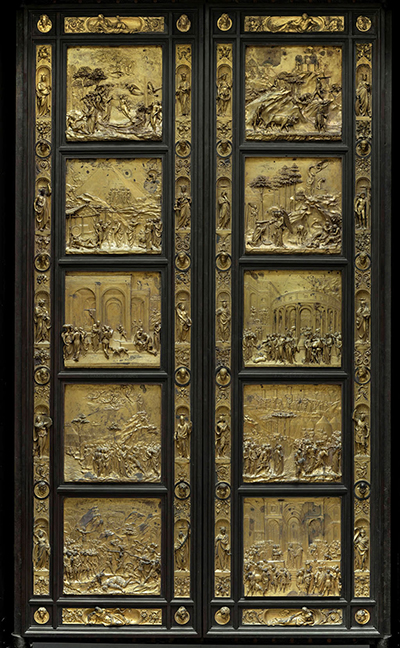
The door was made between 1403 and 1424 and is now preserved in the Museo dell'Opera del Duomo; the Baptistery's exterior door is a copy. The catalogue reports this relief within a proposed Krautheimer phase around 1415–1420. This is a modern stylistic reconstruction, not a precise documented execution date.
The boat as compressed community
The apostles crowd into a vessel at the left. Its restricted space forces bodies to overlap and makes their shared danger immediately legible. The boat's edge contains them, but sail and mast expand their presence upward.
Rigging is more than nautical description. Its diagonals divide the quatrefoil into smaller directional fields and amplify the sense that the boat is under strain. The frame becomes part of an unstable maritime space.
Christ and Peter
Christ stands apart at the right, upright against the moving water. Peter occupies the gap between him and the boat. Matthew 14:22–33 gives Peter the most extensive role, while Mark 6:45–52 and John 6:16–21 also establish the walking-on-water episode.[3]
The relief's central drama lies in this interval. The crowded boat represents one kind of precarious safety; Christ's vertical figure represents calm outside it; Peter attempts the passage between them.
Making water visible in bronze
Wave ridges occupy the lower field. Their repeated lines distinguish water from the boat and bodies without requiring deep carving. The bronze surface becomes an active element, catching light differently along each rise.
Comparison with the Baptism shows two uses of water. In the earlier scene, water creates a quiet central place for ritual. Here it becomes unstable ground and a measure of trust.
A nautical close reading
Begin with the mast and follow the rigging down into the boat. Count how many bodies are compressed within its edge, then move toward Peter and Christ. Finally, trace the wave lines across the bottom and compare their lateral movement with Christ's upright pose.
The panel's achievement is to turn a small quatrefoil into a convincing field of risk. Sail, rigging, crowd and waves fill it with competing directions, yet the narrative remains clear because Christ supplies a calm endpoint. Instability is not merely described; it is built into the composition.
Discussion
Ghiberti rewards slow looking: relief, gilding, narrative structure, workshop practice and conservation evidence can all change how a work is read.
Join the Conversation
Have an observation about Christ Walks upon the Water, a source to add, or a comparison that sharpens the reading? Share it below.
References
- Opera del Duomo scientific catalogue, Christ Walks upon the Water
- Opera del Duomo scientific catalogue, North Door
- Matthew 14:22–33; Mark 6:45–52; John 6:16–21.