 by Tom Gurney
Tom Gurney BSc (Hons) is an art history expert with over 20 years experience
Published on June 19, 2020 / Updated on July 28, 2026
Email: tomgurney1@gmail.com / Phone: +44 7429 011000
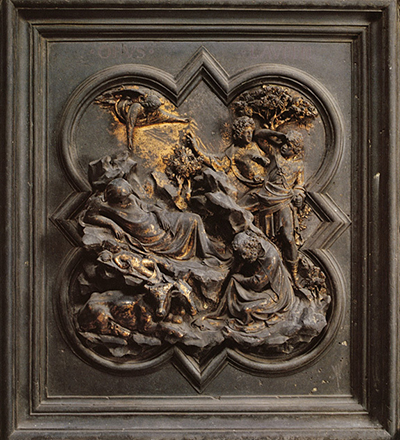
Lorenzo Ghiberti's Nativity is built from a rising mass of rock, bodies and drapery. Mary reclines diagonally beside the infant; Joseph sits lower at the right; angels gather above, while animals and shepherd-related details occupy the compressed landscape. Unlike the divided architectural setting of the adjacent Annunciation, this relief makes terrain hold several scales of attention together.
Contents
- Position and sequence
- Mary and the infant
- Joseph and the earthly group
- Angels and distant attention
- A composition of diagonals
Position and sequence
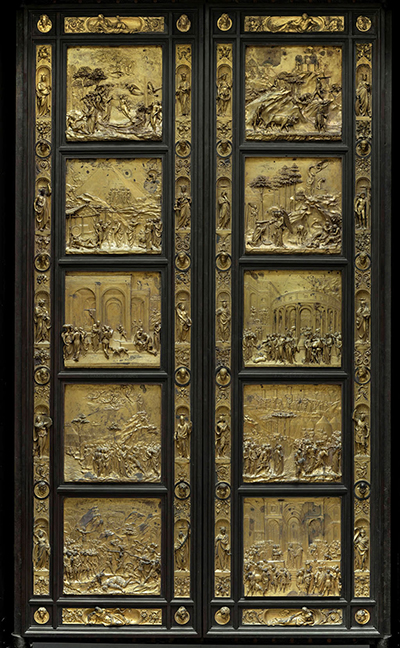
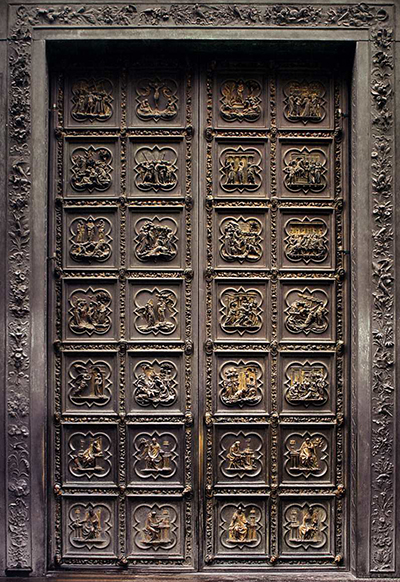
The panel is on the left leaf of the North Door, beside the Annunciation at the lowest level of the twenty scenes from Christ's life. The two reliefs begin the narrative programme. Above them, the left leaf continues with Baptism, Temptation and later episodes; the Evangelists and Doctors occupy the registers below.
The North Door was made between 1403 and 1424 and is now displayed in the Museo dell'Opera del Duomo. A copy stands on the Baptistery's exterior. Opera del Duomo reports a proposed Krautheimer phase around 1403–1407 for the Nativity. That grouping is a modern stylistic reconstruction, not a surviving record of the panel's precise execution date.[1][2]
Mary and the infant
Mary's reclining body creates the principal diagonal across the rocky foreground. Her scale and long drapery folds make her the broadest human form, but attention is directed toward the much smaller infant. The difference in scale establishes both maternal presence and the vulnerability of the child.
The pose also gives the panel a low centre of gravity. Rather than enthroning Mary, Ghiberti places her within the terrain. Rock and cloth meet so closely that the figure appears embedded in the setting.
Joseph and the earthly group
Joseph sits at the lower right, turned inward. His position completes the foreground group without reproducing Mary's diagonal. The quieter, compact pose offers a visual pause near the quatrefoil edge.
Animals and other stable details locate the birth in a humble setting. They are compressed around the principal figures rather than expanded into a broad architectural interior. This density makes the relief feel intimate even though it contains several narrative levels.
Angels and distant attention
Angels gather above, introducing a celestial register. Shepherd-related details extend the event beyond the immediate family and route the viewer toward Luke 2:1–20. The scriptural passage identifies the birth and announcement; the relief distinguishes them by height and scale.[3]
The upper forms are not detached from the foreground by a straight boundary. Rocky rises and overlapping bodies lead the eye upward. Ghiberti therefore turns elevation into narrative connection: the intimate birth below and the heavenly proclamation above belong to one continuous landscape.
A composition of diagonals
To read the relief closely, begin with Mary's reclining body and follow the slope of the ground toward the angels. Then return to Joseph at the lower right and compare his inward turn with the outward spread of the upper group. Finally, locate the smallest stable and shepherd details and note how little physical depth is needed to distinguish them.
The panel's character comes from accumulation rather than separation. Figures, rock and drapery create an almost unbroken rising form, yet mother, child, Joseph, animals and angels remain individually legible. The Nativity makes compression a source of unity and differs sharply from the architectural opposition of the neighbouring Annunciation.
Discussion
Ghiberti rewards slow looking: relief, gilding, narrative structure, workshop practice and conservation evidence can all change how a work is read.
Join the Conversation
Have an observation about Nativity, a source to add, or a comparison that sharpens the reading? Share it below.