 by Tom Gurney
Tom Gurney BSc (Hons) is an art history expert with over 20 years experience
Published on June 19, 2020 / Updated on July 28, 2026
Email: tomgurney1@gmail.com / Phone: +44 7429 011000
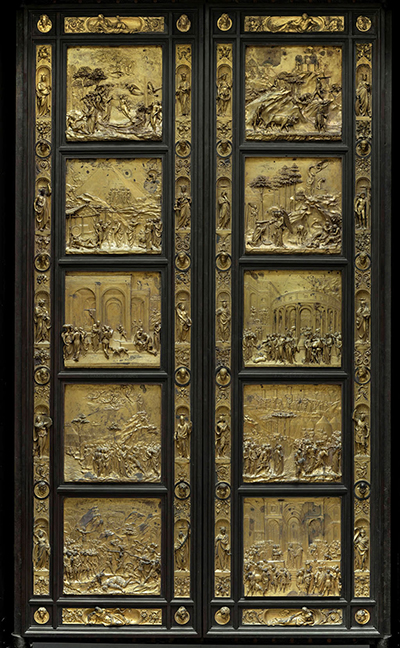
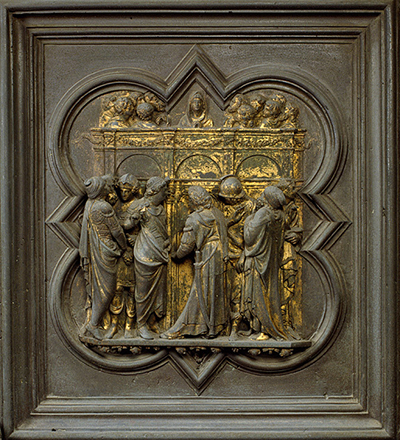
Lorenzo Ghiberti closes the North Door's narrative cycle with an ordered community. The Virgin is enthroned at the upper centre while the apostles gather in a frontal semicircle below. A richly articulated architectural screen binds the tiers, and upward gazes and gestures connect the earthly assembly with divine descent.
Contents
Position on the North Door
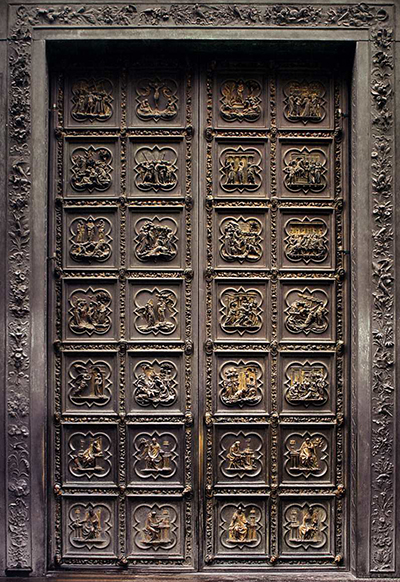
The panel occupies the uppermost narrative level of the right leaf, paired with the Resurrection. It is the final scene in the door's twenty-part sequence, following Christ's life, Passion and victory over death.
The North Door was produced between 1403 and 1424 and is now displayed in the Museo dell'Opera del Duomo; the door outside the Baptistery is a copy. Opera del Duomo reports Pentecost within a proposed Krautheimer phase around 1420–1424. The grouping is a modern stylistic reconstruction rather than a precise documented execution date.[1][2]
The gathered apostles
The apostles stand or sit in a compact frontal assembly. Their bodies overlap, but the group is more ordered than the crowds of the Arrest or Way to Calvary. Faces and gestures turn upward and inward, making collective attention the principal action.
Acts 2:1–13 identifies the descent of the Holy Spirit and the apostles' transformed speech. The relief represents the event through gathered response rather than attempting to illustrate every tongue or listener described in the text.[3]
The Virgin and the upper centre
Mary occupies the upper centre in an elevated seat. Her frontal stability anchors the community below and provides a vertical focus comparable to Christ in the paired Resurrection. Yet the emphasis has shifted from one transformed body to a collective sacred institution.
Architecture reinforces this hierarchy. Arches, panels and vertical supports organize the crowded figures into tiers, giving the event an ecclesial setting rather than an open landscape.
Ending the cycle
Compare Pentecost with the Last Supper. Both use dense groups and architectural enclosure, but the earlier meal contains tension and betrayal, whereas the final gathering is ordered by shared revelation.
A close reading should begin with the lower semicircle, follow the apostles' gazes upward, and then examine how architecture frames Mary. The narrative programme ends not with dispersal or solitary triumph but with a community made coherent through attention, gesture and structure.
Discussion
Ghiberti rewards slow looking: relief, gilding, narrative structure, workshop practice and conservation evidence can all change how a work is read.
Join the Conversation
Have an observation about Pentecost, a source to add, or a comparison that sharpens the reading? Share it below.