by Tom Gurney
Tom Gurney BSc (Hons) is an art history expert with over 20 years experience
Published on June 19, 2020 / Updated on November 2, 2026
Email: tomgurney1@gmail.com / Phone: +44 7429 011000
Lilacs in a Window by Mary Cassatt: Introduction
Purple and white lilacs spread above a dark vessel, their many small marks crossing leaves, stems and the green framework of a window. The bouquet is dense, but the space around it is sharply divided by angled bars and a sill. In Mary Cassatt’s Lilacs in a Window, abundant flowers and a constructed setting make one another more conspicuous.
The Metropolitan Museum of Art dates the oil on canvas to about 1880–83. It measures 61.5 × 51.1 cm and is accession 1997.207, currently credited as a gift of Mr. and Mrs. Douglas Dillon, 1997. The museum describes it as one of Cassatt’s rare pure still lifes, rather than her only example of the subject. [1]
At a Glance
- ArtistMary Cassatt [1]
- DateAbout 1880–83 [1]
- MediumOil on canvas [1]
- Dimensions61.5 × 51.1 cm [1]
- CollectionMetropolitan Museum of Art, New York [1]
- Accession1997.207 [1]
- Current creditGift of Mr. and Mrs. Douglas Dillon, 1997 [1]
- SubjectLilacs in a vessel by a window; one of Cassatt’s rare pure still lifes [1]
This work across Mary Cassatt’s career
Lilacs in a Window (current article)
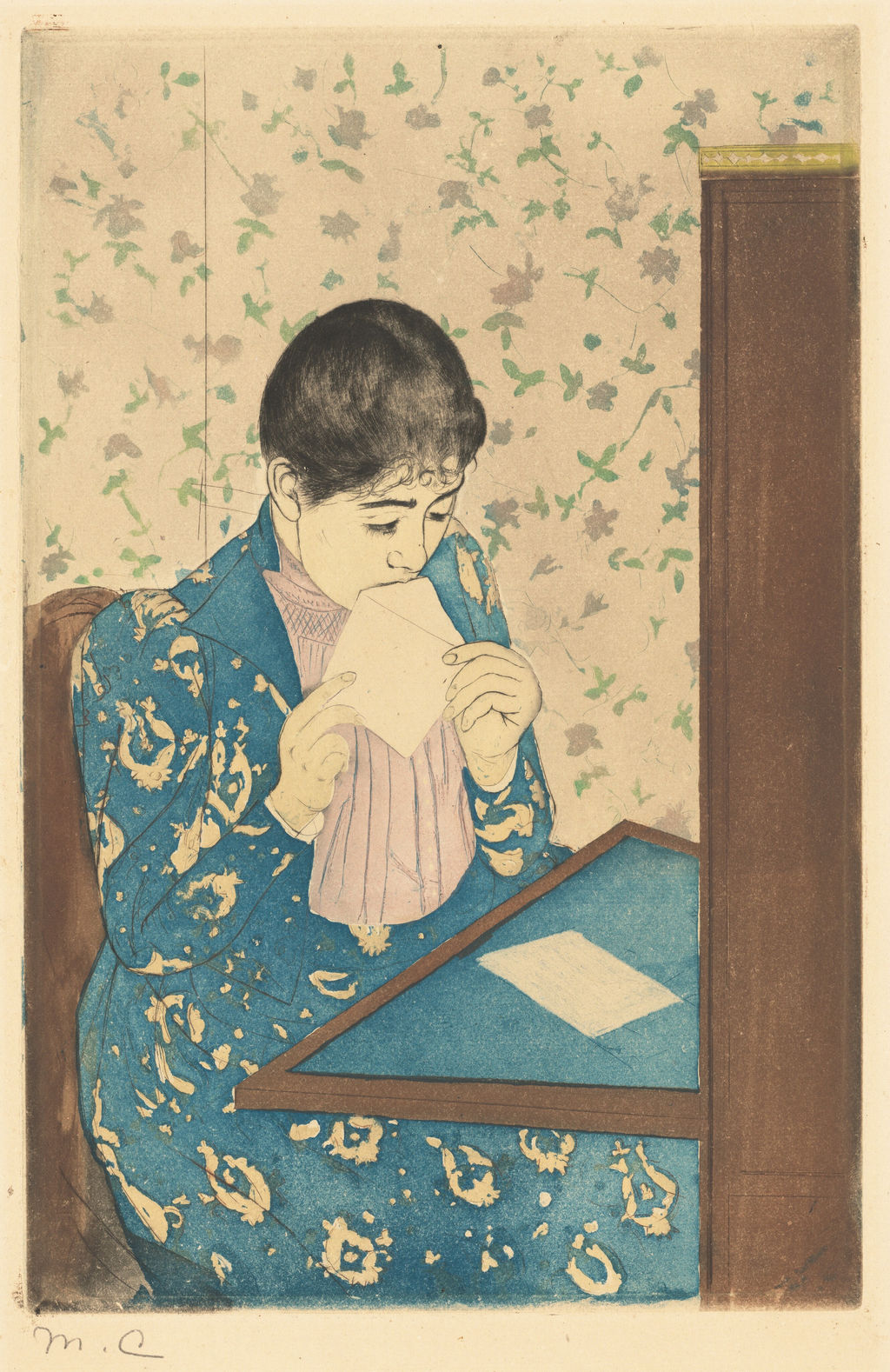
About 1880–83 [1]The Letter
1890–91 [6]Modern Woman
1892–93; displayed in 1893 [7] [8] [9]The Boating Party
1893–94 [10]The Child's Bath
1893 [11]Woman with a Sunflower
About 1905 [13]Young Woman in Green Outdoors in the Sun
About 1914 [14]Contents
- A bouquet wider than its container
- Purple and white clusters
- Leaves give the bouquet another scale
- The dark vessel anchors the lower picture
- The window is an active structure
- Light around a dense object
- A greenhouse or country-house window?
- Why a pure still life is unusual here
- Brushwork and the scale of looking
- Moyse Dreyfus and the museum gift
A bouquet wider than its container
The flowers extend well beyond the vessel. Some clusters project towards the left, while the taller mass rises near the upper centre and right. Their uneven boundaries make the bouquet seem expansive within a canvas whose main object remains relatively close.
The dark container is much narrower. It provides a base below the spread of stems and leaves, giving the arrangement a stable lower point. That contrast of widths is fundamental: a broad, irregular mass appears to grow from a compact vessel.
The flowers do not form one smooth canopy. Separate clusters hang at different heights, leaving small intervals through which leaves, stems or parts of the setting can be seen. These breaks keep the bouquet from becoming a single solid shape.
The container’s upper part is partly concealed. It is easier to follow its lower body and rounded base than to trace every stem entering it. Overlap is doing practical work, establishing that leaves and flowers stand in front of some parts of the vessel.
Purple and white clusters
Violet and pale lilac areas occupy much of the upper bouquet. White clusters interrupt them nearer the middle and right. The colours are distributed unevenly, giving the eye several smaller groups to follow rather than one central blossom.
Short marks build the effect of many small flowers. At an ordinary viewing distance they cooperate in describing clusters; closer looking reveals different strokes of light, pink, blue and darker colour. The painting’s description changes with the scale at which it is examined.
The white areas are not isolated pure white blocks. Cooler and warmer touches vary them, just as the darker violet groups contain lighter accents. That internal variation lets a cluster feel substantial without requiring each tiny floret to have an individually complete outline.
A few projecting stems and small gaps help distinguish one part of the bouquet from another. The eye can move along a branch towards a hanging cluster, then return through leaves to a larger mass. This makes the bouquet complex without reducing it to a list of separately named parts.
The title securely identifies lilacs. The painted marks alone should not be used to diagnose an exact cultivar or establish a horticultural history for the particular stems. The more useful visible distinction is between the sizes and densities of the flower clusters.
Leaves give the bouquet another scale
The leaves have broader, more continuous shapes than the small blossoms. Their dark green surfaces interrupt the flower masses and create a middle scale between individual marks and the whole bouquet.
Some leaves project towards the viewer over the vessel. Others sit farther back among the flowers. Their overlaps make the bouquet feel layered, rather than arranged along a single flat plane.
The green also links the living forms with the window framework, but it does not make them identical. A leaf has an irregular pointed outline and changes direction around its stem. The painted frame has longer, straighter boundaries that continue behind the bouquet.
Looking between those forms is especially revealing. The same general colour can describe growth or a built structure, depending on edge, direction and scale. Cassatt makes those differences visible within a relatively compressed space.
The dark vessel anchors the lower picture
The vessel sits below the busiest part of the bouquet. Its rounded body contains quieter changes of brown, violet and dark colour, with lighter marks helping describe the surface turning towards the base.
That relative quiet matters. If the vessel were as densely broken into small accents as the flowers, the arrangement might have no stable lower focus. Its simpler mass lets the many marks above remain active without making the entire canvas equally busy.
The base meets a light surface with cooler and darker passages around it. Those neighbouring marks help locate the object on a support, rather than allowing it to float beneath the stems. The relation between container and sill is as necessary as the relation between stem and flower.
The vessel’s dark colour should not be mistaken for an elaborate decorative pattern. Its visible role is to hold the bouquet and supply a rounded form beneath it. The comparatively simple surface gives the eye a quieter area below the many flower marks.
The window is an active structure
Green bars divide the luminous background at several angles. Their long lines continue behind the flowers, making the bouquet interrupt a framework that the viewer can partly reconstruct around it.
The lower rail runs across the canvas behind the vessel. Higher bars rise towards the top, while the open window and its support introduce further angles. These divisions differ from the rounded container and irregular foliage.
The structure also creates several light areas of different shapes. The background is therefore not one empty pale field. Bars, edges and the sill organise it into intervals through which light and colour can be seen.
A thin prop helps explain the opening of the window. The Met’s acquisition entry describes the adjacent window as held open in this way, while qualifying the setting as what seems to be a greenhouse sill or work surface. [15]
The point of the framework is not only identification. Its straight divisions make the bouquet’s abundance more apparent, while the flowers keep the window from becoming the picture’s sole organising subject. Each structure gives the other something to work against.
Light around a dense object
The setting is bright compared with the dark vessel and some of the leaves. Pale pink, yellow and cooler passages appear around the bouquet, giving the flowers a light environment without requiring a detailed view beyond the glass.
That arrangement creates a challenge in defining the bouquet. White flowers must remain distinguishable against a light background, while dark leaves need to be read both within the mass and against the window. Small changes of edge and neighbouring colour do much of that work.
The darker vase provides another contrast. It anchors a lower area that could otherwise merge with the sill’s light surface. The bouquet is consequently not illuminated through one repeated effect: different parts depend on different relationships with their surroundings.
The Met interprets the painting through this partnership of sunlight and structure. That account fits the visible contrast between irregular flowers and the longer window divisions without requiring an exact reconstruction of the room’s orientation or the hour of the day. [1]
Watch: Mary Cassatt
Choose a film to explore the artist’s work, its interpretation and its wider setting.
Demonstrating Mary Cassatt's Color Printmaking Techniques
The Philadelphia Museum of Art demonstrates techniques used to make Cassatt’s colour prints.
Watch on YouTubeA greenhouse or country-house window?
The 1998 acquisition entry offers a greenhouse setting as a qualified reading. In Public Parks, Private Gardens, Colta Ives later places the arrangement at a country house rented by the family outside Paris and evokes cool spring light. These are museum interpretations of the setting, rather than a surviving address or dated record of the painting session. [15] [16]
The distinction preserves what is useful about the proposal. An open glazed structure close to flowers can help explain the meeting of interior object and outdoor light. It also directs attention towards the prop, sill and window bars that might be overlooked in a flower-only description.
It does not identify a particular Beaufresne window or establish that the canvas records one spring day exactly as it occurred. A plausible setting and a documented site are different levels of claim. The painting’s spatial construction can be examined without choosing an unsupported address.
The bouquet’s freshness likewise does not supply a duration. Flowers can suggest a temporary arrangement, but their painted appearance cannot tell us how many sessions Cassatt used or whether the position of every cluster remained unchanged throughout.
Why a pure still life is unusual here
Cassatt frequently placed flowers within figure compositions, but the Met singles out this canvas as a rare work devoted to still-life objects alone. Here no sitter occupies the centre or redirects attention away from the bouquet. [1]
The absence of a figure changes how space becomes legible. A hand is not shown setting down the vessel, and a person does not establish scale beside it. Container, sill, stems and window must supply those relationships themselves.
This makes the painting more than an incidental floral backdrop enlarged into a subject. The dark rounded base, broad bouquet and divided setting have to sustain the entire encounter. Their contrasts provide enough movement and variation without an accompanying human action.
The description rare should remain distinct from unique. It acknowledges the relative place of still life within Cassatt’s work without making an unsupported claim that she painted only one. A precise account of this canvas does not require a complete census of every floral picture associated with her name.
Brushwork and the scale of looking
The shortest flower marks differ from the longer strokes crossing the window and sill. The vessel has another kind of handling, with broader changes describing its rounded surface. These differences help the subject remain readable across the canvas.
A very close detail can make some flower passages look almost abstract. The whole image brings those marks back into clusters, stems and a bouquet. The relationship between those views is important: a crop can reveal handling, but it also removes the structure that gives the marks their place.
Our guide to Cassatt’s style and technique considers how local marks contribute to larger forms. In this still life, a small light stroke may belong to a blossom, a window edge or a reflected passage on the sill, depending on the surrounding arrangement.
None of those visible effects identifies an exact pigment or proves fading. Reproductions can differ in brightness and colour balance. The finished painting and a scientific examination of its materials would answer questions that a comparison between two printed or digital images cannot settle.
Moyse Dreyfus and the museum gift
The Met’s 1998 acquisition entry reports Moyse Dreyfus, a Parisian collector and early patron, as the painting’s original owner. That is a specific collecting claim in the museum’s published history, rather than an inferred identity for the depicted room. [15]
The current collection record credits the Dillon gift in 1997. The earlier acquisition publication used partial-and-promised-gift wording. The two published credits do not, by themselves, date the change in that arrangement. [1] [15]
The accession number 1997.207 keeps the physical canvas identifiable across those changing descriptions. Ownership history and setting interpretation remain separate: knowing an early collector does not establish whose greenhouse or window appears in the painting.
Poppies in a Field: an attribution distinction
The work often reproduced as Red Poppies requires a different kind of comparison. Philadelphia Museum of Art catalogues Poppies in a Field as attributed to Victor Gabriel Gilbert and formerly attributed to Mary Cassatt. It should therefore not be used as a securely identified Cassatt landscape demonstrating a floral-style progression from this still life. [17]
Its image also presents a different structure. Three figures occupy a broad field, with red flowers dispersed across the ground beneath a distant sky. Flowers belong to an outdoor setting around people, rather than gathering into one vessel before a window.
The supports differ too: the Philadelphia picture is oil on panel, while Lilacs in a Window is oil on canvas. That material distinction belongs to the individual records, alongside the more consequential difference in attribution. [17]
The comparison is useful precisely when those limits remain visible. Two flower subjects associated historically with the same artist’s name need not have the same current authorship status. In the securely identified Met canvas, attention can return to the specific achievement: dense clusters, broad leaves and a compact vessel held within the window’s angular, light-filled space.

Poppies in a Field, attributed to Victor Gabriel Gilbert; formerly attributed to Mary Cassatt.
Cassatt artworks and studies
A source-bounded directory of documented works and studies, including the works in the National Gallery’s 2026 checklist and one clearly marked former attribution. Different print impressions are grouped by design and remain searchable by their recorded accessions. This is not a complete catalogue raisonné. Unlinked titles have no individual article here.
| Name | Date | Medium |
|---|---|---|
| A Child’s Bath — LACMA oil | 1880 | Oil on canvas |
| A Goodnight Hug | 1880 | Pastel |
| After the Bullfight | 1873 | Oil on canvas |
| Afternoon Tea Party | 1890–91 | Colour print |
| At the Theatre (Lydia Cassatt Leaning on Her Arms, Seated in a Loge) | About 1879 | Pastel |
| Automne, portrait de Lydia Cassatt | 1880 | Oil on canvas |
| Breakfast in Bed | 1897 | Oil on canvas |
| Bust of Ellen with Bows in Her Hair | 1898 | Pastel |
| By the Pond | About 1896 in Met and Terra records; about 1898 at MoMA | Not established |
| Child Drinking Milk from a Bowl; provisionally identified composition (qualified identification) | About 1890, following inventory and catalogue text | Pastel |
| Child in a Straw Hat | About 1886 | Oil on canvas |
| Child Picking a Fruit | 1893 | Oil on canvas |
| Children Playing on the Beach | 1884 | Oil on canvas |
| Clarissa, Turned Left, with Her Hand to Her Ear | About 1890–93 in Sotheby’s 2012 entry; about 1893 in GCMA notice | Pastel |
| Denise at her Dressing Table | About 1908–09 | Oil on canvas |
| Driving | 1881 | Oil on canvas |
| Eddy Cassatt (Edward Buchanan Cassatt) | 1875 | Oil on canvas |
| Ellen Mary Cassatt in a White Coat | About 1896 | Oil on canvas |
| Emmie and her Child | About 1890 | Oil on canvas |
| Gathering Fruit | About 1893 | Not established |
| Girl Arranging her Hair | 1886 | Oil on canvas |
| Head of a Child with a Red Hat | 1903, signed and dated | Pastel |
| Head of a Woman in a Large Hat | About 1909 | Pastel |
| Head of Simone in a Green Bonnet with Wavy Brim | About 1904 | Pastel |
| In the Garden | 1903 or 1904 | Oil on canvas |
| In the Loge | 1878 | Oil on canvas |
| In the Omnibus | 1890–91 | Colour print |
| In the Omnibus [recto] — preparatory drawing | c. 1891 | Chalk and graphite |
| In the Opera Box (No. 3) [recto] — preparatory drawing | 1880 | Graphite |
| In the Opera Box (No. 3) — print | c. 1880 | Intaglio print |
| Jeune fille au jardin (Young Woman Sewing in a Garden) | 1880–82 | Oil on canvas |
| Jules Dried by His Mother; provisionally identified composition (qualified identification) | 1901, following catalogue text | Oil on canvas |
| Lady in Black, in a Loge, Facing Right | c. 1880 | Etching |
| Lilacs in a Window | About 1880–83 | Oil on canvas |
| Little Girl in a Blue Armchair | 1878 | Oil on canvas |
| Louise Nursing her Child | 1899 in Luxembourg caption; 1898–99 in loan and Arp records | Pastel |
| Madame Gaillard and Her Daughter Marie-Thérèse | 1897, Reynolda collection listing | Pastel |
| Maternal Caress | 1890–91 | Not established |
| Maternal Caress — preparatory drawing | About 1891 | Charcoal and graphite |
| Mathilde Holding a Baby Who Reaches out to the Right | About 1889, Christie’s catalogue | Pastel |
| Mimi as a Brunette | c. 1889 | Drypoint |
| Mimi Holding a Japanese Fan | c. 1889 | Drypoint |
| Modern Woman | 1892–93; displayed in 1893 | Not established |
| Mother about to Wash her Sleepy Child | 1880 | Oil on canvas |
| Mother and Child (Maternal Kiss) | 1896 | Pastel |
| Mother and Child (Nude Dark-Eyed Little Girl with Mother in Patterned Wrapper) | About 1898–99, Sotheby’s catalogue | Pastel |
| Mother and Child (The Oval Mirror) | About 1899 | Oil on canvas |
| Mother Berthe Holding Her Nude Baby | 1898–99 | Pastel |
| Mother in Purple Holding her Child | About 1914, Christie’s catalogue | Pastel |
| Mother Playing with Child | About 1897 | Pastel |
| Mother’s Kiss | 1890–91 | Colour print |
| Nurse Reading to a Little Girl | 1895 | Pastel |
| Poppies in a Field (formerly Cassatt; attributed to Victor Gabriel Gilbert) | About 1880, current museum record | Oil on panel |
| Portrait of an Elderly Lady | c. 1887 | Oil on canvas |
| Portrait of Madame AF Aude and her Two Daughters | 1899, Breeskin 1970 exhibition catalogue | Pastel |
| Portrait of the Artist | 1878 | Watercolour and gouache |
| Reading Le Figaro | 1878, NGA 2026 checklist; about 1877–78 in SAAM’s 2015 caption | Oil on canvas |
| Reflection — drypoint | c. 1890 | Drypoint |
| Sara Holding a Cat | About 1907–08 | Oil on canvas |
| Sara in a Green Bonnet | About 1901 | Oil on canvas |
| Sara with Her Dog, in an Armchair, Wearing a Bonnet with a Plum Ornament | 1901 | Pastel |
| Self Portrait | About 1880 | Watercolour and gouache |
| Simone in Blue Plumed Hat | About 1903 | Pastel |
| Simone Seated on the Grass next to her Mother | 1901–02 | Pastel |
| Sketch of Master St. Pierre | Date not established | Pastel |
| Sleepy Baby | About 1910 | Pastel |
| Smiling Mother with Sober Faced Child | Date not established | Pastel |
| Spanish Dancer Wearing a Lace Mantilla | 1873 | Oil on canvas |
| Summertime, horizontal painting | 1894–95, current Sotheby’s catalogue | Oil on canvas |
| Tea — print | c. 1890 | Drypoint |
| The Bath | 1890–91 | Not established |
| The Boating Party | 1893–94 | Oil on canvas |
| The Caress | 1902 | Oil on canvas |
| The Child's Bath | 1893 | Oil on canvas |
| The Coiffure | 1890–91 | Colour print |
| The Cup of Tea | About 1880–81 | Oil on canvas |
| The Fitting | 1890–91 | Colour print |
| The Lamp | 1890–91 | Colour print |
| The Letter | 1890–91 | Colour print |
| The Loge | About 1878–1880 | Oil on canvas |
| The Mandolin Player | 1868 | Oil on canvas |
| The Manicure (Les Ongles; The Nails) | About 1908 | Intaglio print |
| The Tea; Le Thé | About 1880 | Oil on canvas |
| The Visitor | c. 1880 | Intaglio print |
| Two Sisters | 1896 | Pastel |
| Two Women Seated by a Woodland Stream | About 1869 | Oil on canvas |
| Two Women Throwing Flowers During Carnival | 1872 | Oil on canvas |
| Under the Horse-Chestnut Tree | 1896–97, National Gallery and MoMA records | Not established |
| Woman Bathing (La Toilette) | 1890–91 | Colour print |
| Woman in a Loge (Woman with a Pearl Necklace) | 1879 | Oil on canvas |
| Woman Reading | 1878–79 | Oil on canvas |
| Woman Standing, Holding a Fan | 1878–79 | Distemper |
| Woman with a Fan | c. 1878–1879 | Oil on canvas |
| Woman with a Red Zinnia | 1891 | Oil on canvas |
| Woman with a Sunflower | About 1905 | Oil on canvas |
| Young Girl at a Window | c. 1883–1884 | Oil on canvas |
| Young Girl with Brown Hair, Looking Left | About 1913 (1997 summary catalogue) | Pastel |
| Young Mother Sewing | 1900 | Oil on canvas |
| Young Woman in Green, Outdoors in the Sun | About 1914 | Oil on canvas |
Discussion
Look again at the images and ideas explored in Lilacs in a Window by Mary Cassatt. These editorial prompts invite your observations.
Reader Insights
Purple and white lilacs spread above a dark vessel, their many small marks crossing leaves, stems and the green framework of a window. What does this first detail make you notice?
The flowers extend well beyond the vessel. How does it affect your reading of the whole work?
How do the window’s straight divisions change your view of the flower clusters?
Join the Conversation
Share a detail, comparison or question about Lilacs in a Window by Mary Cassatt below.
References
- Metropolitan Museum of Art, Lilacs in a Window, 1997.207, current record; approximate date, dimensions, gift credit, rarity and light-and-structure interpretation. View source.
- Denver Art Museum, Whistler to Cassatt Access Guide, The Salon, stop 104. View source.
- Denver Art Museum, Whistler to Cassatt:American Painters in France, bilingual exhibition livret,The Salon,no2. View source.
- National Gallery of Art, Little Girl in a Blue Armchair, 1983.1.18. View source.
- Philadelphia Museum of Art, Driving, 1881. View source.
- National Gallery of Art, The Letter,1943.3.2763. View source.
- Art Institute of Chicago, Ryerson and Burnham Archives, Bertha Honoré Palmer Correspondence Collection finding aid, selected Mary Cassatt entries, Box1Folder3. View source.
- Museum of Modern Art, Mary Cassatt artist essay and print records. View source.
- MaudHoweElliott(ed.) / UniversityofIllinoisUrbanaChampaign scan, Art and Handicraft in the Woman’s Building of the World’s Columbian Exposition,Chicago,1893,Chicago:RandMcNally,1894. View source.
- National Gallery of Art, The Boating Party, 1963.10.94. View source.
- Art Institute of Chicago, The Child’s Bath,1910.2,current expanded collection entry. View source.
- Metropolitan Museum of Art, Young Mother Sewing, 29.100.48. View source.
- National Gallery of Art, Woman with a Sunflower, 1963.10.98. View source.
- Sotheby’s, Young Woman in Green Outdoors in the Sun, Modern Day. View source.
- Metropolitan Museum of Art, entry signed JKH, Recent Acquisitions: A Selection, 1997–1998, Bulletin 56, no. 2, Fall 1998, p. 58; exact illustration, qualified greenhouse description, Moyse Dreyfus ownership and historical acquisition credit. View source.
- Colta Ives, Public Parks, Private Gardens: Paris to Provence, 2018, selected Cassatt discussion, pp. 150–151; setting interpretation. View source.
- Philadelphia Museum of Art, Poppies in a Field, 1978-1-6, public object record and embedded attribution data; attributed to Victor Gabriel Gilbert, formerly attributed to Mary Cassatt. View source.
- Art Gallery of Ontario, Cassatt–McNicoll:ImpressionistsBetweenWorlds. View source.
- Metropolitan Museum of Art, The Bath, 16.2.7. View source.
- National Gallery of Art, Children Playing on the Beach, 1970.17.19. View source.
- Colby College Museum of Art, Explore Inside Out: The Prints of Mary Cassatt; Mother Berthe Holding Her Nude Baby,2013.549. View source.
- Sotheby’s, syndicated auction catalogue hosted by Invaluable, Simone in Blue Plumed Hat, Watson collection, 18 May 2005, lot 20. View source.
- The Huntington, Breakfast in Bed, 83.8.6. View source.
- Adelyn Dohme Breeskin / Smithsonian Institution Press; University of California scan indexed by Google Books, Mary Cassatt:A Catalogue Raisonné of the Oils,Pastels,Watercolors,and Drawings,1970,322pp; selected public search snippets pp91–92,143–144,316,318. View source.
- Metropolitan Museum of Art, The Private Collection of Edgar Degas: A Summary Catalogue, Cassatt entries, printed p.7, no.48. View source.
- Art Institute of Chicago, After the Bullfight, 1969.332. View source.
- Smithsonian American Art Museum, Art Inventories, After the Bullfight, siris_ari_180619. View source.
- Smithsonian American Art Museum, The Caress, 1911.2.1. View source.
- Museum of Modern Art, Under the Horse-Chestnut Tree,671.1940. View source.
- National Gallery of Art, Under the Horse-Chestnut Tree,1959.12.4. View source.
- Virginia Museum of Fine Arts, Board of Trustees minutes,17September2020,loan recommendation7:ChildPickingaFruit75.18. View source.
- Cincinnati Art Museum, Les Ongles(The Nails;The Manicure),ca1908,1940.155,secondstate. View source.
- Sotheby’s, Clarissa Turned Left with Her Hand to Her Ear, 2012 lot 51. View source.
- Greenville County Museum of Art, Recent Acquisitions Funded by Sale of Alma Thomas Painting, 2021. View source.
- Metropolitan Museum of Art, The Coiffure,16.2.3. View source.
- Metropolitan Museum of Art, The Cup of Tea, 22.16.17. View source.
- Sotheby’s, Mother and Child (Nude Dark-Eyed Little Girl with Mother in Patterned Wrapper), 19 May 2010, lot 31. View source.
- Metropolitan Museum of Art, Denise at Her Dressing Table, 2005.129. View source.
- Denver Art Museum, Whistler to Cassatt exhibition guide, stop 112: Bust of Ellen with Bows in Her Hair. View source.
- Museum of Fine Arts, Boston, Ellen Mary in a White Coat, 1982.630. View source.
- Amon Carter Museum of American Art, Woman Standing Holding a Fan, 2011.20. View source.
- Smithsonian American Art Museum, Special Installation of Nineteen American Masterworks, 2015. View source.
- Metropolitan Museum of Art, The Fitting, 16.2.8 final state. View source.
- Reynolda House Museum of American Art, Mary Cassatt collection listing: Madame Gaillard and Her Daughter Marie-Thérèse, 1897. View source.
- Wake Forest University, Wake Women 2023 schedule, Highlighting the Art of Women at Reynolda, captioned Cassatt image. View source.
- Detroit Institute of Arts, In the Garden, 36629. View source.
- National Gallery of Art, Gathering Fruit,1943.3.2757. View source.
- Sotheby’s, A Goodnight Hug,N09860lot11,14May2018. View source.
- Sotheby’s, syndicated auction catalogue hosted by Invaluable, Head of Simone in a Green Bonnet with Wavy Brim, Watson collection,18May2005,lot39. View source.
- National Gallery of Art, Girl Arranging Her Hair, 1963.10.97. View source.
- Joslyn Art Museum, Art Break:Woman Reading,1943.38,program object caption. View source.
- Los Angeles County Museum of Art, A Child’s Bath, M.62.8.14. View source.
- National Gallery of Art, The Lamp, 5937. View source.
- Sotheby’s, Tête de Femme au Grand Chapeau, 2008 N08449 lot135. View source.
- National Gallery of Art, The Loge,1963.10.96. View source.
- Arp Museum Bahnhof Rolandseck, Maestras: Malerinnen1500–1900,25February–16June2024,official five-page flyer. View source.
- Spanish official gazette / exhibition insurance schedule, BOE-A-2023-19808,21September2023,Maestras loan schedule. View source.
- Nationalmusée um Fëschmaart / ArpMuseum CollectionRauforUNICEF, Louise,NursingHerChild,1899,GR1.949;FromRenoirtoMonet2026–27. View source.
- Petit Palais / Paris Musées, Automne, portrait de Lydia Cassatt, PPP706; IIIF manifest 160008392. View source. (in French).
- Metropolitan Museum of Art, Maternal Caress, 16.2.5. View source.
- Philadelphia Museum of Art, Mother and Child Maternal Kiss, object 54049. View source.
- Metropolitan Museum of Art, Maternal Caress, preparatory drawing64.123.3, c1891. View source.
- Christie’s, Mathilde Holding Baby who Reaches out to Right, lot 5459369. View source.
- National Portrait Gallery / Catalog of American Portraits, Madame Meerson and her Daughter, SSSA2282. View source.
- Museum of Fine Arts Boston, In the Loge, 10.35. View source.
- Smithsonian art inventories, Child Drinking Milk from a Bowl, siris_ari_197517. View source.
- MutualArt public auction index; original auctioneer undisclosed without subscription, Child Drinking Milk from a Bowl, public listing dated 2 June 2024. View source.
- National Gallery of Art, Mother's Kiss,1963.10.254. View source.
- National Gallery of Art, Mary Cassatt the Daring Printmaker, 23 January 2026. View source.
- National Gallery of Art, Mary Cassatt An American in Paris checklist, updated 24 February 2026. View source.
- Adelyn D. Breeskin / National Gallery of Art, Mary Cassatt 1844–1926, 1970 exhibition catalogue. View source.
- Metropolitan Museum of Art, Nurse Reading to a Little Girl, 62.72. View source.
- National Gallery of Art, In the Omnibus, 46725. View source.
- Metropolitan Museum of Art, Mother and Child (The Oval Mirror), 29.100.47. View source.
- Philadelphia Museum of Art, Woman in a Loge, 1978-1-5, object72182. View source.
- Metropolitan Museum of Art, Mother Playing with Child, 22.16.23. View source.
- Metropolitan Museum of Art, By the Pond,60.732bis. View source.
- Museum of Modern Art, By the Pond,673.1940. View source.
- Terra Foundation for American Art, By the Pond,1999.25. View source.
- Christie’s, Mother in Purple Holding Her Child, lot 5369421. View source.
- Sotheby’s, Tête d’enfant au chapeau rouge, American Art N09229, 20 November 2014, lot 39. View source.
- Christie’s, Sara Holding a Cat, lot 5561267. View source.
- Smithsonian American Art Museum, Art Inventories Catalog, Sara with Her Dog, in an Armchair, Wearing a Bonnet with a Plum Ornament; IAP 80170363 / siris_ari_180925. View source.
- Smithsonian American Art Museum, Sara in a Green Bonnet, 1929.6.11. View source.
- Mary Cassatt Catalogue Raisonné project, with Adelson Galleries, presented on Artnet, Sara with Her Dog, in an Armchair, Wearing a Bonnet with a Plum Ornament, work 424155733. View source.
- Metropolitan Museum of Art, Portrait of the Artist, 1975.319.1. View source.
- National Portrait Gallery, Mary Cassatt Self-Portrait, NPG.76.33. View source.
- Musée d’Orsay, Jeune fille au jardin,RF193720. View source. (in French).
- Sotheby’s, Simone Seated on the Grass Next to Her Mother, 30 September 2020, lot 33. View source.
- Dallas Museum of Art, Sleepy Baby,1952.38.M. View source.
- Sotheby’s, Smiling Mother with Sober Faced Child, 2022. View source.
- Smithsonian American Art Museum, Spanish Dancer Wearing a Lace Mantilla, 1967.40. View source.
- Spencer Museum of Art,University of Kansas, The Manicure,c1908,1991.0266. View source.
- Christie’s, Sketch of Master St Pierre, 2017 online lot. View source.
- National Gallery of Art, Child in a Straw Hat, 1983.1.17. View source.
- Sotheby’s, Summertime, Armand Hammer: The Private Collection, Modern Evening Auction 2026. View source.
- National Gallery of Art, Afternoon Tea Party, 46731. View source.
- Museum of Fine Arts, Boston / Erica E. Hirshler, The Tea, 42.178. View source.
- The Nelson-Atkins Museum of Art, At the Theater,F77-33;French Paintings and Pastels appendixII. View source.
- Metropolitan Museum of Art, Woman Bathing La Toilette, 16.2.2. View source.
- Sotheby’s, Two Sisters, 2005 American Paintings sale N08134, lot 44. View source.
- Wichita Art Museum, Mother and Child, M109.53. View source.
- Smithsonian American Art Museum, Art Inventories, Two Women Seated by a Woodland Stream / Duex femmes assises aupres de l’eau, IAP 80170008. View source.
- Tacoma Art Museum / David Setford, Impressionist Painting: From Pleasure Gardens to the Palais Garnier, 22 October 2019. View source.
- Tacoma Art Museum, French Impressionism and the Northwest, Works of Art Adoption Program, 2019–2020, no. 10 / PDF p. 12. View source.