by Tom Gurney
Tom Gurney BSc (Hons) is an art history expert with over 20 years experience
Published on June 19, 2020 / Updated on November 2, 2026
Email: tomgurney1@gmail.com / Phone: +44 7429 011000
Woman with a Pearl Necklace in a Loge by Mary Cassatt: Introduction
A curved strand of pearls rests above a low pink neckline. The seated woman turns towards the right, with a pale glove and open fan lying across her lap. Behind her, tiers of spectators appear above red upholstery. The mirror brings a much larger theatre into a close view of one figure.
Philadelphia Museum of Art calls the painting Woman in a Loge. The familiar title Woman with a Pearl Necklace in a Loge identifies the same oil on canvas, dated 1879, accession 1978-1-5. The current record gives canvas dimensions of 81.5 × 59.5 centimetres and credits the 1978 bequest of Charlotte Dorrance Wright. [1]
At a Glance
- ArtistMary Cassatt [1]
- Museum titleWoman in a Loge [1]
- Familiar titleWoman with a Pearl Necklace in a Loge [1] [2]
- Date1879 [1]
- MediumOil on canvas [1]
- Dimensions81.5 × 59.5 cm (canvas; frame measured separately) [1]
- CollectionPhiladelphia Museum of Art [1]
- Accession1978-1-5 [1]
- CreditBequest of Charlotte Dorrance Wright, 1978 [1]
This work across Mary Cassatt’s career
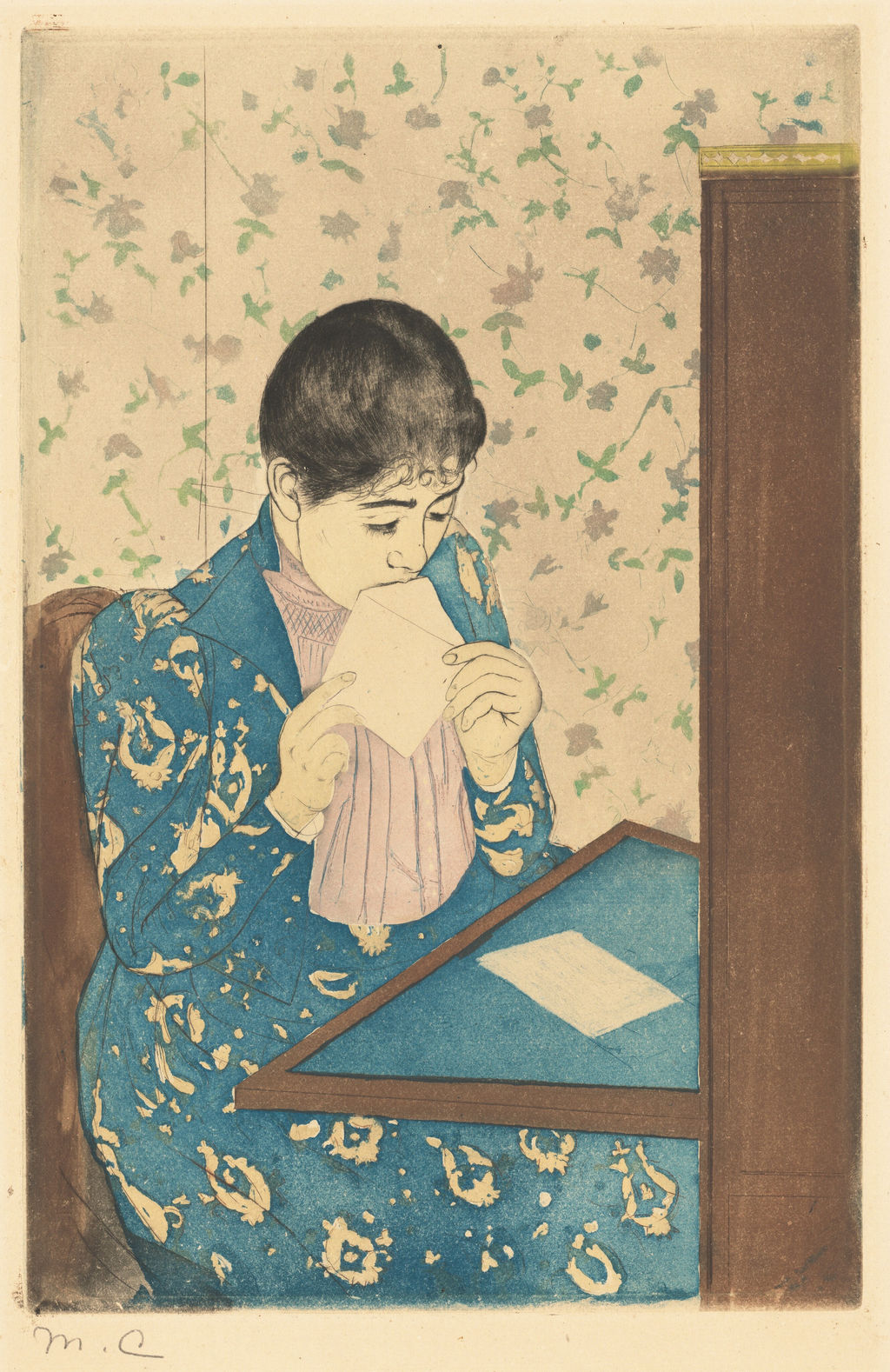
The Letter
1890–91 [7]Modern Woman
1892–93; displayed in 1893 [8] [9] [10]The Boating Party
1893–94 [11]The Child's Bath
1893 [12]Woman with a Sunflower
About 1905 [14]Young Woman in Green Outdoors in the Sun
About 1914 [15]Contents
- The face turned to the right
- The necklace and the neckline
- Pink fabric, gloves and the fan
- Red upholstery around a light figure
- What appears in the mirror
- Chandelier and artificial light
- Is the woman Lydia Cassatt?
- Exhibition in 1879
- The Rouart names in the ownership history
- The Loge: two actual figures
The face turned to the right
The figure fills most of the vertical canvas. Her upper body is presented broadly towards the viewer, but the head turns to the right. The difference makes the face part of an activity of looking rather than the fixed centre of an entirely frontal portrait.
Reddish-gold hair creates a compact mass above the face. Lighter marks across its upper portion meet darker passages near the temple and ear. The arrangement gives the head volume without isolating it from the warmer colours moving through the surrounding interior.
The mouth is slightly open, with a pale line between the warmer lips. Together with the turned head, it gives the face a lively appearance. It does not establish that the sitter is speaking a particular sentence or responding to a named person outside the frame.
The shoulders make a much broader light area below. One slopes towards the left edge, while the other meets the decorated strap and sleeve at the right. Their unequal presentation carries the head’s turn into the upper body without making the entire figure rotate into profile.
The eyes remain directed away from a simple encounter with the viewer. We can inspect the face while the figure appears attentive to another part of the surrounding space. That difference between our view and hers becomes more significant once the reflected auditorium is recognised.
The necklace and the neckline
The necklace follows a curved route around the base of the neck. Small light beads separate it from the larger, more continuous passages of skin. Its form is delicate in scale, but conspicuous because it crosses an otherwise relatively open area.
The curve also helps explain the neck’s rounded volume. The pearls rise at the sides and dip across the front, offering another indication of the body’s shape beneath the turned face. Jewellery participates in modelling as well as in the identification of evening dress.
Below, the pink garment opens into a wide neckline bordered with pale trim. The edge passes across the chest and changes direction at the shoulder. The necklace and the dress therefore create two different curved boundaries, with an area of skin between them.
They should not be reduced to the same kind of line. The necklace consists of distinct small units. The dress border is more irregular, interrupted by folds, touches of white and changes in the fabric. The contrast keeps both legible while relating them through their pale colour.
The title draws attention to the pearls, but they are not the picture’s only important accessory. Looking downward reveals the glove and fan; looking upward reveals a chandelier fragment. Small bright objects connect several parts of the composition rather than concentrating all ornament at the neck.
Pink fabric, gloves and the fan
The dress occupies much of the lower image, shifting between warmer pinks, cooler accents and pale highlights. Its broad form is interrupted at the waist and lap, where fabric folds and the gloved hand make overlapping shapes.
At the right shoulder, a small arrangement of darker green and warmer accents appears near the pale strap and bow. This concentrated decoration contrasts with the larger pink passages below. It marks the shoulder without requiring a precise botanical identification.
A pale gloved hand crosses the lap near the lower middle. The glove changes the relationship between hand and flesh: it offers a cooler, lighter surface than the exposed neck and shoulders. The fingers remain readable through their elongated shape and contact with the fan.
The fan spreads towards the lower right. Its narrow ribs and patterned surface establish an object held across the lap rather than raised before the face. It provides a directional movement out towards the edge, extending the figure’s arrangement beyond the torso.
The difference between this lowered fan and a face-covering fan is substantial. Here the mouth and expression remain visible, while the accessory contributes to the lower composition. Its position is a visible part of the pose; it does not establish a coded social message or a conversation outside the picture.
Red upholstery around a light figure
A strong red area rises behind the right shoulder and curves around the seated body. The upholstery provides a darker, warmer enclosure for the pale skin and pink dress. At the left, another red passage enters beside the arm, bringing the surrounding seat close to the picture’s boundary.
The furniture is not described as an independent complete object. We see the portions that frame and support the sitter, with much of its structure hidden by the body. The overlap makes the person feel close while leaving the exact dimensions of the seat unresolved.
The upper red curve also separates foreground figure from the reflective space above. It creates an immediate boundary behind the shoulders, while the balconies appear farther back. This layered arrangement lets the painting move from a close body to a large interior within a short vertical distance.
Red does not remain isolated in the chair. Related warm colours appear in hair, skin, dress and the darker reflected auditorium. The recurrence connects the setting without making its different materials indistinguishable.
The effect depends on the varied sizes of these passages. A broad red seat surrounds the torso; smaller warm touches animate the face and reflected spectators. The viewer can follow colour across the image while still recognising a hierarchy of near figure and more distant crowd.
What appears in the mirror
Philadelphia identifies the reflected balconies as those of the Paris Opéra. The mirror is behind the foreground woman, so its image brings another direction of the theatre into the space surrounding her. This location is the museum’s account of the setting. [1]
The reflected architecture consists of broad curving bands. Pale yellow and cooler accents describe balcony fronts, while darker openings contain small figures. These curves pass behind the head and shoulder, preventing the upper field from becoming a neutral backdrop.
The spectators are much smaller than the seated woman. Light touches suggest heads, garments and grouped bodies against the dark recesses. They establish a populated auditorium without becoming a series of equally detailed portraits.
This change of scale is essential. The woman in front remains individually legible through her expression, jewellery and hands. The crowd contributes social space through repetition and grouped marks. The two levels of description coexist without competing on equal terms.
The mirror also complicates a first impression of the picture. The balconies may initially appear to be directly behind the sitter. Recognising the reflected view means that we are seeing space reached through another surface and another direction. The image gives us access to more of the theatre than the foreground body alone would reveal.
There is no need to map every reflected spectator onto an exact seat in a reconstructed auditorium. The curves, small figures and change of scale already explain the important visual relationship. A mirror can expand the scene without making its entire geometry recoverable from one painting.
Chandelier and artificial light
A fragment of chandelier enters at the upper left, its pale forms cut by the top edge. The cropping makes the light fitting part of a larger object beyond the canvas. It also introduces brightness high above the necklace and face.
The chandelier does not need to be represented in full to affect the composition. Its light marks interrupt the warmer architecture and provide a different kind of small repeated shape from the pearls. One belongs to the room; the other follows the sitter’s body.
Philadelphia interprets the painting in relation to artificial light on flesh and to Cassatt’s exchange with Degas. This is a curatorial interpretation of its colour and setting. It does not attribute the painted surface to Degas’s hand. [1]
Visible colour changes across the face and shoulders support looking closely at illumination. Warm highlights meet cooler or darker passages beneath the chin, beside the eyes and along the neckline. Skin is not filled with one uniform flesh colour.
The oil medium matters here as a documented fact, but the reproduction does not provide a chemical account of the paint. Brightness in jewellery, chandelier or skin cannot by itself establish metallic pigment. Technical observations for a separate theatre pastel cannot be transferred to this canvas because the titles and subjects resemble one another.
Watch: Mary Cassatt
Choose a film to explore the artist’s work, its interpretation and its wider setting.
Demonstrating Mary Cassatt's Color Printmaking Techniques
The Philadelphia Museum of Art demonstrates techniques used to make Cassatt’s colour prints.
Watch on YouTubeIs the woman Lydia Cassatt?
The museum says that the sitter is often identified as the artist’s sister Lydia. That wording leaves the identification qualified. It is more precise to preserve the proposal than to present a certain name unsupported by a documented sitting. [1]
A familiar face across several Cassatt images can invite comparison, but resemblance alone cannot settle the identity. Differences of pose, lighting and medium also affect appearance. The historical suggestion remains useful as a suggestion, rather than a reason to make every theatre sitter the same person.
The scene itself does not depend on a biographical certainty. A figure in evening dress sits within a reflective theatre interior, looking away from the viewer. The necklace, fan, upholstery and auditorium retain their particular relationships whether the proposed name is accepted or left open.
The title Woman in a Loge reflects that descriptive level. A loge is a theatre box, and the title locates the figure within a type of space. The longer pearl-necklace title adds a distinctive visible feature, helping separate this oil from other works with similarly concise theatre names.
Exhibition in 1879
Philadelphia records that the painting appeared at the fourth Impressionist exhibition in Paris in 1879 and received praise. The exhibition statement is attributed to the museum; no particular contemporary critic’s words are required to describe the work here. [1]
The 1970 National Gallery exhibition catalogue later reproduced the same composition as entry 15. Its illustration and historical title help connect the familiar pearl-necklace name with the current Philadelphia object. The catalogue is a later publication, distinct from an original 1879 review. [2]
The subject also needs to remain separate from the occasion of exhibition. An artwork shown in 1879 does not automatically record a particular performance attended on a known date. The represented theatre and the later public display of the canvas answer different historical questions.
The reflected balconies provide enough specificity to discuss spectatorship. A named opera, exact interval or conversation would require evidence beyond the composition. The image’s engagement with public life can be considered through its visible audience and illuminated figure without supplying those details.
The Rouart names in the ownership history
The museum’s provenance begins with Alexis Rouart and qualifies a possible purchase from Cassatt around 1879. Alexis was the brother of the artist and collector Henri Rouart, and also had a son named Henri. These are different people, a distinction necessary for following the work’s early ownership. [1]
The provenance notes also preserve an ambiguous reference to Louis Rouart in Achille Ségard’s 1913 publication. The museum explains that more than one relative could fit that name. It does not resolve the ambiguity by treating every Rouart reference as a single collector. [1]
This is a useful example of how a documented family collection can still contain uncertainty. A surname, a repeated first name and an abbreviated historical credit are not necessarily enough to establish an unbroken sequence. The possible early acquisition should retain its qualification.
The museum then records Marcel Midy by 1953, a sale to Wildenstein in 1966 and purchase by Charlotte Dorrance Wright and William Coxe Wright on 24 October that year. Charlotte’s bequest brought it to Philadelphia in 1978. These later stages are distinct from the proposed original artist-to-collector transaction. [1]
The present museum credit therefore concerns the work’s eventual public collection, not the identity of the woman or the circumstances of the theatre scene. Provenance, portrait identification and depicted setting should remain related but separate histories.
The Loge: two actual figures
The National Gallery’s The Loge is a separate oil dated about 1878–80, accession 1963.10.96. It presents two figures with a raised fan and a bouquet, rather than this single prominent woman wearing pearls. [16]
In that composition, the fan partly covers one face and helps distinguish the pair. The bouquet occupies the other figure’s lap. Here the fan stays low, the full face remains visible and the necklace supplies another curved accent around the neck.
Both paintings use theatre architecture to extend the space around close figures. Their differing arrangements change what the viewer can inspect: a pair with separate accessories in one, a single foreground sitter and a more prominent reflected auditorium in the other.
The comparison also shows why titles need an object identity. The Loge and Woman in a Loge sound closely related, but their figures, accessions and collecting histories are distinct. Their shared subject does not supply shared sitter names.

The Loge.
In the Loge: looking through glasses
Boston’s In the Loge is an oil of 1878, accession 10.35. Its museum identifies the setting with a matinée at the Comédie-Française. That is a different institutional location from Philadelphia’s account of the reflected Paris Opéra. [17]
The Boston figure raises opera glasses towards her eyes, turning in profile as she looks across the auditorium. A distant observer behind directs another act of looking towards her. The optical device and the other spectator make attention unusually explicit.
In the pearl-necklace painting, no glasses conceal the eyes. The head turns, while the mirror supplies the expanded view of the surrounding audience. The spectator is herself available to our inspection even as her attention appears directed elsewhere.
These contrasting arrangements make the theatre more than a decorative setting. Glasses, reflection, figure scale and head direction determine what each person can see and what the viewer is shown. Cassatt develops different relationships between those elements in three paintings with closely related titles.

In the Loge.
Cassatt artworks and studies
A source-bounded directory of documented works and studies, including the works in the National Gallery’s 2026 checklist and one clearly marked former attribution. Different print impressions are grouped by design and remain searchable by their recorded accessions. This is not a complete catalogue raisonné. Unlinked titles have no individual article here.
| Name | Date | Medium |
|---|---|---|
| A Child’s Bath — LACMA oil | 1880 | Oil on canvas |
| A Goodnight Hug | 1880 | Pastel |
| After the Bullfight | 1873 | Oil on canvas |
| Afternoon Tea Party | 1890–91 | Colour print |
| At the Theatre (Lydia Cassatt Leaning on Her Arms, Seated in a Loge) | About 1879 | Pastel |
| Automne, portrait de Lydia Cassatt | 1880 | Oil on canvas |
| Breakfast in Bed | 1897 | Oil on canvas |
| Bust of Ellen with Bows in Her Hair | 1898 | Pastel |
| By the Pond | About 1896 in Met and Terra records; about 1898 at MoMA | Not established |
| Child Drinking Milk from a Bowl; provisionally identified composition (qualified identification) | About 1890, following inventory and catalogue text | Pastel |
| Child in a Straw Hat | About 1886 | Oil on canvas |
| Child Picking a Fruit | 1893 | Oil on canvas |
| Children Playing on the Beach | 1884 | Oil on canvas |
| Clarissa, Turned Left, with Her Hand to Her Ear | About 1890–93 in Sotheby’s 2012 entry; about 1893 in GCMA notice | Pastel |
| Denise at her Dressing Table | About 1908–09 | Oil on canvas |
| Driving | 1881 | Oil on canvas |
| Eddy Cassatt (Edward Buchanan Cassatt) | 1875 | Oil on canvas |
| Ellen Mary Cassatt in a White Coat | About 1896 | Oil on canvas |
| Emmie and her Child | About 1890 | Oil on canvas |
| Gathering Fruit | About 1893 | Not established |
| Girl Arranging her Hair | 1886 | Oil on canvas |
| Head of a Child with a Red Hat | 1903, signed and dated | Pastel |
| Head of a Woman in a Large Hat | About 1909 | Pastel |
| Head of Simone in a Green Bonnet with Wavy Brim | About 1904 | Pastel |
| In the Garden | 1903 or 1904 | Oil on canvas |
| In the Loge | 1878 | Oil on canvas |
| In the Omnibus | 1890–91 | Colour print |
| In the Omnibus [recto] — preparatory drawing | c. 1891 | Chalk and graphite |
| In the Opera Box (No. 3) [recto] — preparatory drawing | 1880 | Graphite |
| In the Opera Box (No. 3) — print | c. 1880 | Intaglio print |
| Jeune fille au jardin (Young Woman Sewing in a Garden) | 1880–82 | Oil on canvas |
| Jules Dried by His Mother; provisionally identified composition (qualified identification) | 1901, following catalogue text | Oil on canvas |
| Lady in Black, in a Loge, Facing Right | c. 1880 | Etching |
| Lilacs in a Window | About 1880–83 | Oil on canvas |
| Little Girl in a Blue Armchair | 1878 | Oil on canvas |
| Louise Nursing her Child | 1899 in Luxembourg caption; 1898–99 in loan and Arp records | Pastel |
| Madame Gaillard and Her Daughter Marie-Thérèse | 1897, Reynolda collection listing | Pastel |
| Maternal Caress | 1890–91 | Not established |
| Maternal Caress — preparatory drawing | About 1891 | Charcoal and graphite |
| Mathilde Holding a Baby Who Reaches out to the Right | About 1889, Christie’s catalogue | Pastel |
| Mimi as a Brunette | c. 1889 | Drypoint |
| Mimi Holding a Japanese Fan | c. 1889 | Drypoint |
| Modern Woman | 1892–93; displayed in 1893 | Not established |
| Mother about to Wash her Sleepy Child | 1880 | Oil on canvas |
| Mother and Child (Maternal Kiss) | 1896 | Pastel |
| Mother and Child (Nude Dark-Eyed Little Girl with Mother in Patterned Wrapper) | About 1898–99, Sotheby’s catalogue | Pastel |
| Mother and Child (The Oval Mirror) | About 1899 | Oil on canvas |
| Mother Berthe Holding Her Nude Baby | 1898–99 | Pastel |
| Mother in Purple Holding her Child | About 1914, Christie’s catalogue | Pastel |
| Mother Playing with Child | About 1897 | Pastel |
| Mother’s Kiss | 1890–91 | Colour print |
| Nurse Reading to a Little Girl | 1895 | Pastel |
| Poppies in a Field (formerly Cassatt; attributed to Victor Gabriel Gilbert) | About 1880, current museum record | Oil on panel |
| Portrait of an Elderly Lady | c. 1887 | Oil on canvas |
| Portrait of Madame AF Aude and her Two Daughters | 1899, Breeskin 1970 exhibition catalogue | Pastel |
| Portrait of the Artist | 1878 | Watercolour and gouache |
| Reading Le Figaro | 1878, NGA 2026 checklist; about 1877–78 in SAAM’s 2015 caption | Oil on canvas |
| Reflection — drypoint | c. 1890 | Drypoint |
| Sara Holding a Cat | About 1907–08 | Oil on canvas |
| Sara in a Green Bonnet | About 1901 | Oil on canvas |
| Sara with Her Dog, in an Armchair, Wearing a Bonnet with a Plum Ornament | 1901 | Pastel |
| Self Portrait | About 1880 | Watercolour and gouache |
| Simone in Blue Plumed Hat | About 1903 | Pastel |
| Simone Seated on the Grass next to her Mother | 1901–02 | Pastel |
| Sketch of Master St. Pierre | Date not established | Pastel |
| Sleepy Baby | About 1910 | Pastel |
| Smiling Mother with Sober Faced Child | Date not established | Pastel |
| Spanish Dancer Wearing a Lace Mantilla | 1873 | Oil on canvas |
| Summertime, horizontal painting | 1894–95, current Sotheby’s catalogue | Oil on canvas |
| Tea — print | c. 1890 | Drypoint |
| The Bath | 1890–91 | Not established |
| The Boating Party | 1893–94 | Oil on canvas |
| The Caress | 1902 | Oil on canvas |
| The Child's Bath | 1893 | Oil on canvas |
| The Coiffure | 1890–91 | Colour print |
| The Cup of Tea | About 1880–81 | Oil on canvas |
| The Fitting | 1890–91 | Colour print |
| The Lamp | 1890–91 | Colour print |
| The Letter | 1890–91 | Colour print |
| The Loge | About 1878–1880 | Oil on canvas |
| The Mandolin Player | 1868 | Oil on canvas |
| The Manicure (Les Ongles; The Nails) | About 1908 | Intaglio print |
| The Tea; Le Thé | About 1880 | Oil on canvas |
| The Visitor | c. 1880 | Intaglio print |
| Two Sisters | 1896 | Pastel |
| Two Women Seated by a Woodland Stream | About 1869 | Oil on canvas |
| Two Women Throwing Flowers During Carnival | 1872 | Oil on canvas |
| Under the Horse-Chestnut Tree | 1896–97, National Gallery and MoMA records | Not established |
| Woman Bathing (La Toilette) | 1890–91 | Colour print |
| Woman in a Loge (Woman with a Pearl Necklace) | 1879 | Oil on canvas |
| Woman Reading | 1878–79 | Oil on canvas |
| Woman Standing, Holding a Fan | 1878–79 | Distemper |
| Woman with a Fan | c. 1878–1879 | Oil on canvas |
| Woman with a Red Zinnia | 1891 | Oil on canvas |
| Woman with a Sunflower | About 1905 | Oil on canvas |
| Young Girl at a Window | c. 1883–1884 | Oil on canvas |
| Young Girl with Brown Hair, Looking Left | About 1913 (1997 summary catalogue) | Pastel |
| Young Mother Sewing | 1900 | Oil on canvas |
| Young Woman in Green, Outdoors in the Sun | About 1914 | Oil on canvas |
Discussion
Look again at the images and ideas explored in Woman with a Pearl Necklace in a Loge by Mary Cassatt. These editorial prompts invite your observations.
Reader Insights
A curved strand of pearls rests above a low pink neckline. What does this first detail make you notice?
The figure fills most of the vertical canvas. How does it affect your reading of the whole work?
Does the mirror make the sitter feel more public, or does the close view keep your attention on her face and jewellery?
Join the Conversation
Share a detail, comparison or question about Woman with a Pearl Necklace in a Loge by Mary Cassatt below.
References
- Philadelphia Museum of Art, Woman in a Loge, 1879, accession 1978-1-5; current label and publicly embedded object details, provenance and notes. Canvas and frame dimensions are separately labelled; Lydia identification and early Rouart purchase remain qualified. View source.
- Adelyn D. Breeskin, National Gallery of Art, Mary Cassatt 1844–1926, 1970, entry and matching illustration 15; historical pearl-necklace title and image identity. View source.
- Denver Art Museum, Whistler to Cassatt Access Guide, The Salon, stop 104. View source.
- Denver Art Museum, Whistler to Cassatt:American Painters in France, bilingual exhibition livret,The Salon,no2. View source.
- National Gallery of Art, Little Girl in a Blue Armchair, 1983.1.18. View source.
- Philadelphia Museum of Art, Driving, 1881. View source.
- National Gallery of Art, The Letter,1943.3.2763. View source.
- Art Institute of Chicago, Ryerson and Burnham Archives, Bertha Honoré Palmer Correspondence Collection finding aid, selected Mary Cassatt entries, Box1Folder3. View source.
- Museum of Modern Art, Mary Cassatt artist essay and print records. View source.
- MaudHoweElliott(ed.) / UniversityofIllinoisUrbanaChampaign scan, Art and Handicraft in the Woman’s Building of the World’s Columbian Exposition,Chicago,1893,Chicago:RandMcNally,1894. View source.
- National Gallery of Art, The Boating Party, 1963.10.94. View source.
- Art Institute of Chicago, The Child’s Bath,1910.2,current expanded collection entry. View source.
- Metropolitan Museum of Art, Young Mother Sewing, 29.100.48. View source.
- National Gallery of Art, Woman with a Sunflower, 1963.10.98. View source.
- Sotheby’s, Young Woman in Green Outdoors in the Sun, Modern Day. View source.
- National Gallery of Art, The Loge, about 1878–80, accession 1963.10.96; separate two-figure oil. View source.
- Museum of Fine Arts, Boston, In the Loge, 1878, accession 10.35; separate oil with glasses, distant observer and attributed Comédie-Française setting. View source.
- Art Gallery of Ontario, Cassatt–McNicoll:ImpressionistsBetweenWorlds. View source.
- Metropolitan Museum of Art, The Bath, 16.2.7. View source.
- National Gallery of Art, Children Playing on the Beach, 1970.17.19. View source.
- Colby College Museum of Art, Explore Inside Out: The Prints of Mary Cassatt; Mother Berthe Holding Her Nude Baby,2013.549. View source.
- Sotheby’s, syndicated auction catalogue hosted by Invaluable, Simone in Blue Plumed Hat, Watson collection, 18 May 2005, lot 20. View source.
- The Huntington, Breakfast in Bed, 83.8.6. View source.
- Adelyn Dohme Breeskin / Smithsonian Institution Press; University of California scan indexed by Google Books, Mary Cassatt:A Catalogue Raisonné of the Oils,Pastels,Watercolors,and Drawings,1970,322pp; selected public search snippets pp91–92,143–144,316,318. View source.
- Metropolitan Museum of Art, The Private Collection of Edgar Degas: A Summary Catalogue, Cassatt entries, printed p.7, no.48. View source.
- Art Institute of Chicago, After the Bullfight, 1969.332. View source.
- Smithsonian American Art Museum, Art Inventories, After the Bullfight, siris_ari_180619. View source.
- Smithsonian American Art Museum, The Caress, 1911.2.1. View source.
- Museum of Modern Art, Under the Horse-Chestnut Tree,671.1940. View source.
- National Gallery of Art, Under the Horse-Chestnut Tree,1959.12.4. View source.
- Virginia Museum of Fine Arts, Board of Trustees minutes,17September2020,loan recommendation7:ChildPickingaFruit75.18. View source.
- Cincinnati Art Museum, Les Ongles(The Nails;The Manicure),ca1908,1940.155,secondstate. View source.
- Sotheby’s, Clarissa Turned Left with Her Hand to Her Ear, 2012 lot 51. View source.
- Greenville County Museum of Art, Recent Acquisitions Funded by Sale of Alma Thomas Painting, 2021. View source.
- Metropolitan Museum of Art, The Coiffure,16.2.3. View source.
- Metropolitan Museum of Art, The Cup of Tea, 22.16.17. View source.
- Sotheby’s, Mother and Child (Nude Dark-Eyed Little Girl with Mother in Patterned Wrapper), 19 May 2010, lot 31. View source.
- Metropolitan Museum of Art, Denise at Her Dressing Table, 2005.129. View source.
- Denver Art Museum, Whistler to Cassatt exhibition guide, stop 112: Bust of Ellen with Bows in Her Hair. View source.
- Museum of Fine Arts, Boston, Ellen Mary in a White Coat, 1982.630. View source.
- Amon Carter Museum of American Art, Woman Standing Holding a Fan, 2011.20. View source.
- Smithsonian American Art Museum, Special Installation of Nineteen American Masterworks, 2015. View source.
- Metropolitan Museum of Art, The Fitting, 16.2.8 final state. View source.
- Reynolda House Museum of American Art, Mary Cassatt collection listing: Madame Gaillard and Her Daughter Marie-Thérèse, 1897. View source.
- Wake Forest University, Wake Women 2023 schedule, Highlighting the Art of Women at Reynolda, captioned Cassatt image. View source.
- Detroit Institute of Arts, In the Garden, 36629. View source.
- National Gallery of Art, Gathering Fruit,1943.3.2757. View source.
- Sotheby’s, A Goodnight Hug,N09860lot11,14May2018. View source.
- Sotheby’s, syndicated auction catalogue hosted by Invaluable, Head of Simone in a Green Bonnet with Wavy Brim, Watson collection,18May2005,lot39. View source.
- National Gallery of Art, Girl Arranging Her Hair, 1963.10.97. View source.
- Joslyn Art Museum, Art Break:Woman Reading,1943.38,program object caption. View source.
- Los Angeles County Museum of Art, A Child’s Bath, M.62.8.14. View source.
- National Gallery of Art, The Lamp, 5937. View source.
- Sotheby’s, Tête de Femme au Grand Chapeau, 2008 N08449 lot135. View source.
- Metropolitan Museum of Art, Lilacs in a Window, 1997.207. View source.
- Arp Museum Bahnhof Rolandseck, Maestras: Malerinnen1500–1900,25February–16June2024,official five-page flyer. View source.
- Spanish official gazette / exhibition insurance schedule, BOE-A-2023-19808,21September2023,Maestras loan schedule. View source.
- Nationalmusée um Fëschmaart / ArpMuseum CollectionRauforUNICEF, Louise,NursingHerChild,1899,GR1.949;FromRenoirtoMonet2026–27. View source.
- Petit Palais / Paris Musées, Automne, portrait de Lydia Cassatt, PPP706; IIIF manifest 160008392. View source. (in French).
- Metropolitan Museum of Art, Maternal Caress, 16.2.5. View source.
- Philadelphia Museum of Art, Mother and Child Maternal Kiss, object 54049. View source.
- Metropolitan Museum of Art, Maternal Caress, preparatory drawing64.123.3, c1891. View source.
- Christie’s, Mathilde Holding Baby who Reaches out to Right, lot 5459369. View source.
- National Portrait Gallery / Catalog of American Portraits, Madame Meerson and her Daughter, SSSA2282. View source.
- Smithsonian art inventories, Child Drinking Milk from a Bowl, siris_ari_197517. View source.
- MutualArt public auction index; original auctioneer undisclosed without subscription, Child Drinking Milk from a Bowl, public listing dated 2 June 2024. View source.
- National Gallery of Art, Mother's Kiss,1963.10.254. View source.
- National Gallery of Art, Mary Cassatt the Daring Printmaker, 23 January 2026. View source.
- National Gallery of Art, Mary Cassatt An American in Paris checklist, updated 24 February 2026. View source.
- Adelyn D. Breeskin / National Gallery of Art, Mary Cassatt 1844–1926, 1970 exhibition catalogue. View source.
- Metropolitan Museum of Art, Nurse Reading to a Little Girl, 62.72. View source.
- National Gallery of Art, In the Omnibus, 46725. View source.
- Metropolitan Museum of Art, Mother and Child (The Oval Mirror), 29.100.47. View source.
- Metropolitan Museum of Art, Mother Playing with Child, 22.16.23. View source.
- Metropolitan Museum of Art, By the Pond,60.732bis. View source.
- Museum of Modern Art, By the Pond,673.1940. View source.
- Terra Foundation for American Art, By the Pond,1999.25. View source.
- Philadelphia Museum of Art, Poppies in a Field, attributed to Victor Gabriel Gilbert; formerly attributed to Mary Stevenson Cassatt, 1978-1-6. View source.
- Christie’s, Mother in Purple Holding Her Child, lot 5369421. View source.
- Sotheby’s, Tête d’enfant au chapeau rouge, American Art N09229, 20 November 2014, lot 39. View source.
- Christie’s, Sara Holding a Cat, lot 5561267. View source.
- Smithsonian American Art Museum, Art Inventories Catalog, Sara with Her Dog, in an Armchair, Wearing a Bonnet with a Plum Ornament; IAP 80170363 / siris_ari_180925. View source.
- Smithsonian American Art Museum, Sara in a Green Bonnet, 1929.6.11. View source.
- Mary Cassatt Catalogue Raisonné project, with Adelson Galleries, presented on Artnet, Sara with Her Dog, in an Armchair, Wearing a Bonnet with a Plum Ornament, work 424155733. View source.
- Metropolitan Museum of Art, Portrait of the Artist, 1975.319.1. View source.
- National Portrait Gallery, Mary Cassatt Self-Portrait, NPG.76.33. View source.
- Musée d’Orsay, Jeune fille au jardin,RF193720. View source. (in French).
- Sotheby’s, Simone Seated on the Grass Next to Her Mother, 30 September 2020, lot 33. View source.
- Dallas Museum of Art, Sleepy Baby,1952.38.M. View source.
- Sotheby’s, Smiling Mother with Sober Faced Child, 2022. View source.
- Smithsonian American Art Museum, Spanish Dancer Wearing a Lace Mantilla, 1967.40. View source.
- Spencer Museum of Art,University of Kansas, The Manicure,c1908,1991.0266. View source.
- Christie’s, Sketch of Master St Pierre, 2017 online lot. View source.
- National Gallery of Art, Child in a Straw Hat, 1983.1.17. View source.
- Sotheby’s, Summertime, Armand Hammer: The Private Collection, Modern Evening Auction 2026. View source.
- National Gallery of Art, Afternoon Tea Party, 46731. View source.
- Museum of Fine Arts, Boston / Erica E. Hirshler, The Tea, 42.178. View source.
- The Nelson-Atkins Museum of Art, At the Theater,F77-33;French Paintings and Pastels appendixII. View source.
- Metropolitan Museum of Art, Woman Bathing La Toilette, 16.2.2. View source.
- Sotheby’s, Two Sisters, 2005 American Paintings sale N08134, lot 44. View source.
- Wichita Art Museum, Mother and Child, M109.53. View source.
- Smithsonian American Art Museum, Art Inventories, Two Women Seated by a Woodland Stream / Duex femmes assises aupres de l’eau, IAP 80170008. View source.
- Tacoma Art Museum / David Setford, Impressionist Painting: From Pleasure Gardens to the Palais Garnier, 22 October 2019. View source.
- Tacoma Art Museum, French Impressionism and the Northwest, Works of Art Adoption Program, 2019–2020, no. 10 / PDF p. 12. View source.