by Tom Gurney
Tom Gurney BSc (Hons) is an art history expert with over 20 years experience
Published on June 19, 2020 / Updated on September 28, 2026
Email: tomgurney1@gmail.com / Phone: +44 7429 011000
About the painting
A dark apple tree spreads across a field of blue, orange and yellow marks. Its trunk rises from near the bottom of the picture, bends, and divides into an arch of branches that almost fills the width. Around it, short strokes run in many directions, so the space seems as restless as the tree. Piet Mondrian's Apple Tree, Pointillist Version keeps a familiar natural subject while making colour and the movement of paint impossible to overlook.
The Dallas Museum of Art calls this painting Apple Tree, Pointillist Version and dates it 1908–1909. RKD catalogues the Dallas work as A673, under the shorter title Apple tree, with inventory 1982.26. The museum records oil on composition board, measuring 56.833 × 74.93 cm. These details identify a particular painting, separate from Mondrian's other blue and red apple trees of the same period.[1][2]
At a glance
- ArtistPiet Mondrian (Piet Mondriaan, 1872–1944)
- Museum titleApple Tree, Pointillist Version
- RKD title and numberApple tree, Joosten A673
- Date1908–1909
- MediumOil on composition board
- Dimensions56.833 × 74.93 cm (height × width)
- CollectionDallas Museum of Art, Foundation for the Arts Collection
- CreditGift of the James H. and Lillian Clark Foundation
- Museum inventory1982.26[1][2]
Where the Dallas apple tree sits in Mondrian's career
Contents
- What does the painting show?
- Why is it called Pointillist Version?
- Does the blue have a symbolic meaning?
- How does it compare with Mondrian's other trees?
- Where is Apple Tree, Pointillist Version?
What does the painting show?
The trunk is a dark anchor near the lower centre. It climbs a short distance before turning into a thick, irregular spread of limbs. Smaller branches fork from those large arcs, running both left and right. Their many changes of direction make the crown appear wider than the central trunk suggests. The tree remains recognisable, yet Mondrian gives us much more to follow than a single outline.
 The Red Tree Piet Mondrian.jpg)
Blue is prominent behind the branches and in scattered marks around them. Warm orange and yellow strokes interrupt it. At the lower edge, clusters of blue and orange suggest a ground, but there is no carefully modelled landscape setting. The eye can travel from the base up the trunk, follow a branch to the upper edge, then return through the bright marks that surround it. The background participates in that journey rather than sitting passively behind the subject.
The Dallas Museum of Art describes the branches as radiating and calls attention to the intense colour and slashing lines. In the reproduction, many short marks appear to move outward from the centre of the tree. Others cross at different angles. Their changing directions give the surface an animated texture without requiring us to decide that every touch stands for an individual leaf, blossom or shaft of sunlight. The painting's energy comes from the relationship between branching lines and broken colour.[1]
Look especially at the middle, where a patch of blue sits inside the dark branching mass. That opening keeps the tree from becoming a solid silhouette. Blue appears both within and beyond the tree. This repeated colour draws together areas that might otherwise seem separate: the crown, the sky-like field and the marks at the bottom. Mondrian allows the subject to remain clear while also making the whole painted surface matter.
Why is it called Pointillist Version?
“Pointillist Version” is part of the Dallas museum's title, so it is a useful way to identify this work. The paint is visibly broken into small, separate touches. Blue, orange and yellow are not blended into one smooth tone; their differences remain apparent when looking closely. This gives the picture a flickering quality, especially where the bright marks press against the dark branches.[1]
The title does not mean that every stroke is a tiny round dot. Some marks are dashes, while others are longer and more forceful. The museum itself stresses the slashing lines. It is more accurate to describe the mixture we can see than to impose a uniform recipe on the entire painting. Nor does the title alone document that Mondrian was applying the exact method of another named painter to this particular board.
The contrast with the tree's larger, darker forms is essential. From farther away, the crown's arch and the bright blue-orange field can be grasped together. A closer view makes the individual marks more insistent. Both experiences belong to the work: the subject gives the eye a path through the image, and the separate strokes keep interrupting a simple reading of that subject. Mondrian's treatment of an apple tree is therefore as much about arrangement and rhythm as botanical description.
The museum's title also helps distinguish this painting from others in the same group. RKD's Apple tree is a shorter catalogue name, not evidence of a second Dallas work. Its A673 entry and the museum's longer title refer to the painting in Dallas with inventory 1982.26. The distinct Apple Tree in Blue belongs to Kunstmuseum Den Haag. Similar subject matter and overlapping dates make these paintings easy to confuse, so the collection, support and catalogue number are more reliable than a general “blue apple tree” label.[1][2][3]
Watch: Piet Mondrian
See his studio, the move toward geometric abstraction and the rhythms of his New York paintings.
Piet Mondrian: Abstract Painting as We Know It
Curator Michael White explores the paintings and Mondrian’s studio as an abstract space.
Watch on YouTubeDoes the blue have a symbolic meaning?
The Dallas Museum of Art offers a possible interpretation: the dominant blue and a triangular impression created by the tree may have drawn on symbols important to Theosophists. Its wording matters. This is a museum's suggestion about the work, not proof that each blue stroke carries a fixed message or that the painting depicts a particular spiritual event. The museum also reads the radiating branches and forceful lines as a way of conveying nature's energy.[1]
The visual facts can be considered without settling a symbolic reading. Cool blue surrounds the dark limbs; orange and yellow enliven the gaps. The trunk and branching crown form an expanding shape, but the individual limbs refuse to fit neatly inside a rigid triangle. This tension between a broad overall form and many irregular parts helps explain why the painting feels active. A viewer may find the colour suggestive, yet the image does not require one coded interpretation to be rewarding.
The work's date is also useful context. Around 1908–09 Mondrian repeatedly chose trees and strong colour, but the paintings are not interchangeable illustrations of a single theory. The Dallas board has its own scale, material and dense short strokes. Its distinctive effect can be described directly before connecting it to ideas the museum cautiously proposes.
How does it compare with Mondrian's other trees?
Apple Tree in Blue, which Kunstmuseum Den Haag titles The Blue Tree, is close in date but separate in every important object record: A672, object 0320911, tempera on cardboard, 75.5 × 99.5 cm. The Dallas A673 is smaller and is oil on composition board. Both display a bent tree among blue marks, but the Dallas picture's short orange and blue strokes spread vigorously around its dark branches. Comparing them is a way to see different handling of colour and surface, not a reason to merge their titles or measurements.[2][3]
Avond (Evening): The Red Tree offers another nearby comparison. Kunstmuseum Den Haag dates that work 1908–1910, identifying it as oil on canvas and object 0332041. Its fiery red tree stands against a deep blue field. The Dallas painting sets its dark trunk amid many dispersed blue and warm-coloured marks. Each gives branches a strong presence, but their colour relationships differ. Their dates overlap, so neither should be presented as an inevitable completed step after the other.[4]
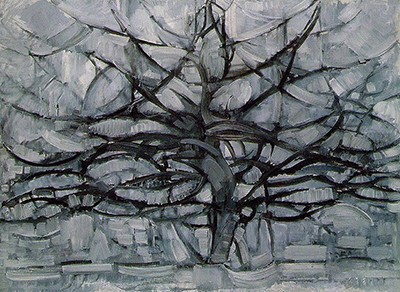
The later Gray Tree of 1911 can sharpen the comparison again. There, Mondrian lets branches and a restrained gray field draw closer in tone. In the Dallas work, brilliant broken colour presses against a dark branching structure. The contrast shows the range of choices available to him while he explored a recurring motif. It does not make A673 merely a preliminary exercise for a later painting.[5]
Where is Apple Tree, Pointillist Version?
The painting belongs to the Dallas Museum of Art. The museum's credit is Foundation for the Arts Collection, gift of the James H. and Lillian Clark Foundation; RKD records the Dallas inventory as 1982.26. The museum-supplied artwork page gives the object facts and links to the museum's own record. A collection listing does not establish whether the painting is on view on a chosen day, so check current museum information before a visit focused on this work.[1][2]
The painting rewards a second look because it refuses to separate the tree from its surroundings. The trunk provides a route into the picture; short coloured strokes continually pull attention outward. Its familiar subject survives, but lines and colour carry much of the experience. That balance makes the Dallas apple tree a distinctive work rather than simply another name for Mondrian's better-known blue tree.
Mondrian artworks directory
Frequently asked questions
When was Apple Tree, Pointillist Version painted?
What is it painted on?
Is RKD's Apple tree a different painting?
Is this the same as Apple Tree in Blue?
Does the museum say the colours are Theosophical symbols?
The museum suggests that the blue and triangular tree form may relate to Theosophical symbols. It presents this as a possibility, not a proved meaning for each colour.[1]
Discussion
Where does the dark trunk first draw your eye, and where do the colours take over?
Reader Insights
Follow a branch toward the right edge. Which blue or orange marks answer it?
Which short strokes below the trunk seem to echo marks above the tree?
How does the Dallas tree differ from The Blue Tree or The Red Tree?
Join the Conversation
Share what you notice in this painting below.
References
- Dallas Museum of Art via Google Arts & Culture, Apple Tree, Pointillist Version, 1908–09, object description and details. View source.
- RKD – Netherlands Institute for Art History, Mondrian catalogue raisonné, Amsterdam 1908–11 landscapes, A673 Apple tree and neighbouring A672. View source.
- Kunstmuseum Den Haag, collection record for The Blue Tree, object 0320911. View source.
- Kunstmuseum Den Haag, collection record for Avond (Evening): The Red Tree, object 0332041. View source.
- Kunstmuseum Den Haag, collection record for The Grey Tree. View source.
- Lead image credit. Piet Mondrian, Apple Tree, Pointillist Version, 1908–09. Dallas Museum of Art, inventory 1982.26.