 by Tom Gurney
Tom Gurney BSc (Hons) is an art history expert with over 20 years experience
Published on June 19, 2020 / Updated on September 28, 2026
Email: tomgurney1@gmail.com / Phone: +44 7429 011000
About the painting
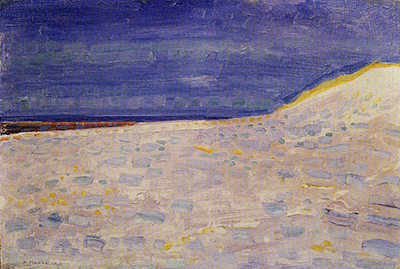
A broad pale beach fills much of Piet Mondrian's Beach with One Pier at Domburg. At the left, a long dark structure meets a thin strip of sea. At the right, the sand rises into a light dune beneath a deep blue-violet sky. There is very little to count, yet the painting is full of small marks. Soft blue, cream and yellow touches interrupt the beach, while horizontal strokes make the sky feel dense and active. Mondrian painted this Domburg seascape in 1909.[1]
RKD catalogues the painting as A699, between two other 1909 Domburg pier pictures, A697 and A698. The catalogue lists The Judith Rothschild Foundation, New York City; that entry identifies a recorded collection but does not establish whether the work is presently on view. A gallery exhibited the painting in London in 2009 as Beach with One Pier at Domburg (Dune). The parenthetical word draws attention to the large dune, but it is not a different painting. This is a separate work from the five-piers canvas at the Museum of Fine Arts, Boston, and the three-or-four-piers picture identified by the Kröller-Müller Museum.[1][2]
At a glance
- ArtistPiet Mondrian (Piet Mondriaan, 1872–1944)
- TitleBeach with One Pier at Domburg; also exhibited as Beach with One Pier at Domburg (Dune)
- Date1909
- MediumOil on canvas, according to an RKD-sourced Commons object record
- Dimensions46 × 67 cm (height × width), according to that record
- Catalogue raisonnéJoosten A699
- Collection lineThe Judith Rothschild Foundation, New York City, as listed by RKD[1][2][3]
Where the Domburg beach sits in Mondrian's career
Contents
- What can you see in the painting?
- Why did Mondrian paint the Domburg coast?
- Is it the same as Mondrian's other pier paintings?
- What does the 2009 exhibition tell us?
- Where is Beach with One Pier at Domburg now?
What can you see in the painting?
The eye first meets the open expanse of sand. It occupies most of the lower half and extends almost to the horizon at left. Mondrian has not filled it with people, umbrellas or buildings. Instead, small strokes of cream, blue-gray, pink and yellow make the pale surface varied. They do not each need to stand for a specific pebble or patch of wet sand. Together they make the foreground shimmer while allowing it to remain broad and uncluttered.
 The Red Tree Piet Mondrian.jpg)
A low, dark line reaches across the left side near the water. It is the singular pier or breakwater named by the title. In a small image, it is easy to miss because it lies close to the horizon and takes up little space. Its horizontal direction is nevertheless decisive. It interrupts the bright meeting of beach and sea and draws the viewer toward the open left edge. The dark line also gives scale to the otherwise expansive shore.[1]
Above this low strip, the sky has a different density from the beach. Deep blue-violet paint is spread in horizontal strokes, with paler passages toward the horizon. Mondrian does not sharply outline clouds or specify a time of day. The colour and layered marks give the upper part of the painting a weight of its own. The sea between sky and beach is narrow, so the picture sets a large dark field above a large light one.
The dune rises on the right. Its pale slope catches yellow and warm cream touches, forming a bright edge against the dark sky. It is more than a piece of local scenery: its diagonal lifts the composition where the beach and pier run sideways. Follow the low line from the left toward the dune, and the eye changes direction. That small change makes the shore feel like a place with depth, even with few objects depicted.
At a glance, the picture may seem simple because it has a single named structure. A closer view reveals differences in how each area is made. The beach has scattered short marks, the sky has broader lateral movement, and the dune gathers lighter strokes along a rising slope. Mondrian lets these kinds of mark remain visible. The view is recognizable, but the paint itself is part of what the viewer sees.
Why did Mondrian paint the Domburg coast?
Mondrian repeatedly visited Domburg on the Walcheren peninsula from 1908. Kunstsammlung Nordrhein-Westfalen's account of this period names the sea, dunes, church tower and Westkapelle lighthouse among his subjects. It describes a growing distance from naturalistic colour and the use of visible, often parallel brushstrokes. Beach with One Pier fits this setting: a specific stretch of coast supplies the subject, while the choice of colour and direction gives it a force beyond topographical description.[4]
The coast offered recurring forms under changing light. Dunes slope toward the shore, and breakwaters extend into the sea. Fondation Beyeler's guide calls these horizontal structures characteristic of Domburg. Mondrian could return to them without repeating exactly the same view. In A699, one low pier is enough. Its position near the left horizon shifts attention toward the open beach and the luminous dune, rather than making the coastal structures dominate the painting.[5]
Kunstsammlung Nordrhein-Westfalen also places Mondrian within Domburg's artistic circle, where he knew Jacoba van Heemskerck and Jan Toorop. This context helps explain why the resort mattered during a period of experimentation. It does not require reading a fixed symbol into the pier or each colour. The painting's visible relationships are already rich: dark sky against pale beach, horizontal shore against diagonal dune, and one man-made line against the moving water.[4]
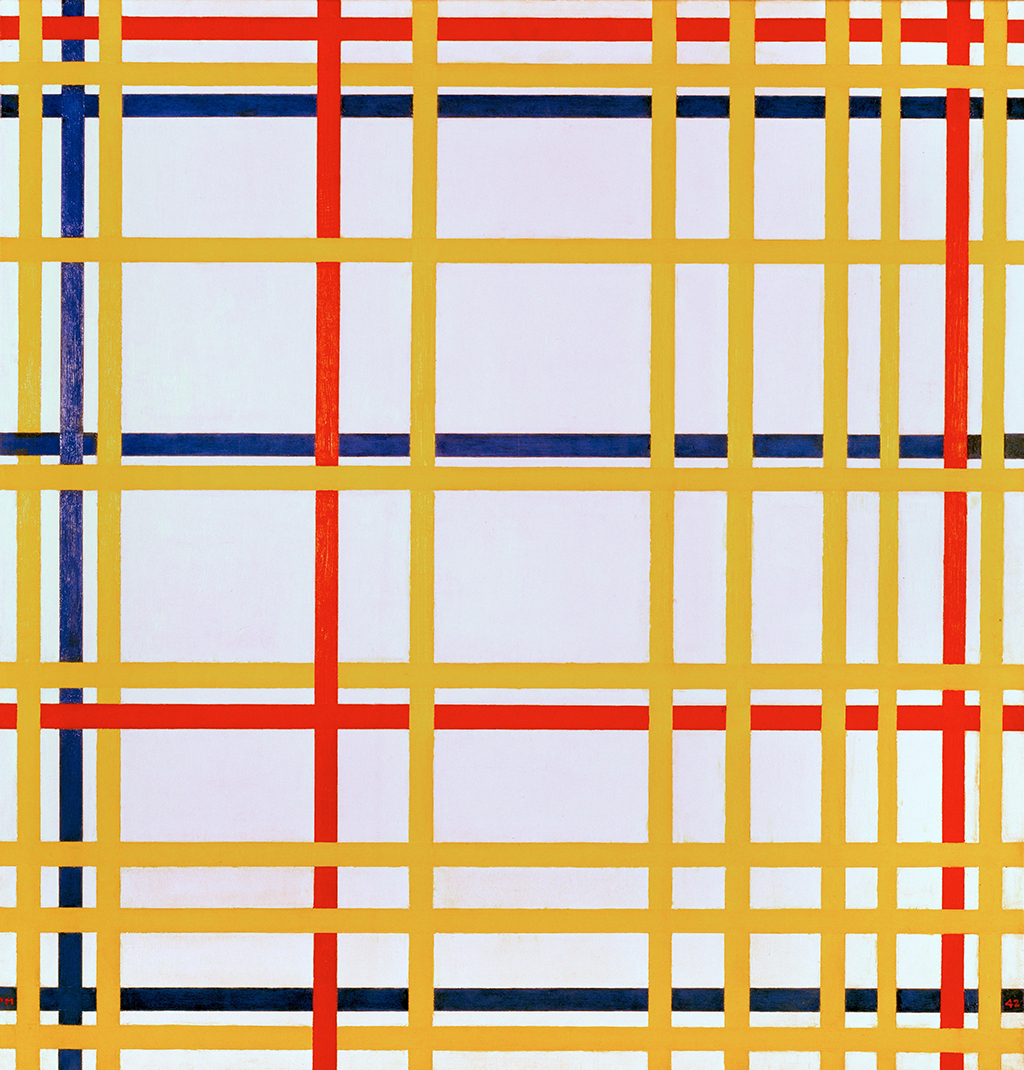
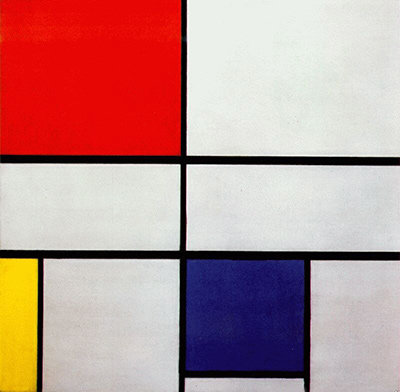
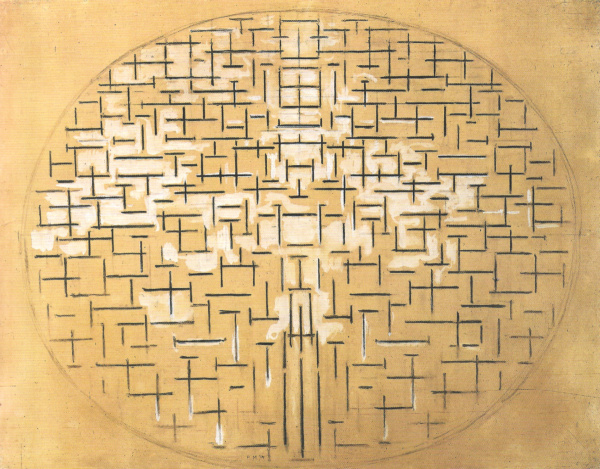
The sea view is neither a conventional record of a holiday nor a fully nonrepresentational composition. The shore remains clear, yet Mondrian makes broad areas and contrasting directions carry much of its effect. Looking at this 1909 picture beside his later work shows an evolving interest in relationships between forms. It should still be enjoyed as a beach painting in its own right, with its particular colour and spare view.
Watch: Piet Mondrian
See his studio, the move toward geometric abstraction and the rhythms of his New York paintings.
Piet Mondrian: Abstract Painting as We Know It
Curator Michael White explores the paintings and Mondrian’s studio as an abstract space.
Watch on YouTubeIs it the same as Mondrian's other pier paintings?
No. RKD gives A699 its own title, image and catalogue number. A697, Beach with Five Piers at Domburg, has several dark projections across the water, a lilac sky and a curving coast at right. The Museum of Fine Arts, Boston records that work as accession 2023.654. Those object details belong to A697, not to this one-pier scene.[1]
A698, Beach with Three or Four Piers at Domburg, also differs. Its image has marked bands of surf and a steep yellow dune at right beneath a gray-blue sky. The Kröller-Müller Museum identifies it as KM 108.956. A699 gives more space to a pale open beach and shows a single low dark reach near the water. The titles are close because Mondrian repeatedly worked with the same coastline, not because the paintings are interchangeable.[1]
RKD then lists A700, View from the Dunes with Beach and Piers, Domburg, in MoMA's collection. Its title makes the different viewpoint explicit. The four catalogue entries offer a useful way to see Mondrian testing a motif, but each needs its own image, source and object facts. Grouping them under a broad “Domburg pier” label would lose the differences in beach, dune, horizon and structures that make each picture distinct.[1]
What does the 2009 exhibition tell us?
Hauser & Wirth included the painting in its London exhibition White Light / White Heat, held 27 February–28 March 2009. The gallery named it Beach with One Pier at Domburg (Dune) and described it as one of a group of 1909 paintings exploring a repeated motif through different styles. The exhibition is a useful documented moment in the picture's later history and another source for the variant title.[2]
A past gallery display is not the same as a current collection record. The gallery account does not say that the picture is permanently held by Hauser & Wirth, and the 2009 date cannot tell a visitor where it hangs now. RKD's online list names The Judith Rothschild Foundation. Both records can be reported without pretending that either proves the painting's present display status.[1][2]
The word Dune is also more than an incidental addition. It points to the pale rise on the right, which occupies a large and bright part of the composition. The original RKD title calls attention to the solitary pier; the exhibition variant directs attention to the landform. Both describe recognizable features of the same image. Seeing how the two labels guide the eye is a useful way to begin looking at it.
Where is Beach with One Pier at Domburg now?
RKD's catalogue line lists The Judith Rothschild Foundation, New York City for A699. The available online entry does not give a dated display notice, so the safest answer is that this is the recorded collection in RKD rather than a promise that the painting can be seen at a particular venue today. The 2009 London exhibition shows where it was displayed at one past moment. A visitor should use current exhibition information before making travel plans around this specific work.[1][2]
The painting rewards looking even in reproduction. The long, quiet beach might at first seem to have little to hold the eye. Then the low pier establishes a line, the dune lifts it, and small colour strokes make the sand and sky active. Mondrian's spare choice of coastal features leaves room for the viewer to notice how deliberately those features are arranged.
Mondrian artworks directory
Frequently asked questions
When was Beach with One Pier at Domburg painted?
RKD dates the separate A699 work to 1909.[1]
What is the pier in the title?
What are its medium and size?
An RKD-sourced Commons object record gives oil on canvas and 46 × 67 cm. Those details are attributed to that record rather than to a museum object page.[3]
Is “Dune” a second painting?
No. Hauser & Wirth used Beach with One Pier at Domburg (Dune) for this work in its 2009 exhibition.[2]
Is it the five-piers painting in Boston?
No. That is RKD A697; this one-pier work is A699.[1]
Discussion
Does the open beach or deep sky hold your eye first?
Reader Insights
Follow the low pier from the left edge. Where does your eye stop?
Which small colour marks in the pale sand become clearer after a second look?
How does the one-pier view differ from the other Domburg beach paintings?
Join the Conversation
Share what you notice in this painting below.
References
- RKD – Netherlands Institute for Art History, Mondrian catalogue raisonné, Zeeland seascapes A697–A700, including A699 collection line and image. View source.
- Hauser & Wirth, White Light / White Heat, London exhibition, 27 February–28 March 2009. View source.
- Wikimedia Commons, RKD-sourced file record for A699, reporting oil on canvas and 46 × 67 cm. View source.
- Kunstsammlung Nordrhein-Westfalen, Mondrian — Evolution, 1908–11 chapter on Domburg. View source.
- Fondation Beyeler, Mondrian Evolution room guide on Domburg's breakwaters. View source.
- Lead image credit. Piet Mondrian, Beach with One Pier at Domburg, 1909. RKD A699; The Judith Rothschild Foundation is RKD’s listed collection.