by Tom Gurney
Tom Gurney BSc (Hons) is an art history expert with over 20 years experience
Published on June 19, 2020 / Updated on September 28, 2026
Email: tomgurney1@gmail.com / Phone: +44 7429 011000
About the painting
Piet Mondrian's Duinlandschap (Dune Landscape) is a wide, vividly coloured view of the Zeeland coast. Rounded dunes rise across the foreground in purples, blues and greens; a low strip of sea and a restless sky extend behind them. Although the subject is recognisable, the painting's broad bands and repeated strokes already make colour and rhythm as important as a literal description of the place. The work is dated 1911, is an oil on canvas measuring 141 × 239 cm, and belongs to Kunstmuseum Den Haag as object 0334307. The RKD catalogue identifies it as B1. The existing image on this page depicts this unusually wide dune composition.[1][2]
At a glance
Dune Landscape in Mondrian's Zeeland sequence
Contents
- What does the painting show?
- Why did Mondrian paint the Domburg dunes?
- How does B1 relate to other dune and pier works?
- What is known about its date, exhibition and collection?
What does the painting show?
The painting stretches horizontally. Its dunes occupy most of the lower half, with rounded crests that rise and fall from left to right. Rather than painting every grain of sand or blade of grass, Mondrian makes the slopes from adjacent patches and short directional marks. Blue-green and darker green strokes interrupt lavender and violet ground. Some marks can be read as vegetation, while others chiefly emphasise the sweep of the terrain. The forms feel both solid and mobile: each dune has weight, but its outlines lead the eye onward.
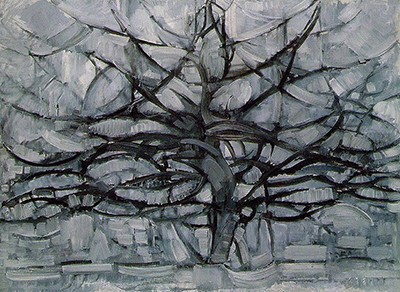
 The Red Tree Piet Mondrian.jpg)
A dark, nearly horizontal band divides the land from the distant water and sky. This clear break steadies the composition after the irregular movement in the foreground. Beyond it, narrow blue and violet strips suggest sea and distance. Above, the sky occupies a broad area. Pale pink and purple cloud forms drift through its blue-violet field, giving the upper half a different, slower rhythm. The colours do not behave like a neutral topographical record. Mondrian heightens contrasts so that one band answers another across the canvas.
The original's 239 cm width matters. This is not a small sketch enlarged in a browser: it is a substantial painting that asks the viewer to scan across the scene. A curve begun at the left continues through broken colour marks toward the centre and right. The horizon then pulls the eye back along a straight path. The painting holds a recognisable dune landscape and an emphatic arrangement of horizontal and curved forces together.[1]
The image does not let us name an exact viewpoint, identify individual plants, or claim a particular hour of the day. Those details are unnecessary to see the central experiment. The coast gives Mondrian a changing set of light, land and water forms; he organises them into large areas of colour. The expressive colour is a feature of this 1911 landscape, not evidence that he had already arrived at the severe primary-colour grids of his much later work.
Why did Mondrian paint the Domburg dunes?
Mondrian repeatedly worked at Domburg, on the island of Walcheren in Zeeland, from 1908. Museum accounts describe his interest in the area's particular light and in subjects that could be returned to in different treatments: dunes, sea, church towers and trees. Kunstmuseum Den Haag explains that the artist Jan Toorop helped draw him into the Domburg circle. The place offered both landscape material and other artists engaged with new ways of using colour and form.[3][4]
The dunes were especially useful because their shape could be simplified without ceasing to look like land. In Duinlandschap, a slope can read as a dune and as a curved band of colour. The low horizon allows the sky and ground to remain distinct, yet the brushwork and violet-blue palette link them. Kunstsammlung Nordrhein-Westfalen describes Mondrian's Zeeland period in terms of parallel strokes, bold non-natural colour and post-Impressionist and Fauvist influences. Those broad traits provide context for what is visible here; they do not require assigning this canvas to a single movement or copying another artist's technique.[4]
This painting belongs to the years before Mondrian's best-known geometric abstraction. Looking backward from the later grids can make it tempting to call every band a precursor of a black line or coloured rectangle. A more useful first reading starts with the coast itself. Dunes, sea and cloud give him distinct kinds of movement: rounded land, level distance and shifting sky. The painting tests how much of each can be carried by stroke and colour.
Watch: Piet Mondrian
See his studio, the move toward geometric abstraction and the rhythms of his New York paintings.
Piet Mondrian: Abstract Painting as We Know It
Curator Michael White explores the paintings and Mondrian’s studio as an abstract space.
Watch on YouTubeHow does B1 relate to other dune and pier works?
The RKD's Zeeland catalogue groups Dune Landscape B1 with a number of related but separate coastal works. They include View from the Dunes with Beach and Piers A700 of 1909, Dune Sketch in Orange, Pink and Blue A707 of 1909, Summer, Dune in Zeeland A708 of 1910, and Dunes near Domburg A709, dated around 1910. The sequence shows Mondrian returning to comparable motifs, materials and colour problems rather than making one definitive picture of the coast.[2]
The distinction is important for this page. The view from the dunes with beach has a different title, date and composition. Dune IV is another dune painting, not an alternative title for this large 1911 B1 canvas. Similar subjects and translated titles can easily blur together in search results. Here, the combination of the 141 × 239 cm scale, Kunstmuseum Den Haag 0334307 and RKD B1 identifies the work precisely.[1][2]
The comparison also helps to see change without forcing a straight line from representation to abstraction. Mondrian varied scale and emphasis. A pier view can give human-built structure a role; a dune sketch can be more economical; the large Duinlandschap allows waves of terrain and sky to spread across a long canvas. They are related experiments, but each needs its own image and object record.
What is known about its date, exhibition and collection?
Kunstmuseum Den Haag's collection record supplies the core facts: 1911, oil on canvas, 141 × 239 cm, object 0334307, with the Salomon B. Slijper bequest credit. RKD separately lists the painting as B1 in its Zeeland catalogue. The museum record establishes that the original belongs to its collection; it does not, by itself, prove that the canvas is on display in a gallery today.[1][2]
The museum's account of The Light of Zeeland names Dune Landscape among works shown at the Modern Art Circle exhibition in 1911. It describes the strong reaction to Mondrian's newer work and places the coastal paintings within a moment of rapid experiment. That documented exhibition link gives a firmer historical setting than the vague claim that the painting was simply an early step toward his later style. The work was visible to contemporaries as a bold picture in its own time.[3]
The Slijper connection is also part of the object's history. It appears in the museum's own collection credit, so this page can state it without inventing a fuller chain of ownership. We should distinguish the object's current museum record from assumptions about where it hung in every intervening year or where it may be displayed at this moment. For visitors seeking the original, the museum's collection page is the reliable starting point.[1]
Mondrian artworks directory
Frequently asked questions
When did Mondrian paint Duinlandschap?
Where is the original Dune Landscape?
It belongs to Kunstmuseum Den Haag in The Hague, object 0334307, credited to the Salomon B. Slijper bequest. Check with the museum for current display information.[1]
How large is it?
The oil painting measures 141 cm high by 239 cm wide. Its long format is central to the broad dune, sea and sky arrangement.[1]
Is this the same painting as Dune IV?
Why are the dunes purple and blue?
Mondrian used heightened, non-natural colour during his Zeeland experiments. In this painting the violet, blue and green marks describe light and terrain while giving the large foreground its own visual rhythm. The exact intention behind each stroke is an interpretation of the image, rather than a statement from the artist.[4]
Discussion
Which foreground dune first catches your eye, and why?
Reader Insights
Follow the curved dune ridges across the canvas. Where does your eye stop?
Which band of sky or sea most strongly answers the coloured ground?
How does this broad B1 canvas differ from a smaller Domburg dune painting?
Join the Conversation
Share what you notice in this painting below.
References
- Kunstmuseum Den Haag, collection record for Dune Landscape, 1911, oil on canvas, 141 × 239 cm, object 0334307, Salomon B. Slijper bequest. View source.
- RKD – Netherlands Institute for Art History, Mondrian digital catalogue, Zeeland 1909–11 coastal sequence including Dune Landscape B1 and distinct works A700, A707–A710. View source.
- Kunstmuseum Den Haag, The Light of Zeeland, on Mondrian in Domburg and the 1911 Modern Art Circle presentation. View source.
- Kunstsammlung Nordrhein-Westfalen, Dunes, the Sea, and Towers, on Mondrian's Walcheren visits, light, colour and related dune paintings. View source.
- Lead image credit. Piet Mondrian, Duinlandschap (Dune Landscape), 1911, oil on canvas, 141 × 239 cm, RKD B1; Kunstmuseum Den Haag 0334307, Salomon B. Slijper bequest.