 by Tom Gurney
Tom Gurney BSc (Hons) is an art history expert with over 20 years experience
Published on June 19, 2020 / Updated on September 29, 2026
Email: tomgurney1@gmail.com / Phone: +44 7429 011000
About the painting
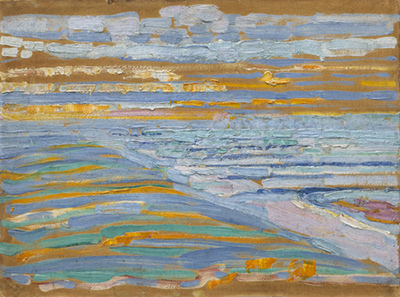
Orange and blue horizontal strokes move across a coastal view that seems to tilt toward the sea. Mondrian painted this View from the Dunes with Beach and Piers, Domburg in 1909. The work is RKD A700 and The Museum of Modern Art 479.1985. MoMA records oil and pencil on cardboard, 28.5 × 38.5 cm. The existing page title is shortened, but the fuller museum title matters: it specifies both Domburg and the piers within the picture.[1][2]
At a glance
Mondrian across periods
Contents
- What does the view show?
- Why is Domburg important?
- How did MoMA acquire it?
- Two directions in one small study
- What its history can and cannot tell us
- A good comparison within Zeeland
What does the view show?
The dunes occupy the left side, while sea extends across the right. Beach and piers are absorbed into a network of broad coloured marks. Above, sky lies in horizontal bands; below, blues and oranges shift around the coast. It is possible to recognise a beach, but many boundaries are softened by the thick paint.
 The Red Tree Piet Mondrian.jpg)
MoMA calls attention to the oblique angle of the shoreline. That distinguishes the picture from a front-facing sea horizon: the coast leads the eye diagonally away. The museum also points to the strong orange-and-blue horizontals and thickly applied lines as part of Mondrian's formal experimentation. The picture balances a specific place with a more independent arrangement of colour and direction.[2]
The small scale is easy to forget when looking at a digital image. At less than forty centimetres wide, the cardboard study contains a wide sense of space. Pencil is part of the recorded medium, so the visible structure should not be described as oil paint alone.[2]
Why is Domburg important?
Domburg, on the Zeeland coast, was a place Mondrian visited repeatedly. Kunstmuseum Den Haag's By the Sea exhibition describes his visits from 1908 and the 1909 group of sea and dune studies. It also places him within a coastal artist community that included Jan Toorop and Jacoba van Heemskerck. This background helps explain the sustained attention to changing shore light, but it does not identify an exact day or hour for A700.[3]
The picture belongs to a closely related group rather than an isolated seascape. RKD lists A693–A710 around sea and dunes, with A700 specifically titled View from the dunes with beach and piers, Domburg. The Hague Seascape and Sea Toward Sunset are other 1909 studies, but they are separate objects with different proportions, media records and catalogue numbers.[1]
How did MoMA acquire it?
MoMA's provenance traces the work to Dr. J. F. S. Esser by 1913, then to his heirs. Later records include a Dutch private collection, E. V. Thaw, and the Jason McCoy Gallery. MoMA purchased it in December 1985 through the A. Conger Goodyear Fund. The museum marks the provenance as ongoing research, so gaps are not filled here by assumption.[2]
The gallery text is also careful about what the picture depicts. It is not an accurate map of every pier or dune. Orange, blue and broken horizontal marks give the viewer a felt view of coast and light. Mondrian's later abstract art may make those marks look prophetic, but the work remains a 1909 study of a real coastal motif.
Watch: Piet Mondrian
See his studio, the move toward geometric abstraction and the rhythms of his New York paintings.
Piet Mondrian: Abstract Painting as We Know It
Curator Michael White explores the paintings and Mondrian’s studio as an abstract space.
Watch on YouTubeTwo directions in one small study
The shoreline runs obliquely, drawing the eye into depth, while orange and blue strokes repeatedly cross the image horizontally. Those directions do not cancel each other. The slant anchors a particular coastal viewpoint; the bands turn the view into a study of how sea, beach and sky can be held together by colour. MoMA specifically notes the oblique shore and the thick, emphatic paint. Its object record also names pencil, an important reminder that drawn structure and oil colour both belong to the physical work.[2]
The fuller title includes piers and Domburg. It supplies a place and a feature that may be less obvious in the reduced image. The work should therefore not be described simply as an invented abstract coast. At the same time, the painted bands are not a topographic survey of the piers. The value of the study lies in the tension between a named place and the decisive marks that reorganise its appearance.
What its history can and cannot tell us
The museum's provenance places the picture with Dr J. F. S. Esser by 1913 and records the later route to its 1985 MoMA purchase. That early possession is valuable evidence that the study circulated soon after the Zeeland period. The public provenance still has gaps, which should not be filled with a presumed direct sale or an invented exhibition. Object 479.1985 and RKD A700 are the secure identifiers for this particular study among many 1909 coast views.[1][2]
A good comparison within Zeeland
Set this study beside the Hague Seascape. Both belong to 1909 and use strong horizontal colour, but A700 begins from an oblique dune-and-beach view with piers, while A695 offers a more open spread of water. Their media and supports also differ in the museum records. The comparison shows Mondrian experimenting with more than one way to structure the same coastal environment; neither image should be used as a generic stand-in for all his Zeeland seascapes.[1][2]
Mondrian artworks directory
Frequently asked questions
What materials did Mondrian use?
MoMA lists oil and pencil on cardboard.[2]
Is it the same as Seascape A695?
No. A695 is a different 1909 cardboard work in Kunstmuseum Den Haag. A700 is the oblique Domburg view with beach and piers in MoMA.[1]
Discussion
How does the oblique coast lead the eye?
Reader Insights
Where do orange and blue divide the picture?
How does it differ from the front-facing Hague seascapes?
How does it differ from the front-facing Hague seascapes?
Join the Conversation
Share what you notice in this painting below.
References
- RKD – Netherlands Institute for Art History, Zeeland sea and dune catalogue, A700. View source.
- The Museum of Modern Art, official object 479.1985, material, dimensions, gallery account and provenance. View source.
- Kunstmuseum Den Haag, By the Sea, Mondrian's Domburg visits and coastal artistic context. View source.
- Lead image credit. Piet Mondrian, View from the Dunes with Beach and Piers, Domburg, 1909, oil and pencil on cardboard, 28.5 × 38.5 cm, MoMA 479.1985, RKD A700.