 by Tom Gurney
Tom Gurney BSc (Hons) is an art history expert with over 20 years experience
Published on June 19, 2020 / Updated on September 28, 2026
Email: tomgurney1@gmail.com / Phone: +44 7429 011000
About the painting
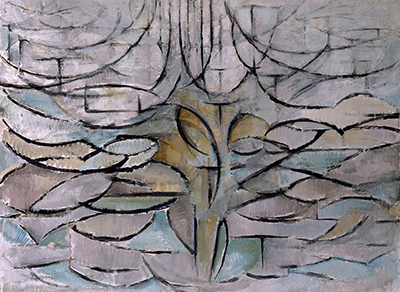
The first thing to notice in Piet Mondrian's Flowering Apple Tree may be the tree's trunk. It rises through the centre of a pale, crowded canvas, splits into upward lines and sends curving branches toward both sides. Look longer, and those branches begin to share the surface with bars, patches and intervals of colour that are less easily assigned to a recognizable landscape. The tree is present, but the painting asks us to follow the movement of lines and the spaces they create as closely as we follow a natural subject.
Kunstmuseum Den Haag identifies the work as an oil on canvas from 1912, measuring 78.5 × 107.5 cm and catalogued as object 0332113. RKD gives it the catalogue number B19 and spells its title Flowering appletree. The two records refer to the same painting. They also help distinguish it from Mondrian's other tree pictures, some of which have similar names but different dates, owners and designs.[1][2]
At a glance
- ArtistPiet Mondrian (Piet Mondriaan, 1872–1944)
- TitleFlowering Apple Tree; Flowering appletree in the RKD catalogue
- Date1912
- MediumOil on canvas
- Dimensions78.5 × 107.5 cm (height × width)
- CollectionKunstmuseum Den Haag, The Hague
- Museum object number0332113; inventory Sch-1934-0055
- Catalogue raisonnéJoosten B19; distinct from B20 Flowering Trees[1][2]
Where this painting sits in Mondrian's career
Contents
- What can you see in Flowering Apple Tree?
- Why does the tree look less solid than in earlier paintings?
- Was it painted during Mondrian's first year in Paris?
- Is Flowering Trees the same artwork?
- Where is the original and why does it matter?
What can you see in Flowering Apple Tree?
Begin low in the centre. A narrow trunk moves upward from a pale area near the bottom edge. It divides into a pair of rising dark forms, then into a network of lines. Some lines bend like branches; others flatten into nearly horizontal passages or stop abruptly beside a patch of paint. The crown spreads across most of the canvas. Unlike a tree standing clearly before a distant view, this one seems to share the same shallow space as its surroundings.
The dark lines are not all the same weight. Some are thick and decisive; others are thin, broken or partly concealed. Near the left edge, several curves sweep horizontally and then turn. On the right, similar forms repeat at different heights. Together they give the broad canvas a rhythm that can be read from side to side as well as upward from the trunk. A viewer's eye may travel along one curve, lose it among intersecting marks and find an answering curve elsewhere.
The edges help shape that experience. Branch-like lines enter or approach the left and right sides, so the crown feels wider than the part we can see. Near the top, rising strokes meet a pale strip of ground rather than opening onto a distant horizon. Lower down, the trunk narrows toward the edge, but surrounding curves continue to cross its path. The tree therefore gives the composition a centre without making the rest of the canvas subordinate to it.
Colour is quieter than the red and cobalt blue of an earlier Mondrian tree painting. Muted blue and pale gray appear around the lower part of the image. Small areas of warm beige, soft rose and yellowish colour sit among cooler passages. They do not produce a single stable sky, ground or canopy. Instead they help separate one loop from another and make light and dark patches alternate across the surface. The precise hue can vary between reproductions; the composition's main effect depends on how restrained colour and dark linear marks work together.
The title asks us to think about an apple tree in bloom, yet the image does not present a clearly outlined mass of flowers. A blossom can be suggested by pale broken marks and small colour shifts without being illustrated petal by petal. Some viewers may identify the subject only after reading the title. Others may start with the trunk and recognize it immediately. Both responses can be tested against the painting: the central branching structure is visible, while many of its individual marks resist a simple naturalistic label.
That tension makes the picture rewarding to inspect closely. It has the width and branching spread of a tree painting, but its repeated curves and broken intervals also behave as a composition in their own right. Calling it merely “abstract” can hide how much of the tree remains. Calling it simply a landscape can hide how decisively Mondrian has compressed and rearranged what a landscape normally tells us about space.
Why does the tree look less solid than in earlier paintings?
Compare the clear red trunk in Avond (Evening): The Red Tree with the more divided trunk here. Kunstmuseum Den Haag dates the red painting 1908–1910 and describes its forceful contrast of fiery red and cobalt blue. Its branches cross the sky, but the two colours make the relation of tree and background apparent at once. In Flowering Apple Tree, darker lines and pale colour occupy the same compressed field. The edges of a branch can still be followed, but they no longer hold the subject apart so firmly from everything around it.[3]
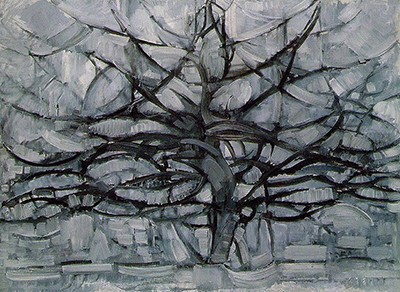
The comparison becomes different again with Gray Tree, dated 1911. Kunstmuseum Den Haag describes that painting's reduction to black, white and gray and connects it with Mondrian's response to Cubism before his move to Paris. Its trunk and boughs remain strong, sweeping forms, yet they begin to merge with related tones in the background. The 1912 apple tree carries a further density of short, interrupted marks and flattened spaces. Looking among the three works lets us notice changes in handling a familiar motif without pretending that each was made only to prepare the next.[4]
In this painting, the central trunk is not erased; it is integrated into a mesh. Pale zones pass behind and beside it. Dark arcs can signify branches, but their directions also balance one another across the canvas. That double reading is a useful way to approach the work. We can see a tree and at the same time see an arrangement of lines, tones and intervals that need no detailed account of a real garden to make visual sense.
There is no need to declare a precise moment when Mondrian “became abstract.” The dated records give us individual works, not a switch thrown on a single day. His tree motif permitted changes in colour, line and spatial depth over several years, and other kinds of pictures occupied him too. The B19 painting has its own solution: it keeps the trunk as a point of orientation while allowing the surrounding network to become the main visual event.
Watch: Piet Mondrian
See his studio, the move toward geometric abstraction and the rhythms of his New York paintings.
Piet Mondrian: Abstract Painting as We Know It
Curator Michael White explores the paintings and Mondrian’s studio as an abstract space.
Watch on YouTubeWas it painted during Mondrian's first year in Paris?
RKD places B19 in the catalogue section for Paris 1, 1912–1914, and the museum dates the painting 1912. Kunstmuseum Den Haag's account of Gray Tree says Mondrian moved to Paris in January 1912. These records locate Flowering Apple Tree in the year of that move and within the first Paris-period group of catalogued works. They do not give us an exact day, studio address or outdoor site for this particular canvas.[1][2][4]
Paris matters as context because Mondrian was testing ways to organise a picture that moved beyond the descriptive landscape. The museum links the preceding Gray Tree to his encounter with discussion of Cubism and to a 1911 Amsterdam exhibition that brought Cubist work before Dutch painters. That account supports a careful comparison of the two tree paintings' increasingly shared foreground and background. It does not license a claim that Flowering Apple Tree copies a specific Picasso or Braque painting or that its subject was a tree found on a Paris street.[4]
The painting still has an organic source: a trunk dividing into curves. But the marks around it are arranged so that we notice relations among them, not only the species, season or place represented. A curved branch gains force from a roughly parallel curve elsewhere. A dark interruption changes how a pale area reads. A vertical line near the centre can connect the bottom of the composition with its upper edge even when we cannot confidently assign every segment to the same physical branch.
This is why the year 1912 is more than a date label without being a complete explanation. It helps place the picture among Mondrian's changing methods. The visual evidence tells us what this particular painting does: it holds a natural motif and a highly organised painted surface in tension. That observation can stand without an invented account of the conditions under which he painted it.
An earlier Dutch study illustrates the 78 × 106 cm Bloeiende appelboom as its figure 134, dimensions close to today's museum measurement for B19. A. B. Loosjes-Terpstra described its softly curved lines as a mostly horizontal rhythm, punctuated by firmer meetings of horizontal and vertical. She also noted the fine transitions among grey, lilac, pink and white. Her suggested identification of this canvas with a work shown at the 1912 Moderne Kunstkring exhibition was explicitly tentative. The exhibit association adds historical context, while the physical description and current museum number keep the discussion tied to this canvas rather than to the separately catalogued B20 Flowering Trees.[5][6]
Is Flowering Trees the same artwork?
No. RKD lists B19 Flowering appletree and B20 Flowering trees as separate 1912 paintings. B19 is the Kunstmuseum Den Haag canvas, object 0332113. RKD associates B20 with the Judith Rothschild Foundation. Similar titles and adjacent catalogue numbers can easily lead to mixed descriptions, so the museum object number is the simplest way to keep this page tied to the right painting.[1][2]
The distinction also affects what a reader should expect to see. This page's reproduction shows a centrally divided tree form and sweeping, dark contours against pale colour. A related title does not mean a second image is a detail, a later state or another name for this canvas. The site's Flowering Trees page should be read as a separate object once its own image and catalogue identity have been checked.
RKD's surrounding entries include tree studies and compositions from 1912–13. Their presence shows how often Mondrian returned to branching motifs. But catalogue order alone is not a technical reconstruction of which marks were drawn first on B19 or which painting borrowed a form from another. Treat each entry as an individual work before comparing it with its neighbours.
Where is the original and why does it matter?
The original Flowering Apple Tree is in Kunstmuseum Den Haag, object 0332113. The museum records its medium, year and dimensions on the direct collection page. RKD's B19 number supplies a second identifier. The record establishes ownership; anyone planning to see the work in person should check current display arrangements with the museum rather than assume it is always hanging.[1][2]
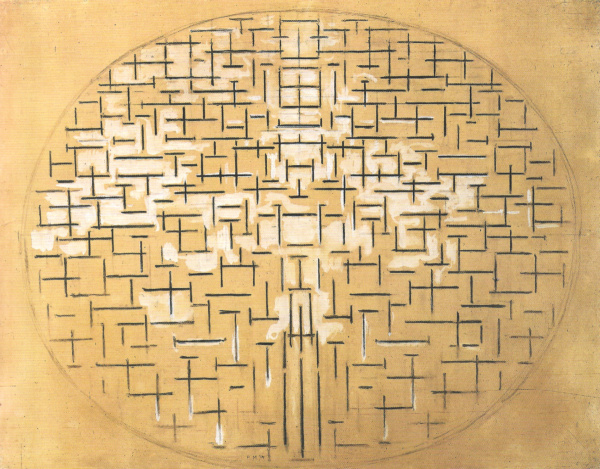
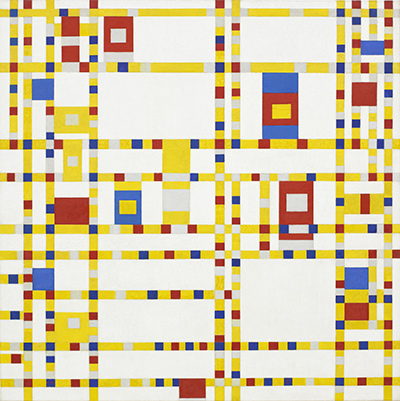
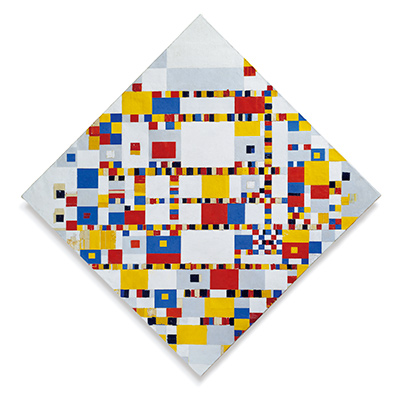
The painting matters because it resists a simple choice between a tree and a nonrepresentational design. Its trunk gives the eye a starting point. From there, curved lines, straight interruptions and pale fields repeatedly draw attention away from a single, stable outline. The work lets us experience a change in how Mondrian treated nature through the specific decisions on one canvas. It is not necessary to read the later red, yellow and blue grids backward into every branch in order to find this painting compelling.
Mondrian artworks directory
Frequently asked questions
When was Flowering Apple Tree painted?
How big is the painting?
The museum records 78.5 cm in height and 107.5 cm in width, in oil on canvas.[1]
Where is the original?
It belongs to Kunstmuseum Den Haag, object 0332113. Check the museum's current display information before planning a visit around it.[1]
Is Flowering Apple Tree the same as Flowering Trees?
No. RKD numbers this painting B19 and Flowering Trees B20; they are separate 1912 works with different collection records.[2]
Is the tree still visible in the image?
A central trunk and branching contours can be followed, although many marks also read as a network of lines across a shallow field. The title helps orient a viewer without making every mark a literal branch.
Discussion
Where can you follow the central trunk into a branch, and where do dark lines become a pattern?
Reader Insights
Follow a curved line from the left edge. Does it lead you back to the trunk?
Which pale colour passage makes a nearby dark curve easiest to see?
How does this apple tree change what you notice in Gray Tree or The Red Tree?
Join the Conversation
Share what you notice in this painting below.
References
- Kunstmuseum Den Haag, collection record for Piet Mondrian, Flowering Apple Tree, object 0332113. View source.
- RKD – Netherlands Institute for Art History, Mondrian catalogue raisonné, Paris 1, 1912–14, entries B19 and B20. View source.
- Kunstmuseum Den Haag, collection record for Avond (Evening): The Red Tree, object 0332041. View source.
- Kunstmuseum Den Haag, collection record for The Grey Tree, object 0334314. View source.
- A. B. Loosjes-Terpstra, Moderne kunst in Nederland 1900–1914, “Het werk,” pp. 155–56 and notes, on Bloeiende appelboom, its forms and tentative exhibition identification. View source.
- A. B. Loosjes-Terpstra, list of illustrations, no. 134, recording a 78 × 106 cm Bloeiende appelboom in the Hague museum. View source.
- Lead image credit. Piet Mondrian, Flowering Apple Tree, 1912. Kunstmuseum Den Haag, object 0332113.
 The Red Tree Piet Mondrian.jpg)