by Tom Gurney
Tom Gurney BSc (Hons) is an art history expert with over 20 years experience
Published on June 19, 2020 / Updated on September 28, 2026
Email: tomgurney1@gmail.com / Phone: +44 7429 011000
About the painting
Dark curves sweep across a pale, horizontal field in Piet Mondrian's Flowering Trees. A diagonal enters from the upper left, vertical marks cluster near the bottom, and many smaller lines cross or stop before they settle into a recognizable trunk or canopy. The title tells us to look for trees, but the painting holds the viewer between that subject and the pattern made by its marks. It is a tree painting whose spaces and intersecting directions demand attention of their own.
RKD catalogues this work as B20, Flowering trees (1912), in its sequence of Mondrian's first Paris-period works. Its image matches the composition reproduced on this page. RKD lists The Judith Rothschild Foundation, New York City as the collection in its catalogue entry; that is a catalogue identification rather than a promise about where the painting can be seen today. B20 must also be kept separate from the neighbouring B19 Flowering appletree, another 1912 work held by Kunstmuseum Den Haag.[1]
At a glance
- ArtistPiet Mondrian (Piet Mondriaan, 1872–1944)
- TitleFlowering Trees; Flowering trees in RKD's catalogue
- Date1912
- MediumOil on canvas, as recorded in the RKD-derived image record
- Dimensions60 × 85 cm (height × width), as recorded in the RKD-derived image record
- Catalogue raisonnéJoosten B20
- Collection lineThe Judith Rothschild Foundation, New York City, in RKD's catalogue
- Distinct fromB19 Flowering appletree, Kunstmuseum Den Haag object 0332113[1][2][3]
Where this painting sits in Mondrian's career
Contents
- What can you see in Flowering Trees?
- How is it different from Flowering Apple Tree?
- Where does it fit in Mondrian's changing tree paintings?
- Is this the later Flowering Tree sometimes called C20?
- Where can readers find the original?
What can you see in Flowering Trees?
Start at the left edge, where one dark diagonal rises toward the upper centre. Another line crosses it, and thinner curves run away in several directions. Near the middle, a series of arcs and loops creates the impression of branches viewed through other branches. Some marks are thick enough to pull forward; others are so faint that they nearly dissolve into the gray ground. The result gives no simple outline to trace all the way around a single tree.
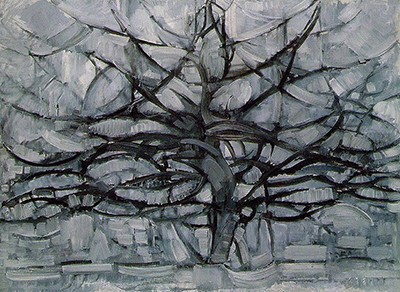
The lower part of the picture has a different energy. Several short verticals stand close together near the centre, while darker near-horizontal strokes travel across the bottom. They may make a viewer think of trunks, a base or ground level. But the image does not give enough spatial clues to assign each line to a separate tree with certainty. The title is plural; the visible structure remains deliberately hard to divide into individual specimens.
The pale ground is not empty. Its grays shift toward warmer beige and brownish passages in places. Light areas between the lines carry as much compositional weight as the lines themselves: a large pale opening at the upper right makes the nearby curves distinct, while smaller enclosed spaces lower down make the surface denser. Moving from one such interval to another can be more revealing than trying to count branches.
The composition is broad and shallow. Marks reach toward all four edges, so the viewer may sense a larger branching network continuing beyond the frame. At the same time, the dark lines gather in the central and lower regions, giving the image a loose internal balance. A diagonal can make the upper left feel active; a group of verticals below answers it with a more settled rhythm. These are observations of the painted design, not a technical account of the order in which Mondrian applied paint.
It is possible to look at this picture twice in two different ways. First, follow the title and search for trees. Then set the title aside and attend to curves, crossings, gaps and tonal shifts. Neither view cancels the other. The painting's force lies partly in their coexistence: an organic subject remains a starting point, while its forms are rearranged into a tight network across the surface.
How is it different from Flowering Apple Tree?
Mondrian's Flowering Apple Tree is the B19 painting, also dated 1912. Kunstmuseum Den Haag holds it as object 0332113, and the museum records its oil-on-canvas size as 78.5 × 107.5 cm. Those measurements belong to B19, not to Flowering Trees. RKD lists B20 separately and gives it a different collection line. Similar titles can obscure the difference, but the two reproductions make it clear.[1][3]
In B19, a central trunk provides a relatively firm point of orientation. Curved branch-like marks spread from it, even as pale passages make the distinction between tree and surrounding space uncertain. In B20, the central point is harder to locate. Diagonal, vertical and looping marks appear throughout the field. We can compare how the two pictures balance branching structure and the spaces between marks without claiming that one is simply a corrected or later version of the other.
The closeness of their catalogue numbers is useful for placing them in Mondrian's 1912 work, but it is not a record of a day-by-day painting order. Nor does it mean the two canvases depict the same tree. The objects have distinct titles, dimensions and collection histories. Their visual relationship is stronger when each is allowed its own design: one is organized around a more traceable central trunk, while the other disperses that organizing role among several directions.
Watch: Piet Mondrian
See his studio, the move toward geometric abstraction and the rhythms of his New York paintings.
Piet Mondrian: Abstract Painting as We Know It
Curator Michael White explores the paintings and Mondrian’s studio as an abstract space.
Watch on YouTubeWhere does it fit in Mondrian's changing tree paintings?
Gray Tree provides an earlier comparison. Kunstmuseum Den Haag dates that painting 1911 and describes Mondrian's reduction of a recognizable tree through black, white and gray tones. A trunk and wide, arching boughs remain visible there even as foreground and background draw closer together. In B20, the network becomes still harder to separate into a single tree before a distinct background. That is a comparison a viewer can make in the two images, rather than a claim that every canvas follows an inevitable sequence toward later grids.[4]
The museum says Mondrian moved to Paris in January 1912. RKD places B20 among his first Paris-period catalogue entries. Together, those sources put Flowering Trees in the year of his move. They do not tell us the exact month of execution, where he found the motif, or whether he worked outdoors. The painting's structure is more informative than an invented setting: repeated dark marks break up the pale field, and tree-like curves meet straighter strokes in a compressed space.[1][4]
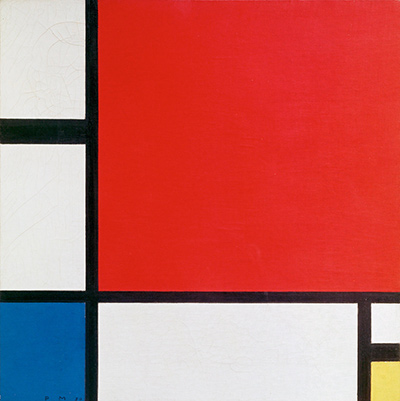
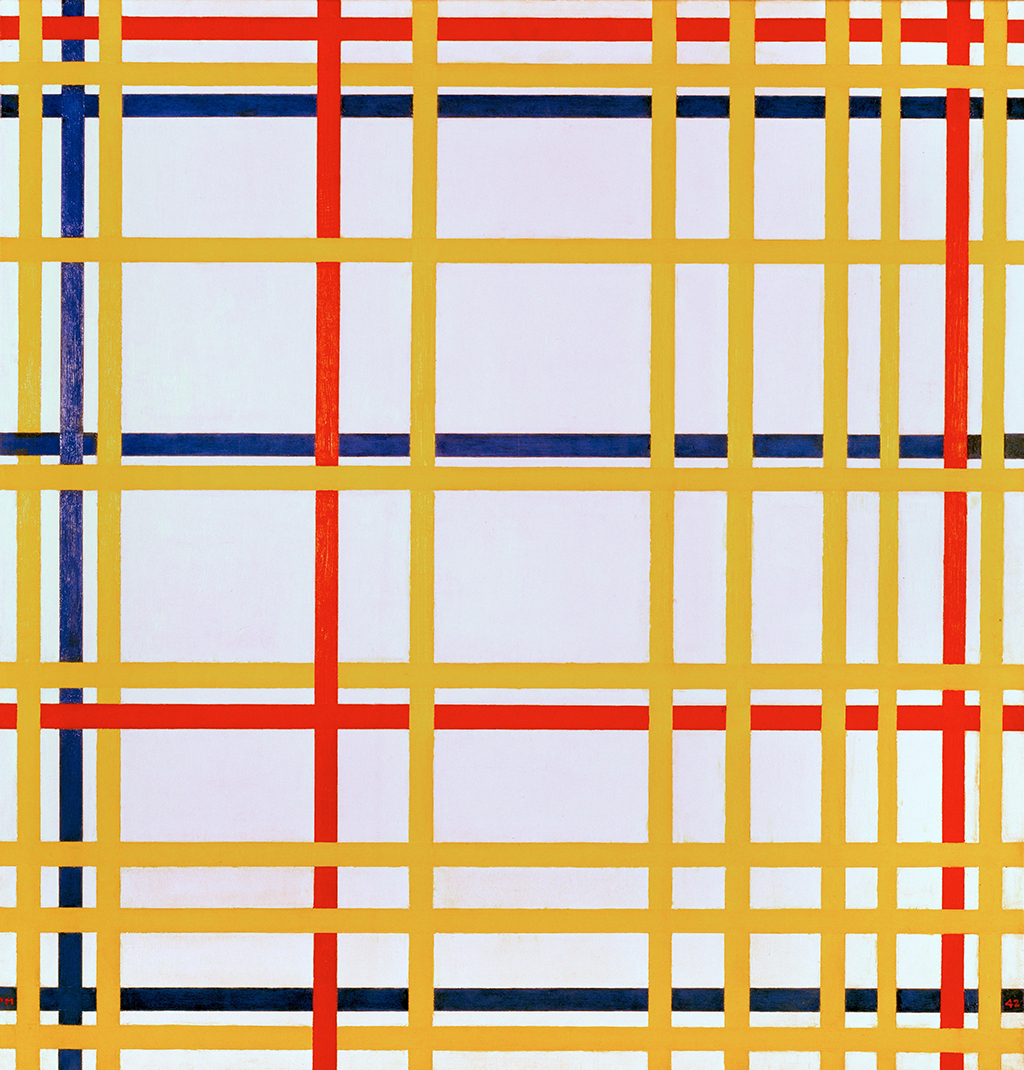
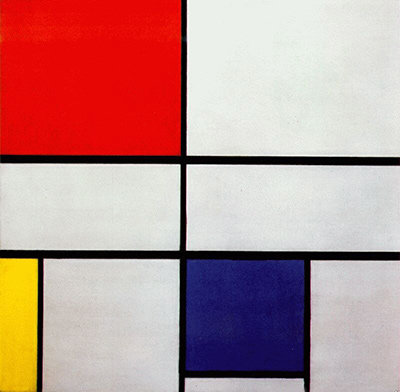
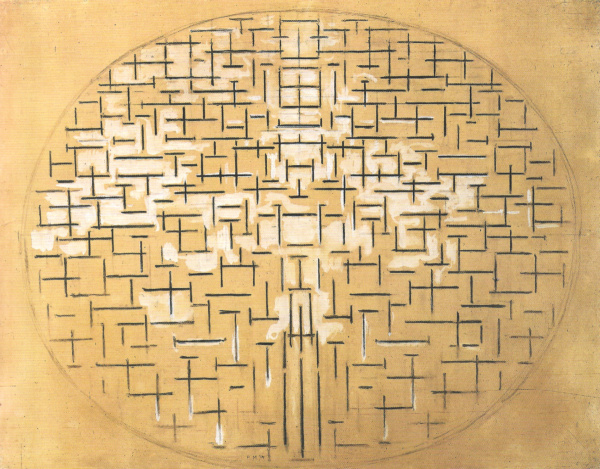
These tree pictures are often viewed beside Mondrian's much later compositions of straight black bars and primary-colour areas. The comparison can illuminate his continuing interest in relations among lines and spaces, but B20 still has its own curving forms and subdued colour. It deserves attention as a 1912 painting, not just as a forecast of work made many years later.
Is this the later Flowering Tree sometimes called C20?
No. A later work titled Flowering tree appears under the catalogue number C20. Christie's records that C20 is a pencil-and-crayon drawing on paper, about 18.5 × 25 cm, executed around 1917–18. The exact reproduction on this page matches RKD's B20 image and belongs to the B20 Flowering trees entry dated 1912. Assigning C20's later date or drawing medium to this composition would mix two distinct artworks.[1][5]
When a Mondrian title uses a common motif such as a flower or tree, the image and catalogue number are more reliable than the wording alone. B19, B20 and C20 can all appear in nearby searches, but they should not share an image, medium, size or ownership without an exact object match. Here the matching image and RKD entry establish the B20 identity.
Where can readers find the original?
RKD's catalogue lists The Judith Rothschild Foundation, New York City for B20. The direct RKD catalogue section is a useful starting point for the object's documented identity and reproduction. It does not state where the painting is currently displayed, so a reader should check a current collection or exhibition record before making a visit specifically to see it.[1]
Flowering Trees matters because its subject and its design remain available at once. Branching curves invite a reading of nature; diagonals, short verticals and pale intervals invite a reading of how a painting is built. The viewer's uncertainty about exactly which mark belongs to which tree is productive. It sends the eye back across the whole surface, where Mondrian's experiment is visible in the relations among parts rather than in a single hidden symbol.
Mondrian artworks directory
Frequently asked questions
When did Mondrian paint Flowering Trees?
RKD dates the B20 painting to 1912.[1]
Is it the same painting as Flowering Apple Tree?
What size is B20?
Where is the painting held?
RKD's catalogue lists The Judith Rothschild Foundation, New York City. The catalogue line should not be read as confirmation of current public display.[1]
Is the picture a completely unrecognizable abstraction?
Dark curves and verticals can still suggest a branching group of trees, especially with the title in mind. The exact identification of each mark is less clear than in Mondrian's earlier tree paintings.
Discussion
Where do the dark curves suggest trees, and where do they become a pattern?
Reader Insights
Follow the diagonal entering from the upper left. Where does your eye go next?
Which pale interval makes a crossing line most noticeable?
How does this painting change what you notice in Flowering Apple Tree?
Join the Conversation
Share what you notice in this painting below.
References
- RKD – Netherlands Institute for Art History, Mondrian catalogue raisonné, Paris 1, 1912–14, B20 Flowering trees and adjacent B19. View source.
- Wikimedia Commons, RKD-derived file record for Flowering trees B20, including medium, measurements, source and public-domain status. View source.
- Kunstmuseum Den Haag, collection record for Piet Mondrian, Flowering Apple Tree, B19, object 0332113. View source.
- Kunstmuseum Den Haag, collection record for The Grey Tree, object 0334314. View source.
- Christie's, catalogue record for Piet Mondrian, Flowering tree, catalogue C20, pencil and crayon on paper, c. 1917–18. View source.
- Lead image credit. Piet Mondrian, Flowering Trees, 1912. RKD catalogue B20; the RKD entry lists the Judith Rothschild Foundation.
 The Red Tree Piet Mondrian.jpg)