by Tom Gurney
Tom Gurney BSc (Hons) is an art history expert with over 20 years experience
Published on June 19, 2020 / Updated on September 29, 2026
Email: tomgurney1@gmail.com / Phone: +44 7429 011000
About the painting
The mill stands near the middle of a bend in the River Gein. A small moon appears just to its right, while trees close the left side of the horizon and a dark pool fills the foreground. Piet Mondrian's Oostzijdse Mill along the River Gein by Moonlight is an early view of a subject he would return to repeatedly. The Rijksmuseum dates this canvas about 1903 and identifies it as SK-A-4987; the RKD catalogue assigns it A411b. It is distinct from the later, darker Oostzijdse Mill in Moonlight of about 1907 at Kunstmuseum Den Haag, A420.[1][2][3]
At a glance
- ArtistPiet Mondrian (Piet Mondriaan, 1872–1944)
- TitleOostzijdse Mill along the River Gein by Moonlight
- DateAbout 1903
- Catalogue numberRKD A411b
- MediumOil on canvas
- Dimensions63 × 75.4 cm (height × width)
- CollectionRijksmuseum, Amsterdam
- Object numberSK-A-4987
- DisplayThe Rijksmuseum object page listed the painting in gallery 3.1 when checked; displays can change[1][2]
Four views of the Oostzijdse Mill
Moonlit Gein (A411b)
c. 1903Moonlight (A420)
c. 1907Extended sky (A411)
1907–08Panoramic sunset (A418)
1907–08Contents
- What does the moonlit view show?
- Why did Mondrian paint the Oostzijdse Mill?
- How does it connect to the Hague School?
- Where is the original painting?
- How does it differ from the later moonlit mill?
What does the moonlit view show?
Mondrian places the Oostzijdse Mill by a curve of the Gein near Abcoude. The building rises at the centre of a low horizon. On its right is a smaller summer house; a compact group of trees balances the composition on the left. The moon sits above and slightly to the right of the mill, partly obscured by cloud. In front, the water and wet ground make a dark oval-like space containing a reflection of the mill. These features are described in the Rijksmuseum's detailed object record and can be followed in the image itself.[1]
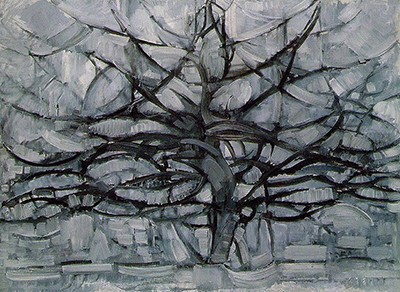
 The Red Tree Piet Mondrian.jpg)
The river does more than identify the location. Its curve carries the eye from the foreground toward the mill, making a modest building the focus of an expansive landscape. The banks form broad, muted bands. The moon is small, so the painting does not depend on a spectacular circle of light. Instead, the changing tone of the sky and its echo in the water give the scene its night-time atmosphere. That restraint distinguishes this canvas from some of Mondrian's brighter Gein landscapes of 1907–08.[1][3]
The reproduction should not be mistaken for a literal photographic record of a particular hour. The museum explicitly calls attention to Mondrian's adjustment of lines and colours for a decorative effect. Even at this comparatively early stage, he was shaping the observed place into an ordered image. The clear horizon, centred vertical mill and broad sweep of foreground water are compositional choices as well as landscape features.[1]
Why did Mondrian paint the Oostzijdse Mill?
The Oostzijdse Mill was a real windmill along the Gein, south of Amsterdam. The Rijksmuseum's account notes that it remains close enough for a cycle journey from the museum today, while cautiously saying Mondrian perhaps made a similar trip. That is a helpful sense of geography, not documentary proof of his exact route to the site. The mill offered a tall, readable silhouette in a flat landscape of water, banks and wide sky.[4]
It became one of several Gein subjects that Mondrian revisited. The RKD catalogue records multiple Oostzijdse Mill views, distinguishing them by viewpoint, sky, moonlight and sunset. Its numbering makes clear that the Amsterdam canvas A411b and the Hague moonlight canvas A420 are separate objects. The later group also includes the very wide, blue-yellow-purple sky of A411, held by Kunstmuseum Den Haag, and the privately held sunset view A418. Repetition let Mondrian test how changing light and framing could transform the same motif.[2][3]
Those catalogue numbers are identifiers, not a simple chronological list. The newly added A411b carries a date around 1903 even though A411 describes a later picture. The distinction matters because an image search for an “Oostzijdse Mill by moonlight” may return several paintings with similar words in their titles. The Rijksmuseum accession SK-A-4987 identifies the exact work on this page.[1][2]
Watch: Piet Mondrian
See his studio, the move toward geometric abstraction and the rhythms of his New York paintings.
Piet Mondrian: Abstract Painting as We Know It
Curator Michael White explores the paintings and Mondrian’s studio as an abstract space.
Watch on YouTubeHow does it connect to the Hague School?
The Rijksmuseum sees a strong debt to the Hague School in this early landscape. It points in particular to Paul Gabriël's In the Month of July, a painting Mondrian had copied a few years before. Similarity of arrangement does not make the two works identical: the museum stresses that their general impressions differ and that Mondrian altered lines and colour to produce a less realistic, more decorative painting.[1]
This comparison gives a more precise account of Mondrian's development than treating every early landscape as a rough draft for abstract grids. Here the natural setting remains recognisable: a mill, a river bend, a moon and trees. Yet Mondrian has already simplified the scene into large relations—vertical mill against horizontal land, dark foreground against pale distance. The image's balance is deliberate without requiring an assertion that he was already applying the later rules of Neo-Plasticism in 1903.
The museum's research library also records a detailed study by Jenny Reynaerts and Marguerite Isoud Tuijn of this acquisition, its dating, provenance and relation to Hague School examples. The study's abstract discusses a possibility that the canvas could be an otherwise unidentified work called Avond from 1903. That remains an identification question in the research, so this page follows the Rijksmuseum's current object title and “about 1903” date rather than presenting Avond as a settled alternate title.[5][1]
Where is the original painting?
The canvas is in the Rijksmuseum, Amsterdam. It measures 63 cm high by 75.4 cm wide and is painted in oil. The museum purchased it in 2005 with support from the BankGiro Lottery and the Rijksmuseum Fonds. Its object page currently lists it on display in gallery 3.1. A visitor should check the museum's current display page before travelling specifically to see it.[1]
The Rijksmuseum also publishes a provenance summary. It traces the picture through a Danish family, later sales and a dealer before the 2005 acquisition, while noting that its provenance account may be incomplete. That qualification is worth retaining: an institutional list of known ownership is evidence of recorded transfers, not a claim that every interval has been resolved.[1]
The museum marks the work public domain on its object page and makes a downloadable image available. This local article retains the site's existing image, which visibly corresponds to the centred mill, small moon, left-hand trees and foreground bend described in the object record. Any future replacement can be judged against that exact composition and the museum's reuse information.[1]
How does it differ from the later moonlit mill?
Kunstmuseum Den Haag owns Oostzijdse Mill in Moonlight, catalogue A420 and object number 0332363. The Hague museum dates that oil canvas about 1907 and measures it 99.5 × 125.5 cm. It is a substantially larger, later composition. Its low dark mill silhouette and strongly glowing moon produce a more concentrated night scene than the open river bend of the Rijksmuseum picture.[3][6]
The Hague museum's conservation publication reports that cleaning A420 revealed an orange ground and details including a small shed and moonlight reflected on water. These technical observations belong to A420, not automatically to the Amsterdam A411b canvas. They are valuable precisely because they show how two paintings of similar subjects can differ in construction as well as in appearance.[6]
The comparison also shows why both artworks deserve their own pages. One is a c. 1903 Rijksmuseum painting with a centred mill and river bend; the other is a c. 1907 Kunstmuseum Den Haag painting with a stronger moonlit silhouette. Shared words in English titles should not erase their separate dates, dimensions, collections or catalogue numbers.[1][3]
Mondrian artworks directory
Frequently asked questions
When was the Rijksmuseum painting made?
Is this the same as Oostzijdse Mill in Moonlight ?
What materials did Mondrian use?
The Rijksmuseum records oil on canvas for this painting, which measures 63 × 75.4 cm.[1]
Where can I see it?
The Rijksmuseum's online object page listed it in gallery 3.1 when checked. Gallery displays can change.[1]
Discussion
How does the river bend guide your eye to the mill?
Reader Insights
What role does the small moon play against the broad sky?
How does this early view differ from the darker Hague A420?
How does this early view differ from the darker Hague A420?
Join the Conversation
Share what you notice in this painting below.
References
- Rijksmuseum, official collection record for Oostzijdse Mill along the River Gein by Moonlight, SK-A-4987: date, medium, dimensions, visual description, provenance, rights and display. View source.
- RKD – Netherlands Institute for Art History, Mondrian digital catalogue, new additions, entry A411b for the Rijksmuseum painting. View source.
- RKD – Netherlands Institute for Art History, landscapes along the Gein, entries A411, A418 and A420. View source.
- Rijksmuseum, “Then and now” story locating the Oostzijdse Mill near Amsterdam. View source.
- Rijksmuseum Research Library, record for Jenny Reynaerts and Marguerite Isoud Tuijn, “Naturalisme als uitgangspunt: Piet Mondriaan, Oostzijdse molen bij maanlicht,” Bulletin van het Rijksmuseum 54 (2006), pp. 246–65. View source.
- Kunstmuseum Den Haag, official object record for its separate A420 painting and a conservation publication discussing its orange ground and reflected moonlight. Object record; Conservation publication.
- Lead image credit. Piet Mondrian, Oostzijdse Mill along the River Gein by Moonlight, c. 1903, oil on canvas, 63 × 75.4 cm, Rijksmuseum, Amsterdam, SK-A-4987, RKD A411b.