 by Tom Gurney
Tom Gurney BSc (Hons) is an art history expert with over 20 years experience
Published on June 19, 2020 / Updated on September 29, 2026
Email: tomgurney1@gmail.com / Phone: +44 7429 011000
About the painting
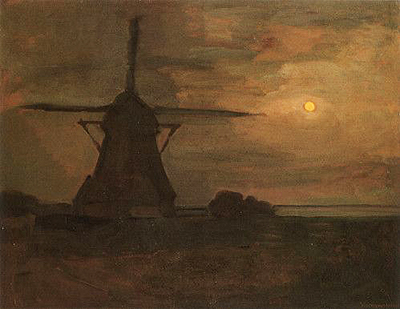
Against a deep night sky, the Oostzijdse Mill becomes a heavy silhouette while an orange moon glows to the right. This is Piet Mondrian's Oostzijdse Mill in Moonlight, an oil painting dated about 1907 in Kunstmuseum Den Haag. The museum records it as 0332363, measuring 99.5 × 125.5 cm; the RKD catalogue identifies it as A420. It must not be confused with the smaller, earlier moonlit Gein view at the Rijksmuseum, A411b.[1][2][3]
At a glance
- ArtistPiet Mondrian (Piet Mondriaan, 1872–1944)
- TitleOostzijdse Mill in Moonlight; Dutch museum title Oostzijdse molen in maanlicht
- DateAbout 1907
- Catalogue numberRKD A420
- MediumOil on canvas
- Dimensions99.5 × 125.5 cm (height × width)
- CollectionKunstmuseum Den Haag, The Hague
- Object number0332363; RKD also gives museum catalogue number 20-1939[1][2]
Four views of the Oostzijdse Mill
Moonlit Gein (A411b)
c. 1903Moonlight (A420)
c. 1907Extended sky (A411)
1907–08Panoramic sunset (A418)
1907–08Contents
- What does Oostzijdse Mill in Moonlight show?
- How did Mondrian create the moonlight effect?
- Where is the Oostzijdse Mill?
- What changed in Mondrian's landscapes around 1907?
- Where is the painting now?
What does Oostzijdse Mill in Moonlight show?
The mill dominates the left half of this wide canvas. Its dark wings and body emerge from a low bank, with small buildings and water held close to the base. The moon is a bright warm disc in the upper right. The rest of the image is built from densely related browns, ochres, greens and blackish tones. Light reflected in the water gives the lower portion a second, less concentrated glow. The composition is simple enough to register at a distance, yet it contains details that become visible only when the eye adjusts to the dark passage.[4]
 The Red Tree Piet Mondrian.jpg)
The opposing positions of mill and moon matter. The mill is solid, earthbound and nearly black; the moon appears small but intense. Mondrian does not need a sharply drawn shoreline to hold them together. A broad low band of land bridges the two sides, while the water reflects just enough light to stop the lower third from becoming a blank mass. Seen this way, the painting is an experiment in how little descriptive detail a night landscape requires.
The subject is recognisable rather than abstract. Viewers can locate windmill, sky and water. But Mondrian has enlarged and simplified their tonal relationships. The shape of the mill functions as a compositional weight, and the pale disc is a counterweight. This interpretation comes from the visible arrangement; it does not mean that Mondrian had already adopted the strict grids of his later Paris and New York work.
How did Mondrian create the moonlight effect?
Kunstmuseum Den Haag's conservation publication supplies an unusually concrete clue. During removal of old varnish, conservator Leonoor Speldekamp noticed an orange glow shining through the image. The painting proved to have an orange ground layer, rather than the more usual white or cream ground. The museum also reports that cleaning brought out details that had been difficult to see, including a small shed and the reflection of moonlight in the water.[4]
That finding helps explain why the dark scene feels warm rather than simply black. An orange preparation can contribute to the picture's overall colour impression where it is visible through or between upper layers. The museum's conservation account establishes the ground for this specific A420 canvas. It should not be casually applied to every mill painting from the same period. Nor can a screen reproduction show the ground, varnish and surface at the scale of the original.[4]
The moon is a point of light, but the rest of the painting also depends on glow and reflection. In a museum education resource, Kunstmuseum Den Haag uses this work to ask how backlighting is suggested and whether Mondrian's moonlit setting is naturalistic or idealised. Those are productive questions because the image balances an observed place with a strongly composed atmosphere. The windmill remains legible even as its details are suppressed by the light behind it.[5]
Watch: Piet Mondrian
See his studio, the move toward geometric abstraction and the rhythms of his New York paintings.
Piet Mondrian: Abstract Painting as We Know It
Curator Michael White explores the paintings and Mondrian’s studio as an abstract space.
Watch on YouTubeWhere is the Oostzijdse Mill?
The Oostzijdse Mill stood on the River Gein near Abcoude, south of Amsterdam. Mondrian returned to this motif through several years and many changing conditions. The RKD catalogue groups numerous views of the mill within the Gein landscapes, distinguishing works by the position of the mill, the width and colour of the sky, and the time of day. A420 sits after a related moonlight compositional study A419 in that sequence. The sequence is a catalogue distinction, not a claim that the study's every decision can be traced into this painting without examining both originals.[2]
Painting the same mill more than once allowed Mondrian to change one visual problem at a time. In the early Rijksmuseum A411b from about 1903, the mill is centred at a river bend beneath a small moon. Here, several years later, the broader canvas emphasizes the black silhouette and amber moon. The site remains similar, but the distribution of light and dark has changed so much that the two works have different moods and structures.[2][3]
Another nearby work, A411, spreads a blue, yellow and purple evening sky across a much shallower horizontal format. The RKD records it in the same museum but under another object number, 0334233. That is a sunset or evening colour study, not the moonlit A420. Precise identifiers matter because English descriptions of “the Oostzijdse Mill” are often shortened in reproductions.[2][6]
What changed in Mondrian's landscapes around 1907?
Kunstmuseum Den Haag describes Mondrian's early career as beginning with realistic landscapes before line and colour became more individual around the turn of the twentieth century. Its discussion of the related A411 painting says that by 1907 he was condensing natural elements into large shapes and contours. A420 develops another aspect of that exploration: the dark mill is still a specific object, but the picture depends on the overall arrangement of darkness, moon and reflection more than on the description of brickwork or machinery.[6]
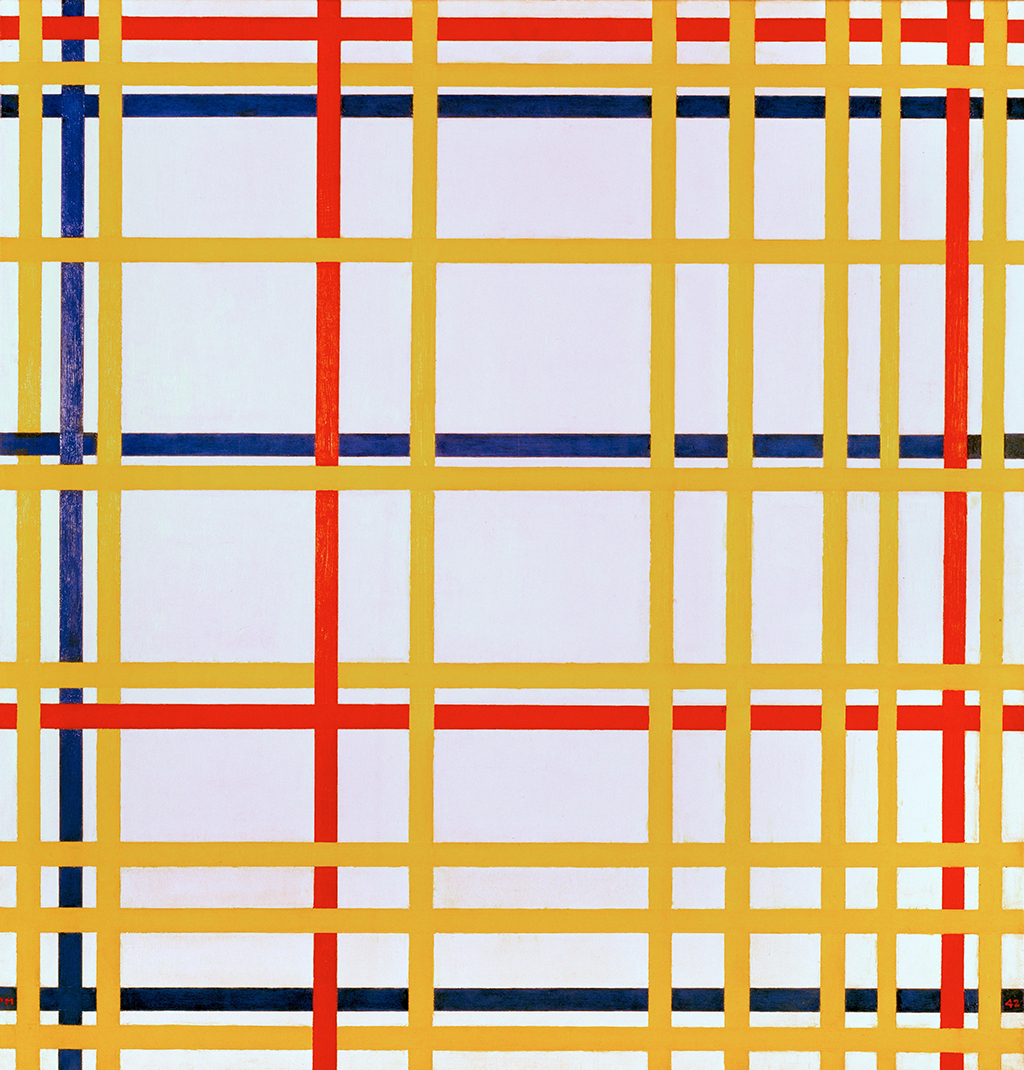
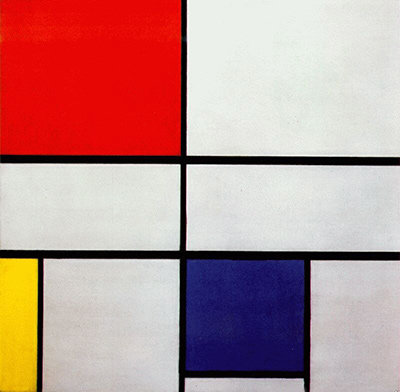
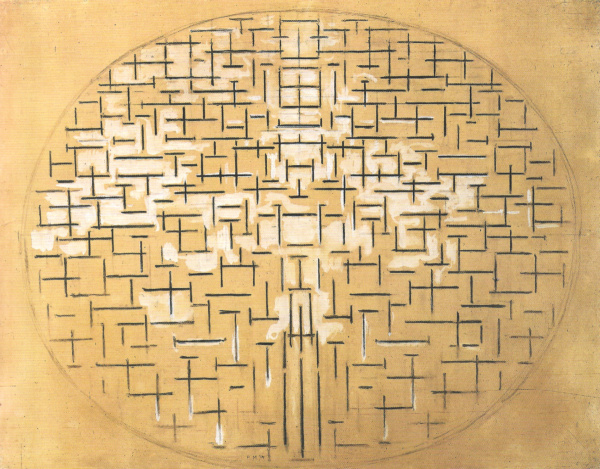
The transition is better understood as a sequence of different experiments than as one instant when Mondrian “became abstract.” These canvases still show the Gein landscape. Their freedom lies in adjusting colour, silhouette, framing and rhythm so that the painted experience is more than a record of topography. The A420 orange ground adds a material dimension to that story: colour is present in the construction of the canvas, not only in the moon painted on its surface.[4]
This painting also shows why photographs of the work can differ. A dark reproduction may lose the small shed and water reflections that conservation made more legible; a brightened one can flatten the deep tonal contrast. The original's 99.5 × 125.5 cm size allows the eye to move between the silhouette and small interior details at a scale that a small web image cannot reproduce.[1][4]
Where is the painting now?
The original belongs to Kunstmuseum Den Haag, The Hague. The museum's collection page supplies the Dutch title, date, medium, dimensions and accession 0332363. Its online record establishes collection ownership but does not promise that the work is continuously on display; visitors should check the current gallery programme if seeing this particular canvas is their reason for visiting.[1]
The local image on this page remains the site's existing reproduction. It visibly matches the wide dark composition and right-hand moon associated with A420. The conservation publication provides an independent visual and technical cross-check. A higher-resolution replacement is optional and would require a clearly usable licence; it is not necessary to identify the painting or explain it accurately.[4]
Mondrian artworks directory
Frequently asked questions
What is the painting made of?
Is it the Rijksmuseum's moonlit mill?
Why does the night scene look warm?
The museum's conservators found an orange ground layer that glows through parts of the painting. The warm moon and its reflection also shape the visible colour.[4]
Discussion
How does the low bank connect the mill and moon?
Reader Insights
Where is reflected light visible in the dark water?
How does this painting differ from the earlier Rijksmuseum A411b?
How does this painting differ from the earlier Rijksmuseum A411b?
Join the Conversation
Share what you notice in this painting below.
References
- Kunstmuseum Den Haag, official collection record for Oostzijdse molen in maanlicht, object 0332363, c. 1907, oil on canvas, 99.5 × 125.5 cm. View source.
- RKD – Netherlands Institute for Art History, Mondrian catalogue, Gein landscapes, A419 and A420, with related A411. View source.
- Rijksmuseum, official record for the separate c. 1903 A411b, SK-A-4987. View source.
- Kunstmuseum Den Haag, conservation publication, pp. 18–19, on orange preparation, varnish removal, shed and reflected moonlight in A420. View source.
- Kunstmuseum Den Haag, art education guide discussing backlighting and the moonlit mill. View source.
- Kunstmuseum Den Haag, official record and interpretation for the separate A411 Oostzijdse molen bij avond. View source.
- Lead image credit. Piet Mondrian, Oostzijdse Mill in Moonlight, c. 1907, oil on canvas, 99.5 × 125.5 cm, Kunstmuseum Den Haag, 0332363, RKD A420.