 by Tom Gurney
Tom Gurney BSc (Hons) is an art history expert with over 20 years experience
Published on June 19, 2020 / Updated on September 29, 2026
Email: tomgurney1@gmail.com / Phone: +44 7429 011000
About the painting
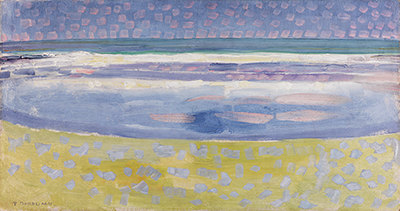
A wide band of water reaches across the middle of this small, unusually broad coastal study. Above it, a violet sky is broken into short marks; below it, pale yellow shore and blue-grey water appear in strips and dabs. The painting on this page is RKD A694, Sea toward Sunset, made in 1909 and held by Kunstmuseum Den Haag as 0334289. The museum's current English record calls the same object Sea after sunset. That title overlap matters because a different 1909 canvas, A693, also carries Sea after Sunset in RKD. The object number and visible image keep these two works apart.[1][2]
At a glance
Three distinct 1909 sea views
Contents
- What does the seascape show?
- Why does the title differ between RKD and the museum?
- What was Mondrian doing at the Zeeland coast?
- How does it compare withSeascape?
What does the seascape show?
The picture is nearly twice as wide as it is high. Mondrian uses that long rectangle to give the horizontal horizon and the strips around it room to breathe. The sky at the top is a field of mauve and blue marks. A thin pale strip near the horizon separates it from the darker water. Below, broad cooler shapes lead towards a light, yellowish foreground. The exact boundary between sea and shore is softened by small strokes and colour changes.
 The Red Tree Piet Mondrian.jpg)
The painting does not give a prominent ship, figure or pier to establish scale. The broad divisions do most of the work. Purple above, grey-blue through the centre and yellow below could seem simple when named in words, but each band contains variations. Individual marks accumulate into the impression of light moving over water. The little interruptions prevent the view from becoming a flat striped design.
The shore is especially lively. Warm yellow appears beside cool lavender and pale blue. Seen from a distance these touches merge into a bright strip; nearer the image they remain separate. This is one way Mondrian could explore the changing brightness of a coast without tracing every wave. The picture still refers to sea, sky and land, even as its colour and spacing attract attention in their own right.
Why does the title differ between RKD and the museum?
The RKD digital catalogue lists A694 as Sea toward sunset, 1909, with Hague inventory 0334289. Kunstmuseum Den Haag's current object page gives 0334289 the English title Sea after sunset, along with oil on cardboard and 41 × 76 cm. These records point to the same physical object despite different English title wording. The title on this page follows RKD because it distinguishes the route from other seascapes, while the museum's wording is given openly rather than silently corrected.[1][2]
The neighbouring A693 is also called Sea after sunset in RKD, but its museum inventory is 0333679, not 0334289. The Hague exhibition lists A693's larger 62.5 × 74.5 cm oil-on-cardboard study. Another adjacent work, A695, is simply Seascape, object 0334290, 34.5 × 50.5 cm. Exact numbers and proportions are therefore necessary when an English web page, search result or image caption uses a short title.[1][3][4]
The retained image on this route has the broad yellow foreground, dark central water and violet upper field associated with the 41 × 76 cm A694 composition. It should not be swapped with the more evenly lit yellow-and-blue image of A695 merely because both are 1909 sea views. Their different shapes, colours and museum numbers allow a confident separation.
Watch: Piet Mondrian
See his studio, the move toward geometric abstraction and the rhythms of his New York paintings.
Piet Mondrian: Abstract Painting as We Know It
Curator Michael White explores the paintings and Mondrian’s studio as an abstract space.
Watch on YouTubeWhat was Mondrian doing at the Zeeland coast?
Kunstmuseum Den Haag's exhibition By the Sea describes Domburg and the Zeeland coast as a meeting place for artists interested in bright light, dunes and water. Mondrian first visited Domburg in 1908 and returned in 1909. The museum places his sea and dune studies among work made in contact with Jan Toorop, Jacoba van Heemskerck and others. The sea views, it suggests, register a more personal perception of nature rather than a purely objective record of topography.[3]
This context helps explain why A694 has so little conventional detail. The interest lies in the experience of looking across the sea toward a changing horizon. The long horizontal format lets small changes in colour seem expansive. It is still an observed coastal subject, and the cited sources do not establish the exact day, hour or point on the shore at which this study was made.
The cardboard support also matters. The museum identifies the work as oil on cardboard, not oil on canvas. It belongs among a set of relatively small experimental coastal works in varied supports. One cannot infer a precise speed of execution from the support alone, but the direct, broken marks make sense as part of the artist's concentrated study of light and colour.[2]
How does it compare with Seascape?
The 1909 Seascape is A695, also in Kunstmuseum Den Haag but under object 0334290. It is smaller at 34.5 × 50.5 cm and shows brighter yellow strips across the water beneath a cooler blue sky. A694 is much wider, with a violet upper zone and a yellow foreground. Looking at them side by side makes clear that Mondrian was not repeating one standard seaside formula.[1][2][4]
The two studies offer different rhythms of horizontals. In A694 the dark middle and broad lower area make the horizon feel distant; in A695 more vivid yellow bands move through the centre. Both remain images of an open shore, but the relative placement of light and colour changes the viewer's sense of space.
Mondrian artworks directory
Frequently asked questions
What is the catalogue number of Sea Toward Sunset ?
It is RKD A694, Kunstmuseum Den Haag 0334289.[1]
Why does the museum call it Sea after sunset ?
What is it made of?
The collecting museum records oil on cardboard, 41 × 76 cm.[2]
Is it the same as Mondrian's Seascape ?
Discussion
Where does the horizon sit in this wide view?
Reader Insights
How do violet, dark blue and yellow create distance?
How does this work differ from A695?
How does this work differ from A695?
Join the Conversation
Share what you notice in this painting below.
References
- RKD – Netherlands Institute for Art History, Mondrian seascape catalogue A693–A710, identifying A694, A693 and A695 by title and inventory. View source.
- Kunstmuseum Den Haag, official Sea after sunset object record for 0334289, 1909, 41 × 76 cm, oil on cardboard. View source.
- Kunstmuseum Den Haag, By the Sea exhibition account of Mondrian's Domburg visits and the distinct A693 sea study. View source.
- Kunstmuseum Den Haag, official Seascape object record for the separate 0334290, 1909, 34.5 × 50.5 cm. View source.
- Lead image credit. Piet Mondrian, Sea toward sunset (museum title Sea after sunset), 1909, oil on cardboard, 41 × 76 cm, Kunstmuseum Den Haag, 0334289, RKD A694.