


 by Tom Gurney
Tom Gurney BSc (Hons) is an art history expert with over 20 years experience
Published on June 19, 2020 / Updated on August 9, 2026
Email: tomgurney1@gmail.com / Phone: +44 7429 011000
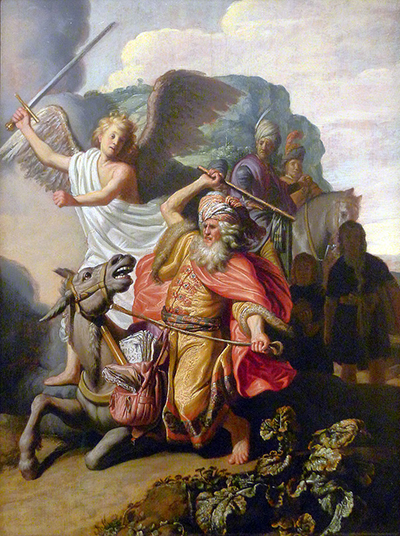
Balaam and the Ass is one of Rembrandt's earliest signed biblical paintings
Balaam and the Ass and The Baptism of the Eunuch arrived in the same year and have undeniable similarities in the way in which Rembrandt completed figurative detail and gradiented clothing. Many new to the work of Rembrandt would not consider this to be part of his oeuvre, but this was simply an artist developing his career and fighting to find his prefered style.
The early years of Rembrandt as an artist were spent in Leiden and it was perhaps during this period that he lacked enough influences from other artists to develop his own path as an artist. This would change in Amsterdam. This particular scene portrays the biblical story of a talking ass arguing with Balaam. This diviner in the Torah would be captured by many other artists too.
This scene captures the arrival of the Israelites in the Jordan valley. In fear of an imminent attack, Balak, King of Moab, would order Balaam to place a curse on them. The biblical story (22:1-35) tells of the ass becoming able to speak and Balaam then being able to see an angel drawing her sword. This conversion would touch on the appearance of Christ to Thomas and is yet another entry of religion into the work of Renaissance and Baroque artists.
Balaam and the Ass can be found in the Musée Cognacq-Jay, Paris which also holds work by the likes of François Boucher, Canaletto, Jean-Siméon Chardin, Jean-Honoré Fragonard, Giovanni Battista Tiepolo, Jean-Antoine Watteau, Camille Corot, Paul Cézanne and Edgar Degas. The fact that it remains in an impressive, but smaller art institution underlines its relative prominence within Rembrandt's overall output.
Object Notes and Research Context
The Musee Cognacq-Jay presents Balaam and the Ass as an oil on wood signed and dated 1626, made when Rembrandt was about twenty. Its importance lies in that early date. The young painter had only recently begun working independently and was still close to the example of Pieter Lastman, whose Amsterdam studio taught him how to stage biblical and mythological history subjects.
The story comes from Numbers 22. Balaam sets out to curse Israel, but his donkey sees the angel blocking the road before he does; after Balaam beats the animal, the miraculous speech of the donkey forces him to recognise the divine warning. Rembrandt condenses the story into an ascending knot of bodies: Balaam, the animal, the servant and the angel are pressed together so that revelation feels sudden and physical.
A 2006-2010 restoration, discussed in Technè, addressed a thick yellowed varnish that had obscured dark passages and distorted lighter colours. That conservation history is a good reason to retain the page: it gives readers an accessible example of how early Rembrandt paintings have been studied, cleaned and reassessed in modern museums.
The painting's early date makes Lastman's influence important. Pieter Lastman specialised in crowded, vividly staged history subjects, and the young Rembrandt learned from that approach before simplifying and deepening his own narrative style. Balaam and the Ass still shows a youthful appetite for action: animal, rider, servant and angel are pressed into a compact moment of revelation.
The restoration history gives the page a second strong thread. Cleaning a yellowed varnish does more than make an old painting look brighter; it can recover spatial relations, alter the visibility of figures and change how scholars understand early colour choices. For a 1626 Rembrandt, that matters because every surface detail contributes to the reconstruction of his earliest independent development.
The animal is usually called Balaam's ass in older biblical and art-historical titles, but the story is the same as Balaam and the donkey in current English. Both terms help modern readers recognise the subject.
Further Rembrandt Context
This shorter legacy page remains part of the Rembrandt archive. For fuller context, use the refreshed Rembrandt pages below, which explain the artist's biography, media, technique, attribution issues and major works in greater depth.
For secure object data, attribution and collection history, compare Balaam and the Ass with the relevant museum or catalogue record before treating older page text as final.
 Rembrandt.jpg)
Discussion
What feels most useful when looking at Balaam and the Ass: the subject, the handling of light, the medium, the attribution history, or its place within Rembrandt's wider painting output?
Reader Insights
Set this page beside the refreshed Rembrandt hubs before relying on older summaries alone.
Rembrandt pages often need museum records, catalogue history and attribution caution, especially where older sources use broader labels.
Which detail would you most want clarified next: date, medium, collection, attribution, subject, condition or comparison with another Rembrandt work?
Join the Conversation
Have a thought or observation about Balaam and the Ass? Share it below. Thoughtful responses may be added as the Rembrandt archive continues to be reviewed.