


 by Tom Gurney
Tom Gurney BSc (Hons) is an art history expert with over 20 years experience
Published on June 19, 2020 / Updated on August 9, 2026
Email: tomgurney1@gmail.com / Phone: +44 7429 011000
Minerva by Rembrandt: Introduction
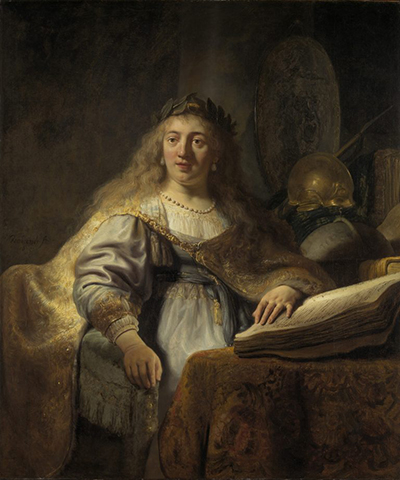
Rembrandt's Minerva in Her Study is a painting about power held in reserve. The goddess is not charging into battle. She is seated with a large open book, turning toward the viewer as if her concentration has just been interrupted. Behind and around her are the signs of her other identity: a golden helmet, spear, shield and the head of Medusa. The result is a scholar-warrior image, where wisdom and force belong to the same figure.
The painting is in The Leiden Collection, New York, which records it as Rembrandt's Minerva in Her Study, dated 1635, oil on canvas, 138 x 116.5 cm, inventory RR-107. It is signed and dated along the left edge: Rembrandt. f / 1635.
Those object facts place the work at a decisive moment in Rembrandt's early Amsterdam career. In the mid-1630s he was not only making portraits. He was also trying to prove that he could make ambitious history paintings: learned subjects from scripture, mythology and antiquity, painted with scale, drama, texture and emotional presence. Minerva in Her Study belongs to that claim.
At a Glance
- ArtistRembrandt van Rijn.
- TitleMinerva in Her Study.
- Date1635.
- Mediumoil on canvas.
- Dimensions138 x 116.5 cm.
- CollectionThe Leiden Collection, New York.
- Inventory numberRR-107.
- Signature and dateRembrandt. f / 1635, centered along the left edge.
- SubjectMinerva, Roman goddess of wisdom, arts, craft, strategy and war.
Contents
- Introduction
- At a Glance
- Who Is Minerva?
- Wisdom With Armor Nearby
- A History Painting Without Spectacle
- Costume, Light And Texture
- Minerva And Rembrandt's 1630s Goddesses
- Object History And Attribution
- How To Look At Minerva
- Why Minerva Matters
Who Is Minerva?
Minerva is the Roman counterpart of Athena. She is a goddess of wisdom, learning, the arts, poetry, medicine, craft and strategic war. That combination matters. Minerva is not only a war goddess in the blunt sense. She represents disciplined intelligence: the mind that plans, judges, invents and protects.
Rembrandt's painting depends on that complexity. The helmet, spear and shield tell the viewer that Minerva belongs to war. The books, study, globe and inward setting tell a different story: this is a goddess of knowledge. Her force is not shown as action but as command, self-possession and alert thought.
This is why the painting should not be read simply as a costume portrait or a decorative mythological woman. It is a history painting without a crowded event. Rembrandt gives the viewer a single figure who carries a large field of meaning: antiquity, learning, peace, power, craft and artistic ambition.
Wisdom With Armor Nearby
One of the strongest choices in the painting is the placement of Minerva's armor. Rembrandt does not remove it. He leaves it close enough to define her. The helmet gleams in the background. The shield bears the Gorgon's head, the frightening face of Medusa. The spear stands nearby. These are serious attributes, not casual decorations.
Yet the goddess herself has turned away from them. She is seated at a table with a book. This shift changes the whole tone of the image. Minerva's martial identity is present, but her attention has moved toward reading, thought and study. Rembrandt makes peace look powerful because the warrior's equipment has not vanished; it has been set aside.
The laurel wreath adds another layer. Laurel is more often associated with poetry, victory and honor than with Minerva's usual olive branch. In Rembrandt's image it helps turn the goddess into a figure of intellectual victory. She is crowned not because she has struck a blow, but because wisdom itself has authority.
A History Painting Without Spectacle
In seventeenth-century art theory, history painting was often treated as the most demanding kind of painting. It included biblical, classical, mythological, allegorical and historical subjects. A painter had to invent figures, gestures, costumes, settings and meanings that could carry a story or idea.
Minerva in Her Study belongs to that tradition, but it does not work like The Blinding of Samson or Belshazzar's Feast. There is no violent action, no sudden miracle and no crowded group. The drama is quieter. Minerva looks up from her book, and that small interruption becomes enough.
This restraint is part of the painting's intelligence. Rembrandt makes a mythological subject feel present without turning it into a stage scene. He gives Minerva a body, face, hair, clothing and weight. She is antique in meaning, but not distant in feeling. She looks like a mind interrupted, not a symbol arranged for a lesson.
That quality also explains why the painting belongs near Rembrandt's broader history-painting pages. It shows a different kind of ambition: not narrative shock, but monumental presence. The subject is learned, the scale is imposing, and the figure is built to hold attention.
Costume, Light And Texture
The painting is also a display of Rembrandt's skill with surface. Minerva wears rich clothing that lets him move between embroidery, satin, cloak, sash, pale fabric, pearls, hair and metal. The costume is not an archaeological reconstruction of ancient dress. It is studio invention: a way to make antiquity visible through luxurious materials.
This matters because Minerva is also a goddess of craft. A painting about Minerva gives Rembrandt an unusually fitting subject for showing what painting can do. Drapery, hair and polished armor were difficult things to paint convincingly. Here they become part of the meaning. The goddess of skill is made through painterly skill.
Light helps organize the effect. Minerva's face, hair and body are brought forward against darkness, while the objects behind her remain partly shadowed. The viewer notices the human presence first, then the attributes. The result is not a flat inventory of symbols. It is a gradual recognition: reader, goddess, warrior, patron of the arts.
Her blond hair is especially important. It falls loose and bright, softening the grandeur of the figure while also making her seem alive. The strong face, wide eyes and heavy costume could easily become stiff. Rembrandt avoids that by giving the figure a moment of attention. She is not posing blankly. She has looked up.
Minerva And Rembrandt's 1630s Goddesses
Minerva in Her Study belongs to a remarkable group of Rembrandt images from the 1630s in which women from antiquity, mythology or heroic story are shown at large scale. The Leiden Collection entry connects it with works such as Bellona, now at the Metropolitan Museum of Art, the Prado painting now titled Judith at the Banquet of Holofernes, and Flora images associated with spring, costume and Saskia traditions.
These comparisons are useful because they show Rembrandt experimenting with a kind of heroic female presence. Bellona is closer to war. Flora is closer to seasonal poetry and pastoral costume. Danae turns myth into a chamber scene of light and bodily response. Minerva is different again: learned, armed, monumental and self-possessed.
The group also shows how carefully identity has to be handled. Several of these paintings have attracted sitter traditions, title changes or competing subject readings. Minerva was once connected with Saskia in older title history, but the safer reading is not to treat it as a certain portrait of Rembrandt's wife. The figure is better understood as an idealized goddess shaped through Rembrandt's familiar interest in costume, role and human presence.
This caution does not make the painting colder. It makes it more interesting. Rembrandt's mythological figures often work because they are not pure abstractions. They feel close to lived bodies and faces, but they also belong to roles larger than portraiture.
Object History And Attribution
Minerva in Her Study spent much of its later life in private collections and was not always as visible as Rembrandt's better-known museum pictures. The Leiden Collection catalogue traces its early recorded history to the Somerville family in Scotland in the eighteenth century, followed by later private ownership in Europe and Japan. The Leiden Collection acquired the painting in 2008.
The painting also has an attribution history worth noting. Earlier scholars sometimes doubted whether it was entirely by Rembrandt, partly because a drawn copy associated with Ferdinand Bol raised questions about workshop practice. The Rijksmuseum holds a drawing after Rembrandt's composition, attributed to Bol, probably made soon after Bol entered Rembrandt's studio in 1636.
That copy is important, but it does not reduce the Leiden Collection painting to a workshop product. The Rembrandt Research Project accepted Minerva in Her Study as a wholly autograph work from 1635. Technical observations also place the painting firmly within Rembrandt's mid-1630s studio world, including links between its canvas and canvases used for other works associated with the period.
For readers, the point is not to turn the page into an attribution dispute. It is to understand that major old-master paintings often have long records of ownership, visibility, study and reassessment. Minerva is now best introduced as a 1635 Rembrandt painting, while still remembering that its modern reputation was shaped by research and renewed visibility.
How To Look At Minerva
Begin with the interruption. Minerva is reading, then she looks up. That small turn gives the painting its life. She is not simply displayed with attributes; she seems to have a mind in motion.
Then look at the armor. The helmet, spear and shield are not the main action, but they change everything. Without them, the figure might read as a noble woman in a study. With them, she becomes the goddess whose wisdom includes martial power.
Next, follow the surfaces. The painting moves from blond hair to pearls, from embroidered fabric to cool blue sash, from book to metal. Rembrandt uses texture to give the image authority. The goddess of wisdom and craft is made persuasive through the craft of painting itself.
Finally, compare her with Rembrandt's other mythological and heroic women. Flora transforms a woman through flowers and costume. Danae responds to a divine arrival. Artemisia or Judith sits inside a more uncertain heroic subject. Juno, in Rembrandt's later career, offers another monumental goddess image. Minerva stands among them as the figure of learned strength.
Why Minerva Matters
Minerva in Her Study matters because it widens the usual picture of Rembrandt. He was not only the painter of self-portraits, civic groups and biblical scenes. He also used classical subjects to test what history painting could become in the Dutch Republic.
The painting is learned without being dry. It is grand without requiring violence. It lets armor, books, light and fabric define a goddess whose strength lies in disciplined intelligence. That balance makes it one of Rembrandt's most revealing mythological works.
It also shows how his 1630s ambition could take more than one form. Belshazzar's Feast shocks the eye. The Blinding of Samson overwhelms the body. Danae turns myth into intimate light. Flora turns costume into role. Minerva makes wisdom monumental.
For anyone following Rembrandt's history paintings, that is the essential reason to pause here. Minerva in Her Study is not a side note. It is Rembrandt imagining the power of thought as a body in a room, with war waiting behind her and a book open before her.
Frequently Asked Questions About Rembrandt's Minerva
The painting is dated 1635. It is signed and dated along the left edge: Rembrandt. f / 1635.
Minerva is the Roman goddess of wisdom, arts, craft, strategy and war. In Rembrandt's painting, her armor remains visible, but she is shown in a study with books, emphasizing wisdom and peaceful authority.
Older title history connected the painting with Saskia, but the safer reading is to treat the figure as an idealized Minerva rather than a certain portrait of Rembrandt's wife.
The painting is important because it shows Rembrandt's 1630s ambition as a history painter. It brings together mythology, scholarship, costume, light, texture and the idea of a woman whose power comes from wisdom as much as war.
Discussion
What feels most important in Minerva: Rembrandt's light, the figure's expression, the material surface, the historical source, or the way the work sits beside his other paintings and prints?
Reader Insights
Begin with one detail in Minerva, then move outward to light, gesture, surface and the surrounding space.
Connect the work to Rembrandt's biography, workshop, medium and the museum record rather than reading it as an isolated image.
Which detail changes the interpretation most once you know the date, subject, attribution history or present collection?
Join the Conversation
Have a thought or observation about Minerva? Share it below. Thoughtful responses may be added to this section as the Rembrandt pages develop.
References
- The Leiden Collection, Volker Manuth, Minerva in Her Study: https://www.theleidencollection.com/artwork/minerva-in-her-study/
- The Leiden Collection, Rembrandt and The Leiden Collection: https://www.theleidencollection.com/essays/rembrandt-and-the-leiden-collection/
- Rijksmuseum, attributed to Ferdinand Bol, Minerva in her Study, drawing after Rembrandt: https://www.rijksmuseum.nl/en/collection/object/Minerva-in-her-Study--2bf83121b1649b88552ac5cd191ba71e
- Metropolitan Museum of Art, Bellona: https://www.metmuseum.org/art/collection/search/437389
- Museo Nacional del Prado, Judit en el banquete de Holofernes (in Spanish): https://www.museodelprado.es/coleccion/obra-de-arte/judit-en-el-banquete-de-holofernes/08f69e61-f7c5-43f9-a76d-b24fbdc63681
- National Gallery, London, Saskia van Uylenburgh in Arcadian Costume: https://www.nationalgallery.org.uk/paintings/rembrandt-saskia-van-uylenburgh-in-arcadian-costume
- State Hermitage Museum, Dutch Painting of the 17th and 18th Centuries: Catalogue of the Collection, Vol. 4: Rembrandt-Holsteyn, 2023: https://hermitagemuseum.org/research/publications/publication_141
 Rembrandt.jpg)