


 by Tom Gurney
Tom Gurney BSc (Hons) is an art history expert with over 20 years experience
Published on June 19, 2020 / Updated on August 9, 2026
Email: tomgurney1@gmail.com / Phone: +44 7429 011000
Artemisia: Introduction
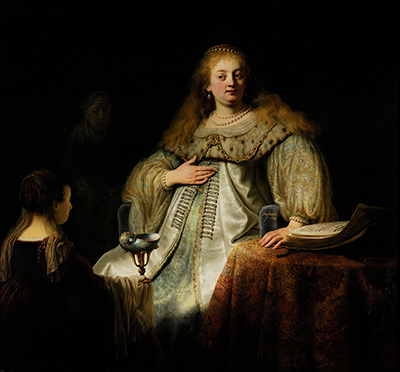
The painting often searched for as Rembrandt's Artemisia is now titled Judith at the Banquet of Holofernes by the Museo Nacional del Prado. That title change is not a small label problem. It changes the way the whole picture is read.
At first glance, the older Artemisia title seems plausible. The painting shows a richly dressed woman seated in grandeur, attended by servants and offered a precious cup. Her jewels, heavy costume and inward gesture could belong to a noble heroine from ancient history. For a long time, viewers connected the scene with Artemisia of Caria, the widow of Mausolus, who was said to have drunk her husband's ashes mixed with wine. Others proposed Sophonisba, the Carthaginian noblewoman who drank poison rather than submit to Roman captivity.
The Prado's current identification turns the scene toward a biblical heroine instead. The museum now presents the painting as Judith at the banquet of Holofernes: the moment before Judith kills the Assyrian general who threatens her people. The older title still matters because it records how difficult the picture has been to name. But the safest starting point is the current object record: a 1634 oil on canvas by Rembrandt, in Madrid, whose subject is now understood through Judith, luxury, courage and theatrical ambiguity.
At a Glance
- ArtistRembrandt, Rembrandt Harmensz. van Rijn.
- Current titleJudith at the Banquet of Holofernes.
- Older common titleArtemisia.
- Date1634.
- Medium/supportoil on canvas.
- Dimensions143 x 154.7 cm.
- CollectionMuseo Nacional del Prado, Madrid.
- Inventory numberP002132.
- Signature/datesigned and dated Rembrandt / f : 1634 on the front; the Prado discusses the signature's condition but attributes the painting to Rembrandt.
- Subject cautionthe painting has been identified as Artemisia, Sophonisba, Cleopatra, Esther and Judith; the Prado now uses the Judith title.
Contents
- Introduction
- At a Glance
- Artemisia, Sophonisba or Judith?
- What Rembrandt Shows
- A Heroine in Luxury Costume
- Why the Judith Reading Matters
- Technical Evidence and Change
- How to Look at Artemisia
- Why the Painting Matters
Artemisia, Sophonisba or Judith?
The subject has attracted competing names because the painting is deliberately rich but not easily explicit. Artemisia and Sophonisba are both stories about noble women, loyalty, death and a cup. Artemisia, queen of Caria, was remembered for mourning Mausolus so intensely that she became a living tomb for him by drinking his ashes in wine. Sophonisba, caught in the politics of Rome and Numidia, was said to have accepted a poisoned cup rather than be taken in triumph.
Those stories help explain the older reading. The cup in Rembrandt's painting is prominent, and the seated woman has the dignity expected of a ruler or heroine. Nothing about her costume is ordinary. She appears in a world of pearls, gold, white silk, embroidered dress, a large collar and glowing fabric. If the picture were only a woman receiving a cup, Artemisia and Sophonisba would remain natural possibilities.
The difficulty is that other details pull the painting toward Judith. The Prado's interpretation gives special weight to the older servant in the dark background, who holds a sack. In the Judith story, the sack becomes the container for the head of Holofernes after Judith kills him. The goblet, the banquet setting, the attendants and the hidden violence of the story fit a scene before the act rather than after it.
That does not make the old title useless. Artemisia is part of the painting's reception history, and it explains why many readers still arrive at the work through that name. A careful account should not simply erase it. But the current Prado title asks the viewer to read the cup not as ashes or poison, but as wine offered in Holofernes's tent before Judith turns hospitality into deliverance.
What Rembrandt Shows
Rembrandt places the woman close to the viewer, almost monumental in scale. She sits in a velvet armchair beside a table with an open book. Her body turns slightly, her head tilts, and one hand rests near her breast. Her loosened hair falls over her shoulders, threaded with pearls and gold. The costume is extravagant: embroidered fabric, a bright over-gown, an ermine collar, pearl jewelry and a chain set with coloured stones.
A young servant kneels before her and offers a nautilus-shell goblet mounted on a gold stem. The shell cup is more than a luxury object. It is the narrative hinge of the scene, the thing that makes the viewer ask what kind of drink is being offered and what decision is about to follow. Behind them, partly swallowed by darkness, an older servant appears with the sack that supports the Judith reading.
The open book on the table is another important clue. It does not provide a readable label, but it gives the scene an intellectual and scriptural weight. In a history painting, a book can point toward the authority of a story, the designs of providence or the learned status of the subject. Here it helps prevent the scene from becoming only a display of costume and jewels.
The painting's atmosphere depends on contrast. Strong light falls from the left and strikes the central figure's white garment, making her body glow against the dark background. Reflected light touches the servant, goblet and book. The rest of the scene recedes. Rembrandt makes the woman visible as a public heroine while letting the story gather in half-darkness around her.
A Heroine in Luxury Costume
The costume is one reason the painting can be mistaken for a portrait or a courtly image. Rembrandt gives the central figure the presence of a woman dressed for ceremony, not for ordinary life. The jewels and fabrics matter because they lift her into the world of history painting, where clothing can declare rank, virtue, danger or theatrical identity.
Yet the painting is not a straightforward portrait of a known sitter. The Prado record notes the older tradition that connected the female type with Saskia van Uylenburgh, Rembrandt's wife, but it also stresses that the figure is better understood as a type or prototype rather than a portrait. That distinction matters. Rembrandt may have used familiar faces, models or studio types, but the painting's meaning does not depend on proving that the woman is Saskia.
This is the same caution needed with Flora, Danae and Bathsheba at Her Bath. Rembrandt's richly dressed or exposed women often tempt viewers toward biography. The wiser path begins with role, story and painting. Flora moves between goddess, costume and possible Saskia association. Danae turns mythology into a chamber of light and fabric. Bathsheba transforms a biblical nude into an inward scene of power and decision. The Prado picture belongs in that company because it makes a woman carry a historical or biblical role without becoming a flat emblem.
The emotional ambiguity is crucial. If the figure is Judith, she is not shown in the violent climax. She is seated before the act, receiving the cup, already inside the enemy's world. Her hand near her breast can feel composed, ironic, guarded or inwardly charged. Rembrandt does not give her a theatrical mask of heroism. He makes her powerful by leaving her partly unreadable.
Why the Judith Reading Matters
Judith was an important heroine for the Dutch imagination because her story could be read as the liberation of a threatened people from a foreign oppressor. The Prado connects the interpretation with that broader political and religious resonance. The story was not only a biblical episode; it could speak to the Dutch struggle for freedom in the early modern period.
This helps explain why Rembrandt might choose a moment so difficult to recognise at first. Rather than show Judith with Holofernes's head, he shows an earlier, more psychologically charged interval. The banquet is underway. The cup is offered. The servant waits. The future violence is not visible yet, but the viewer who knows the story can feel it approaching.
The Prado's account also points to early inventory evidence. In eighteenth-century Spanish royal and collection records, the painting was described in terms that connect it with Judith and attendants. Those old descriptions do not settle every technical question by themselves, but they strengthen the current reading. They show that Judith was not merely a modern invention imposed on the picture.
The result is a painting about anticipation. Judith has not yet acted, but the visible world is already arranged around what she will do. The goblet, book, servants, sack, curtains and costume all become pieces of a story held just before its decisive turn.
Technical Evidence and Change
The Prado record makes this painting especially valuable because it joins iconography with technical evidence. X-radiography reveals important changes below the surface. The earlier composition included a different female figure in the space between the seated woman and the servant with the goblet. It also showed changes around the book, a goblet that was later removed, and adjustments to the bracelet near the left hand.
The background is particularly important. The current dark setting is not a simple untouched Rembrandt darkness. The Prado notes that the original background was covered and that pigment evidence places an important alteration in the seventeenth century. The older servant with the sack was painted over this changed background. At the same time, the present condition makes it impossible to say with certainty whether Rembrandt himself painted every part of the background figure.
That caution should not be exaggerated into a rejection of the painting. The Prado attributes the work to Rembrandt, and its record states that the Rembrandt Research Project included it as an original work in the 1986 Corpus, supported by the Prado's technical study. The signature has raised questions because of its appearance, but the date and form of the name fit Rembrandt's early-1630s practice well enough for the museum to keep the work under his authorship.
The more interesting point is that the painting's identity may have been clarified through change. If the early arrangement was hard to read, adding or emphasizing the old servant with the sack would have made the Judith story more legible. The painting therefore becomes a case where subject, revision and later appearance cannot be separated.
How to Look at Artemisia
Begin with the cup. It is beautiful, strange and dangerous because so many interpretations turn on it. In the Artemisia reading, the cup points toward mourning and ashes. In the Sophonisba reading, it points toward poison. In the Judith reading, it belongs to the banquet before Holofernes is killed. The same object carries different stories.
Then look at the seated woman's hand. It does not explain her emotion completely. It creates restraint. Rembrandt often makes hands do more than gesture; they hold thought in place. Here the hand near the breast gives the figure dignity and guarded feeling.
Next, look at the older servant in the background. She is easy to miss because the darkness has become so heavy, but she changes the painting. The sack she holds is the strongest visible reason the Prado now reads the painting as Judith. The dimness is not empty atmosphere. It contains the clue that changes the title.
Finally, return to the costume. The pearls, collar, chain, white garment and glowing fabric are not merely decorative. They stage the figure as a heroine. Rembrandt makes luxury morally active: beautiful enough to command attention, ambiguous enough to make the viewer ask what story is unfolding beneath it.
Why the Painting Matters
The painting matters because it shows Rembrandt using uncertainty as part of history painting. A weaker picture would announce its subject immediately. This one asks to be decoded through cup, servant, sack, book, costume, light and technical evidence. Its history of names is not an embarrassment; it is part of its life.
It also matters because it belongs to Rembrandt's early Amsterdam ambition. In 1634 he was painting portraits, exploring costume and competing with the power of Flemish Baroque art. The Prado record places the work among a small group of heroic women painted between 1633 and 1635. In those pictures, Rembrandt used female figures from antiquity and the Old Testament to test grandeur, material richness and emotional force.
For readers who know Rembrandt mainly through self-portraits, group portraits or late religious scenes, Artemisia opens another door. It shows the painter of luxury costume, heroic women and ambiguous narrative. It sits naturally beside Flora, Danae, Bathsheba at Her Bath, Minerva and Juno, not because all those works say the same thing, but because they show Rembrandt using women in role to explore identity, power, story and paint.
The current title, Judith at the Banquet of Holofernes, should guide the reading. But the old title Artemisia should not disappear completely. It reminds us that famous paintings can change names when evidence is reweighed. Rembrandt's picture remains compelling because the woman at its centre is both splendidly visible and still difficult to possess.
Frequently Asked Questions About Artemisia
The Prado dates the painting to 1634. It is signed and dated on the front, although the museum discusses questions around the signature's appearance.
It is an oil painting on canvas. The Prado gives the dimensions as 143 x 154.7 cm.
The older title Artemisia remains common, but the Prado now identifies the subject as Judith at the Banquet of Holofernes. Earlier interpretations included Artemisia, Sophonisba, Cleopatra and Esther.
The Artemisia interpretation was connected with the cup. Artemisia of Caria was said to have drunk the ashes of her husband Mausolus mixed with wine. That story made sense of the cup and noble female figure, but the Prado now gives greater weight to details connected with Judith.
The figure has traditionally been connected with Saskia van Uylenburgh, but the Prado record treats the female type as a prototype rather than a straightforward portrait. The painting should be read first through its heroic subject and role.
It is important because it combines Rembrandt's early Amsterdam history painting, luxury costume, heroic female subject matter, technical change and a complicated title history. It shows how a single cup, a servant's sack and a darkened background can change the meaning of a famous work.
Discussion
What feels most important in Artemisia: Rembrandt's light, the figure's expression, the material surface, the historical source, or the way the work sits beside his other paintings and prints?
Reader Insights
Begin with one detail in Artemisia, then move outward to light, gesture, surface and the surrounding space.
Connect the work to Rembrandt's biography, workshop, medium and the museum record rather than reading it as an isolated image.
Which detail changes the interpretation most once you know the date, subject, attribution history or present collection?
Join the Conversation
Have a thought or observation about Artemisia? Share it below. Thoughtful responses may be added to this section as the Rembrandt pages develop.
References
- Museo Nacional del Prado, Judith at the Banquet of Holofernes, inventory P002132: https://www.museodelprado.es/en/the-collection/art-work/judit-en-el-banquete-de-holofernes/08f69e61-f7c5-43f9-a76d-b24fbdc63681
- Museo Nacional del Prado, Judit en el banquete de Holofernes [Rembrandt] (in Spanish): https://www.museodelprado.es/aprende/enciclopedia/voz/judit-en-el-banquete-de-holofernes-rembrandt/2f65e1b7-944e-40cf-8d9d-088ea4c6884c
- Museo Nacional del Prado, Judith at the Banquet of Holofernes. Rembrandt, easy-to-read page: https://www.museodelprado.es/en/easy-to-read/judith-at-the-banquet-of-holofernes-rembrandt/298abeb7-6148-8c15-a941-a27b804bb479
- Museo Nacional del Prado, Commented works: Judith at the banquet of Holofernes, Rembrandt (1634): https://www.museodelprado.es/en/whats-on/multimedia/commented-works-judith-at-the-banquet-of/c7e86ed2-e69f-4ab1-bb34-e57eac866228
- Rembrandt Database, mission and scope: https://rembrandtdatabase.org/about/mission-and-scope.html
- Rembrandt Database, A Corpus of Rembrandt Paintings: https://rembrandtdatabase.org/literature/corpus.html
 Rembrandt.jpg)