


 by Tom Gurney
Tom Gurney BSc (Hons) is an art history expert with over 20 years experience
Published on June 19, 2020 / Updated on August 9, 2026
Email: tomgurney1@gmail.com / Phone: +44 7429 011000
Philosopher in Meditation by Rembrandt: Introduction
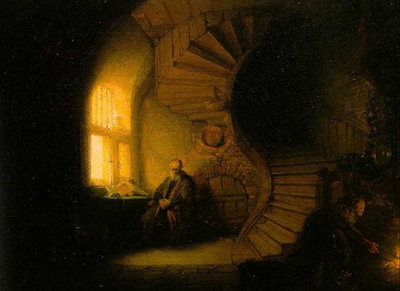
Philosopher in Meditation is one of the most memorable small paintings associated with Rembrandt: a dim room, an old man seated near a glowing window, a woman or servant near the fire, and a spiral stair turning upward through shadow. Few interiors in seventeenth-century painting feel so large while being so small. The panel is only about 28 by 34 cm, yet its staircase, light and quiet figures create the impression of an entire inner world.
The painting discussed here is the Louvre work recorded as INV 1740 / MR 946. The Louvre's current title is Le Philosophe en contemplation, longtemps appele aussi Philosophe en meditation, which can be understood as The Philosopher in Contemplation, long also called Philosopher in Meditation. The museum identifies the artist as Rembrandt, dates the work to 1632, and records it as oil on wood. The Louvre record also gives another descriptive title: two figures in an interior with a spiral staircase.
Those title details matter. The familiar English name is useful because it is how many readers know the painting, but it should not be treated as proof that Rembrandt painted a professional philosopher. The Louvre itself presents the title as a tradition going back to the eighteenth century. The picture's power lies partly in that uncertainty. It looks like meditation, study, waiting, prayer and domestic life at once.
Contents
- Introduction
- The Exact Louvre Painting
- What the Painting Shows
- The Spiral Stair
- Light, Shadow and Stillness
- Is the Figure Really a Philosopher?
- A Possible Tobit and Anna Reading
- Domestic Space and Spiritual Thought
- The Companion Painting Problem
- Attribution and Scholarship
The Exact Louvre Painting
The object facts give the safest starting point. The painting is a small oil on wood panel, dated 1632, with the inventory numbers INV 1740 and MR 946. The Louvre records a signature and date, RHL van Rijn 1632, while noting that the inscription is hard to read. The record places the painting at the boundary between the end of Rembrandt's Leiden period and the beginning of his Amsterdam period.
That moment in Rembrandt's career is important. In the early 1630s he was moving from the experimental intensity of Leiden toward the larger market and ambitions of Amsterdam. He was already interested in old age, inward attention, theatrical light, biblical subjects and small pictures that feel bigger than their dimensions. Philosopher in Meditation belongs to that world of early invention.
The Louvre's current location field places the work at Louvre Abu Dhabi on the captured record. That does not change its collection identity: the work belongs to the Louvre's Department of Paintings and has long been associated with the Louvre tradition. For readers, the essential point is to identify the object precisely before building interpretation around it.
This is especially necessary because the title has been unstable. Philosopher in Meditation, Philosopher in Contemplation, and descriptive titles around an interior with a spiral staircase all point toward the same Rembrandt panel. They do not all carry the same interpretive weight. A title can preserve reception history without settling what the scene represents.
What the Painting Shows
The composition is simple at first glance. An old man sits at the left, near a window that brings warm light into the room. His body is quiet, his head lowered, his hands gathered. At the right, a second figure bends near the hearth. Between and above them rises the great spiral stair, turning through the interior like a column of shadow and light.
The room is not described with ordinary domestic clarity. It is part house, part stage, part mental architecture. The floor, walls, opening, stair and fire give enough information to make the space believable, yet the arrangement feels too charged to be merely casual. The stair is useful as architecture, but it is also the painting's main visual event.
The seated man anchors the scene. He does not perform an obvious action. He is not speaking, teaching or reading theatrically. The hands and bowed head make him look absorbed. That absorption is why the traditional title has had such force. Viewers feel that they are looking at thought, or at a body given over to inward life.
The figure by the fire changes the painting. If the subject were only a solitary philosopher, the second figure would be an intrusion. Instead, Rembrandt gives the room a domestic rhythm: light near the window, warmth near the hearth, stillness near the seated man, labour or tending at the side. The painting does not isolate thought from household life. It places inwardness inside a lived interior.
The Spiral Stair
The spiral stair is the image most viewers remember. It rises in the centre of the painting and curves away from the floor into a darker upper space. It is both practical and strange. A viewer can imagine climbing it, but the painting makes the stair feel almost symbolic because it gathers so much of the picture's motion.
It would be too easy to assign one fixed meaning to the staircase. It may suggest ascent, time, thought, spiritual movement, architectural ingenuity or the turning of vision itself. But none of those meanings should be presented as a code Rembrandt simply inserted for readers to decode. The painting works because the stair remains physically present and mentally suggestive at the same time.
The curve also organizes the eye. The viewer enters through the bright area at the left, moves across the old man, follows the roundness of the stair, and then returns to the lower room and the fire. The composition does not move in a straight line. It turns. That turning suits a painting about contemplation, waiting or spiritual inwardness.
The stair also makes the small panel feel expansive. Without it, the room might become a modest interior scene. With it, the interior seems to open into another order of space. The old man sits below, but the architecture moves above him. Rembrandt turns a domestic room into a place where thought and space rise together.
Light, Shadow and Stillness
Light in Philosopher in Meditation is not just a way to make objects visible. It is the painting's emotional structure. The left side glows around the window and the seated figure. The right side has the warmer, lower light of the fire. Between them, shadow gathers in the stair, the walls and the upper interior.
This double lighting gives the painting its unusual mood. Window light and hearth light belong to ordinary life, but Rembrandt makes them feel contemplative. The old man receives the light without dramatic gesture. The second figure tends the fire or works near it. The space between them becomes a field of quiet attention.
The darkness is just as important. It does not simply hide detail. It makes the visible parts feel chosen. Rembrandt asks the viewer to look slowly: face, hands, window, stair, fire, figure, shadow. Nothing is pushed forward like a single obvious lesson. The painting invites sustained attention because it withholds as much as it reveals.
That balance is one reason the picture has long appealed to modern viewers. It seems to picture thinking without explaining thinking. The old man's stillness, the woman at the hearth, the circling stair and the soft light create a mood that feels philosophical even if the exact subject is not a philosopher.
Is the Figure Really a Philosopher?
The safest answer is: the painting is traditionally known by that title, but the subject is not certain. The Louvre says the Philosopher in Contemplation title is a traditional one from the eighteenth century. That makes the title historically important, but not necessarily original to Rembrandt or definitive for the scene.
A professional philosopher would normally be identified by clearer signs of study or learning: books, instruments, writing, a scholarly setting or an established iconographic pattern. This painting gives us a seated old man, a domestic room, another figure and a powerful staircase. The atmosphere is contemplative, but atmosphere is not the same as subject identification.
That distinction improves the painting rather than diminishing it. If the title is read too literally, the picture becomes a charming scene of a thinker in his study. If the title is read as a later tradition, the painting becomes more open and more interesting. It can still speak to meditation, but it can also hold age, waiting, faith, household labour and sacred story.
Rembrandt often made images that refuse a single easy label. A figure may be a biblical person, a tronie, an old model, a scholar, an apostle or a person caught between those categories. The viewer's uncertainty is not always a failure of evidence; sometimes it is part of how Rembrandt's art works. Here, the painting's fame comes from a title that may be less exact than the visual experience it names.
A Possible Tobit and Anna Reading
One important interpretation links the painting with the Book of Tobit. In that story, the blind Tobit and his wife Anna wait for the return of their son Tobias, who has gone on a journey. Rembrandt treated Tobit subjects elsewhere, and the National Gallery in London describes its Anna and the Blind Tobit as a picture of aged waiting, faith and patience rather than a dramatic miracle.
The Tobit comparison helps because Philosopher in Meditation also contains an old seated figure, a domestic interior, a woman-like figure near household work, and a mood of waiting rather than action. If the old man is read as Tobit and the woman as Anna, the painting becomes less a philosopher's private study than a biblical domestic scene.
That reading should still be handled with care. The Louvre's public title does not rename the work as Tobit and Anna. The old man's blindness is not made unmistakable. The second figure is small and partly absorbed into the room. The painting does not display a clear narrative sign such as Tobias, Raphael, the fish or the moment of healing.
The best public wording is therefore cautious. The painting can be read near Rembrandt's interest in Tobit, old age and waiting, and some scholarship has found that direction persuasive. But one overconfident title should not simply be replaced with another. Philosopher in Meditation may not be a secure subject, yet Tobit and Anna also belongs as interpretation rather than settled fact.
Domestic Space and Spiritual Thought
The uncertainty around the title opens a larger point: Rembrandt often located spiritual seriousness in ordinary rooms. In his religious art, revelation does not always arrive through spectacle. It can appear through a face, a hand, a meal, a bed, a threshold, a table or a hearth.
In this painting, the room feels domestic but not merely everyday. The hearth figure matters because labour, warmth and household care sit beside the old man's stillness. If the scene is sacred, it is sacred in the middle of domestic time. If the scene is philosophical, it is philosophical without leaving the household behind.
That combination is deeply Rembrandt-like. His art repeatedly gives weight to old bodies, dim rooms and quiet attention. He does not need a crowd or a dramatic gesture to make a subject serious. The interior itself becomes a moral and spiritual space.
The painting's scale reinforces that intimacy. This is not a large public altarpiece or civic commission. It is a small panel that asks to be approached closely. Its size pulls the viewer inward, while the staircase expands the imagination upward. The result is a private picture that feels strangely monumental.
The Companion Painting Problem
The Louvre links Philosopher in Meditation with a related pendant, Philosophe au livre ouvert, INV 1741 / MR 947. That companion is not currently presented as Rembrandt. The Louvre identifies it as by Salomon de Koninck, dates it to about 1640-1650, and notes that it was attributed to Rembrandt in the eighteenth and nineteenth centuries.
This matters because the two works have a shared reception history. They were treated as a pair in eighteenth-century collecting, engraving and display traditions. A viewer who meets the title Philosopher in Meditation may therefore also encounter the related Philosopher with an Open Book tradition and assume both are Rembrandts. That assumption would be wrong.
The Louvre's record for the Koninck painting is especially useful because it distinguishes the companion from the Rembrandt panel. It says the Koninck work was probably made later, in a Rembrandtesque manner, and that the pairing may have been created in the eighteenth century rather than from the beginning. In plain terms: the pendant history is real, but it does not make the pendant a Rembrandt.
For the present page, the rule is simple. The main painting is the Louvre Rembrandt panel INV 1740. The companion may be mentioned because it shaped the title and collecting history. It should not be used as evidence for Rembrandt's composition except with caution, and it should never be substituted visually or factually for the Rembrandt object.
Attribution and Scholarship
The Louvre's current record identifies the painting as by Rembrandt. That gives the page a firm collection authority for ordinary public presentation. At the same time, the painting belongs to the wider world of Rembrandt attribution and corpus scholarship, where titles, dates, signatures, workshop practice and old catalogue traditions have all been debated.
The Louvre bibliography itself points toward that scholarly history. It includes references to the Rembrandt Research Project's Corpus volumes and to Jean-Marie Clarke's study of the Louvre painting's signature and date. The record also notes that the signature is difficult to read, while preserving the date 1632.
The right public tone is neither suspicious nor overconfident. The article can say that the Louvre currently names Rembrandt and dates the work to 1632. It can also say that Rembrandt scholarship has treated the painting with careful attention to title, inscription, subject and related versions. That is enough for a reader without turning the article into a specialist catalogue.
This is where links to pages on Rembrandt's workshop and attribution, the corpus of Rembrandt paintings, and Rembrandt's style and technique are useful. The painting is famous because of its mood. It is also useful because it teaches readers how exact Rembrandt wording needs to be.
How to Look at Philosopher in Meditation
Begin with the light. Notice the difference between the window glow and the fire glow. The old man belongs to one kind of illumination; the hearth figure belongs to another. The painting's interior is held between them.
Then follow the staircase. Do not rush to name it as a symbol. Let it work first as architecture. See how it turns the eye, enlarges the room and makes the small panel feel deep.
Next, look at the seated figure without assuming too quickly that he is a philosopher. His bowed head and gathered hands suggest thought, age and inwardness. They do not by themselves identify his profession or narrative role.
After that, look at the figure by the fire. This small presence keeps the scene from becoming a solitary study. The room is shared. Whether the picture is read as domestic, biblical or contemplative, the second figure gives the painting its human balance.
Finally, hold the title lightly. Philosopher in Meditation is a beautiful and useful name, but it is also a historical tradition. The painting is stronger when the title becomes a doorway rather than a cage.
Why the Painting Matters
Philosopher in Meditation matters because it shows how much Rembrandt could make from a small interior. There is no crowd, no spectacular miracle and no grand public setting. The drama is made from light, space, old age, domestic presence and the turn of a staircase.
It also matters because it teaches caution. A famous title can become so familiar that it feels like fact. Here, the Louvre's record reminds us that Philosopher in Meditation is an older title tradition, while the image itself remains more open. The painting can be philosophical without necessarily depicting a philosopher.
The picture belongs naturally beside Rembrandt's broader art of inwardness. In his paintings of biblical recognition, aged saints, Christ heads, quiet interiors and late religious figures, meaning often emerges through stillness rather than spectacle. This early panel already understands that kind of power.
For modern viewers, the appeal is easy to feel. The room is small but immense. The old man is quiet but absorbing. The stair is architectural but dreamlike. The light is ordinary but almost spiritual. Rembrandt's gift is to make contemplation visible while leaving room for mystery.
Frequently Asked Questions About Philosopher in Meditation
The Louvre records the work as Le Philosophe en contemplation, longtemps appele aussi Philosophe en meditation, with Philosophe en meditation as an older title and a descriptive alternate title referring to two figures in an interior with a spiral staircase.
The Louvre dates the painting to 1632.
The Louvre records the painting as oil on wood, measuring 0.28 m high by 0.34 m wide, excluding later accessories or frame-related additions recorded separately.
Not definitely. The philosopher title is a long-standing tradition, but the exact subject is uncertain. The scene can be read as contemplation, domestic waiting, or possibly near the Tobit and Anna story.
No. The Louvre-linked pendant Philosophe au livre ouvert, INV 1741 / MR 947, is currently identified by the Louvre as by Salomon de Koninck, not Rembrandt.
The staircase organizes the composition and gives the small interior a sense of height, motion and inward depth. It may suggest ascent or thought, but it should not be reduced to one fixed symbol.
Discussion
What feels most important in Philosopher in Meditation: Rembrandt's light, the figure's expression, the material surface, the historical source, or the way the work sits beside his other paintings and prints?
Reader Insights
Begin with one detail in Philosopher in Meditation, then move outward to light, gesture, surface and the surrounding space.
Connect the work to Rembrandt's biography, workshop, medium and the museum record rather than reading it as an isolated image.
Which detail changes the interpretation most once you know the date, subject, attribution history or present collection?
Join the Conversation
Have a thought or observation about Philosopher in Meditation? Share it below. Thoughtful responses may be added to this section as the Rembrandt pages develop.
References
- Louvre, Le Philosophe en contemplation, longtemps appele aussi Philosophe en meditation, INV 1740 / MR 946: https://collections.louvre.fr/en/ark%3A/53355/cl010062022
- Louvre, Philosophe au livre ouvert, INV 1741 / MR 947: https://collections.louvre.fr/ark%3A/53355/cl010062582
- National Gallery, London, Anna and the Blind Tobit, NG4189: https://www.nationalgallery.org.uk/paintings/rembrandt-anna-and-the-blind-tobit
- Rembrandt Database, mission and scope: https://rembrandtdatabase.org/about/mission-and-scope.html
- Rembrandt Database, A Corpus of Rembrandt Paintings: https://rembrandtdatabase.org/literature/corpus.html
- National Gallery of Art, Washington, Issues of Attribution: Rembrandt and Workshop: https://www.nga.gov/research/publications/dutch-paintings-seventeenth-century/issues-attribution-rembrandt-workshop
 Rembrandt.jpg)