



 by Tom Gurney
Tom Gurney BSc (Hons) is an art history expert with over 20 years experience
Published on June 19, 2020 / Updated on November 3, 2026
Email: tomgurney1@gmail.com / Phone: +44 7429 011000
The Fall of Satan: William Blake’s Job Plate 16: Introduction
Satan falls with his head below his shoulders and his feet thrown towards heaven. His muscular body fills the centre of William Blake’s engraving, but its strength has become helpless weight. On either side, human witnesses remain on the broken ground. Above them, a bearded figure sits with an open book across his knees. The picture makes a violent descent take place within an otherwise remarkably steady arrangement. [1]
The Fall of Satan is the sixteenth illustration in Blake’s Book of Job sequence. Its subject is his own expansion of the biblical story: Job never witnesses this spectacular expulsion in the book itself. Blake joins Job’s encounter with God to passages from the Gospels, Revelation and Paul. The inscriptions around the scene make that joining visible, asking us to read the fall through several biblical voices at once. [1][2]
The familiar title can suggest the war in heaven illustrated in Blake’s Paradise Lost drawings. Here, however, Job and his companions anchor the event to another story. Their different reactions matter as much as the body hurtling between them. The engraving shows a power losing its place, and people discovering that they stand in different relationships to its defeat.
At a Glance
- SequenceJob plate 16 [1]
- Tate impressionA00027, reprinted 1874 [1][3]
- Yale impressionB1978.43.1518, dated 1826 [1][3]
This work across William Blake’s career
Gothic art and antiquarian study
Apprenticeship, 1772–1779 [4]Poetical Sketches
1783 [5]The Marriage of Heaven and Hell
Offered in the 1793 prospectus [7]Night Thoughts
Published selection, 1797 [9]The Ghost of a Flea
c.1819–1820 [11]Job engravings
Agreement 1823; issue 1826 [12]Dante illustrations
1824–1827 [13]The Fall of Satan — Book of Job, plate 16 (current article)
Suite issued 1826; later printings vary [1]Contents
- A body with nowhere to stand
- The people beside the opening
- The likenesses falling with Satan
- Whose judgement is written below?
- Lightning, the accuser and the weak
- The open book above the abyss
- One design, different surviving sheets
- Annotated details
A body with nowhere to stand
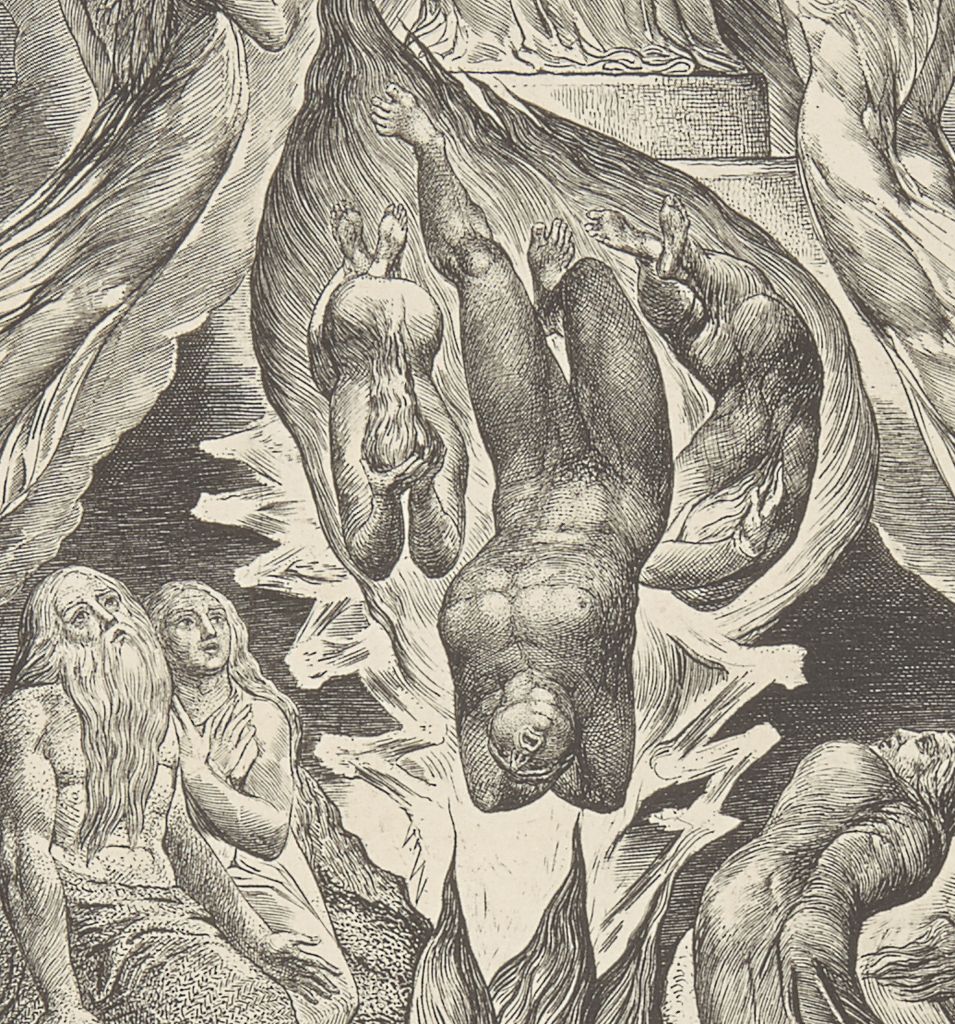
Begin with Satan’s head. His mouth opens towards us, his face compressed between his arms. The forearms bend around his head while the legs rise above his torso, one extending farther than the other. His unevenly bent legs and closely held arms make the descent look involuntary. The broad chest and strongly modelled thighs make the inability to resist especially palpable. [1][3]
Two smaller bodies fall beside him. One is seen chiefly from behind, with hair hanging below its inverted head; the other curls sideways, its limbs drawn close. All three occupy a bright, irregular channel. Jagged edges break into the dark background, while longer tongues of flame rise from the opening below. The channel has the sudden brightness of a lightning flash and the sustained, winding shape of fire. These effects let the image accommodate both the language of falling lightning and an abyss into which the figures disappear.
The curving forms around the bodies enlarge the movement. They sweep down from beneath the throne and gather around the falling group. At either side, the great wings and flowing drapery of the heavenly attendants rise towards the upper corners, turning back around the central light. The eye can follow these long curves downwards, then return along them to heaven. Blake gives the plunge a surrounding order that survives its violence.
The contrast depends on the engraving’s marks. Close strokes darken Satan’s limbs; shorter, varied lines articulate the faces and clothing of the witnesses. Across the upper background, lines radiate from the light around the seated figure. The pale interior of that light and the bright fissure below are both made through the paper showing between dark marks. A single restricted range of ink and paper distinguishes calm illumination from destructive brilliance.
There is no armed angel striking Satan in this scene. The principal attendants flank the opening, while the seated figure raises one hand above the book. The fall is already taking place. That choice moves attention from a contest of weapons to a change in position: the figure once able to move between heaven and the human world is being removed from their shared space. [1]
The people beside the opening
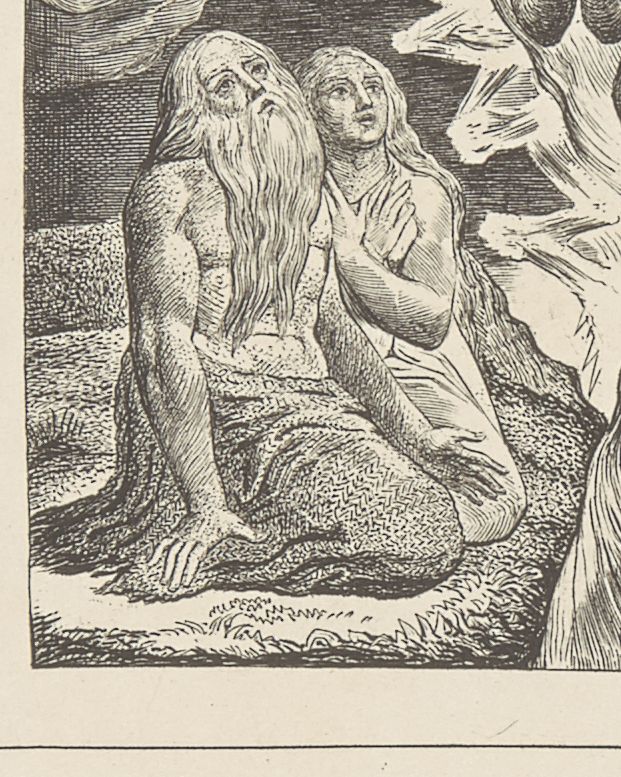
Job kneels at the lower left, his long beard falling over his bare chest. One hand rests flat against the ground. His wife kneels close behind him, with a hand held to her breast. Both look upwards. Their bodies retain a comparatively open shape, and the ground beneath Job’s palm gives him a physical steadiness that the inverted figures lack. He has somewhere to rest his weight.
Across the fissure, three men crowd into the lower right corner. Their backs bend, their heads turn or draw together, and one raises a hand near his face. The group seems to contract under what it sees. Blake places this tightly folded mass against the more upright pair on the opposite bank. The fracture makes a distinction that can be followed through posture before it is explained through theology. [1][3]
Martin Butlin’s Tate catalogue identifies the two groups as Job and his wife, calmly accepting the Lord’s judgement, and Eliphaz with the other two companions. He reads the splitting ground as separating their responses. The friends remain on its edge; the picture does not show them tumbling into the abyss alongside Satan. Their fear belongs to witnesses whose position has become precarious. [1]
That distinction also leaves room for what follows. At the biblical ending, God rebukes Eliphaz and his companions for their speech, then requires them to seek Job’s prayer. Job’s intercession precedes his restoration. The frightened men in this engraving therefore have a future beyond the present judgement. Within the wider Book of Job illustrations, their relationship to the sufferer can still change. [2]
The likenesses falling with Satan
The smaller falling figures complicate any simple division between good people on one bank and bad people on the other. Butlin identifies them as likenesses of Job and his wife, recalling forms already present in the flames around Satan in the second illustration, Satan Before the Throne of God. He calls them simulacra: appearances of the couple, distinct from the people kneeling safely below. [1][14]
Looking between the engravings makes the return striking. In plate two, Satan travels horizontally beneath the enthroned figure, carrying the fiery forms around his outstretched body. The lower household remains together. In plate sixteen, the central body has turned head down, the surrounding likenesses have acquired full inverted bodies, and the human gathering is divided by the opening. A composition first used to connect heavenly permission with earthly vulnerability becomes the structure of expulsion. [14][1]
These repetitions make it difficult to read Satan as an unrelated monster who has briefly entered the picture. The falling forms carry recognisable human associations. Butlin interprets their solidity as the form error must acquire before it can be cast out. That is an account of Blake’s imaginative procedure, rather than a literal incident recoverable from Job’s narrative. The engraving allows the couple to witness the removal of likenesses that are bound to Satan while remaining distinct from their own living bodies. [1]
Annotated Details from The Fall of Satan: Lines and Borders
These details show the Yale Center for British Art’s impression of plate 16 from Illustrations of the Book of Job, dated 1826 in its collection record, B1978.43.1518. Follow the falling body, the seated figure above, the witnesses below and the words surrounding the scene.
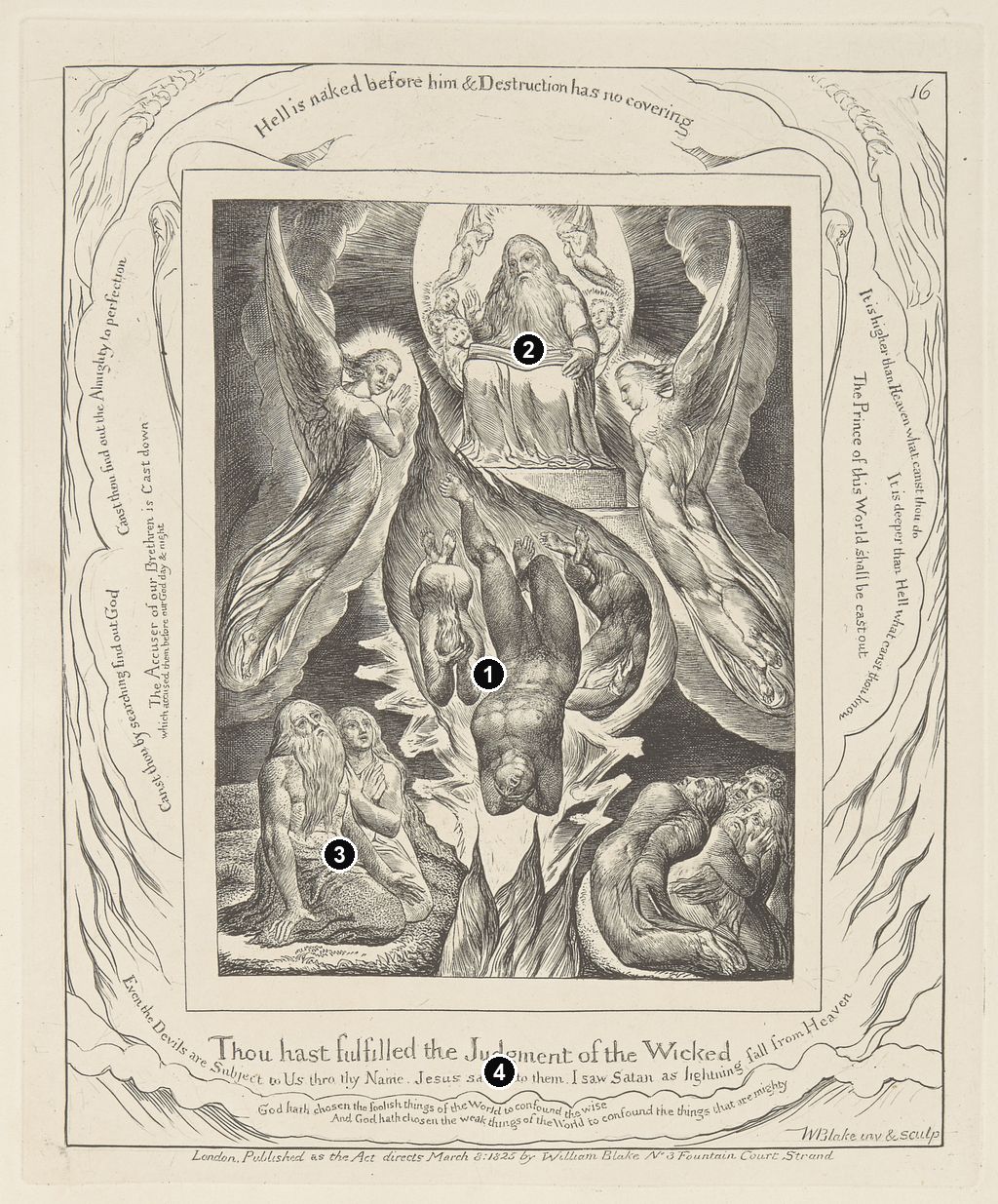
Details from THE FALL OF SATAN: LINES AND BORDERS
The engraved lines change direction across limbs, wings and flames. The surrounding inscriptions draw the eye beyond the central picture to the sheet as a whole.
A body falling head first
The inverted body drops between two sweeping wings. Fine curved lines describe the turning torso, while darker strokes and pointed flames strengthen the downward movement.
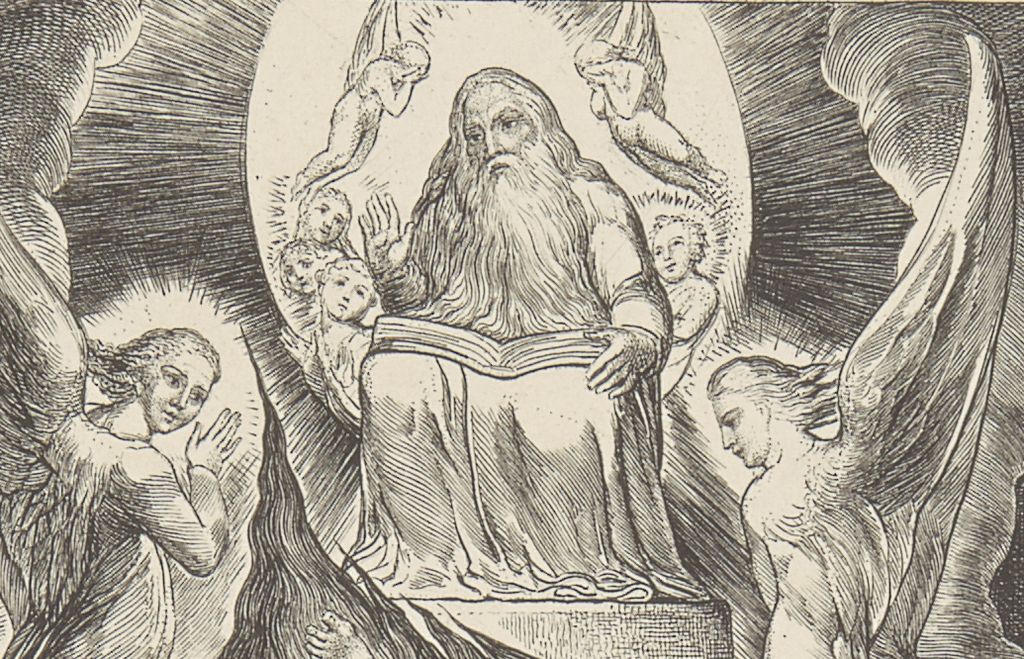
Stillness above the fall
The seated figure holds an open book across his lap. A rounded field surrounds his head and shoulders, contrasting with the sharply directed lines around the descending body.
Witnesses at the lower edge
Two figures sit together at the lower left and look upward. Their close, upright poses give a point of stillness beside the falling figure and the rising tongues of flame.
The picture continues into words
Several lines of lettering follow the lower frame. Curving plants carry the border around them, linking the written passages with the engraved scene.
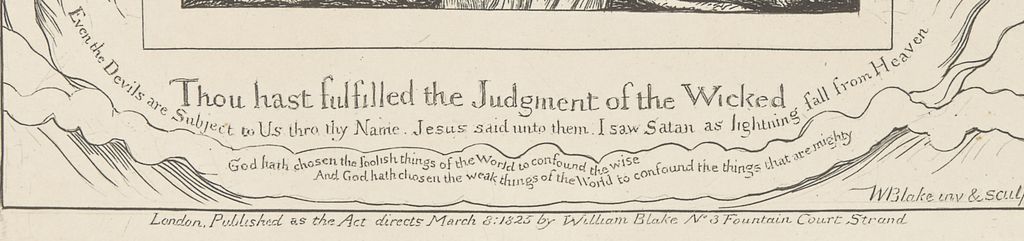
Image: Yale Center for British Art, B1978.43.1518. Numbered overview and detail crops from the collection’s original image. Collection record · CC0 1.0
Whose judgement is written below?
The largest inscription beneath the picture comes from Job 36:17: “Thou hast fulfilled the Judgment of the Wicked”. In the biblical chapter, Elihu is speaking to Job. He declares that he has more to say on God’s behalf, describes affliction as an occasion for instruction, and warns Job against iniquity. The verse begins with an adversative and continues by saying that judgement and justice have taken hold of him. [1][2]
Blake isolates part of that sentence and places it below the falling accuser. The changed setting gives it a new force. Read with the picture, fulfilment can suggest judgement accomplished through Satan’s defeat; read with its original chapter, the words retain Elihu’s pressure upon the sufferer. The reader has to hold both relations in mind. A speech within Job’s debate has become a large statement beneath a vision that the biblical speaker never describes.
The writing up the outer sides comes from another speaker again. Zophar asks in chapter eleven whether Job can discover God completely through searching. His questions measure divine wisdom against heaven and the depths below. In context, they form part of a rebuke: Zophar has already accused Job of speaking falsely and has claimed that his punishment is less than his wrongdoing deserves. These are a friend’s words in an argument, not a detached pronouncement by the book’s narrator. [2]
Around Blake’s image, those questions describe the very height and depth we are looking into. The eye moves upwards towards the throne and downwards towards the fissure. Yet Zophar’s confident application of divine mystery to Job’s supposed guilt becomes troubling when the engraving shows the accuser being cast out. The border preserves the words while changing the conditions under which we hear them.
Across the top, Job himself supplies a third voice. His statement that Hell is naked before God comes from chapter twenty-six, a reply beginning with sharp questions about how his companion has helped the powerless. It develops into an account of divine reach through waters, clouds, heaven and the depths. Even that magnificent description ends by acknowledging how little has been heard or understood. Blake places this language of exposure above a scene in which the dark lower space has opened to view. [1][2]
Lightning, the accuser and the weak
Under the principal inscription, a curved line of smaller writing joins the report of Christ’s returning followers to his vision of Satan falling. Luke’s tenth chapter begins with the sending out of seventy disciples. They return delighted that demons submit to them through Jesus’s name; Jesus responds that he has seen Satan fall like lightning. Blake compresses and adapts the exchange, introducing Jesus by name and using the verb of seeing found on the engraving. [1][15]
The surrounding Gospel passage gives the event a particular emphasis. Jesus tells the disciples to rejoice that their names are recorded in heaven, rather than in their power over spirits. He then thanks the Father for revealing what has been hidden from the wise to babes. The fall belongs to a discussion of revelation, knowledge and the proper grounds for joy. This context helps explain why a vision of Satan’s defeat can become meaningful within Job’s education, beyond its immediate dramatic appeal. [15]
The inner inscription at the left identifies the defeated power through Revelation: the accuser who prosecuted the brethren before God day and night has been cast down. In Revelation twelve this announcement follows the heavenly battle between Michael’s angels and the dragon. The chapter continues with danger on earth, as the expelled dragon pursues the woman and her offspring. Blake selects the declaration of accusation defeated and places it beside Job’s human ordeal. The scriptural source includes a larger conflict than this one engraving undertakes to narrate. [1][16]
At the right, John’s Gospel supplies the expulsion of the prince of this world. In John twelve, Jesus speaks of the judgement of the world as his death approaches. The casting out is followed by his statement about being lifted up and drawing people to himself, which the Gospel connects explicitly to the manner of his death. Blake’s border thus brings Christ’s saving action into the interpretation of Job without adding a Crucifixion scene to the picture. [1][17]
At the bottom, two small lines from First Corinthians describe God choosing the foolish and the weak to confound the wise and mighty. Paul’s chapter challenges divisions, status and confidence in human wisdom through the preaching of the cross. Beneath Blake’s image, these words bear directly on its unequal bodies: the powerful torso falls, while the elderly sufferer remains supported on the ground. Physical strength has ceased to guarantee authority. The smallest lettering gives a different measure by which to judge the largest body. [1][18]
The inscriptions therefore do more than name the action. Their speakers and settings differ, and Blake has brought them into a new relationship. Job’s debate, the disciples’ return, Christ’s approaching death and an apocalyptic victory converge around a single illuminated opening. The thin flames, cloud bands and small heavenly forms in the border carry the eye between them. Reading becomes part of looking around the whole sheet.
The wording also has a history of revision. In his study of unrecorded proofs, Robert N. Essick reported that a 1936 auction catalogue described a plate sixteen impression without the passage identifying the accuser. Essick could not trace the sheets and relied on the sale descriptions; he also distinguished surviving proof states in which the first line of that passage preceded the addition of its continuation. The border’s declaration of defeat acquired its fuller wording during the plate’s development. [19]
The same auction description recorded a version of Luke’s exchange beginning “And he said unto them”. The following proof state named the speaker explicitly: “Jesus said unto them”. Essick suggests that Blake probably wanted to identify who was speaking. That modest change matters in a border gathering several biblical voices. The finished wording ensures that the statement about Satan’s fall belongs unmistakably to Jesus. These are reported stages in the engraving’s making, rather than variants visible on every surviving impression. [19]
Watch: William Blake’s world and working methods
Choose an introduction to Blake, a printing demonstration, or a discussion of his radical ideas.
William Blake: Poet, Artist & Visionary - a genius of early Romanticism in England
An introduction to Blake’s art, poetry and imaginative world.
Watch on YouTubeThe open book above the abyss
The enthroned figure has a long beard, a robe and an open book; his raised hand and level seat offer a counterweight to the overturned bodies. Small radiant faces and descending infant forms occupy the light around him. The two larger winged attendants turn inwards. Their presence gives the upper space company and attentiveness, while Satan’s compressed body appears increasingly isolated as it descends. [1][3]
Butlin interprets this figure as Christ with the Book of Life, connecting Job’s judgement with Blake’s treatments of the Last Judgement. The Christian inscriptions support that reading, but the face alone does not settle it. Discussing the tradition behind the identification, Penelope Minney observes that there are no obvious identifying tokens in Blake’s depiction. She also cautions against making books uniformly oppressive in the series: the open volume here accompanies a scene of release. [1][20]
Minney reads the expulsion as a personification of Job’s change of mind in chapter forty-two. That interpretation gives the headlong body an inward significance. Error can grip a person powerfully even when its authority is false. Its defeat becomes something Job can see, after the arguments about what his suffering must mean. [20]
In that chapter, Job acknowledges the limits of what he has said and understood. He distinguishes his earlier knowledge through hearing from his present seeing, then repents in dust and ashes. Blake gives the change a visible event: Job looks upwards while the false power falls away. The connection depends upon reading his response alongside the invented scene; the biblical verses themselves contain no description of the falling bodies. [2]
Blake’s own writing offers a closely related way of thinking, although it is not a commentary on this particular plate. In A Vision of the Last Judgment, he says that rejecting error and embracing truth brings a judgement upon an individual. Elsewhere in the same text he describes Christ delivering the accused from the accuser, and links forgiveness at Jesus’s judgement seat with the accuser’s expulsion. These passages make judgement an act of liberation from a destructive relationship, as well as a division of figures in space. [21]
The engraving gives that distinction a memorable shape. Job’s suffering body is still present; nothing in his kneeling posture erases what has happened to him. Yet the centre is occupied by the fall of the one who accused. The human witnesses, the calm book and the terrible descending weight belong to a moment when the explanation of suffering through accusation is itself brought into judgement.
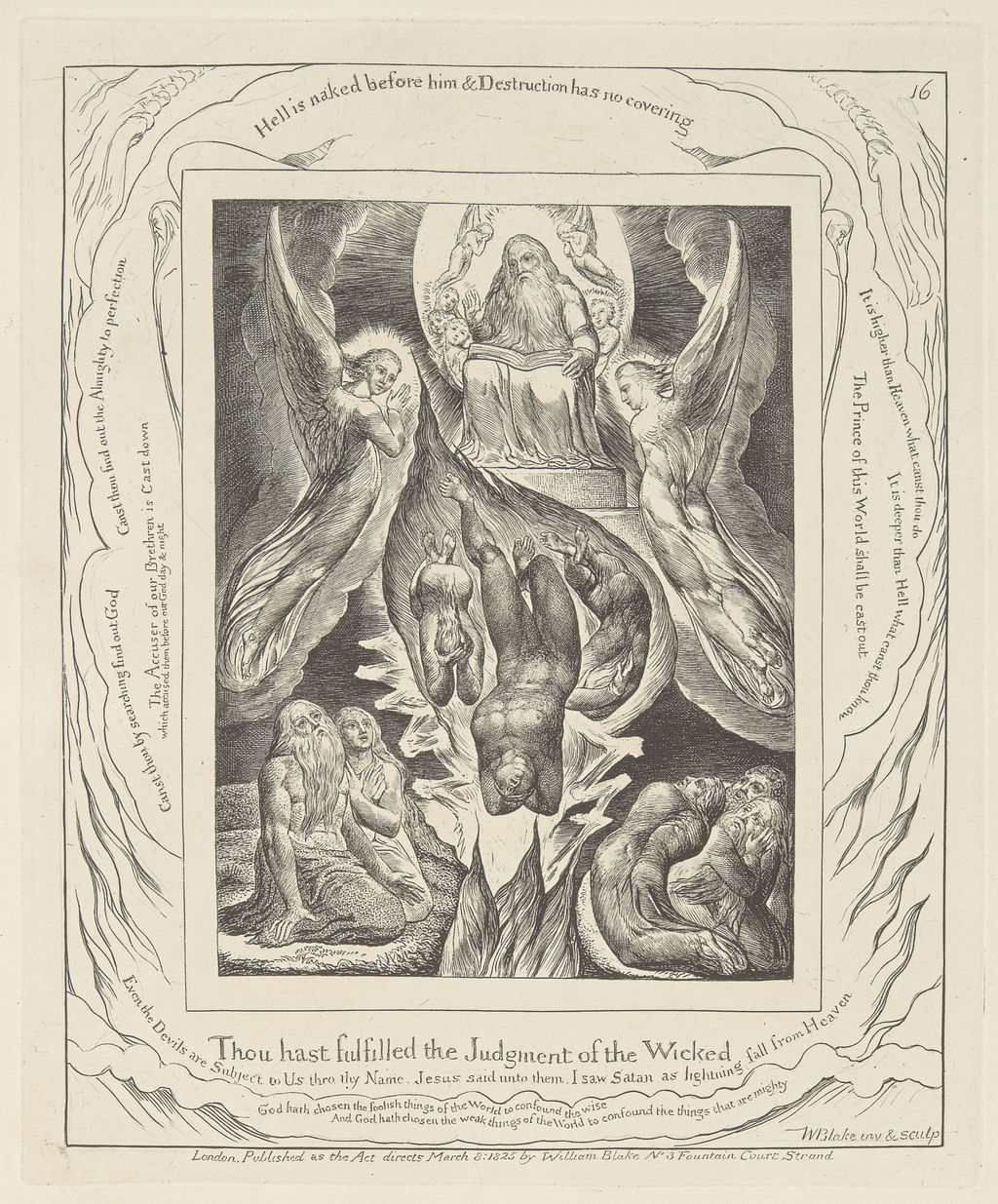
The Fall of Satan. Yale Center for British Art, B1978.43.1518, identified impression dated 1826. The engraved 1825 publication line is a separate date.
One design, different surviving sheets
The engraved publication line carries the date 8 March 1825. Tate’s shared series catalogue distinguishes that inscription from the completion and issue of the suite in 1826. John Linnell’s engraving agreement with Blake dates from 1823; the finished undertaking contained twenty-one subjects and a title plate. These stages explain why several dates can appear in accounts of the same design. [1]
Individual sheets have further histories. Tate catalogues A00027 as a line engraving dated 1825 and reprinted in 1874. The Yale Center for British Art identifies its separate impression, B1978.43.1518, as 1826. Its printed publication line still bears 1825. The identity of a design, the date engraved into its copperplate and the date assigned to a particular impression answer different questions. [1][3]
Those distinctions matter when comparing the fine strokes and pale spaces. The composition remains recognisable across sheets whose paper, printing and later history differ. Its arrangement is still legible: a book held open above, a body deprived of support below, and witnesses whose ways of looking have begun to separate. Blake gives Job a vision of the power that tormented him losing its hold.
Works and designs directory
Browse separate works, impressions and book components. Dates distinguish versions; six Tate copies after Blake are labelled. These records are not a complete catalogue of unique designs.
| Name | Date | Medium |
|---|---|---|
| A Figure Standing in a Gothic Apse, perhaps the Empress Maud. Verso: Detailed Drawings for ‘The Empress Maud in Bed’ | c.1819 | Pencil drawing |
| A Rolling Stone Is Ever Bare of Moss, from Thornton's "Pastorals of Virgil" | 1821 | Wood engraving |
| A Title Page for The Grave | 1806 | Watercolour |
| A Vision of the Last Judgment | 1808 | Watercolour |
| A Vision: The Inspiration of the Poet (Elisha in the Chamber on the Wall) | c.1819–20? | Watercolour |
| Adam and the Beasts, Frontispiece to Hayley's "Ballads" | June 1, 1802 | Engraving |
| Age Teaching Youth | c.1785–90 | Watercolour |
| Alfred and the Neat-Herd’s Wife (after Henry Fuseli) | 1797, published 1798 | Etching and engraving |
| An Allegory of the Bible. Verso: The Shins of an Écorché Male Figure | c.1780–5, ?c.1780 | Watercolour |
| Angel of the Divine Presence Bringing Eve to Adam (The Creation of Eve: "And She Shall be Called Woman) (recto); Sketch for the same (verso) | ca. 1803 | Watercolour |
| Angel of the Revelation (Book of Revelation, chapter 10) | ca. 1803–5 | Watercolour |
| Antaeus setting down Dante and Virgil in the Last Circle of Hell | 1824–1827 | Watercolour |
| Bathsheba at the Bath | c.1799–1800 | Tempera |
| Beatrice Addressing Dante from the Car | 1824–7 | Watercolour |
| Behemoth and Leviathan | 1825–26 | Engraving |
| Behemoth and Leviathan | 1825, reprinted 1874 | Engraving |
| Behemoth and Leviathan | 1826 | Engraving |
| Blasted Trees and Flattened Crops, from Thornton's "Pastorals of Virgil" | 1821 | Wood engraving |
| Boy Returning Joyfully, with Plough and Oxen, from Thornton's "Pastorals of Virgil" | 1821 | Wood engraving |
| Boy Returning Joyfully, with Plough and Oxen, from Thornton's "Pastorals of Virgil" | 1821 | Wood engraving |
| Catherine Blake. Verso: A Man’s Head and Other Drawings | c.1805 | Pencil drawing |
| Cerberus | 1824–7 | Watercolour |
| Cerberus (second version) | 1824–1827 | Watercolour |
| Chaucer’s Canterbury Pilgrims | 1810, reprinted before 1881 | Engraving |
| Christ Appearing to His Disciples After the Resurrection | c.1795 | Colour print |
| Christ Appearing to the Apostles after the Resurrection | c.1795 | Watercolour |
| Christ Blessing the Little Children | 1799 | Tempera |
| Christ in the Carpenter’s Shop: The Humility of the Saviour (after William Blake) | Date not stated | Watercolour |
| Ciampolo the Barrator Tormented by the Devils | 1826–7, reprinted 1892 | Engraving |
| Ciampolo the Barrator Tormented by the Devils | 1826–7, reprinted 1968 | Engraving |
| Circle of Theives: Agnello Brunelleschi Attacked By a Six-Footed Serpent | ca. 1825–27 | Engraving |
| Clarence's Dream (Shakespeare, Richard III, Act 1, Scene 4) | 1774 | Etching and engraving |
| Colinet Mocked by Two Boys, from Thornton's "Pastorals of Virgil" | 1821 | Wood engraving |
| Colinet Rests by a Stream at Night | c.1821, printed 1830 | Wood engraving |
| Colinet Rests by a Stream at Night | 1821, reprinted 1977 | Wood engraving |
| Colinet with his Shepherd’s Pipe, Mocked by Two Boys | c.1821, printed 1830 | Wood engraving |
| Colinet with his Shepherd’s Pipe, Mocked by Two Boys | 1821, reprinted 1977 | Wood engraving |
| Colinet's Journey, Milestone Marked 'LXII Miles to London', from Thornton's "Pastorals of Virgil" | 1821 | Wood engraving |
| Colinet's Journey: Milestone Marked 'LXII Miles to London', from Thornton's "Pastorals of Virgil" | 1821 | Wood engraving |
| Colinet’s Fond Desire Strange Lands to Know | 1821, reprinted 1977 | Wood engraving |
| Colinet’s ‘Fond Desire Strange Lands to Know’ | c.1821, printed 1830 | Wood engraving |
| Composition Sketch for ‘The Fall of the Rebel Angels’? Verso: Standing Figure with Flaming Hair | ?c.1805–10 | Pencil drawing |
| Composition Sketch, Possibly a Subject from Dante. Verso: A Man Standing over a Figure Reclining on a Bed | ?1824–7, ?c.1800–10 | Pencil drawing |
| Composition Sketch. Verso: Standing Figure Holding a Spear | ?c.1805–10 | Pencil drawing |
| Dante and Virgil Approaching the Angel Who Guards the Entrance of Purgatory | 1824–7 | Watercolour |
| Dante and Virgil Penetrating the Forest | 1824–7 | Watercolour |
| Dante in the Empyrean, Drinking at the River of Light | 1824–7 | Watercolour |
| Dante running from the Three Beasts | 1824–1827 | Watercolour |
| Dante Striking against Bocca Degli Abati | 1826–7, reprinted 1892 | Engraving |
| Dante Striking Against Bocca degli Abati | 1826–7, reprinted 1968 | Engraving |
| David Delivered out of Many Waters | c.1805 | Watercolour |
| David Delivered out of Many Waters (after William Blake) | Date not stated | Watercolour |
| Detailed Drawings for ‘A Figure Standing in a Gothic Apse’ | 1819 | Pencil drawing |
| Elohim Creating Adam | 1795–c.1805 | Colour print |
| Enoch | 1806–7 | Lithograph |
| Epitome of James Hervey’s ‘Meditations among the Tombs’ | c.1820–5 | Watercolour |
| Europe. A Prophecy; Frontispiece | ca. 1820 | Relief etching |
| Evening | c.1820/1825 | Watercolour |
| Every Man also Gave him a Piece of Money | 1825, reprinted 1874 | Engraving |
| Every Man also Gave him a Piece of Money. Verso: God the Father with Attendant Angels | c.1821–3 | Watercolour |
| Every One also Gave Him a Piece of Money | 1826 | Engraving |
| Fertilization of Egypt, from Erasmus Darwin's "The Botanic Garden" | 1791 | Engraving |
| First Book of Urizen pl. 10 | 1796, c.1818 | Etching |
| First Book of Urizen pl. 11 | 1796, c.1818 | Etching |
| First Book of Urizen pl. 15 | 1796, c.1818 | Etching |
| First Book of Urizen pl. 17 | 1796, c.1818 | Etching |
| First Book of Urizen pl. 21 | 1796, c.1818 | Etching |
| First Book of Urizen pl. 6 | 1796, c.1818 | Etching |
| Frontispiece to Jerusalem, the Emanation of the Great Albion | [ca. 1804–20] (?) | Engraving |
| Frontispiece to ‘Visions of the Daughters of Albion’ | c.1795 | Relief etching |
| Frontispiece: Thenot and Colinet | c.1821, printed 1830 | Wood engraving |
| George Cumberland's Message Card | 1827 | Engraving |
| God Judging Adam | ca. 1795 | Relief etching |
| God Judging Adam | 1795 | Relief etching |
| Hiding of Moses, from "Remember Me!, or a Pocket Companion" | 1825 | Engraving |
| Homer and the Ancient Poets | 1824–7 | Watercolour |
| Illustration 1 to Milton’s On the Morning of Christ’s Nativity: The Descent of Peace | c.1814–1816 | Watercolour |
| Illustration 1 to Milton’s Paradise Lost: Satan Calling Up His Legions | 1807 | Watercolour |
| Job accepting Charity | 1825–26 | Engraving |
| Job and his Daughters | 1825–26 | Engraving |
| Job and his Daughters | 1825, reprinted 1874 | Engraving |
| Job and His Daughters | 1826 | Engraving |
| Job and His Family | 1825–26 | Engraving |
| Job and his Family | Reprinted 1874; engraved 1828 date is an error | Engraving |
| Job and His Family | 1826 | Engraving |
| Job and his Family Restored to Prosperity | 1825, reprinted 1874 | Engraving |
| Job and his Wife restored to Prosperity | 1825–26 | Engraving |
| Job rebuked by his Friends | 1825–26 | Engraving |
| Job Rebuked by his Friends | 1825, reprinted 1874 | Engraving |
| Job Rebuked by His Friends | 1826 | Engraving |
| Job's Comforters | 1825–26 | Engraving |
| Job's Comforters | 1826 | Engraving |
| Job's Despair | 1825–26 | Engraving |
| Job's Evil Dreams | 1825–26 | Engraving |
| Job's Evil Dreams | 1826 | Engraving |
| Job's Sacrifice | 1825–26 | Engraving |
| Job's Sons and Daughters Overwhelmed by Satan | 1826 | Engraving |
| Job, his Wife and his Friends: The Complaint of Job. Verso: Job’s Wife and Eight Other Sketches | c.1785 | Watercolour |
| Job’s Comforters | 1825, reprinted 1874 | Engraving |
| Job’s Despair | 1825, reprinted 1874 | Engraving |
| Job’s Evil Dreams | 1825, reprinted 1874 | Engraving |
| Job’s Sacrifice | 1825, reprinted 1874 | Engraving |
| Job’s Sons and Daughters Overwhelmed by Satan | 1825, reprinted 1874 | Engraving |
| John Linnell | 1825 | Pencil drawing |
| Joseph of Arimathea Preaching to the Britons | c.1794/1796 | Relief etching |
| Judas Betrays Him | c.1803–5 | Watercolour |
| King John Absolved by Pandulph (after Henry Fuseli) | 1797, published 1798 | Etching and engraving |
| Lamech and his Two Wives | 1795 | Colour print |
| Landscape near Felpham | c.1800 | Watercolour |
| Lear and Cordelia in Prison | c.1779 | Watercolour |
| Los and Orc | c.1792–3 | Watercolour |
| Lower Half of a Woman Playing a Harp. Verso: Seraphim and Other Drawings | c.1785, c.?1807 | Pencil drawing |
| Menalcus Watching Women Dance, from Thornton's "Pastorals of Virgil" | 1821 | Wood engraving |
| Menalcus Watching Women Dance, from Thornton's "Pastorals of Virgil" | 1821 | Wood engraving |
| Moses Indignant at the Golden Calf | c.1799–1800 | Tempera |
| Nebuchadnezzar | 1795–c.1805 | Colour print |
| Newton | 1795–c.1805 | Colour print |
| Oberon, Titania and Puck with Fairies Dancing | c.1786 | Watercolour |
| Pity | ca. 1795 | Relief etching |
| Pity | c.1795 | Colour print |
| Plate 2 of ‘Urizen’: ‘Teach these Souls to Fly’ | ?1796 | Relief etching |
| Plate 3 of ‘Urizen’: Oh! Flames of Furious Desires’ (after William Blake) | Date not stated | Watercolour |
| Plate 4 of ‘Visions of the Daughters of Albion’ | c.1795 | Relief etching |
| Plutus | 1824–7 | Watercolour |
| Preliminary Sketch for ‘Christ Girding Himself with Strength’. Verso: Standing Figure with One Arm Raised | c.1805, c.1805–10 | Pencil drawing |
| Preludium. "The shadowy daughter of Urthona stood before red Orc..." (Plate 3) | 1793 | Relief etching |
| Queen Elizabeth and Essex (after Henry Fuseli) | 1797, published 1798 | Engraving |
| Sabrina's Silvery Flood, from Thornton's "Pastorals of Virgil" | 1821 | Wood engraving |
| Sabrina's Silvery Flood, from Thornton's "Pastorals of Virgil" | 1821 | Wood engraving |
| Sabrina’s Silvery Flood | c.1821, printed 1830 | Wood engraving |
| Sabrina’s Silvery Flood | 1821, reprinted 1977 | Wood engraving |
| Satan Before the Throne of God | 1825–26 | Engraving |
| Satan before the Throne of God | 1825, reprinted 1874 | Engraving |
| Satan before the Throne of God | 1826 | Engraving |
| Satan calling up his Legions | c.1800–05 | Tempera |
| Satan Exulting over Eve | c.1795 | Colour print |
| Satan Going Forth from the Presence of the Lord, and Job’s Charity | 1825, reprinted 1874 | Engraving |
| Satan Going Forth fron the Presence of the Lord | 1825–26 | Engraving |
| Satan in his Original Glory: ‘Thou wast Perfect till Iniquity was Found in Thee’ | c.1805 | Watercolour |
| Satan Smiting Job with Boils | 1825–26 | Engraving |
| Satan Smiting Job with Sore Boils | 1825, reprinted 1874 | Engraving |
| Satan Smiting Job with Sore Boils | c.1826 | Tempera |
| Satan Smiting Job with Sore Boils | 1826 | Engraving |
| Shepherd Chases Away a Wolf, from Thornton's "Pastorals of Virgil" | 1821 | Wood engraving |
| Shepherd Chases Away a Wolf, from Thornton's "Pastorals of Virgil" | 1821 | Wood engraving |
| Sketch for the Title-Page of the Engraved Illustrations to the Book of Job | c.1823/1826 | Pencil drawing |
| Sketch for ‘The Four and Twenty Elders Casting their Crowns before the Divine Throne’. Verso: Standing Figure with Arms at his Side | c.1803, c.1805–10 | Pencil drawing |
| Sketch for ‘Tiriel Supporting the Dying Myratana’. Verso: Sketch for ‘Tiriel Supporting the Dying Myratana’ | c.1786–9 | Pencil drawing |
| Songs of Experience: A Little Boy Lost | [1794] printed ca. 1825 | Relief etching |
| Songs of Experience: A Little Girl Lost | [1794] printed ca. 1825 | Relief etching |
| Songs of Experience: A Poison Tree | [1794] printed ca. 1825 | Relief etching |
| Songs of Experience: Earth's Answer | [1794] printed ca. 1825 | Relief etching |
| Songs of Experience: Frontispiece | [1794] printed ca. 1825 | Relief etching |
| Songs of Experience: Holy Thursday | [1794] printed ca. 1825 | Relief etching |
| Songs of Experience: Infant Sorrow | [1794] printed ca. 1825 | Relief etching |
| Songs of Experience: Introduction | [1794] printed ca. 1825 | Relief etching |
| Songs of Experience: London | [1794] printed ca. 1825 | Relief etching |
| Songs of Experience: My Pretty Rose Tree, Ah! Sun-Flower, The Lilly | [1794] printed ca. 1825 | Relief etching |
| Songs of Experience: Nurses Song | [1794] printed ca. 1825 | Relief etching |
| Songs of Experience: The Angel | [1794] printed ca. 1825 | Relief etching |
| Songs of Experience: The Chimney Sweeper | [1794] printed ca. 1825 | Relief etching |
| Songs of Experience: The Clod & the Pebble | [1794] printed ca. 1825 | Relief etching |
| Songs of Experience: The Fly | [1794] printed ca. 1825 | Relief etching |
| Songs of Experience: The Garden of Love | [1794] printed ca. 1825 | Relief etching |
| Songs of Experience: The Human Abstract | [1794] printed ca. 1825 | Relief etching |
| Songs of Experience: The Little Girl Found (second plate) | [1789] printed ca. 1825 | Relief etching |
| Songs of Experience: The Little Girl Lost | [1789] printed ca. 1825 | Relief etching |
| Songs of Experience: The Little Girl Lost (second plate); The Little Girl Found | [1789] printed ca. 1825 | Relief etching |
| Songs of Experience: The Little Vagabond | [1794] printed ca. 1825 | Relief etching |
| Songs of Experience: The School Boy | [1789] printed ca. 1825 | Relief etching |
| Songs of Experience: The Sick Rose | [1794] printed ca. 1825 | Relief etching |
| Songs of Experience: The Tyger | [1794] printed ca. 1825 | Relief etching |
| Songs of Experience: The Voice of the Ancient Bard | [1789] printed ca. 1825 | Relief etching |
| Songs of Experience: Title-page | [1794] printed ca. 1825 | Relief etching |
| Songs of Experience: To Tirzah | [1794] printed ca. 1825 | Relief etching |
| Songs of Innocence and of Experience, Shewing the Two Contrary States of the Human Soul: Combined Title-page | [1789–94] printed ca. 1825 | Relief etching |
| Songs of Innocence and of Experience: Infant Sorrow | 1794, reprinted 1831 or later | Relief etching |
| Songs of Innocence: A Cradle Song | [1789] printed ca. 1825 | Relief etching |
| Songs of Innocence: A Cradle Song (second plate) | [1789] printed ca. 1825 | Relief etching |
| Songs of Innocence: A Dream | [1794] printed ca. 1825 | Relief etching |
| Songs of Innocence: Frontispiece | [1789] printed ca. 1825 | Relief etching |
| Songs of Innocence: Holy Thursday | [1789] printed ca. 1825 | Relief etching |
| Songs of Innocence: Infant Joy | [1789] printed ca. 1825 | Relief etching |
| Songs of Innocence: Introduction | [1789] printed ca. 1825 | Relief etching |
| Songs of Innocence: Laughing Song | [1789] printed ca. 1825 | Relief etching |
| Songs of Innocence: Little Boy Lost | [1789] printed ca. 1825 | Relief etching |
| Songs of Innocence: Night | [1789] printed ca. 1825 | Relief etching |
| Songs of Innocence: Night (second plate) | [1789] printed ca. 1825 | Relief etching |
| Songs of Innocence: Nurse's Song | [1789] printed ca. 1825 | Relief etching |
| Songs of Innocence: On Anothers Sorrow | [1789] printed ca. 1825 | Relief etching |
| Songs of Innocence: Spring | [1789] printed ca. 1825 | Relief etching |
| Songs of Innocence: Spring (second plate) | [1789] printed ca. 1825 | Relief etching |
| Songs of Innocence: The Blossom | [1789] printed ca. 1825 | Relief etching |
| Songs of Innocence: The Chimney Sweeper | [1789] printed ca. 1825 | Relief etching |
| Songs of Innocence: The Divine Image | [1789] printed ca. 1825 | Relief etching |
| Songs of Innocence: The Ecchoing Green | [1789] printed ca. 1825 | Relief etching |
| Songs of Innocence: The Ecchoing Green (second plate) | [1789] printed ca. 1825 | Relief etching |
| Songs of Innocence: The Lamb | [1789] printed ca. 1825 | Relief etching |
| Songs of Innocence: The Little Black Boy | [1789] printed ca. 1825 | Relief etching |
| Songs of Innocence: The Little Black Boy (second plate) | [1789] printed ca. 1825 | Relief etching |
| Songs of Innocence: The Little Boy Found | [1789] printed ca. 1825 | Relief etching |
| Songs of Innocence: The Shepherd | [1789] printed ca. 1825 | Relief etching |
| Songs of Innocence: Title Page | [1789] printed ca. 1825 | Relief etching |
| St Christopher, Copy from an Engraving? Verso:Part of a Face: Copy from a Plaster Cast: a Daughter of Niobe? | ?c.1779–80 | Pencil drawing |
| The Agony in the Garden | c.1799–1800 | Tempera |
| The Angel Appearing to Zacharias | 1799–1800 | Tempera |
| The Ascent of the Mountain of Purgatory | 1824–7 | Watercolour |
| The Baffled Devils Fighting | 1826–7, reprinted 1892 | Engraving |
| The Baffled Devils Fighting | 1826–7, reprinted 1968 | Engraving |
| The Bard, from Gray | ?1809 | Tempera |
| The Beggar's Opera, Act III | July 1, 1790 | Etching and engraving |
| The Beggar's Opera, Act III | July 1, 1790 | Engraving |
| The Beggar's Opera, Act III | 1790 | Engraving |
| The Blasphemer | c.1800 | Watercolour |
| The Blighted Corn | c.1821, printed 1830 | Wood engraving |
| The Blighted Corn | 1821, reprinted 1977 | Wood engraving |
| The Body of Abel Found by Adam and Eve | c.1826 | Tempera |
| The Body of Christ Borne to the Tomb | c.1799–1800 | Tempera |
| The Book of Job: Title Page | 1825 | Engraving |
| The Book of Thel pl. 6 | 1796, c.1818 | Etching |
| The Circle of Corrupt Officials: The Devils Mauling Each Other | ca. 1825–27 | Engraving |
| The Circle of Corrupt Officials: The Devils Tormenting Ciampolo | ca. 1825–27 | Engraving |
| The Circle of the Lustful: Francesca da Rimini (‘The Whirlwind of Lovers’) | 1826–7, reprinted 1892 | Engraving |
| The Circle of the Lustful: Francesca da Rimini (‘The Whirlwind of Lovers’) | 1826–7, reprinted 1968 | Engraving |
| The Circle of the Lustful: Paolo and Francesca | ca. 1825–27 | Engraving |
| The Circle of the Thieves; Buoso Donati Attacked by the Serpent | ca. 1825–27 | Engraving |
| The Circle of Traitors: Dante's Foot Striking Bocca degli Abbate | ca. 1825–27 | Engraving |
| The Complaint and the Consolation; or, Night Thoughts | 1797 | Etching and engraving |
| The Creation | 1825–26 | Engraving |
| The Crucifixion | c.1825–7 | Pencil drawing |
| The Crucifixion: ‘Behold Thy Mother’ | c.1805 | Watercolour |
| The Dance of Albion (Glad Day) | c.1803/1810 | Engraving |
| The Death of Lucretia, from Allen's "New and Impartial Roman History" | 1797 | Engraving |
| The Death of Saint Joseph | 1803 | Watercolour |
| The Death of the Virgin | 1803 | Watercolour |
| The Descent of Peace [recto] | c.1815 | Pencil drawing |
| The Destruction of Job's Sons | 1825–26 | Engraving |
| The Devils, with Dante and Virgil by the Side of the Pool | 1824–7 | Watercolour |
| The Entombment | c.1805 | Watercolour |
| The Fall of Rosamond (after Thomas Stothard) | 1783 | Etching and engraving |
| The Fall of Satan | 1825–26 | Engraving |
| The Fall of Satan | 1825, reprinted 1874 | Engraving |
| The Fall of Satan | 1826 | Engraving |
| The Four and Twenty Elders Casting their Crowns before the Divine Throne | c.1803–5 | Watercolour |
| The Ghost of a Flea | c.1819–20 | Tempera |
| The Good and Evil Angels | 1795–?c.1805 | Colour print |
| The Good Farmer, Probably the Parable of the Wheat and the Tares. Verso: Rough Sketch of Two or Three Figures in a Landscape | c.1780–5 | Watercolour |
| The Great Red Dragon and the Beast from the Sea | c.1805 | Watercolour |
| The Great Red Dragon and the Woman Clothed with the Sun | c.1805 | Watercolour |
| The Head of the Ghost of a Flea. Verso: A Profile and a Reduced Drawing of Milton’s First Wife | c.1819 | Pencil drawing |
| The Hermit’s Dog, from William Hayley’s "Ballads" | 1805 | Etching and engraving |
| The Hiding of Moses | 1824 | Engraving |
| The House of Death | 1795–c.1805 | Colour print |
| The House of Death | c.1790 | Watercolour |
| The Hypocrites with Caiaphas. Verso: Sketch of a Stooping Figure | 1824–7 | Watercolour |
| The Inscription over the Gate | 1824–7 | Watercolour |
| The Laborious Passage along the Rocks | 1824–7 | Watercolour |
| The Last Trumpet (recto); Two studies of a right eye, a profile of an open-mouthed young man, the head of an eagle, and the head of a lion (verso) | 1780–85 | Pencil drawing |
| The Lord Answering Job out of the Whirlwind | 1825–26 | Engraving |
| The Lord Answering Job out of the Whirlwind | 1825, reprinted 1874 | Engraving |
| The Man Who Taught Blake Painting in his Dreams (counterproof) (after William Blake) | after c.1819–20 | Pencil drawing |
| The Marriage of Heaven and Hell pl. 16 | 1796, c.1818 | Etching |
| The Messengers tell Job of his Misfortunes | 1825–26 | Engraving |
| The Messengers tell Job of his Misfortunes | 1825, reprinted 1874 | Engraving |
| The Night of Enitharmon’s Joy (formerly called ‘Hecate’) | c.1795 | Colour print |
| The Parable of the Wise and Foolish Virgins | ca. 1799–1800 | Watercolour |
| The Parable of the Wise and Foolish Virgins (after William Blake) | Date not stated | Watercolour |
| The Pastorals of Virgil, with a Course of English Reading, Adapted for Schools, Vol. I | 1821 | Wood engraving |
| The Penance of Jane Shore in St Paul’s Church | c.1793 | Watercolour |
| The Pit of Disease: The Falsifiers | 1826–7, reprinted 1892 | Engraving |
| The Pit of Disease: The Falsifiers | 1824–7 | Watercolour |
| The Pit of Disease: The Falsifiers | 1826–7, reprinted 1968 | Engraving |
| The Primaeval Giants Sunk in the Soil | 1824–7 | Watercolour |
| The Punishment of the Thieves | 1824–7 | Watercolour |
| The Raising of Lazarus (after William Blake) | Date not stated | Watercolour |
| The Rest on the Flight into Egypt (The Repose of the Holy Family in Egypt) | 1806 | Watercolour |
| The River of Life | c.1805 | Watercolour |
| The Rock Sculptured with the Recovery of the Ark and the Annunciation | 1824–7 | Watercolour |
| The Serpent Attacking Buoso Donati | 1826–7, reprinted 1892 | Engraving |
| The Serpent Attacking Buoso Donati | 1826–7, reprinted 1968 | Engraving |
| The Serpent Attacking Buoso Donati. Verso: A Man with a Transparent Hood (?) over his Head | 1824–7 | Watercolour |
| The Simoniac Pope | 1824–7 | Watercolour |
| The Six-Footed Serpent Attacking Agnolo Brunelleschi | 1826–7, reprinted 1892 | Engraving |
| The Six-Footed Serpent Attacking Agnolo Brunelleschi | 1826–7, reprinted 1968 | Engraving |
| The Soul Hovering over the Body Reluctantly Parting with Life | c.1805 | Pencil drawing |
| The Spiritual Form of Nelson Guiding Leviathan | c.1805–9 | Tempera |
| The Spiritual Form of Pitt Guiding Behemoth | ?1805 | Tempera |
| The Sun at His Eastern Gate | c.1816–1820 | Watercolour |
| The Temple of Mirth, after Thomas Stothard | 1784 | Engraving |
| The Temptation and Fall of Eve | 1807 | Watercolour |
| The Temptation and Fall of Eve (Illustration to Milton’s Paradise Lost) | 1808 | Watercolour |
| The Thieves and Serpents | 1824–1827 | Watercolour |
| The Vision of Christ | 1825, reprinted 1874 | Engraving |
| The Vision of Eliphaz | 1825–26 | Engraving |
| The Vision of Eliphaz | 1825, reprinted 1874 | Engraving |
| The Vision of God | 1825–26 | Engraving |
| The Wood of the Self-Murderers: The Harpies and the Suicides | 1824–7 | Watercolour |
| The Wrath of Elihu | 1825–26 | Engraving |
| The Wrath of Elihu | 1825, reprinted 1874 | Engraving |
| Thenot and Colinet | 1821, reprinted 1977 | Wood engraving |
| Thenot and Colinet at Supper | c.1821, printed 1830 | Wood engraving |
| Thenot and Colinet at Supper | 1821, reprinted 1977 | Wood engraving |
| Thenot and Colinet Converse Seated between Two Trees | c.1821, printed 1830 | Wood engraving |
| Thenot and Colinet Converse Seated between Two Trees | 1821, reprinted 1977 | Wood engraving |
| Thenot and Colinet Eat Their Evening Meal, from Thornton's "Pastorals of Virgil" | 1821 | Wood engraving |
| Thenot and Colinet Folding their Flocks together at Sunset | c.1821, printed 1830 | Wood engraving |
| Thenot and Colinet Folding their Flocks together at Sunset | 1821, reprinted 1977 | Wood engraving |
| Thenot and Colinet Lead Their Flocks Together, from Thornton's "Pastorals of Virgil" | 1821 | Wood engraving |
| Thenot and Colinet Lead Their Flocks Together, from Thornton's "Pastorals of Virgil" | 1821 | Wood engraving |
| Thenot Remonstrates with Colinet | c.1821, printed 1830 | Wood engraving |
| Thenot Remonstrates with Colinet | 1821, reprinted 1977 | Wood engraving |
| Thenot Remonstrates With Colinet, from Thornton's "Pastorals of Virgil" | 1821 | Wood engraving |
| Thenot Remonstrates With Colinet, from Thornton's "Pastorals of Virgil" | 1821 | Wood engraving |
| Thenot Remonstrates with Colinet, Lightfoot in the Background, from Thornton's "Pastorals of Virgil" | 1821 | Wood engraving |
| Thenot Remonstrates with Colinet: Lightfoot in the Distance | 1821, reprinted 1977 | Wood engraving |
| Thenot Remonstrates with Colinet; Lightfoot in the Distance | c.1821, printed 1830 | Wood engraving |
| Thenot Under a Fruit Tree, from Thornton's "Pastorals of Virgil" | 1821 | Wood engraving |
| Thenot, with Colinet Waving his Arms in Sorrow | c.1821, printed 1830 | Wood engraving |
| Thenot, with Colinet Waving his Arms in Sorrow | 1821, reprinted 1977 | Wood engraving |
| Title Page: Illustrations of the Book of Job | 1825–26 | Engraving |
| Title-Page of ‘The Book of Job’ | 1825, reprinted 1874 | Engraving |
| Tornado–Zeus Battling Typhon, from Erasmus Darwin's "Botanic Garden" | August 1, 1795 | Engraving |
| Tornado–Zeus Battling Typhon, from Erasmus Darwin's "The Botanic Garden" | August 1, 1795 | Engraving |
| Two Figures in a Decorative Border | c.1790 | Pencil drawing |
| Unyok'd Heifers, Loitering Homeward (Return of the Shepherd), from Thornton's "Pastorals of Virgil" | 1821 | Wood engraving |
| Virgil Girding Dante’s Brow with a Rush | 1824–7 | Watercolour |
| Wat Tyler and the Tax-Gatherer (after Henry Fuseli) | 1797, published 1798 | Etching and engraving |
| When the Morning Stars Sang Together | 1825, reprinted 1874 | Engraving |
| When the Morning Stars Sang Together | 1826 | Engraving |
| Winged Figure Flying Through Clouds, from Bell's "Poets" | 1790 | Etching and engraving |
| Winter | c.1820–5 | Tempera |
| ‘A Rolling Stone is ever Bare of Moss’ | c.1821, printed 1830 | Wood engraving |
| ‘A Rolling Stone is ever Bare of Moss’ | 1821, reprinted 1977 | Wood engraving |
| ‘And Unyok’d Heifers, Loitering Homeward, Low’ | c.1821, printed 1830 | Wood engraving |
| ‘And Unyok’d Heifers, Loitering Homewards, Low’ | 1821, reprinted 1977 | Wood engraving |
| ‘Europe’: Fragment of Pages 3 and 4 | 1794–c.1830–5 | Relief etching |
| ‘For him Our Yearly Wakes and Feasts We Hold’ | c.1821, printed 1830 | Wood engraving |
| ‘For him Our Yearly Wakes and Feasts We Hold’ | 1821, reprinted 1977 | Wood engraving |
| ‘Nor Fox, nor Wolf, nor Rat among our Sheep’ | c.1821, printed 1830 | Wood engraving |
| ‘Nor Fox, nor Wolf, nor Rat among our Sheep’ | 1821, reprinted 1977 | Wood engraving |
| ‘Songs of Innocence and of Experience’: ‘Infant Sorrow’ | 1794, reprinted 1831 or later | Relief etching |
| ‘Songs of Innocence and of Experience’: ‘Spring’ | 1794, reprinted 1831 or later | Relief etching |
| ‘Songs of Innocence’: Title-Page | 1789, reprinted 1831 or later | Relief etching |
| ‘Songs of Innocence’: Title-Page | 1789, reprinted 1831 or later | Relief etching |
| ‘With Songs the Jovial Hinds Return from Plow’ | c.1821, printed 1830 | Wood engraving |
| ‘With Songs the Jovial Hinds Return from Plow’ | 1821, reprinted 1977 | Wood engraving |
Frequently Asked Questions
Discussion
Look again at the images and ideas explored in The Fall of Satan: William Blake’s Job Plate 16. These editorial prompts invite your observations.
Reader Insights
Muscular power becomes helpless weight in the inverted body. The surrounding arrangement stays remarkably steady.
Butlin calls the small falling figures likenesses of Job and his wife. They remain distinct from the people supported on the banks.
The central judgement text belongs to Elihu’s speech. Identifying its speaker changes how the inscription addresses the kneeling Job.
Join the Conversation
Share a detail, comparison or question about The Fall of Satan: William Blake’s Job Plate 16 below.
References
- Tate / Martin Butlin. The Fall of Satan, A00027. Current collection record and complete catalogue entry, including shared Illustrations to the Book of Job history; originally published in William Blake 1757–1827, Tate Gallery Collections V (1990). View the record. View source.
- The Holy Bible, King James Version. Job 1–2, 11, 26, 36 and 42; particularly 11:7–8, 26:6, 36:17 and 42:1–10. Read the text. View source.
- Yale Center for British Art. The Fall of Satan, B1978.43.1518, Paul Mellon Collection, dated 1826. Official IIIF record and recto image. Collection record; official image and metadata. View source 1. View source 2.
- Society of Antiquaries of London. “William Blake's drawings of Westminster Abbey,” collection highlight, apprenticeship and antiquarian drawings. View source.
- The Morgan Library & Museum. “175. Poetical Sketches,” 1783, copy X, PML 61487, William Blake's World. View source.
- William Blake. Songs of Innocence and of Experience , title pages; “Introduction,” “The Lamb,” both “The Chimney Sweeper” poems, “The Tyger” and “London,” Erdman digital transcription, Arizona State University. View source.
- William Blake. To the Public , prospectus dated 10 October 1793, E692–693. David V. Erdman edition, electronic transcription. View source.
- Tate; Martin Butlin. Newton , 1795/c.1805, N05058, collection record and catalogue entry in William Blake 1757–1827 , Tate Gallery Collections V (London: Tate Gallery, 1990). View source.
- Sir John Soane's Museum. Edward Young, The Complaint, and the Consolation; or, Night Thoughts (London: R. Noble for R. Edwards, 1797), library reference 3653, collection catalogue. View source.
- William Blake. Exhibition advertisements, conditions of sale and A Descriptive Catalogue , 1809, especially preface and nos. I–V, IX and XI–XVI, E527–550. David V. Erdman edition, electronic transcription. View source.
- Tate; Martin Butlin. The Ghost of a Flea , c.1819–20, N05889, collection record and catalogue entry in William Blake 1757–1827 , Tate Gallery Collections V (1990), including discussion of Varley and Cunningham's testimony. View source.
- Tate; Martin Butlin. Job and his Family , A00012, catalogue introduction to Illustrations to the Book of Job: Engravings , in William Blake 1757–1827 , Tate Gallery Collections V (1990), agreement, publication and textual borders. View source.
- Tate; Martin Butlin. Dante and Virgil Penetrating the Forest , 1824–27, N03351, collection record, 2023 display caption and catalogue entry in William Blake 1757–1827 , Tate Gallery Collections V (1990). View source.
- Tate / Martin Butlin. Satan before the Throne of God, A00013, illustration 2. Complete catalogue entry in William Blake 1757–1827 (1990), particularly the fiery likenesses of Job and his wife. View the record. View source.
- The Holy Bible, King James Version. Luke 10, particularly 10:17–24. Read the text. View source.
- The Holy Bible, King James Version. Revelation 12, particularly 12:7–17. Read the text. View source.
- The Holy Bible, King James Version. John 12, particularly 12:20–36. Read the text. View source.
- The Holy Bible, King James Version. 1 Corinthians 1, particularly 1:18–31. Read the text. View source.
- Robert N. Essick. “Blake’s Job: Some Unrecorded Proofs and Their Inscriptions”, Blake/An Illustrated Quarterly 19.3 (Winter 1985/1986), pp. 96–97: the reported plate 16 accuser inscription and the revision naming Jesus. The untraced proof group is known through the 1936 auction catalogue. Read the article. View source.
- Penelope Minney. Job’s Gethsemane: Tradition and Imagination in William Blake’s Illustrations for the Book of Job, M.Litt. thesis, Durham University (1997), pp. 48, 86–90, 140–141. The discussion distinguishes the earlier watercolours from the engraved series and reviews competing interpretations. Read the thesis. View source.
- William Blake. A Vision of the Last Judgment, manuscript pp. 84, 86/90 and 93, E562, E564–565, in David V. Erdman, ed., The Complete Poetry and Prose of William Blake. Individual judgement, personified error, deliverance from accusation and forgiveness; digital transcription at Arizona State University. Read the text. View source.


