 by Tom Gurney
Tom Gurney BSc (Hons) is an art history expert with over 20 years experience
Published on January 6, 2026 / Updated on January 9, 2026
Email: tomgurney1@gmail.com / Phone: +44 7429 011000
Discover Modigliani's majestic series of nude paintings, the true pinnacle of his career.
Amedeo Modigliani's series of nudes is not just the finest achievement of his life, but also became a major influence on the direction of this genre over the course of the 20th century. He worked at speed in the period of 1916-1919 to explore the nude genre 20 times in total, under the guidance of his dealer, Léopold Zborowski.
Modigliani chose to depict his nude subjects without the traditional narrative of mythology or allegory. They were presented as is, albeit in his particularly expressive manner, with a reduced level of detail. Other technical changes would also be made from the norm in terms of colour, cropping and facial features as this artist forged an approach which was very much his own, albeit with clear influences from a variety of sources.
At the centre of this series is Nu Couché (Reclining Nude), painted in 1917, which has become one of the most iconic images of modern art, symbolising not just the series but Modigliani's artistic reinvention of the nude itself.
In this article we will present all 20 paintings from his nude series, as well as analysing his most famous ones in detail. We shall discuss the influences on his artistic style, and also examine the subtle variations which exist between the various artworks. There was also a great controversy caused by this series of paintings, and we shall outline how that impacted Modigliani's wider career.
Table of Contents
- Key Works in the Nude Series
- Series Variants
- Historical and Cultural Context
- Body in Modigliani's Nude Series
- Interpretation and Meaning
- Modigliani's Models
- Critical Reception
- Technical Comparisons to Other Famous Nudes
- Artists Inspired by Modigliani's Nude Series
- Auction Prices — Major Sales of Modigliani's Nude Paintings
- Legacy and Influence
- FAQs
- References
- Series:Modigliani Nude Series (1916-1919)
- Artist:Amedeo Modigliani
- Key Works:Nu Couché, Reclining Nudes
- Created:1916-1919
- Movement:Modernism
- Significance:Reinvented the nude
Key Works in the Nude Series
Nu Couché (Reclining Nude, 1917)
The most celebrated example in the series is Nu Couché (sur le côté gauche), painted in 1917. This horizontal composition shows a reclining female figure rendered with clear, bold lines and rich flesh tones. It has become typical of Modigliani's contribution to modern art, particularly in this series - a work where sensuality and architectural form work together in harmony.
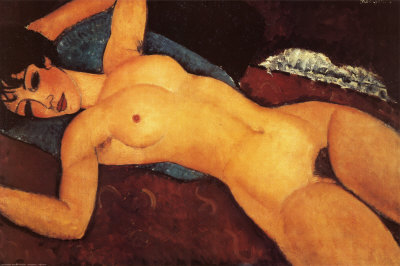
Nu Couche, Amedeo Modigliani
Series Variants
Modigliani had found a genre which really motivated and inspired him - he would continue to work in a similar manner for further variations, but would tweak different elements. His twenty nude paintings, along with many quick sketches, would experiment with different arrangements of posture, gaze and also how the room was arranged. Some nudes would sit on divans, whilst others would recline on long sofas.
The models would arrange their arms differently each time, sometimes behind their heads, sometimes touching their faces, and also covering parts of their lower regions. Modigliani would choose women that he knew personally to model, some of whom he would have relationships with - despite this, he insisted on leaving their eyes blanked out - creating a type of anonymity, despite the rest of their bodies being so openly exposed.
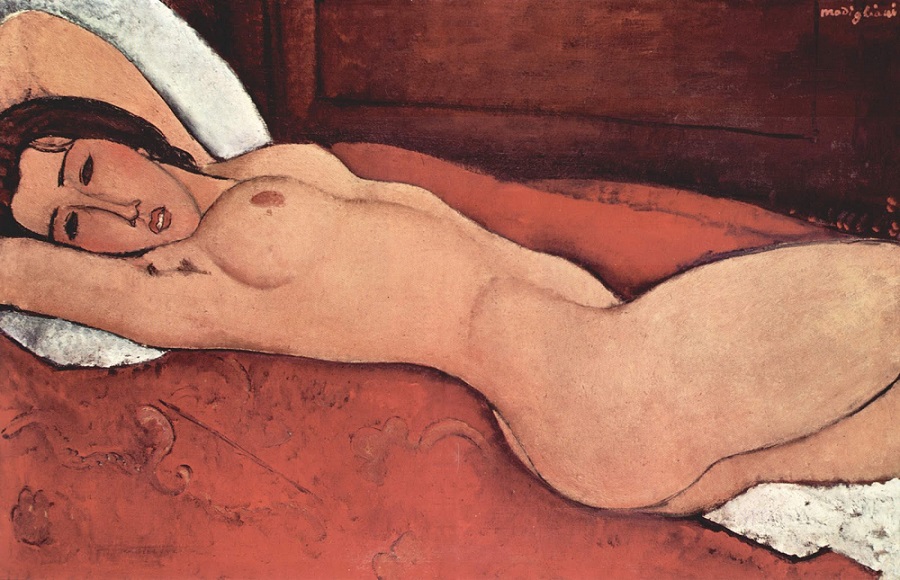
Reclining Nude, Amedeo Modigliani
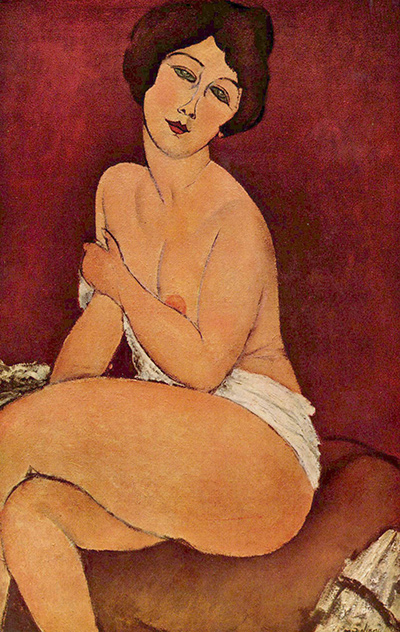
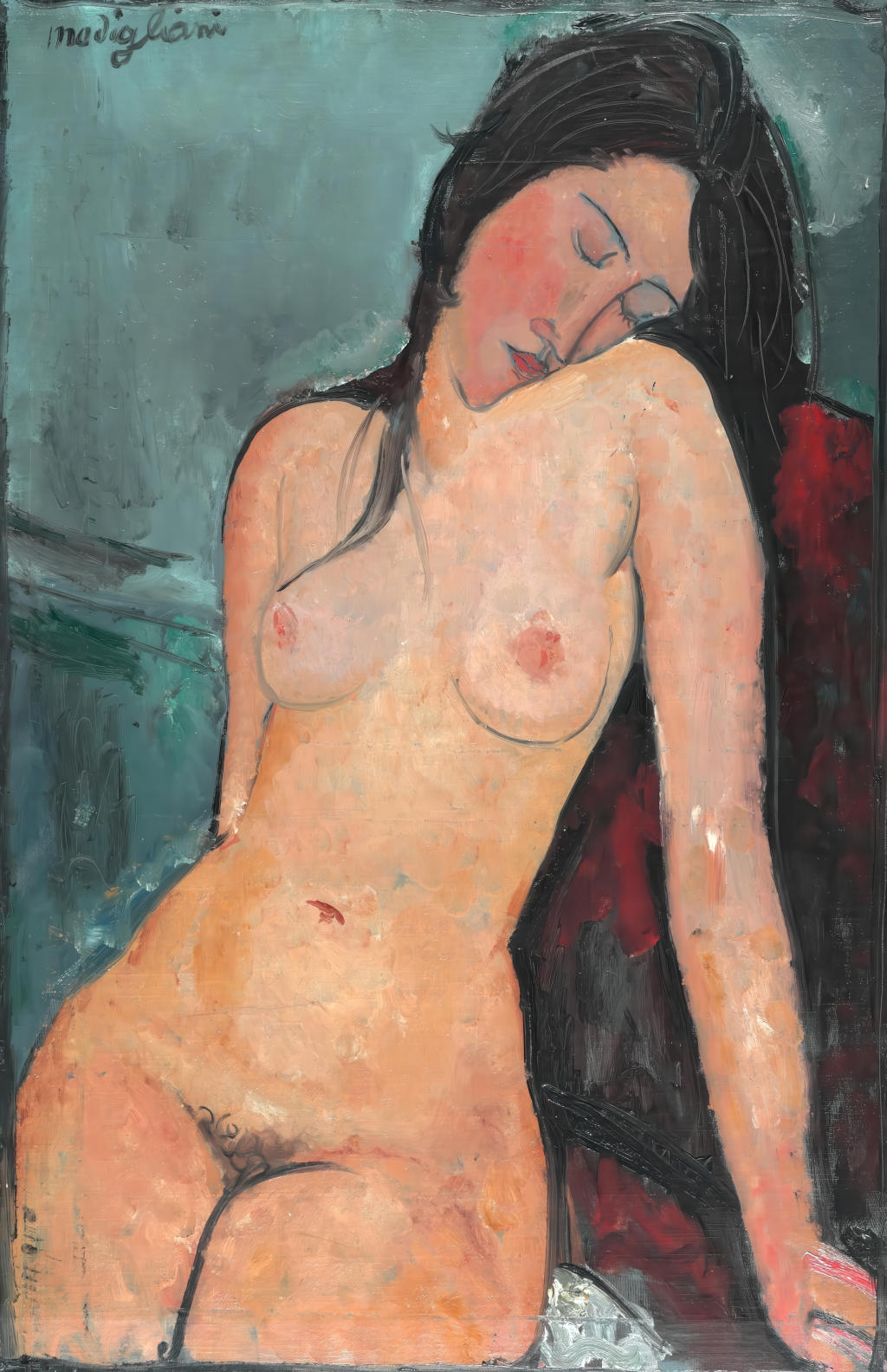
Nude Sitting on a Divan, Amedeo Modigliani
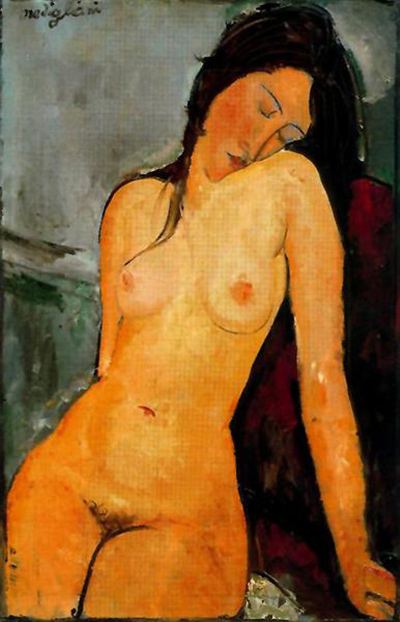
Female Nude, Amedeo Modigliani
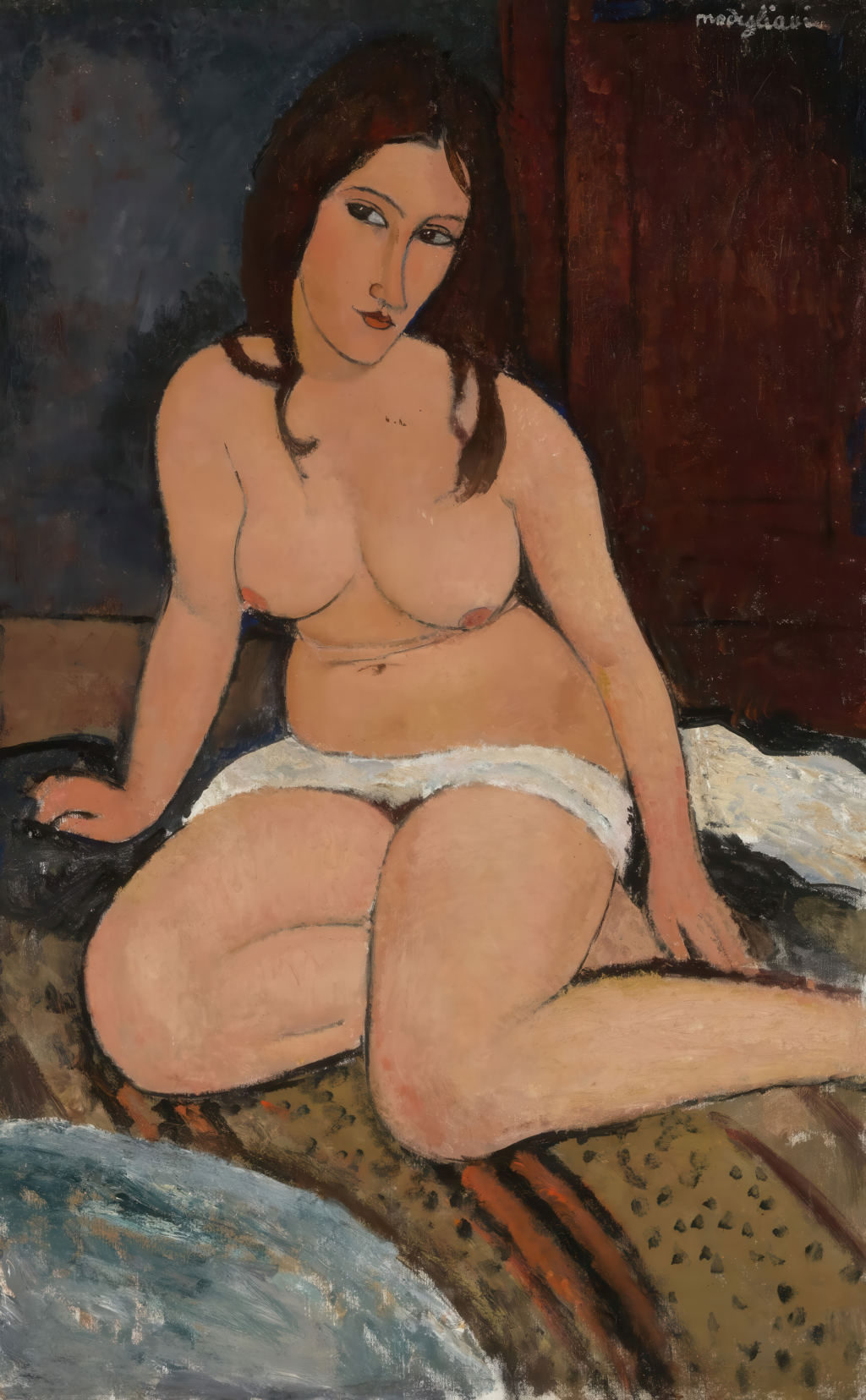
Seated Nude, 1917, Amedeo Modigliani
Historical and Cultural Context
Paris, 1916-1919: A City in Flux
The mid to late 1910s was a turbulent time across Europe. WWI left a big impact on Amedeo, and wider Paris. However, art offered an escape, and this city was at the forefront of new ideas at that time. Modigliani found Cubists, Fauves, Expressionists and sculpture innovators such as Brâncuși in this centre of culture, and many of these different groups would share ideas amongst each other.
Modigliani's role in this complex arrangement of creatives was to re-invent the nude genre, in combination with influences from classical European art and other elements from further afield. He experimented with technique, form, colour and composition, with different variations included across his list of twenty nude paintings, plus a number of supporting drawings.
Modigliani gave up sculpture in 1914 due to the tiring nature of carving stone, but he would transfer stylistic elements of his work over to his paintings. It was then that the nude series came about, and one can identify influences from his sculpture in many of the examples in this page - from elongated limbs to reduced, abstract facial features.
Zborowski's Patronage
Léopold Zborowski, a Polish dealer in Paris, was one of the few individuals within the industry who recognised Amedeo's talent. He also was in a position to financially support the struggling artist and believed that the nude series could bring success at last to Modigliani. Amedeo was not paid much, but could at least concentrate for an extended period on evolving his mastery of line and form, with a solid, consistent focus.
In fact, many of these nude paintings were produced above Léopold's gallery, in a small apartment that the artist used on occasion. Here Amedeo could set up sofas and beds, arrange the background as he needed, and most crucially, experiment with different postures for his mdoels.
The Body in Modigliani's Nude Series
Form and Structure
Modigliani's nude figures would fill most of his composition, despite being relatively low in detail. Background elements would be band of colour rather than highly polished elements, bringing contrasting colour. The artist would stretch his torsos and necks, and pull his models close to the viewer. His use of line for form was always biased towards simplicity, and connected well with his experience as a sculptor.
Across his nude series, Modigliani used warm flesh tones, muted earth reds and dark backgrounds. His brushwork across the background elements would be quick and rough, providing an impression of elements in a room, but not allowing them to distract the viewer's eye. This allowed his models to glow and dominate, though he would experiment with bedsheets, cushions and other items on which the model could lie.
Technical and Material Analysis — How Modigliani Built These Paintings
The style of Modigliani throughout this series is to emphasise his use of line, to simplify surface details, and to create a sculptural feel to his work. This approach carries on throughout the entire series, with the artist merely alternating between postures and angles.
Amedeo primed relatively large canvases (for the period) with a warm ground. He would similarly paint furniture and other room features in dark tones, before contrasting colour for his subjects. He worked with broad strokes, and left a smooth, even finish with oils - his experience in drawing and painting the human body meant he could work fairly efficiently. You will not find the thick oil applications left by other artists of this time.
His use of shadow or gradient was limited. Modigliani would not incorporate great subtleties to produce near-realism, such as with the great Renaissance master like Da Vinci. Instead, he worked from a small palette of colour and concentrated on outlines of form, in a similar manner to how he would sketch patrons in cafes and bars. Any depth within his paintings would therefore be filled in by the eye of the viewer.
The sculptural qualities to his paintings are also not only due to his period as a sculptor some years earlier, but also in his training previous to that. It appeared that he thought like a sculptor, even after having to abandon this discipline due to his struggles with tuberculosis.
Direct Presence, Not Mythology
Traditional nude paintings would include fig leaves, or carefully posed figures to avoid shocking the audience - refer to Ingres or Titian for examples of this. Modigliani chose a more immediate connection, pulling the model forward and presenting as they are, often looking directly at the viewer. This placed a far greater significance on the forms that he produced, and through his regular sketching, this was a major strength of his.
Interpretation and Meaning
The Modern Body
There is a vagueness, deliberately, to many of Modigliani's paintings. He did not force a narrative upon the viewer, such as an historical event, religious or modern. He even allowed the subject to look directly at us, whilst keeping an anonymity through blanked eyes. His focus was on the body itself, and would form it through delightful flourishes of line, simple yet precise.
The artist practiced his craft whenever he could, and learnt how to quickly create the outlines of the female form using the correct curves of a line, with pencil or brush. He would then bring the subject forward towards us, creating an intensity. One is left with many different potential ways of reading his works, and his nudes are the most controversial and thought-provoking of all.
Women and Presence
The nude women are depicted by Modigliani in a respectful, powerful manner. They appear comfortable in their presence in front of him, which was partly due to his strong connection to many of them. Rather than using them as aesthetic tools, Modigliani is believed by most critics to be celebrating the female form in this series.
The role of women in society was changing fast in the early 20th century and Modigliani was tapping into this with his work. His nudes are comfortable, confident and hold a power over the viewer, rather than the other way around. This artistic style would influence artists in later decades as these societal changes continued to take hold.
Sitters & Their Appearances in Modigliani's Work
Modigliani's most famous model was, of course, Jeanne Hébuterne. She did not, however, pose nude for any of this series. Many of those who did remain anonymous, sadly, but will always be remembered through their images within his career.
Beatrice Hastings was an English poet and art critic and Modigliani's lover and model between 1914 and 1916. She is believed to have posed for the Seated Nude from 1916 among other works, and so may have been the strongest relationship held by Amedeo within this series. Their turbulent relationship eventually came to an end, but she is amongst the most significant of his muses, either nude or otherwise.
A specific "ginger-haired, broad-hipped model" was used for the two standing nudes painted in 1917, including Venus (Standing Nude or Nude Medici). She remains anonymous, but has been connected across multiple artworks. Additionally, Elvira is the name suggested for two nude paintings from 1916 and 1918Almaïsa (1916) and Standing Nude (Elvira) (1918). The nature of society in Europe at that time meant that many would be unwilling to pose nude, or wish to keep their identities secret for fear of creating scandal.
Critical Reception
Sadly, the world was not ready for Modigliani's nude series. Whilst Paris was at the forefront of the avant-garde, it still could not accept the style of Amedeo's approach to this niche. Some found his work, displayed at Galerie Berthe Weill in 1917, to be entirely scandalous and pressure was put on the authorities to shut the exhibition down. It was clear that Modigliani's paintings were ground-breaking, and over the rest of the 20th century, they would start to receie acceptance.
Not only has his work been included in a number of retrospectives, but the chief cause of the original controversy - the nude series - has received particular focus from modern audiences. Today, these continue to be subjects for debates around the use of women in art, sexuality, form and modern representation. It is important to remember that Amedeo respected his subjects and intended for them to be seen as strong within their figurative portraits.
Technical Comparisons to Other Famous Nudes
Modigliani's nude series was ground-breaking for this historical niche. One can compare his paintings with famous works from the past to outline the changes that he brought, and from that we can understand why this series proved so controversial, even though the public was entirely used to nude art from previous centuries.
Modigliani and Titian — Venus of Urbino (1538)
In Venus of Urbino, Titian idealises the body through myth; Modigliani monumentalises it through modern realism. The former, from Italian Renaissance times, helped to generate the original template for reclining nudes in art. Modigliani flattens space, reduces modelling, and relies on contour rather than illusion, in line with influences from sculpture and African masks.
Modigliani and Ingres — Grande Odalisque (1814)
Many centuries after the work of Titian came another nude artist, Ingres. His work was exceptionally detailed and lifelike. Ingres' Grande Odalisque is famous for its elongated back and anatomically impossible proportions — a deliberate distortion in service of elegance and fantasy. This may well have influenced Modigliani. The main difference between the two is motivation - Ingres elongates to please the eye, creating a refined object for the viewer. Modigliani elongates to transform it into a rhythmic structure of line and form.
Modigliani vs Manet — Olympia (1863)
Manet's Olympia shocked audiences by presenting a nude woman who acknowledged the viewer with an unapologetic gaze. Though separated by half a century, Modigliani's nudes inherit Olympia's challenge to social norms — but express it differently. Olympia's gaze is confrontational and socially charged, whereas Modigliani's nudes look at us with a neutral calmness.
Modigliani vs Picasso — Early Nudes (1906-1909)
Picasso's early nudes, particularly around the time of Les Demoiselles d'Avignon, fragment the body into angular planes, drawing heavily on African masks, Iberian sculpture and the concepts found in Cubism. Indeed, Picasso had his own spell known specifically as his African Period. Modigliani was in tune with Picasso's work but rather than fracture the body as Picasso would do, he chose to bring everything closer together through smooth lines, a little like how Picasso produced some of his animal drawings.
Artists Inspired by Modigliani's Nude Series
As discussed elsewhere in this article, Modigliani helped to re-imagine nude art in the 20th century, and evolve it onwards from the more traditional approaches. His work also influenced specific artists and artistic disciplines including photography and sculpture.
Alfred Stieglitz and Edward Weston took some of his ideas into photography, and nudity within this medium was already common. They found more creative ways of using this niche, less formal and without a narrative, just as Amedeo have done with his paintings. Henry Moore, the famous British sculptor, made reclining figures of his own, and also made use of elongated limbs.
Lucian Freud and Francis Bacon may have been influenced by Modigliani in their explorations of physical presence in art, and they too were interested in exploring the human body in art in a non-traditional manner. They also brought a psychological side to their portraits, connecting with Modigliani's strange use of blanked out eyes. Expressionists would also continue the experimentation with elongating limbs, faces and more, with post-war atmosphere driving this idea onwards.
Auction Prices — Major Sales of Modigliani's Nude Paintings
Below is a table of major sales for Modigliani's nude painting series. The huge prices displayed indicate how famous Modigliani has now become in mainstream art circles, and also how this series has become his most highly prized of all.
| Title | Year Painted | Auction House | Sale Date | Price (incl. fees) | Notes |
|---|---|---|---|---|---|
| Nu Couché (Reclining Nude) | 1917-18 | Christie's New York | 2015 | $170,405,000 | Record artist price, sold to Chinese collector Liu Yiqian |
| Nu Couché (sur le côté gauche) | 1917 | Sotheby's New York | 2018 | $157,200,000 | Highest price in Sotheby's history at time |
| Nude Sitting on a Divan | 1917 | Sotheby's New York | 2010 | $68,900,000 | Twice sold record before recent peaks |
| Reclining Nude on Blue Cushion | 1916 | Private Sale | 2012 | $118,000,000 | Secondary market sale to Dmitry Rybolovlev |
Legacy and Influence
Modigliani's career today is best known for this nude series as well as his portraits of Jeanne Hebuterne. The paintings are also instantly recognisable as his own, so unique was his style. He fundamentally re-positioned the nude art genre within western nations, breaking its ties with the more traditional periods. Ultimately, this impact would not be felt during his own lifetime, but is reflected today in his international fame, and the extraordinary valuations now given to his original artworks.
Seated Nude, 1917
FAQs
References
- Tate Article on Modigliani's Nude Series
- Sotheby's Focus on Modigliani's Celebrated Reclining Nude Series
- Wikimedia - Paintings of nudes by Amedeo Modigliani