



 by Tom Gurney
Tom Gurney BSc (Hons) is an art history expert with over 20 years experience
Published on June 19, 2020 / Updated on November 13, 2026
Email: tomgurney1@gmail.com / Phone: +44 7429 011000
Prints: Introduction
In one engraving, Theseus sits over the body of the Minotaur with his head lowered. In another, he raises a club and stretches one leg behind him as he pins a centaur. Antonio Canova made both sculptures, but the prints give their shared hero very different outlines. Raphael Morghen sets the seated figure against a dark rectangle. Pietro Bettelini leaves the paper around the combat almost bare, so that the raised arm and the line of the extended leg can be read against it. [1] [2]
An engraving after a sculpture can record details that take time to find in a gallery. It also fixes a particular angle and gives the figure a new setting on the sheet. For anyone choosing a Canova print to frame, there are two objects to identify. One is the sculpture, painting or drawing represented. The other is the print itself, which might be a historical impression or a modern reproduction of an engraving or photograph. [1] [2] [3]
Antonio Canova Prints
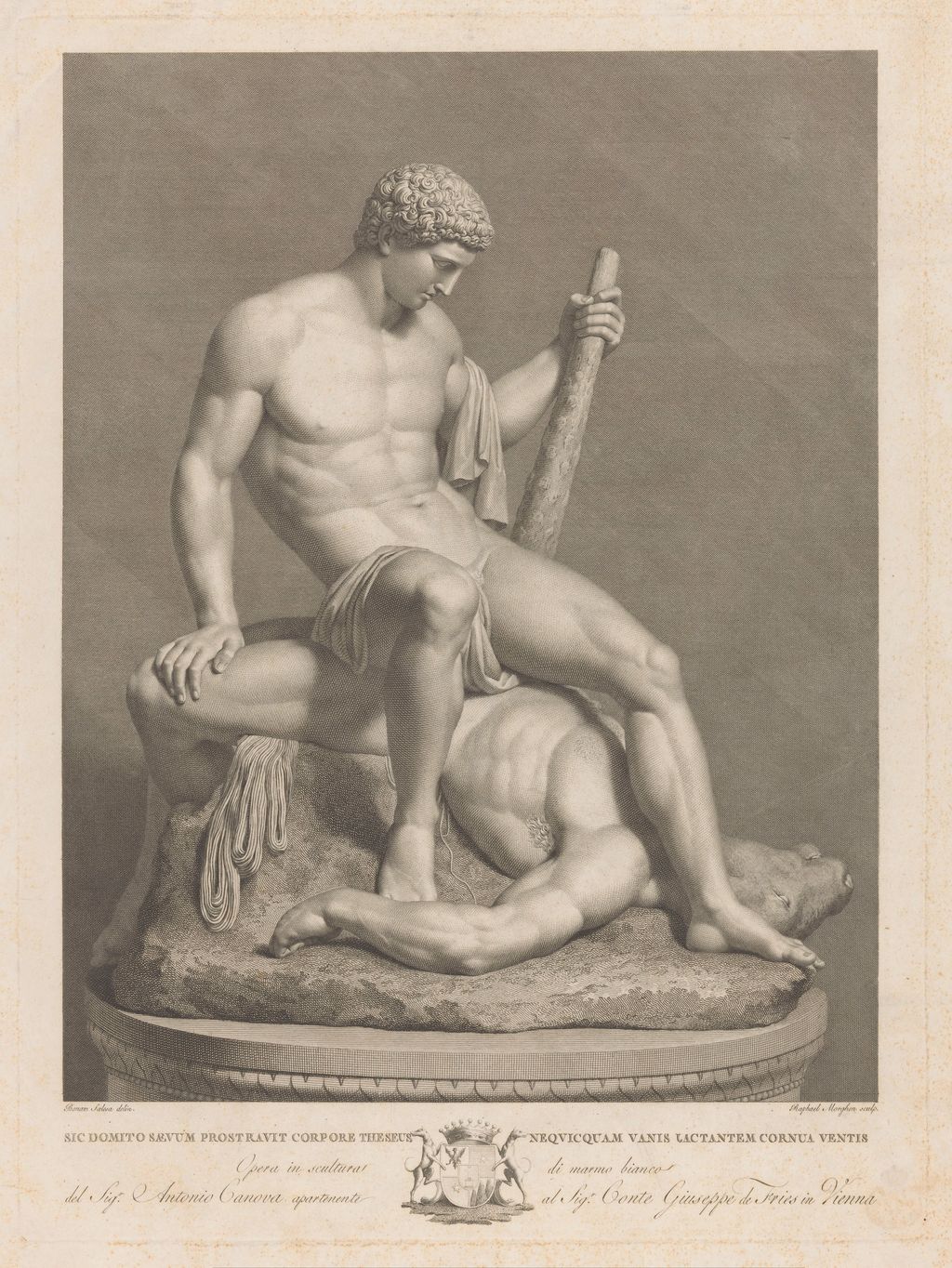
Morghen’s engraving of the seated Theseus and the Minotaur. Rijksmuseum. Image source. Public domain. Resized for display.
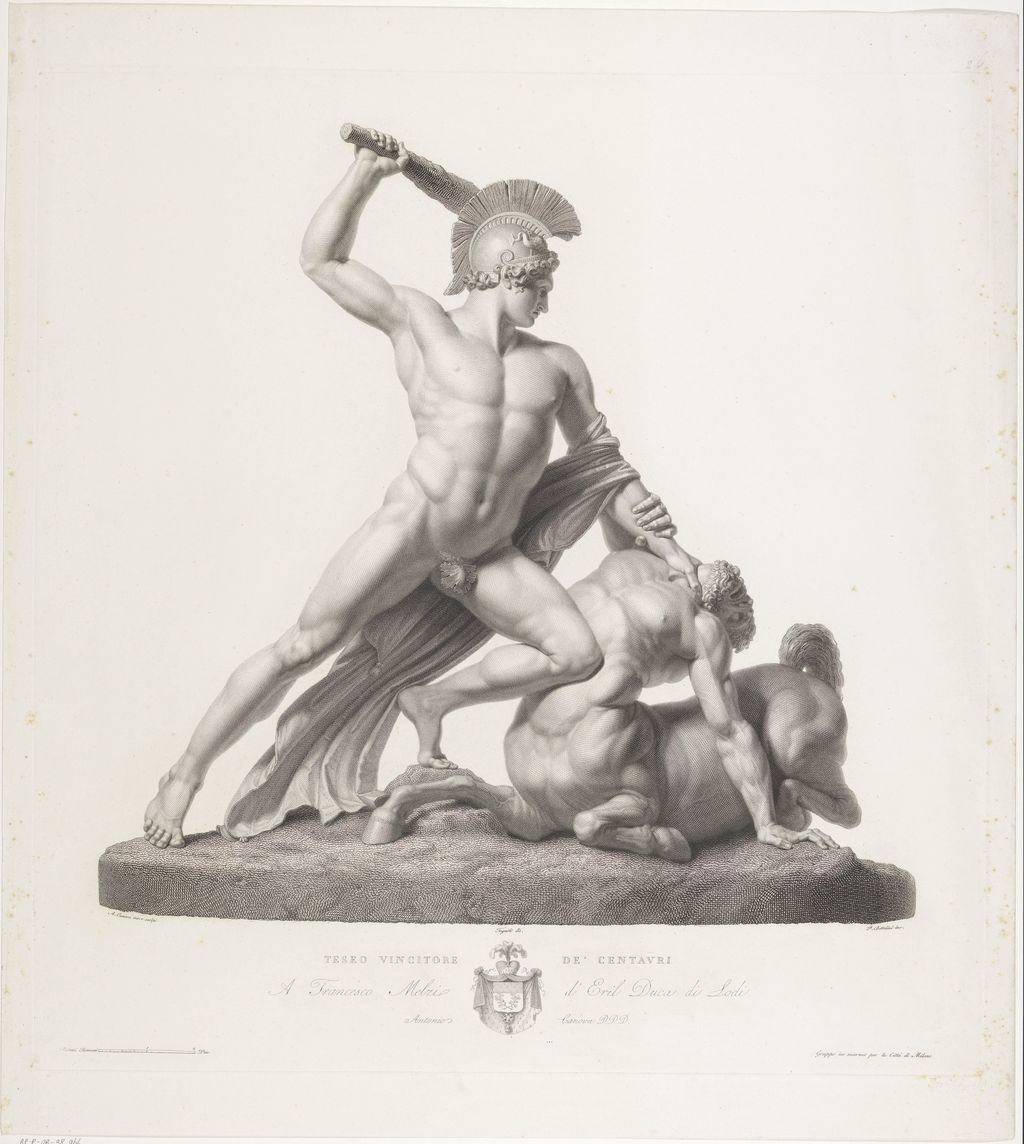
Bettelini’s engraving after Tognolli of Theseus fighting the centaur. Rijksmuseum. Image source. Public domain. Resized for display.
At a Glance
- Seated TheseusRaphael Morghen engraved the group after a drawing by Buonaventura Salesa. [1]
- Theseus and the centaurPietro Bettelini engraved the group after a drawing by Giovanni Tognolli. [2]
- Plate markThe edge of an intaglio plate can leave a rectangular indentation in the paper. [3]
Contents
- Two engravings of Theseus
- The nymph from plaster to paper
- How a monument was made to fit the page
- Choosing a Canova print
Two engravings of Theseus
Morghen’s print shows Theseus and the Minotaur, the seated group now at the Victoria and Albert Museum. The light falls across Theseus’s chest and thighs. Beneath him the Minotaur’s arm runs almost parallel to the edge of the base, and its muzzle appears at the far right. From this viewpoint the lower figure is easy to overlook at first. Morghen leaves it in enough light to draw the eye from Theseus’s foot along the fallen body. A Latin caption runs beneath the image, with a coat of arms and further lettering below it. A cropped reproduction can preserve the grouping and still lose the evidence in that lower margin. [1]
Bettelini’s engraving of Theseus and the Centaur uses a wider arrangement. The centaur’s horse body takes up space across the base, while Theseus’s arm and club reach into the blank paper above. Their hands meet near the middle of the print. From there the eye can travel back up through the hero’s drapery or down the centaur’s arm to the hand braced on the ground. The Rijksmuseum records Canova’s dedication to Francesco Melzi d’Eril and links the sculpture to the Kunsthistorisches Museum in Vienna. The Italian title printed below the scene refers to centaurs in the plural, although only one appears in the image. [2]
The credits on the two prints record three kinds of work. Canova made the sculptures. Salesa and Tognolli made drawings from which the printmakers worked. Morghen and Bettelini translated those drawings into lines that could hold ink. With a burin an engraver cuts grooves into metal, bringing lines close together where the impression needs a darker tone. A press then transfers ink from the grooves to damp paper. Look at the open space around the centaur’s club and compare it with the grey behind the seated Theseus. Even before looking for the finer lines, you can see how each printmaker made the figure stand apart from its surroundings. [1] [2] [3]
The nymph from plaster to paper
In Angelo Bertini’s Ninfa che dorme, the nymph’s head rests at the left of the sheet and her feet cross at the right. The rock and the plinth form long horizontals. The fabric falls over the nearer edge in a triangle, giving the eye a sense of how far the body lies from the front of the support. The view is low enough for the foot to stand out against the paper, while a darker band beneath the hanging cloth separates it from the rough surface below. The Rijksmuseum print is 53.5 centimetres wide in its recorded dimensions. It gives the figure room to stretch out while keeping the title and dedication within the sheet. [4]
The Italian national catalogue traces the image to the plaster for Sleeping Nymph at Possagno and records payments to Bertini in November 1821 and May 1822. The V&A’s marble was commissioned in 1821 and reached the Marquess of Lansdowne in 1824, after the workshop completed it. The Wellcome Collection’s impression names a life-size marble in the lettering and identifies the dedicatee as Lady William Bentinck. It also describes the technique as engraving with etching. The two processes can share a plate. In etching, acid bites lines where the printmaker has exposed the metal through a protective coating. The dates of the payments tell us when work on the plate was under way. The Possagno impression is catalogued as after 1822. Its date belongs to the sheet, while the payments concern the work on the plate. [5] [6] [7] [8]
Videos on Canova
Explore Canova’s workshop methods and the settings for his sculpture.
From Sketch to Stone | Canova: Sketching in Clay
Watch sculptor Fred X. Brownstein recreate a Canova Venus, using clay, plaster and marble.
Watch on YouTubeHow a monument was made to fit the page
Jakob Merz drew Canova’s monument to Maria Cristina of Austria in Vienna after it had been installed in the Augustinerkirche in 1805. In the Albertina drawing he used pen over pencil to set out the procession and pyramid. The museum notes that he turned some figures slightly towards the viewer and moved one of the children forward. Seen on paper, the procession gains space between the figures. The drawing also leaves the stone above the entrance blank. [9]
The Albertina records that the related etching adds inscriptions and architectural boundaries at the sides. The Albertina also holds a watercoloured impression from 1805 in Duke Albert and Maria Cristina’s historical print collection. An impression served as the frontispiece to the German edition of a description of the monument published in Vienna in 1805. The two records show what happened between standing in front of the monument and encountering it at the beginning of a book. A drawing could clarify the outline of the figures, and the print could restore the words and frame the whole group with enough of the church wall to show how it was installed. [9] [10]
Choosing a Canova print
Start with the view you want to live with. A photograph of the whole of The Three Graces can show where the arms, drapery and support meet. A close photograph might give more space to the fingers and the surface of the marble. Check which sculpture the photograph shows. The National Galleries of Scotland and the V&A share the Bedford version, while an earlier version is in the Hermitage. A seller who names the museum or gives the accession number makes it easier to compare the image with a collection photograph. For a whole group, look at the space around the heads and base. For a detail, check where the crop cuts the hands or folds you want to see. [11]
If you want a historical engraving, ask for the printmaker, process, dimensions and any catalogue reference. Ask whether the measurement describes the image, the mark left by the plate or the full sheet. A seller’s photo of the reverse can reveal stamps, inscriptions or traces of old mounting. The Rijksmuseum records a collector’s mark on its Bettelini impression and a catalogue reference for its Morghen impression. Such details help locate a particular sheet among other impressions of the same design. A photographed plate mark or printed signature may also appear in a modern facsimile. For a claim about an early impression, ask what evidence supports the date and whether the seller can identify changes to the plate between printings. [1] [2] [3]
For a modern print, check whether the source is a photograph of the sculpture or a scan of a historical print. Compare the advertised image area with the sheet size and the opening of the mount. A mount can cover the dedication on an engraved image, and a crop can remove a sculpture’s base. For a photograph you intend to frame, the Library of Congress recommends protective matting and avoiding adhesives directly on the print where possible. If you already own a valuable impression, a facsimile is one way to display the image while storing the old sheet away from light. [3] [12] [13]
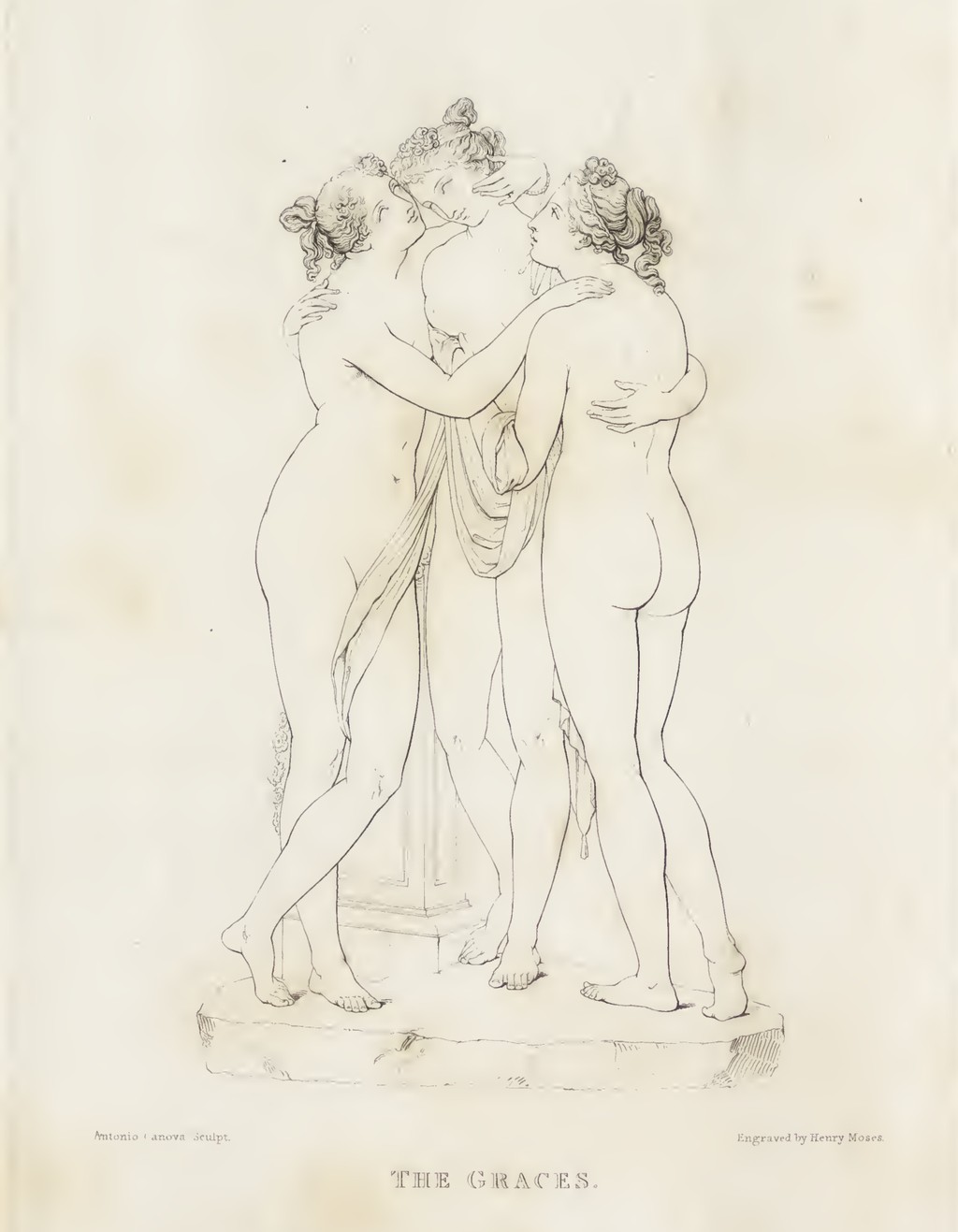
One of Moses’s paired views of The Three Graces, published in the London catalogue of Canova’s works. Henry Moses, after Antonio Canova, engraving published in London, 1824. Getty Research Institute. Image source. Public domain. Scan margins trimmed and image resized.
Explore Canova’s works
Browse the sculptures and paintings covered in this guide. Several entries compare versions or examine details of a larger work.
Discussion
Look again at the images and ideas explored in Prints. These editorial prompts invite your observations.
Reader Insights
What does each engraver choose to show about the sculpture?
Which features would help you identify a particular impression?
Join the Conversation
Share a detail, comparison or question about Prints below.
References
- Rijksmuseum, Raphael Morghen after Buonaventura Salesa and Antonio Canova, Theseus en de Minotaurus, RP-P-OB-36.554. View source.
- Rijksmuseum, Pietro Bettelini after Giovanni Tognolli and Antonio Canova, Theseus overwint de centaur, RP-P-OB-38.966. View source.
- Metropolitan Museum of Art, Engraving, Materials and Techniques. View source.
- Rijksmuseum, Angelo Bertini after Giovanni Tognolli and Antonio Canova, Slapende nimf, RP-P-OB-38.964. View source.
- Catalogo generale dei Beni Culturali, Ninfa dormiente, national catalogue 0500432639. View source.
- Victoria and Albert Museum, Sleeping Nymph, A.30-1930, O16238. View source.
- Wellcome Collection, A sleeping nymph, 3087406i. View source.
- Metropolitan Museum of Art, Wendy Thompson, The Printed Image in the West: Etching. View source.
- Albertina, Jakob Merz, Grabmal der Erzherzogin Marie Christine von Antonio Canova, drawing, 1805, inv. 5921. View source.
- Albertina, Jakob Merz and Johann Maria Monsorno after Antonio Canova, Christinenmonument, watercoloured etching, 1805, It/II/45/1. View source.
- National Galleries of Scotland, Antonio Canova, The Three Graces, NG 2626. View source.
- Library of Congress, Care, Handling and Storage of Photographs. View source.
- Library of Congress, Frequently Asked Questions About Paper. View source.


 Antonio Canova.jpg)

