


 by Tom Gurney
Tom Gurney BSc (Hons) is an art history expert with over 20 years experience
Published on June 19, 2020 / Updated on November 5, 2026
Email: tomgurney1@gmail.com / Phone: +44 7429 011000
The Annunciation by Dante Gabriel Rossetti
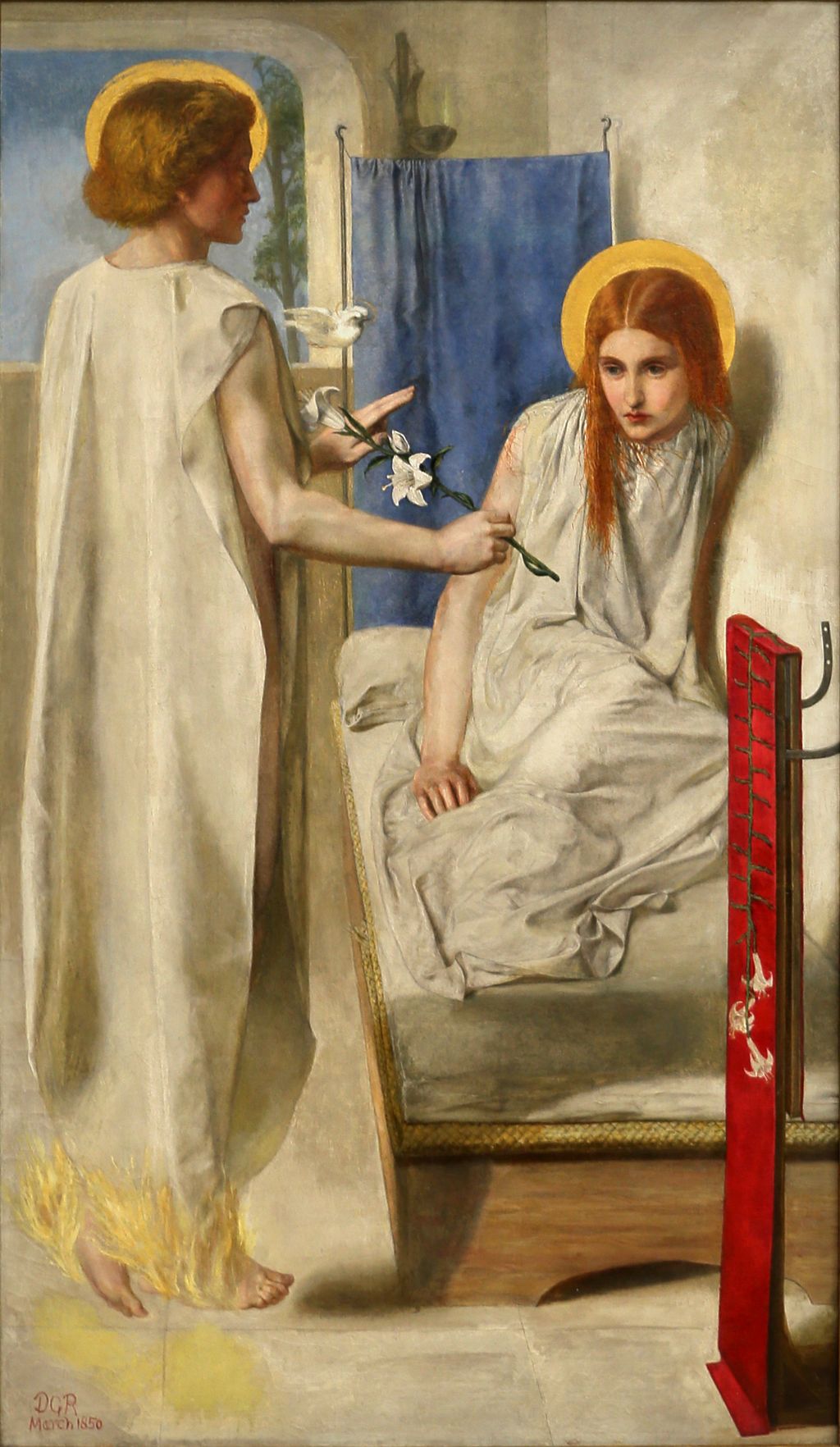
A young woman sits upright on a narrow bed, her shoulder pressed towards the wall. Before her stands an angel who has no wings. He offers a lily, but its long green stem seems to enter the small space she has drawn around herself. Dante Gabriel Rossetti's Ecce Ancilla Domini! (The Annunciation) turns a familiar sacred encounter into a scene of arresting proximity. Painted in 1849–50, the oil on canvas belongs to Tate, where it is catalogued as N01210. Its support measures just 72.4 × 41.9 centimetres: the room's intensity belongs to a surprisingly small picture. [1]
White dominates almost everything: the walls, the bed, the figures' clothing and the bird suspended between them. Yet this is not a blank or peaceful whiteness. Grey shadows divide it into folds, surfaces and awkward intervals. Mary's copper-coloured hair, a blue hanging and a narrow red embroidery break through it with unusual force. The longer we look, the less the painting resembles a simple illustration of a well-known story. Its few objects make the encounter both recognisable and difficult to settle. [2]
At a Glance
Two moments in Rossetti’s career
Contents
A startled Mary
The story comes from Luke's Gospel. Gabriel visits Mary in Nazareth and announces that she will bear Jesus. Mary is troubled by the greeting, asks how the promised birth can happen, and receives an explanation involving the Holy Spirit. Only afterwards does she give the response recalled by Rossetti's Latin title: Ecce ancilla Domini, conventionally translated as “Behold the handmaid of the Lord.” The narrative moves through disturbance, questioning and acceptance; a painting must find a way to hold that sequence in a single image. [3]
Rossetti gives us an unsettled body rather than an explanatory gesture. Mary's knees bend beneath the gathered cloth. One hand rests low beside her, while her upper body leans away from the visitor. Her head turns towards him, but her eyes look down across the space of the lily. She does not return his open-handed gesture. The difference between the two figures is immediately legible: Gabriel extends himself into the room; Mary draws herself together. [2]
Tate's January 2025 label interprets the scene as an interruption of Mary's dreams, finding anxiety in her eyes, pose and the unusual colouring. That is a persuasive reading of what Rossetti shows. It also helps explain why the title and the figure can seem to pull in different directions. The words recall an answer, while the painted posture preserves the shock of receiving an extraordinary message. We can recognise that tension without supplying an unspoken account of Mary's thoughts. [1]
There is little furniture to distract us. No group of attendants witnesses the meeting, and no elaborate threshold comfortably separates the visitor from the person he addresses. Mary's bare room gives the encounter a domestic scale. The miraculous arrival occupies the same confined space as a bed, a hanging and a piece of needlework. [2]
White room and narrow space
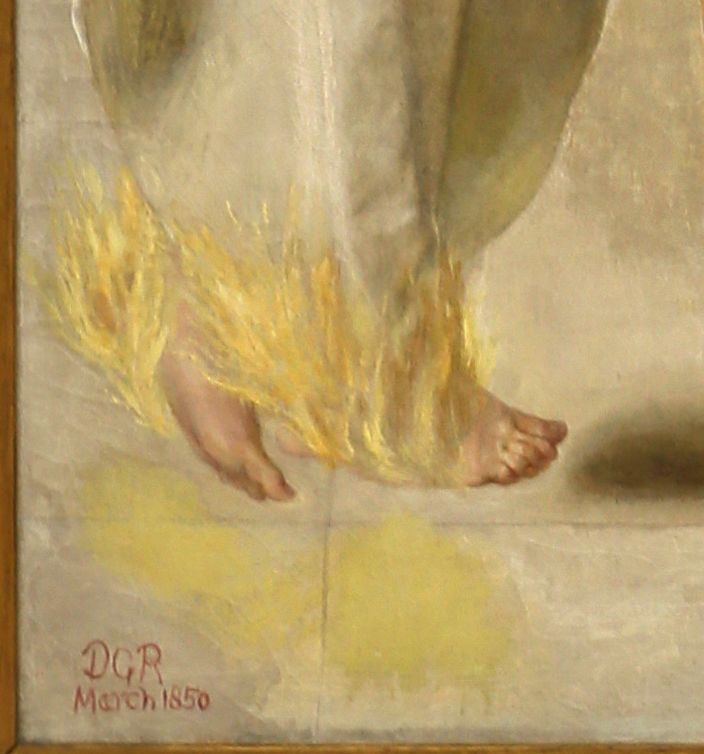
Start with Gabriel's feet. They hover above the pale floor amid fine tongues of gold flame. His long garment hangs in heavy, nearly vertical folds, making his suspension all the stranger. Behind him a shadow stretches towards the bed. The body has weight and casts a shadow, yet it does not rest where an ordinary standing figure would. The supernatural is concentrated in this small disturbance of physical expectation. [2]
The bed makes another kind of uncertainty visible. Its near edge projects towards us, while its far end disappears behind the figures. The right wall leaves Mary little room to withdraw, and the blue hanging rises almost directly behind her head. At the left, the window introduces sky and a strip of greenery, but offers no expansive landscape. Each opening seems quickly checked by another surface. The painting lets the eye move, then brings it back to the meeting. [2]
Jerome McGann's commentary in the Rossetti Archive treats this uneasy space as a significant feature of the work. He relates it to Rossetti's interest in early Italian painting, where individual objects and areas need not submit to a single, consistently organised illusion of depth. On this account, the perspective asks us to move between local relationships rather than survey a perfectly coherent room. The lily, the bed, the window and the embroidery stand each exert a separate pull. [4]
There was practical collaboration behind the apparent simplicity. Art historian Robert Wilkes draws attention to William Michael Rossetti's diary entries recording Frederic George Stephens's help with perspective in late 1849. Wilkes also cites the technical examination in Pre-Raphaelite Painting Techniques, which notes the unresolved junction of floor and wall. How much of the surviving arrangement should be assigned to Stephens remains uncertain. His documented assistance nevertheless complicates the idea of an entirely solitary invention. [5]
White binds these disjointed spaces together. Gabriel's garment has broad, downward folds; Mary's dress is bunched and creased; the wall is comparatively still. These differences prevent the restricted colour from becoming monotonous. Against them, the blue hanging appears almost solid, while the red strip at the right is so strong that it can compete with the figures. Colour does more than decorate the room: it gives our looking a rhythm. [2]
Annotated Details from Ecce Ancilla Domini! (The Annunciation)
Follow the encounter from Mary’s withdrawn pose to the offered lily, then down to the small flames around Gabriel’s feet.
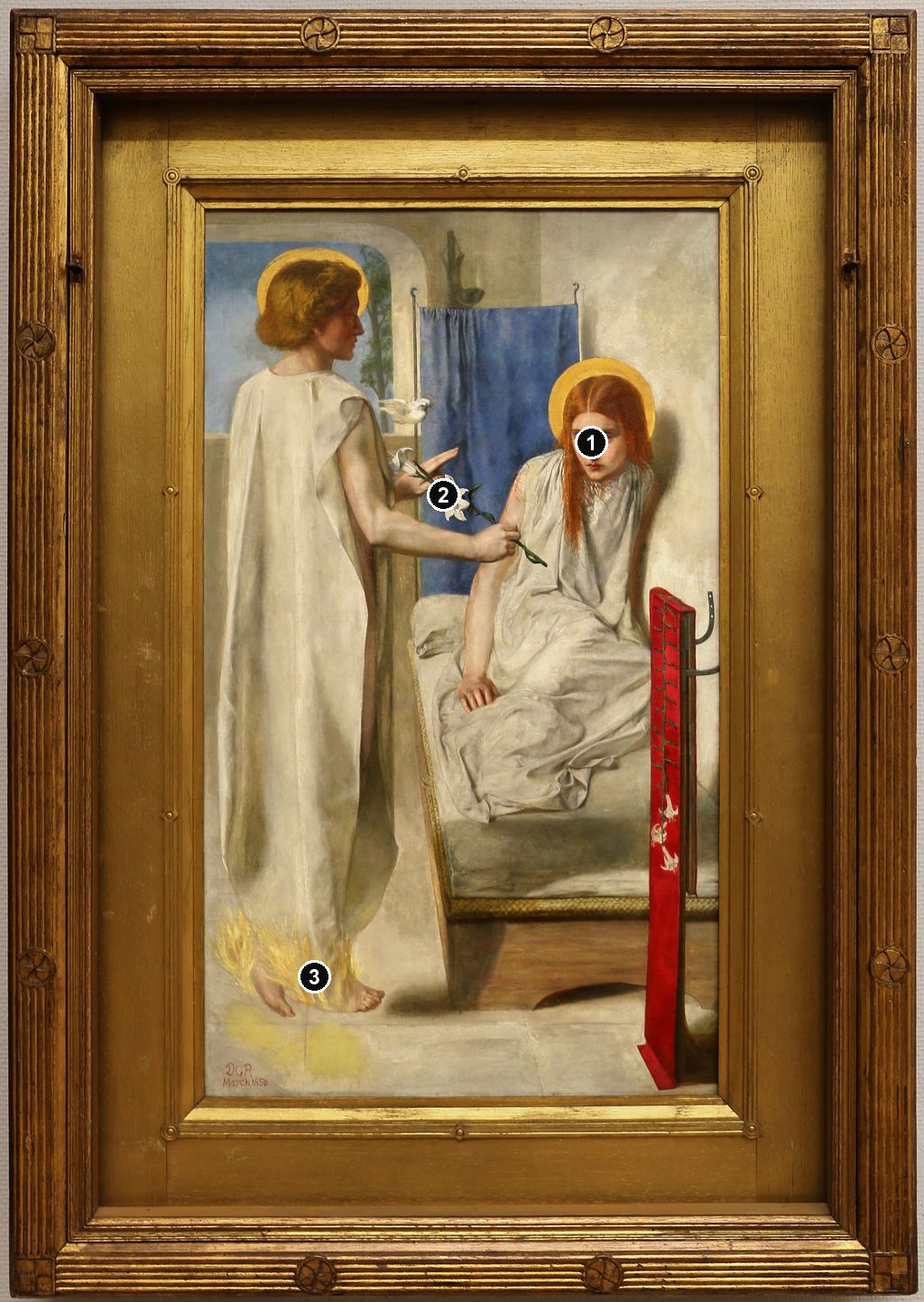
Details from ECCE ANCILLA DOMINI! (THE ANNUNCIATION)
Tate, N01210. Photograph by Sailko, CC BY 3.0. Framed overview annotated; details cropped and resized directly from the unchanged full-resolution photograph.
A face above gathered white cloth
Mary’s head turns towards the visitor while her body draws back against the wall. Her hair and the blue hanging concentrate colour around the pale face and clothing. [2]
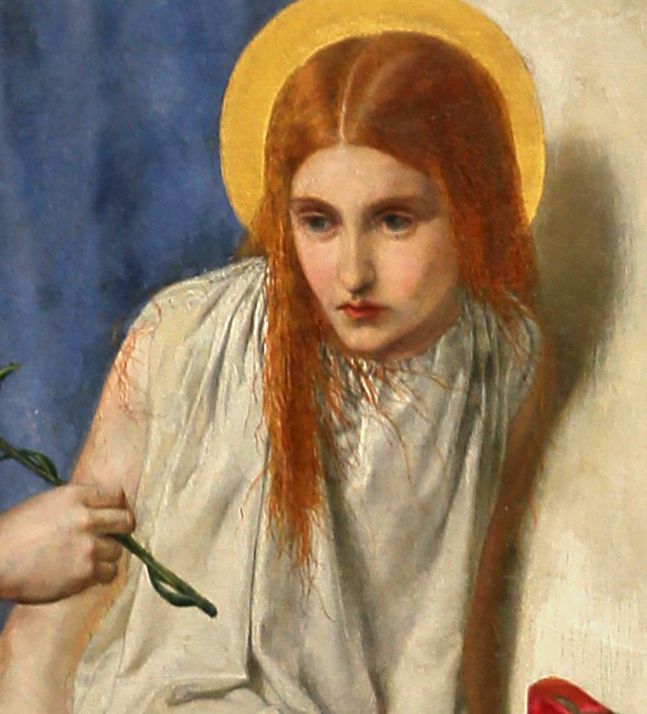
The lily between the figures
Gabriel holds the stem across the narrow interval between the figures. Its white flowers sit among pale hands and clothing, while the green stem cuts a more distinct line. [2]
Flames around the suspended feet
Small golden tongues surround Gabriel’s bare feet above the pale floor. This local disturbance gives a supernatural character to a figure otherwise clothed in heavy folds. [2]
Lily, dove and flame
Gabriel's lily joins the two figures without allowing them to touch. Its pale flowers lie near his upper hand, while the green stem runs down towards Mary. Dillian Gordon, writing for the Visual Commentary on Scripture, reads its direction towards Mary's womb as a reference to the announced conception. She also identifies the lily with the Virgin's purity and the dove with the Holy Spirit. The symbols concentrate the Gospel's meaning into a few small forms. [6]
The bird is easy to miss against the wall. Its spread wings carry it through the interval between Gabriel's head and the lily. Unlike the angel, it has wings; unlike either human figure, it is almost absorbed into the room's prevailing colour. The gold discs around the figures' heads are far more assertive. Mary's halo stands against the blue cloth and wall, while Gabriel's is set against the open window. Their simple circles interrupt the irregular outlines of hair and fabric. [2]
At the right, an embroidered lily repeats the living flower on an intensely red ground. This time the stalk is vertical, held flat by the textile and its stand. One lily crosses the space between two bodies; the other belongs to a piece of domestic work. The repetition rewards a second look because it links an event in progress to an object already present in Mary's room. [2]
Gordon stresses how little ceremonial splendour Rossetti gives the scene. Gabriel's unadorned clothing, his absent wings and the plain hanging strip the subject down to essentials. Her reading brings the painting's humanity into focus: sacred identity survives in a handful of attributes while the meeting itself takes place at close quarters. The small flames beneath Gabriel's feet are especially effective in this setting, where almost everything else looks touchable and ordinary. [6]
The Girlhood of Mary Virgin: a companion in meaning
The red embroidery has a history within Rossetti's own painting. In The Girlhood of Mary Virgin, dated 1848–9 and also at Tate, Mary sits beside her mother, Anne, working at a red textile decorated with a lily. A small angel tends a real lily nearby, and a dove appears above. Tate identifies Christina Rossetti as the model for Mary and the artist's mother, Frances, as the model for Anne. This is a separate painting, N04872, rather than another version of The Annunciation. [7]
Looking between the two makes their relationship unusually concrete. The earlier picture spreads its figures, books, plants and furnishings across a busier setting. Mary's hands are occupied with work under her mother's guidance. In The Annunciation, the familiar textile stands at the foot of the bed, while the lily is now carried towards her by a full-sized visitor. The objects continue across the pictures, but their arrangement changes the experience of looking: a scene of sustained activity becomes a moment of interruption. [2] [7]
The connection also guards against treating the white room as an isolated experiment. Rossetti developed the subject through recurring objects and through the same family model. Yet the later picture does not simply repeat the earlier one's account of Mary's life. Its narrow format, reduced company and bare surroundings bring the meeting between two figures to the foreground. [2] [4]
Models, exhibition and changing titles
Christina supplied the initial model for Mary, while William Michael contributed to Gabriel. The figures were not straightforward portraits of two siblings. In his 1895 memoir, William Michael recalled that several people sat for the angel's head and that another woman, Miss Love, also sat for the Virgin. Such testimony gives the picture a studio history made of separate sittings, adjustments and combined observations. It cautions against assuming that every visible feature records one person's appearance. [8]
The painting was exhibited at the National Institution's Portland Gallery in 1850 and remained unsold until Francis McCracken bought it in 1853. William Michael's memoir reproduces the Athenaeum's hostile April 1850 review, whose objection centred on the deliberate return to the methods of early painting. The criticism attacked the group's rejection of established artistic progress. Its emphasis helps us understand why the awkward room and unfamiliar sacred figures could appear provocative. [8]
The same memoir records the change from the Latin title to The Annunciation when the work went to McCracken, explaining it as a precaution against accusations of Catholic allegiance. Both names remain useful. One identifies the biblical event; the other brings Mary's spoken response into our encounter with her silent painted figure. [8]
Revisions and a public collection
The painting continued to receive attention after its first exhibition. William Michael describes work on Gabriel's hand at the end of 1850 and further adjustments before the 1853 sale. Decades later, when William Graham acquired it, Rossetti again considered revising his early work. These accounts show that the date 1849–50 marks its original creation rather than the last moment at which the artist touched it. [8]
Stephens's 1894 account reproduces Rossetti's letter to William Bell Scott of 17 June 1874. Looking again at the painting, Rossetti thought it best left largely alone: “I couldn't do quite so well now!” Stephens also records its purchase for the National Gallery in 1886 at the Graham sale. Tate's acquisition credit retains that year. [9] [1]
The survival of this small painting allows us to return to qualities that a catalogue entry can only name. Gabriel's open hand, Mary's low resting hand, the flower crossing the room and the repeated flower on the red cloth make a compact network of gestures and objects. Nothing requires a grand architectural setting. The whole encounter is carried by a narrow interval between two bodies, and by the startling amount Rossetti makes white contain. [2]
Artworks directory
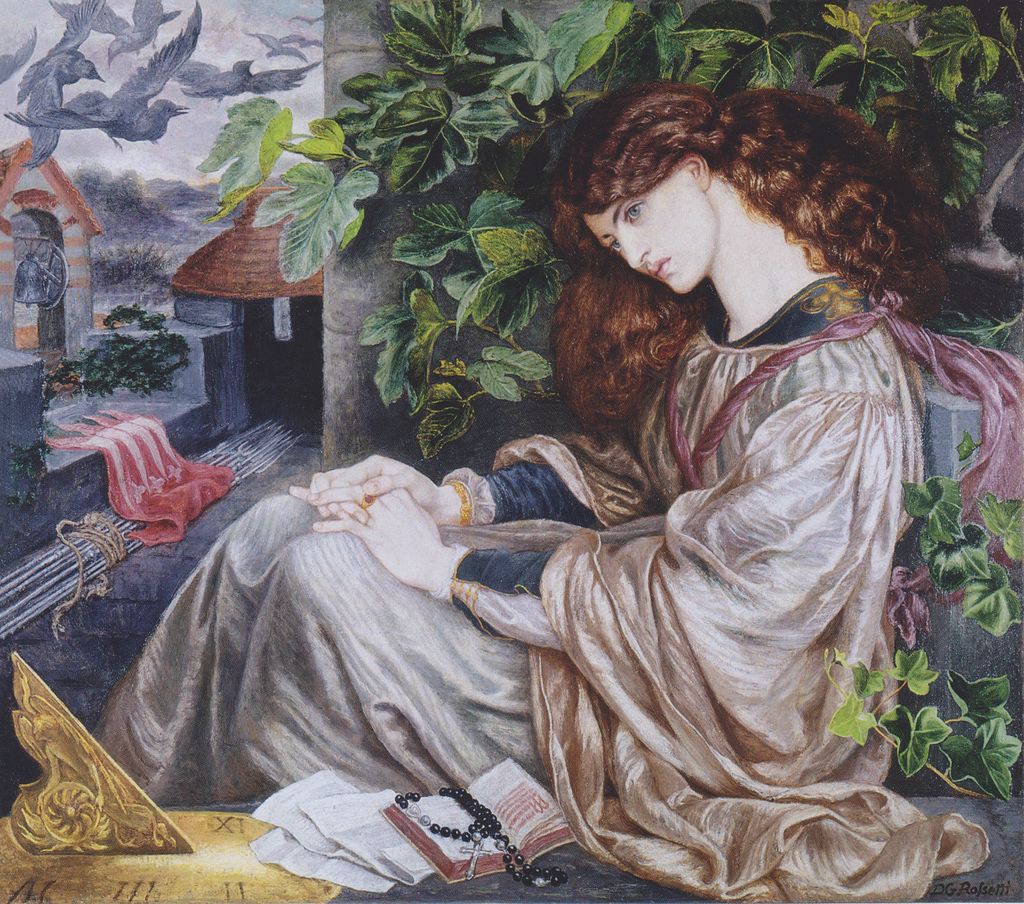
Three paintings documented in the collection records and Rossetti scholarship used here. The extended date of La Pia de’ Tolomei reflects its long development. This is a source-bound selection, not a complete catalogue. Additional entries labelled “Tate” come from the museum’s October 2014 catalogue. They retain its historical titles, dates and attributions; newer collection records are used where available. The list brings together selected records from these sources. [11]
| Name | Date | Medium |
|---|---|---|
| Ecce Ancilla Domini! (The Annunciation) | 1849–50 | Painting |
| The Girlhood of Mary Virgin | 1848–49 | Painting |
| La Pia de’ Tolomei | 1868–80 | Painting |
| David (Tate A00842) | 1858–64 | Drawing |
| The Adoration (Tate A00843) | 1858–64 | Drawing |
| King David (Tate A00844) | 1858–64 | Drawing |
| Fanny Cornforth (Tate A00845) | 1859 | Drawing |
| Study of a Man Smoking a Long Pipe (Tate A00846) | c.1849 | Drawing |
| Beata Beatrix (Tate N01279) | c.1864–70 | Painting |
| Rosa Triplex (Tate N01702) | 1867 | Drawing |
| Sancta Lilias (Tate N02440) | 1874 | Painting |
| Monna Pomona (Tate N02685) | 1864 | Drawing |
| Mary Magdalene leaving the house feasting (Tate N02859) | 1857 | Drawing |
| Mary Nazarene (Tate N02860) | 1857 | Drawing |
| Miss Robertson (Mrs Fernandez) (Tate N03038) | c.1866 | Drawing |
| The Beloved (‘The Bride’) (Tate N03053) | 1865–6 | Painting |
| Monna Vanna (Tate N03054) | 1866 | Painting |
| Aurelia (Fazio’s Mistress) (Tate N03055) | 1863–1873 | Painting |
| Paolo and Francesca da Rimini (Tate N03056) | 1855 | Drawing |
| The Blue Closet (Tate N03057) | 1857 | Drawing |
| The Wedding of St George and Princess Sabra (Tate N03058) | 1857 | Drawing |
| The Tune of the Seven Towers (Tate N03059) | 1857 | Drawing |
| The Chapel before the Lists (Tate N03060) | 1857–64 | Drawing |
| The Damsel of Sanct Grael (Tate N03061) | 1857 | Drawing |
| The Heart of the Night (Mariana in the Moated Grange) (Tate N03062) | 1862 | Drawing |
| Lucrezia Borgia (Tate N03063) | 1860–1 | Drawing |
| The Passover in the Holy Family (Tate N03156) | 1856 | Drawing |
| Arthur’s Tomb (Tate N03283) | 1860 | Drawing |
| Dantis Amor (Tate N03532) | 1860 | Painting |
| Dr Johnson at the Mitre (Tate N03827) | 1860 | Drawing |
| Maids of Elfen-Mere, engraved by the Dalziel Brothers (Tate N03971) | published 1855 | |
| The Palace of Art, engraved by the Dalziel Brothers (Tate N04058) | published 1857 | |
| Roman de la Rose (Tate N04089) | 1864 | Drawing |
| Study for ‘Giotto Painting the Portrait of Dante’ (Tate N04283) | 1852 | Drawing |
| Study for ‘The Bride’ (Tate N04284) | 1865 | Drawing |
| Study for the Head of Love, for ‘Dante’s Dream at the Time of the Death of Beatrice’ (Tate N04285) | 1870 | Drawing |
| St Catherine (Tate N04603) | 1857 | Painting |
| Hesterna Rosa (Tate N04626) | 1853 | Drawing |
| Taurello’s First Sight of Fortune (Tate N04627) | 1849 | Drawing |
| Elizabeth Siddall in a Chair (Tate N04628) | date not known | Drawing |
| Elizabeth Siddall Plaiting her Hair (Tate N04629) | date not known | Drawing |
| Study for ‘Desdemona’s Death Song’ (Tate N04911) | 1870 | Drawing |
| Proserpine (Tate N05064) | 1874 | Painting |
| Dante’s Vision of Rachel and Leah (Tate N05228) | 1855 | Drawing |
| Dante’s Dream at the Time of the Death of Beatrice (Tate N05229) | 1856 | Drawing |
| Mary in the House of St John (Tate N05230) | 1859 | Drawing |
| St George and Princess Sabra (Tate N05231) | 1862 | Drawing |
| Bethlehem Gate (Tate N05232) | 1863 | Drawing |
| Woman in Yellow (Tate N05233) | 1863 | Drawing |
| How Sir Galahad, Sir Bors and Sir Percival Were Fed with the Sanct Grael; but Sir Percival’s Sister Died by the Way (Tate N05234) | 1864 | Drawing |
| Joan of Arc (Tate N05235) | 1864 | Drawing |
| Faust: Margaret in the Church (Tate N05745) | 1848 | Drawing |
| Carlisle Wall (The Lovers) (Tate N05921) | 1853 | Drawing |
| Study for ‘Ecce Ancilla Domini! (The Annunciation)’ (Tate T00287) | c.1849 | Drawing |
| Mrs Vernon Lushington (Tate T00333) | 1865 | Painting |
| Sketch of Angels’ Heads (Tate T03817) | ?c.1875 | Drawing |
Frequently Asked Questions
No. It is a separate earlier painting, Tate N04872, whose lily embroidery provides a meaningful comparison. [7]
Discussion
Look at the narrow space between Mary and Gabriel and the few strong colours within the white room.
Reader Insights
How does Mary’s posture shape the encounter?
Where does white become a shadow, a surface or a fold?
How do the lily and embroidery connect the two early paintings?
Join the Conversation
Share a detail, comparison or question about The Annunciation by Dante Gabriel Rossetti below.
References
- Tate, Ecce Ancilla Domini! (The Annunciation), N01210. Collection fields and gallery label, January 2025; also available through Tate's public object data. View source 1. View source 2.Splash image: Ecce Ancilla Domini! (The Annunciation), 1849–50. Tate, N01210. Photograph cropped and resized. Photograph: Sailko / Wikimedia Commons · CC BY 3.0
- Tate, official photograph of N01210. Visual details discussed from this reproduction. View source.
- Luke 1:26–38, text accompanying the Visual Commentary on Scripture's The Annunciation. Biblical narrative; English Revised Standard Version displayed alongside the commentary. View source.
- Jerome J. McGann, ed., Rossetti Archive, Ecce Ancilla Domini!, object s44. Especially “Scholarly Commentary: Introduction” and “Pictorial”; catalogue and bibliography point to Virginia Surtees, The Paintings and Drawings of Dante Gabriel Rossetti, vol. I (1971), pp.12–14, no.44. View source.
- Robert Wilkes, “F. G. Stephens's contributions to Rossetti's ‘Ecce Ancilla Domini!’”, 1 June 2020. Cites William E. Fredeman, ed., The PRB Journal (1975), pp.26,33, and Joyce H. Townsend, Jacqueline Ridge and Stephen Hackney, Pre-Raphaelite Painting Techniques: 1848–1856 (2004), p.102. View source.
- Dillian Gordon, “A White Annunciation” and “Phases of the Annunciation”, Visual Commentary on Scripture. Interpretation of the lily, dove, Gabriel and plain setting. View source.
- Tate, The Girlhood of Mary Virgin, N04872. Collection fields, November 2019 label and official photograph. View source 1. View source 2.
- William Michael Rossetti, Dante Gabriel Rossetti: His Family-Letters with a Memoir, vol. I (1895), pp.160–163. Recollections of models, exhibition, sale, revisions and title; contemporary review reproduced within the memoir. View source.
- Frederic George Stephens, Dante Gabriel Rossetti (1894), pp.23–24, especially p.24 footnote. Letter to Scott dated 17 June 1874 and purchase history. View source.
- Spencer Museum of Art, University of Kansas, La Pia de’ Tolomei, collection 1956.0031. Collection record and historical labels; accessed 28 October 2026. View source.
- Tate, Tate Collection metadata, artwork_data.csv, October 2014 snapshot, released under CC0. Repository readme states that this dataset is no longer maintained. Downloaded and artist rows inspected 28 October 2026. View source.


