 by Tom Gurney
Tom Gurney BSc (Hons) is an art history expert with over 20 years experience
Published on June 19, 2020 / Updated on November 5, 2026
Email: tomgurney1@gmail.com / Phone: +44 7429 011000
Saint John on Patmos
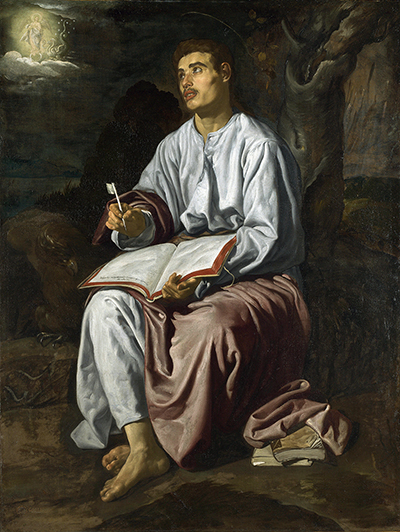
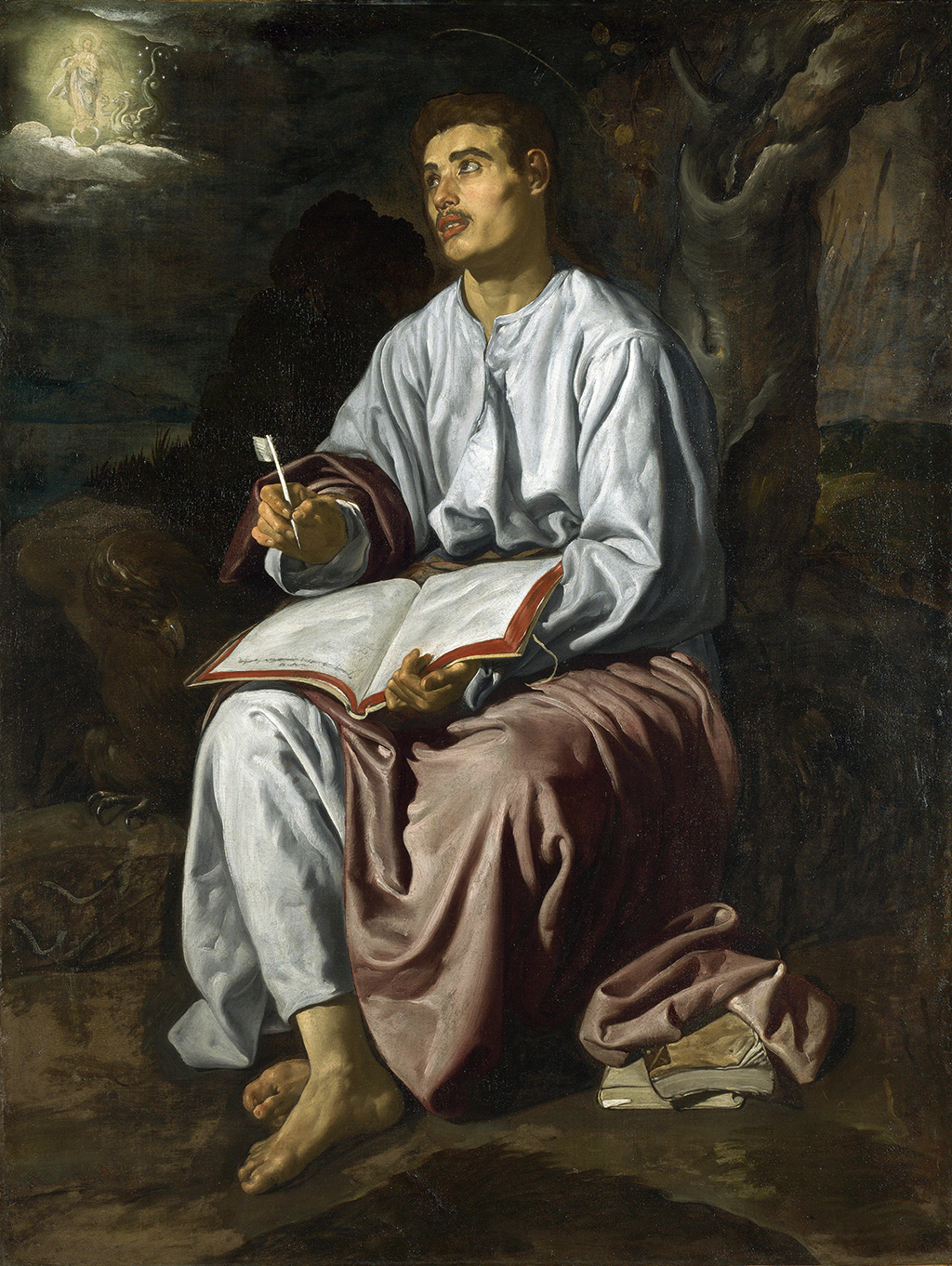
Saint John has stopped writing. His right hand holds a quill above the great book spread across his knees, while his face turns towards a small light in the sky. The movement is slight, but it changes the whole painting: a young man seated among rocks becomes a witness to something beyond the landscape. Diego Velázquez painted Saint John the Evangelist on the Island of Patmos in 1618–19, during his early career in Seville. The oil painting, measuring 135.5 × 102.2 centimetres, belongs to the National Gallery in London, where its collection number is NG6264. [1]
The scene asks us to look twice. First we meet the substantial figure in the foreground, with his bare feet, open mouth and sleeves gathered into deep folds. Only then do we follow his eyes to the pale apparition at the upper left. That difference in scale gives the picture its particular tension. John occupies a world we can almost touch; the event commanding his attention is distant and difficult to see.
At a Glance
Where the painting sits in Velázquez’s career
Contents
The vision above the island
The subject comes from the Book of Revelation. In chapter 12, a woman appears in heaven with the sun as her clothing, the moon beneath her feet and twelve stars around her head. A seven-headed dragon waits to consume her child, but the child is taken up to God. Later in the chapter the woman receives wings that allow her to escape into the wilderness. Velázquez gathers elements of this unfolding story into the small heavenly group above John. Reading the passage helps disentangle what can otherwise look like an indistinct patch of brightness: the woman and the threatening monster belong to a narrative of danger, protection and deliverance. [2]
The painting gives that extraordinary action surprisingly little space. The light surrounding the woman is enclosed by dark clouds, and the twisting forms beside her are harder to make out than the clean silhouette of John's head. Her remoteness makes his response essential. His raised eyes tell us where to look; his waiting pen suggests that what he sees will become words. We approach the vision through the person recording it.
Below, the great tree at the right anchors the scene. Its trunk rises behind John's shoulder, while the broad mass of his seated body fills the lower canvas. Across the other side, shadow opens towards a low horizon. These unequal areas of light and darkness make the island feel both enclosed and exposed: John has a place to sit and write, but the space beyond him has no reassuring domestic boundary.
A writer interrupted
The hands give the encounter a quiet rhythm. The hand with the quill is raised and ready; the other steadies the book. Between them lies an expanse of pale paper whose open shape leads the eye across his lap. The book is heavy enough to require support, and its reddish edges provide a firm boundary against the shifting folds of cloth. Inspiration arrives during a physical task, with materials already in use.
Look, too, at the contrast between the hands and the face. John's fingers remain occupied, but his parted lips and uplifted gaze seem to suspend the action. It is possible to read his expression as concentration or wonder without deciding exactly what he feels. Velázquez leaves that small uncertainty intact. The saint's attention is vivid even when his emotion resists a single label.
The National Gallery identifies the eagle beside him as his traditional attribute and draws attention to his unusually youthful face. It also notes that the figures in Velázquez's early religious paintings appear to have been based on living people. [1] Here, that impression grows from the specificity of the broad brow, strong nose and dark hair. The face feels individual, while the clothing and the book place that individual within a sacred story. Nothing requires us to supply the model's name.
The bare feet help bring him close. One projects towards the foreground, catching light along the toes and instep. Above it, the pale tunic falls in angular folds over his leg, while the darker mantle spreads across the opposite knee and gathers on the ground. The clothing makes a large, stable structure around a body that has momentarily turned its attention elsewhere.
The other half of the picture
John's vision also belongs to a pair of paintings. Velázquez made The Immaculate Conception as its companion, bringing the Virgin into the foreground at a scale comparable to John's. In that work she stands above a moon, surrounded by stars, with her hands together and her gaze lowered. This Marian imagery draws on the Woman of the Apocalypse. The Immaculate Conception concerns Mary's conception without sin. [3]
Seen together, the pictures allow an especially rewarding change of distance. The figure who is so small in John's sky becomes an almost full-length presence in the companion canvas. Our eyes can travel from the witness to the subject of his vision. The direction of their attention creates a further relationship: John looks upwards and outwards, while the Virgin's downward gaze turns the encounter back towards the human world.
Their physical weight is striking. Both figures stand out against their surroundings through concentrated light and strongly formed drapery. Yet the balance differs. John's spread book, bent knees and seated posture occupy a broad area; the Virgin rises vertically, supported visually by the clouds beneath her. Each canvas has its own shape and pace, even as their subject matter binds them together.
The Gallery connects the pair with Seville's devotion to the Immaculate Conception and suggests that they may have responded to celebrations following a papal decree in 1617. Their original commissioner remains unknown. [3] That uncertainty matters: the relationship between the paintings is secure, but a detailed account of the patron's wishes would go beyond the surviving evidence.
Familiar images, newly concentrated
Velázquez was working within a long tradition of showing John writing while looking towards a heavenly apparition. In a study published in 1983, Antonio Martínez Ripoll examined possible models for this composition. He argued for the importance of a print engraved by Jan Sadeler after Marten de Vos, particularly in the arrangement of the woman and dragon. He also proposed a local precedent: Alejo Fernández's image of John in the altarpiece of the Virgin of the Navigators in Seville. These are scholarly arguments based on comparison, rather than a surviving statement by Velázquez about his sources. [4]
Martínez Ripoll's most useful observation concerns the balance of figure and setting. Compared with the print, Velázquez makes the seated man more dominant and reduces the landscape's role. [4] That helps explain why this religious subject feels so immediate. The painter gives us ample time to inspect a sleeve, a foot or a hand before we can fully decipher the miraculous event. The bodily presence of the witness holds the composition together.
What time has changed
Some details now visible were never intended to attract attention. The National Gallery identifies stray marks in the upper-right background as paint wiped from Velázquez's brush. The covering paint has become more transparent, exposing them. It also explains that John's now pinkish mantle was originally a stronger red. [1] The present colour relationships therefore carry the history of the materials as well as the painter's choices.
Technical research adds a more intimate example. Larry Keith and Dawson W. Carr describe the greenish-brown earth ground used in Velázquez's early Seville paintings. In John's face, thick brown paint forms shadows around the lower jaw and neck, but the shadows inside the mouth and beneath the eyebrows were made by leaving the ground exposed. Those exposed areas have since become paler. The ground also supplied much of the original foreground colour. [5]
A ground is the prepared layer beneath the picture's painted surface. Here it sometimes participates directly in the image, allowing an underlying brown to become a small area of shadow. Keith and Carr distinguish these isolated uses from Caravaggio's more systematic exploitation of a dark preparation in modelling flesh. [5] Strong lighting alone does not tell us that two painters built their figures in the same way.
This changes how closely we can read John's face. An apparently minor shadow may be part of the preparation beneath the paint; its present lightness may differ from its first appearance. The picture's material history reaches into the very expression that draws us towards it.
From Seville to London
The pair is first documented in 1800 in the chapter house of the Convent of the Shod Carmelites in Seville. Both later passed through Manuel López Cepero to the British diplomat Bartholomew Frere. His descendants lent them to the National Gallery in 1946; the Gallery acquired Saint John in 1956 and The Immaculate Conception in 1974. [3]
Their shared history preserves the invitation built into John's upward glance. He looks beyond the book, and beyond the substantial forms that surround him, towards a figure whose meaning becomes clearer in the companion painting. The poised quill keeps that act of looking open: there is still something to see before the next words can be written.
Artworks directory
A selection from the collection records and catalogues linked here. The São Paulo and New York Olivares portraits are different paintings. The sculptor’s portrait retains its traditional identification and the dating associated with it. This is not a complete catalogue of Velázquez’s work.
| Name | Date | Medium |
|---|---|---|
| Saint John on Patmos | 1618–19 | Painting |
| The Immaculate Conception | 1618–19 | Painting |
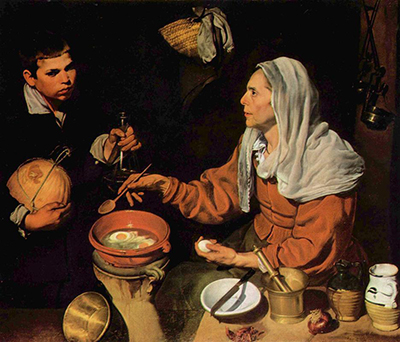
| The Waterseller of Seville | about 1620 | Painting |
| Count-Duke of Olivares (São Paulo) | 1624 | Painting |
| Count-Duke of Olivares (New York) | about 1625–26 | Painting |
| Apollo in the Forge of Vulcan | 1630 | Painting |
| Prince Baltasar Carlos on Horseback | 1634–35 | Painting |
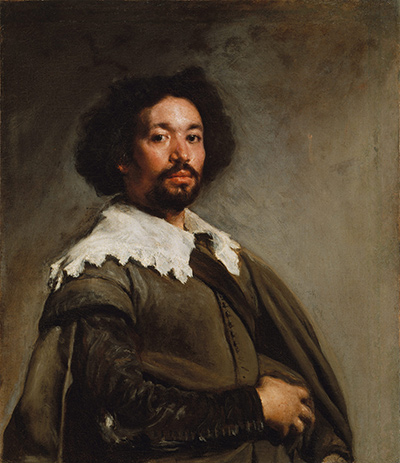
| Portrait of Juan Martínez Montañés (traditional identification) | about 1635–36, on the Montañés identification | Painting |
Frequently Asked Questions
The National Gallery dates the painting to 1618–19, during his early Seville career. [1]
The Immaculate Conception, also at the National Gallery in London, is its companion. [3]
Discussion
Look closely at the witness, the distant vision and the changing colour of the painted surface.
Reader Insights
Which draws your attention first: John’s hands or the small vision in the sky?
How does seeing the companion painting change your reading?
What changes when you notice the exposed ground in John’s face?
Join the Conversation
Share a detail, comparison or question about Saint John on Patmos below.
References
- The National Gallery, London. “Diego Velázquez, Saint John the Evangelist on the Island of Patmos, 1618–19,” NG6264. Collection record, including in-depth commentary, object details and provenance extract from Neil MacLaren, revised by Allan Braham, National Gallery Catalogues: The Spanish School (1988). Undated web record; accessed 28 October 2026. View source.
- The Holy Bible, King James Version. Revelation 12, especially verses 1–6 and 14. Biblical text consulted through King James Bible Online; accessed 28 October 2026. The website's separate commentary is not used. View source.
- The National Gallery, London. “Diego Velázquez, The Immaculate Conception,” NG6424, 1618–19. Collection record, in-depth commentary and provenance extract from The National Gallery: July 1973–December 1975. Undated web record; accessed 28 October 2026. View source.
- Antonio Martínez Ripoll. “El «San Juan evangelista en la isla de Patmos», de Velázquez, y sus fuentes de inspiración iconográfica.” Áreas. Revista Internacional de Ciencias Sociales, nos. 3–4 (1983), printed article pp. 201–208; especially pp. 203–205. Universidad de Murcia. Spanish. Accessed 28 October 2026. ; full text: View source 1. View source 2.
- Larry Keith and Dawson W. Carr. “Velázquez's ‘Christ after the Flagellation’: Technique in Context.” National Gallery Technical Bulletin, vol. 30 (2009), pp. 52–71; especially pp. 52–55, plate 4 and notes 3–4 on p. 70. National Gallery, London. Accessed 28 October 2026. View source.