View Miss La La at the Cirque Fernando in its artwork record.
* As an Amazon Associate, and partner with Google Adsense and Ezoic, I earn from qualifying purchases.
 by Tom Gurney
Tom Gurney BSc (Hons) is an art history expert with over 20 years experience
Published on June 19, 2020 / Updated on September 28, 2026
Email: tomgurney1@gmail.com / Phone: +44 7429 011000
Degas Miss La La At The Cirque Fernando: Introduction
An acrobat rises into the roof of a Paris circus. Her feet have left the ring far below, and the painted building seems to tilt around her. Edgar Degas places Anna Albertine Olga Brown, known professionally as Miss La La, high at the left of Miss La La at the Cirque Fernando. A rope above her meets a leather mouthpiece held between her teeth. She stretches one arm toward the rafters and the other behind her, making a moment of demanding physical control look almost like flight. The view asks us to look up as a spectator might have done, while the huge roof makes her skill seem all the more extraordinary. [1] [8]
The painting is a portrait of a named and accomplished performer, not simply an anonymous circus scene. Brown was a touring aerialist whose career continued beyond the moment Degas painted. The National Gallery's 2024 research brought photographs, posters and other evidence of that career into view. Knowing more about her changes how we look: the canvas records a professional feat, and its striking perspective is one artist's way of presenting a person who already had a public identity. [1][2][3]
At a glance
- ArtistEdgar Degas
- TitleMiss La La at the Cirque Fernando
- Date1879
- MediumOil on unlined canvas
- Dimensions117.2 × 77.5 cm
- CollectionNational Gallery, London, NG4121
- First exhibitionFourth Impressionist exhibition, Paris, 1879, no. 62
Contents
- Introduction
- At a Glance
- The performer behind the stage name
- How the Iron Jaw act worked
- Looking up into the Cirque Fernando
- From live act to constructed picture
- A performer seen through race and art
- The 1879 exhibition and later collection
- How to look at the painting now
The National Gallery gives these facts in its object record. The finished oil should be distinguished from the Getty Museum's smaller 1879 pastel study of Miss La La and the Barber Institute's related drawing. Similar titles describe related images, not interchangeable objects. [1][4][5]
The performer behind the stage name
Miss La La was the professional name of Anna Albertine Olga Brown (1858–1945). The National Gallery identifies her as born in Prussia, in a place now within Poland, to an African-American father and a white European mother. Two of the Gallery's own accounts disagree on the precise place name, so the broad geographical description is safer than pretending that conflict has been settled. She began performing as a child and worked with companies across Europe. By 1879, the name Miss La La was associated with an act that spectators came to watch for its strength and risk. [1][2]
The stage name deserves to sit beside her birth name. It was part of the identity through which she built a career, while the fuller name keeps her from becoming only the picturesque title of a painting. The National Gallery's 2024 exhibition, Discover Degas & Miss La La, presented newly researched photographs and posters, including material on her later life, family and management of a circus. That record makes a simple tale in which the painted performer vanishes after 1879 untenable. It does not supply her thoughts about Degas or an account of every engagement, and the painting alone cannot do so. [2][3]
Brown performed with another aerialist who used the name Kaira la Blanche. Together they appeared as Olga and Kaira. The National Gallery describes an act in which Brown supported her partner using her jaw apparatus, a feat different from the single suspended figure in Degas's oil. The Gallery sources vary in the spelling of Kaira's civil first name; using her stage name here avoids introducing false precision. The partnership shows that Miss La La was part of a wider performance practice, able to devise, rehearse and present routines rather than merely pose for an artist. [1][2]
Her ancestry matters to the painting's history because the picture has long been discussed within European representations of Black performers. The National Gallery calls it Degas's only known painting of a named non-white sitter. That formulation is specific: it identifies this sitter and this documented body of work, while leaving room for future discoveries. The 2024 exhibition placed Brown's own professional history beside the painted image. It made the image harder to treat solely as a study of an unfamiliar racialized body or as a symbol for arguments about Degas. [2][3]
The surviving record should also set limits. We know a full name, performance names, career evidence and later family and management history from the Gallery's research. We do not know what Brown felt during each performance, whether she approved of the canvas, or what conversation took place when Degas studied her. Those tempting first-person stories would turn a real performer into a character invented by the writer. It is enough to take her skill and documented life seriously, then examine what Degas chose to show. [1][2]
How the Iron Jaw act worked
The painting shows Brown being drawn upward by a rope. She clenches a specially made leather mouthpiece between her teeth; the mouthpiece connects her to the hoisting apparatus. Describing her as literally biting a bare rope misses an important part of the act's mechanism. The device did not make the feat effortless. It transferred force through her jaw and body while she controlled her position high above the audience. What looks light and airborne in the image depended on training, muscular endurance and equipment. [1]
The rope appears as a thin vertical against the roof, while the angled arms and legs spread her weight visually across the canvas. We cannot calculate the exact load, height or duration of this particular performance from the painting. Nor does the image prove the engineering details of every version of her act. It lets us identify the specialized mouthpiece and the suspended ascent that the National Gallery describes. The safest account joins what is visible to the museum's performance history without treating Degas's composition as a mechanical diagram. [1]
Other feats widened her reputation. The Gallery notes that she could carry a firing cannon while suspended upside down from a trapeze. That is an arresting fact, but the cannon does not appear in this picture. Conflating the two acts would add drama at the expense of identifying the painting correctly. Her partnership with Kaira likewise belongs to the account of her career, not to a claim that an unseen partner occupies this scene. Separating the acts helps the canvas speak more clearly: this is the Iron Jaw ascent, condensed into a particular visual instant. [1]
The act itself reverses ordinary expectations about a circus body. An aerialist normally seems to depend on hands, feet or a swinging bar; here the viewer learns that a small point near the face bears the force. Degas's chosen angle makes that point hard to inspect. The effect is a tension between what the spectator knows about the feat and what the image allows the eye to verify. Brown's achievement is neither a trick of painted perspective nor a passive lift by a pulley. Her own controlled hold is central to it, even though other people and apparatus may have been required for a live performance. [1]
Looking up into the Cirque Fernando
The Cirque Fernando was built in 1875 near the Place Pigalle in Paris, within reach of Degas's studio. The National Gallery says he saw Miss La La perform there several times. Rather than place us in the ring looking across at a crowd and a performer, he directs our view upward. The circus roof occupies most of the vertical canvas. Windows, arches, decorative supports and diagonal girders form a dense setting around Brown. There is no painted line of audience members at the bottom to tell us where to stand. We are given their upward gaze without their bodies. [1]
Brown is high and left of center. Her dark hair and face sit near the upper left; her costume carries pale, yellow and violet notes against warm orange areas of ceiling and green structural members. The body is comparatively small within the total field, yet the sweep of its limbs and the rope make it the point from which the surrounding architecture is read. The roof provides scale: its broad surfaces tell us how much air separates performer from floor. At the same time, the intersecting lines make the scene less stable than an easy, frontal view of an act. [1]
One arm reaches toward the upper right, roughly paralleling a girder. Her other arm extends back. The legs bend and separate, answering the diagonals and verticals of the supports. This is why a close look can find Brown both isolated and integrated with the building. Her body is not a small figure pasted over an otherwise finished architectural drawing. The lines of her pose help the eye connect the roof's pieces. Conversely, the rigid beams make the movement of her limbs feel freer and more precarious. The National Gallery explicitly draws attention to these visual echoes. [1]
The roof's architecture could almost become the subject. Its pale windows and painted ornaments repeat, and its green beams cut across large orange areas. Yet the performer prevents it from settling into a study of an interior. The rope's near-vertical line draws our eye from the upper edge to her head, while the extended arm pushes it outward again. The painting keeps returning us from pattern to person. This back-and-forth helps explain why the unusual amount of roof is useful, rather than empty space left around a star. [1]
The angle also limits what we see of her face. The National Gallery remarks that the upward view conceals much of her expression. We can describe that formal fact and ask what it does to recognition. We cannot prove that Degas designed the angle with the intention of obscuring Brown's identity. Other evidence shows his sustained interest in drawing her pose and solving the perspective. The canvas nevertheless offers a partial view of a woman whose name, photograph and broader history now allow us to know more than the painted face alone can reveal. [1][2]
Watch: Edgar Degas
Explore his paintings, drawings and sculpture in three short videos.
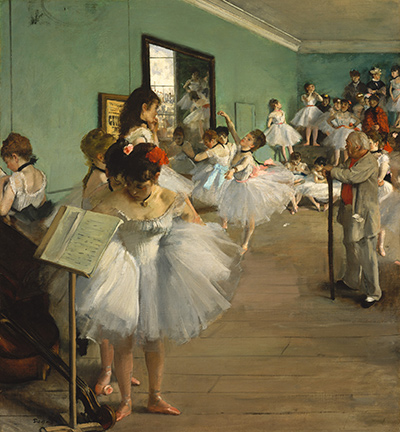
Degas, The Dance Class
Look closely at Degas’s off-duty dancers and his unusual view into the rehearsal room.
Watch on YouTubeFrom live act to constructed picture
Degas did not simply copy one glance toward the rafters. The National Gallery describes several studies of Brown in different positions and clothing, plus work on the circus roof. The Getty Museum owns a pastel, Miss Lala at the Fernando Circus, dated 1879 and numbered 2004.93, on faded blue paper. It identifies that sheet as a study for the National Gallery oil. The Barber Institute records another related drawing. Together the surviving works show a process of looking, testing the body in space and translating the performance into a composition. [1][4][5]
The Getty pastel is smaller, 46.4 × 29.8 cm, and materially different from the 117.2 × 77.5 cm oil. Its colors and marks belong to pastel on paper, not to the final canvas surface. The Getty notes Degas's layered yellow and purple on the performer's costume and his smudged handling of her hair. These are useful clues to how he thought about movement and appearance, but a detail visible in a preparatory sheet should not automatically be claimed for the finished picture. Each object deserves its own caption and collection number when reproduced. [4][6]
The roof was a distinct challenge. Its girders and paired windows had to be made convincing from a position below while still serving the movement of the figure. According to a later recollection by the artist Walter Sickert, Degas sought help from a draughtsman skilled in architecture. The National Gallery reports that account. A recollection of assistance is not the same as a signed technical record or proof that Degas delegated the entire background. What is visible is the sustained problem he took on: how to hold a nearly vertical view of a wide ceiling within a narrow picture and make the body seem suspended in it. [1]
The National Gallery compares the upward, foreshortened figure with Baroque and Rococo ceiling painting, including works associated with Giovanni Battista Tiepolo. Degas knew Italian art, and the comparison helps us see the unusual elevated view. It does not establish that he directly copied a particular Tiepolo canvas or that Brown was meant to be a goddess. The analogy is most helpful when kept visual: a figure seen from below appears to enter an overhead space. In Degas's case, that space is an actual Paris circus and the person is a working modern performer. [1]
These studies also complicate the phrase “caught in a moment.” Brown's act unfolded in time, but a painting is built through decisions made outside the performance. Degas selected a pose, shifted the relation of limbs to roof and balanced the colors. A viewer can feel the immediacy of ascent without mistaking the finished oil for a single unmediated snapshot. The apparent instant is an achievement of making, grounded in repeated observation and revision. That distinction is especially important for a performer who controlled her own practiced routine; the painting is one account of it, made by someone watching. [1][4][5]
A performer seen through race and art
European circus publicity in Brown's period often used racial difference to sell an act. The National Gallery's current writing instead supplies her name, family background and career. That change in framing does not remove race from the picture's history. It lets the subject be more than an example in a general discussion of race. Brown was a mixed-heritage artist whose work brought her across European venues, and the canvas belongs to a culture that could both admire a performer and objectify her. A responsible reading can hold those conditions together without assigning any undocumented private motive to Degas. [1][2][3]
The face partly hidden by the upward view has sometimes invited a story that the artist erased her personhood. The image can support a narrower observation: her facial features are not offered to the viewer as a conventional portrait might offer them. Yet the same image centers her named act, and Degas repeatedly studied her as its subject. Whether the composition is understood as celebration, detachment, curiosity or a mixture, Brown's recovered history should be in the room when the judgment is made. It is evidence about a person, while the intentions one might assign to the painter remain inferences. [1][2]
One practical way to resist flattening her is to describe exactly what she did. “Iron Jaw” names an invented, trained performance using a mouthpiece. “Aerialist” names a profession. “Olga and Kaira” names a working partnership. The 2024 exhibition's photographs and posters documented a career beyond the encounter recorded in Degas's painting. These words are more informative than calling her merely daring, mysterious or exotic. They also make the formal story richer: the skill shown in the canvas was already a recognizable achievement for audiences of the time. [1][2][3]
The Gallery's 2024 exhibition assembled paintings, sketches, posters and photographs around this question of identity and image. Its annual review describes a forty-eight-work display. The exhibition page credits a circa-1880 poster of Miss La La and the Kaira troupe and later publicity for Kaira and Olga. Such documents offer another sort of evidence from Degas's oil: images created for a performer's public career rather than a singular painting for an art exhibition. Comparing their purposes is a useful next step for readers, provided captions keep makers, dates and collections clear. [3][7]
The 1879 exhibition and later collection
The color of the roof helps organize the apparent height. Wide orange and yellow passages might at first look like a single glowing surface. On a longer look, green structural ribs and paler window openings break it into parts that recede and turn. The warm and cool colors do not only decorate the venue: they let the viewer read the complicated overhead space without a conventional horizon. Brown's purple and yellow costume makes a small, bright concentration within that larger field. The lighter fringe and shoes carry the eye down her body, then the darker hair leads it back toward the rope. This reading is based on the visible painting and its owner description, not a claim about what particular pigments Degas used. [1]
The painting's narrow vertical shape also matters. A horizontal canvas could have spread the circus ring and crowd before us; here the format makes room for the distance from Brown's body to the parts of the roof around her. The canvas does not include the floor, so the exact height remains unknowable from the image alone. Still, the pattern of windows and supports gives the mind a building to scale, while the cropped lower structure implies space beyond the edge. Looking up becomes an experience of piecing together a place from fragments rather than surveying it from a safe, fixed seat. [1]
Degas's work with performers often invites a distinction between graceful appearance and labor. In this scene, the split is especially sharp. A light costume and suspended pose can suggest effortless movement, but the mouthpiece tells us that the body is working through a demanding hold. The painted structure is fixed while Brown's body appears ready to shift. The paradox is made visible in the straight rope: it is the connection that allows the ascent but also the line that tells us how gravity still acts. The composition has drama because it does not fully erase weight. It makes the viewer feel the feat by showing a body resisting it. [1]
The audience's position is similarly double. We share an upward view with people who might have paid to see the act, yet we are close enough through the canvas to study details impossible to follow in a moving performance. Degas slows the spectacle. The eye can compare an arm to a girder or return to the mouthpiece after surveying the ceiling. This sustained looking is one of the differences between the historical act and the painting. Brown performed through time before a crowd; Degas made an object that can be examined repeatedly. It would be wrong to replace her performance with the picture, but the picture can make us attend to the skill that a moment of astonishment might otherwise hide. [1]
Degas exhibited the painting at the fourth Impressionist exhibition in Paris in 1879, listed as number 62. The date places it among works shown outside the official Salon system in the years when Degas was an active participant in the independent exhibitions. The National Gallery calls it his only circus painting. That fact makes the choice of Brown's act striking within his painted output, though it should not be stretched into a claim that he never drew another circus subject or never visited another venue. [1]
The exhibition record establishes public display, not a unanimous reaction. Without checking contemporary reviews one by one, it would be careless to say that every viewer was scandalized, delighted or indifferent. The picture's unusual viewpoint gives us plenty to analyze without inventing a reception history. Brown's performance itself had an admiring audience, according to the Gallery, and the 1879 art audience encountered a canvas that presented the act from an equally unexpected vantage. Those are separate audiences and experiences, even when the painting invites us to imagine standing below her. [1]
The work entered the National Gallery through the Courtauld Fund in 1925 and is catalogued there as NG4121. The museum's provenance paragraph has an internal chronological conflict: it says Durand-Ruel acquired the painting from Degas in 1904 and also that the dealer exhibited and sold it in 1902. Both cannot describe the same straightforward sequence. The 1879 display and 1925 acquisition are secure in the museum record; the intervening dealer transfer remains uncertain. [1]
Provenance matters here because an artwork's movement changes the setting in which it is interpreted. A painting first seen at an independent Paris exhibition later became a National Gallery object, studied beside preparatory works in other museums and re-presented with the performer's history in 2024. None of those later settings changes the original oil. They change what evidence a viewer can bring to it. A museum number, a dated exhibition entry and a fuller account of Brown's life give us firmer footholds than a familiar title alone. [1][2][3]
How to look at the painting now
Begin with Brown rather than the ceiling. Locate the leather mouthpiece and rope, follow the tension through her lifted torso and then trace the direction of her arms and legs. Next let the green girders and upper windows pull your eye across the roof. Notice how the body both cuts across and repeats those lines. The enormous architecture makes the suspended performer seem smaller but also gives her feat a visible measure of height. The viewpoint is part of the story, because an audience on the ground could never see her face as they would see a standing portrait sitter. [1]
Then look beyond the frame with care. The Getty pastel and Barber drawing show how Degas tested the subject; the National Gallery's 2024 material tells more of Brown's career and identity. Neither a study nor a poster is a replacement for the finished oil. They answer different questions: how the artist constructed the image, how a performer presented herself to audiences, and how later researchers have restored names and events to a picture often approached first through its dizzying angle. [2][4][5][7]
The painting remains compelling because those questions meet in one view. A trained woman has made herself the center of an extraordinary public act. Degas has translated that act into an ascent through painted architecture. The unusual view can make Brown seem distant, yet the surviving record brings her closer as Anna Albertine Olga Brown, Miss La La, partner, manager and performer. Seeing both the physical feat and the historical person gives the roof its proper scale: it is the stage for her work. For related Degas subjects, see his paintings and portraiture. [1][2][3]
Artworks directory
A selected index of documented works, combining owner records with entries sampled across Michel Schulman’s digital catalogue raisonné. It is not a complete catalogue. View the full catalogue
Discussion
Share what you notice in Degas’s miss la la at the cirque fernando.
Reader Insights
How does the high ceiling change your sense of her performance?
What details make the suspended figure and the building work together?
What can this painting tell us about Miss La La, and what must come from other records?
Join the Conversation
Share your reading of these works below.
References
- National Gallery, Miss La La at the Cirque Fernando, NG4121, overview, in-depth text and catalogue fields, accessed 27 September 2026. View source
- National Gallery, Discover Degas & Miss La La press release, 2024. View source
- National Gallery, Discover Degas and Miss La La exhibition page, 2024. View source
- J. Paul Getty Museum, Miss Lala at the Fernando Circus, 2004.93, collection record. View source
- Barber Institute of Fine Arts, Edgar Degas, drawing of Miss La La, collection record. View source
- J. Paul Getty Museum, Degas at the Getty, exhibition interpretation, 2006. View source
- National Gallery, Annual Review 2025, 2024 exhibition report. View source
- Splash image: Edgar Degas, Miss La La at the Cirque Fernando, 1879, oil on canvas. National Gallery, London, NG4121. Image: Wikimedia Commons. Collection record. View source